
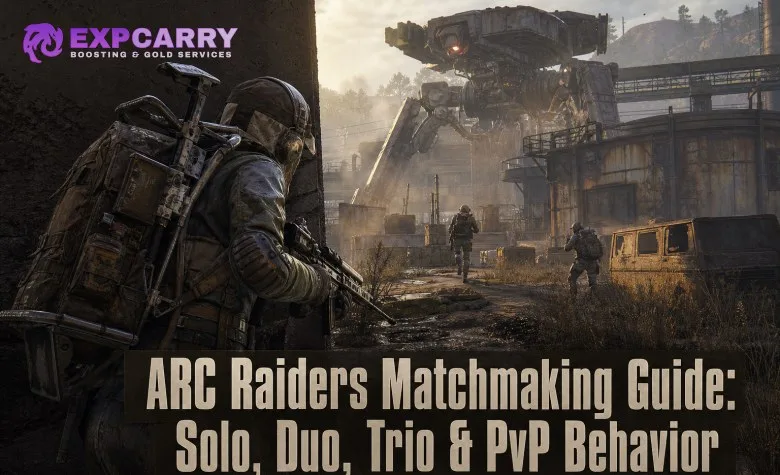
ARC Raiders matchmaking is not a simple solo-only, duo-only, or PvP-only queue system. As of Live Update 1.39.0 on July 28, 2026, Embark tracks your playstyle separately when you raid Solo, Duo, or Trio, then tries to place you with players of a similar squad size and behavior profile. The important catch is that every raid remains PvPvE: matching improves the odds of compatible encounters, but it never guarantees peaceful players, equal squads, or a raid without betrayal.
The practical answer is simple: queue Solo for the most controllable survival and extraction experience, Duo for flexible but potentially uneven squad fights, and Trio when you want coordinated PvP or high-risk ARC objectives. If you want calmer lobbies, avoid initiating unnecessary Raider fights in that specific queue type; since Update 1.39.0, defending yourself does not affect your playstyle estimate during Embark’s current matchmaking test.
How ARC Raiders Matchmaking Works Now
ARC Raiders matchmaking weighs several goals at once: fair chances of success, compatible playstyles, queue time, and connection quality. Equal squad sizes are prioritized where possible, but they are not guaranteed. This matters most in Duo raids, where a two-player team can occasionally encounter a Trio when the system needs to complete a lobby.
Embark has confirmed that matchmaking does not use your loadout value to decide lobby difficulty. Taking an expensive kit does not deliberately place you against stronger players, while using a free or budget kit does not create an easier lobby. Your post-raid feedback also does not directly alter the next lobby you receive.
The system is based partly on a continuous playstyle estimate rather than a hard “friendly” or “PvP” label. A Raider who usually negotiates, avoids fights, and extracts is more likely to meet similarly cautious players over time. A Raider or squad that regularly starts player fights is more likely to meet more PvP-oriented opponents. Neither outcome is absolute: unpredictability is an intended part of Topside.
For the full official explanation of the original system rules, including loadouts, crossplay, squad leaders, and profile persistence, see Embark’s Notes on the Matchmaking System.
Solo, Duo, and Trio Behavior Is Tracked Separately
The biggest current matchmaking change arrived in Live Update 1.36.0. Your behavior in Solo, Duo, and Trio raids is now tracked independently. In practical terms, a PvP-heavy Trio session should no longer push your later Solo raids toward more aggressive lobbies, and peaceful Solo questing should not make your coordinated Trio raids calmer.
| Queue type | What matchmaking prioritizes | What your behavior affects | Best use case |
|---|---|---|---|
| Solo | Other Solo Raiders where possible | Your Solo playstyle profile | Questing, compact loot runs, learning routes, low-commitment extraction |
| Duo | Other Duos where possible | Your Duo playstyle profile | Flexible PvE, shared scouting, controlled PvP |
| Trio | Other Trios where possible | Your Trio playstyle profile | ARC operations, boss attempts, deliberate PvP, high-value objectives |
This separation removes one of the old frustrations of changing party size. You can play friendly Solo raids for contracts and materials, then run aggressive PvP Tríos with regular teammates without needing several raids for the system to readjust.
However, squad-size separation does not mean every encounter will be symmetrical. Embark’s stated priority is to keep Solos and squads separate first, then prioritize Duos into Duo lobbies and Trios into Trio lobbies. Queue population, region, latency, and matchmaking time can still create mixed squad encounters.
What Counts as PvP Behavior in Update 1.39.0
Current matchmaking behavior is especially important for players who avoid starting fights but still defend themselves. Update 1.39.0 introduced an active test in which only fights you choose to initiate influence your playstyle estimate. Returning fire against an aggressor, knocking them out, or protecting a teammate after they are attacked should not count against your profile during this test.
| Situation | How the system currently treats it | What you should do |
|---|---|---|
| Another squad damages, downs, or knocks out your teammate first | Your whole squad is considered to be defending | Fight back, reset, or leave without worrying that defense itself changes your profile |
| You fire first on another Raider or squad | You initiated the fight | Commit only when the objective, position, and extraction route justify the risk |
| You join a firefight already happening between other squads | Third-partying counts as initiating a fight | Treat it as a deliberate PvP choice, not a neutral action |
| A stray shot or short exchange occurs | It still counts as starting a fight, but carries less weight than a long, serious battle | Stop shooting and disengage if the fight was accidental or no longer worth it |
Longer, more serious encounters carry more weight than a brief accidental hit. The system considers the scale of the engagement, including damage dealt and Raiders downed. That means one isolated mistake should not instantly convert your future raids into constant PvP lobbies, but repeated initiation patterns will gradually change what you are more likely to encounter.
Read the exact current definitions in Embark’s Live Update 1.39.0 notes. Because this defensive-PvP treatment is explicitly a test, it may be adjusted in a later update.
Explore services related to this guide, selected from our ARC Raiders catalog.
View All ARC Raiders Services
Which Queue Should You Choose?
Choose Solo for independence and controlled risk
Solo is the best queue when your goal is to finish a quest, gather a specific material, learn a map, or extract reliably with a modest kit. You make every rotation decision yourself, produce less coordination noise, and can disengage immediately rather than waiting for teammates to stabilize.
That does not make Solo a PvE mode. There are no PvE-only servers where other Raiders cannot attack you. Friendly voice chat can help, but it is information first and protection second. Always keep hard cover, a retreat lane, healing, shield recovery, and a usable extraction plan before you trust an encounter.
For practical route planning, stealth decisions, and extraction discipline, use our ARC Raiders Solo Survival and Extraction Guide.
- Best for: contracts, compact loot loops, key runs, blueprint hunting, and recovering from a depleted stash.
- Main advantage: no teammate dependency and cleaner disengages.
- Main risk: every enemy, revive, flank, and extraction defense is your responsibility.
- Key rule: do not turn a successful loot run into a prolonged fight just because you have the first shot.
Choose Duo for flexible teamwork
Duo is the most adaptable party size. One player can search, breach, or handle the objective while the other watches a lane, covers a revive, or listens for rotations. Two players are also quiet enough to move through interiors and change plans quickly.
The limitation is numerical: a Duo has less room for mistakes against a coordinated Trio. If you encounter three Raiders, do not try to win a symmetrical damage trade in the open. Split their sightlines, force them through a choke, create a reset window, and extract if the objective is already complete.
- Best for: mixed loot-and-combat raids, elite ARC targets, and players who want communication without full Trio noise.
- Main advantage: one down does not automatically end the run if the remaining Raider has cover.
- Main risk: occasional Trio encounters and limited ability to cover multiple angles.
- Key rule: assign jobs before dropping: point player, loot/breach player, or alternating overwatch.
Choose Trio for objectives that require sustained control
Trio is the strongest standard party size for loud ARC encounters, contested operations, and intentional PvP. A coordinated team can assign one player to support threats, one to armor or weak-point pressure, and one to watch for Raiders approaching the noise.
But a Trio is not automatically safer. More players create more footsteps, more inventory delays, more disagreement over target priority, and more opportunities for a fight to spiral. A team that stacks on one doorway or chases every gunshot becomes easy to third-party.
- Best for: Queen or Matriarch preparation, ARC Operations, high-risk objectives, and PvP-focused sessions.
- Main advantage: revives, angle control, and enough damage to finish large threats efficiently.
- Main risk: loud movement, crowded positioning, and false confidence after a successful fight.
- Key rule: designate a caller for retreat decisions; three players continuing separate fights is how a winning raid becomes a lost kit.
Before committing to a loud machine objective, review the current ARC Raiders enemies, weak points, and counters guide. Heavy ARC fights attract both reinforcements and opportunistic Raiders, so the extraction plan matters as much as the kill.
Solo vs Squads: The Optional High-Risk Queue
Experienced Solo players can opt into Solo vs Squads once they reach level 40. This toggle places a Solo Raider into the squads queue in exchange for a 20% end-of-round XP bonus, whether the raid ends in extraction or defeat. It is an opt-in challenge, not a normal Solo matchmaking rule.
Only choose it when you specifically want outnumbered PvP pressure, have strong map awareness, and can afford to lose the kit you bring. The XP bonus does not protect your loot, prevent third parties, or make an unwinnable open-field fight favorable. A budget kit, compact objective, and early extraction threshold are more sensible than carrying your best gear into a 1v2 or 1v3 environment.
Embark introduced the option in the Headwinds update; consult the official Solo vs Squads announcement if you need the original eligibility details.
How to Influence Your Lobby Experience Without Chasing Myths
You can influence the kind of raids you are more likely to receive, but you cannot force a perfectly safe or perfectly aggressive lobby. Use these rules instead of trying to manipulate matchmaking through superstition.
- Keep your intent consistent within each queue. If you want calmer Solo raids, prioritize objectives, communication, avoidance, and extraction in Solo. Your Trio behavior is tracked separately, so do not treat every mode as the same profile.
- Do not initiate fights without a reason. A valuable objective, a blocked extraction, a clear positional advantage, or a contract requirement can justify the risk. Curiosity usually does not.
- Defend yourself decisively. Under the Update 1.39.0 test, self-defense does not affect your playstyle estimate. Staying passive after being attacked only gives the aggressor control of the encounter.
- Do not confuse third-partying with defense. Entering someone else’s ongoing fight counts as initiation. Consider whether the loot, position, and escape route justify becoming the new target.
- Give behavior changes time. Matchmaking reacts gradually to patterns over previous raids. One kill, one friendly conversation, or one failed extraction does not immediately redefine your profile.
- Use crossplay settings for connection preferences, not lobby tone. Crossplay changes the available matchmaking pool and may affect queue time, but Embark says it does not guarantee friendlier or more PvP-heavy matches.
Common Matchmaking Mistakes
Expecting guaranteed equal teams
Equal squad sizes are a priority, not a promise. A Duo should always bring a plan for facing a Trio, while a Solo should never assume every nearby Raider is alone just because they entered the Solo queue.
Thinking a cheap kit creates easy lobbies
Loadout cost is not a matchmaking factor. Bring gear that suits the map, objective, and loss tolerance. If you need a practical starting point for weapon roles and utility choices, see the ARC Raiders weapons and gadgets guide.
Assuming peaceful behavior guarantees safety
A cooperative profile can improve your chances of encountering similar players, but ARC Raiders deliberately retains uncertainty. Keep your weapon ready, avoid exposing yourself while talking, and never negotiate from a position where one unexpected shot ends your raid.
Blaming every bad lobby on a permanent profile change
Bad raids happen. Population shifts after an update, map conditions, time of day, regional pool size, and normal matchmaking variance can all alter how a raid feels. Patches do not reset your matchmaking profile, but Embark also does not lock you into one permanent category.
Best Matchmaking Strategy by Goal
| Your goal | Recommended queue | Behavior to prioritize | Avoid |
|---|---|---|---|
| Complete a quest or secure crafting materials | Solo | Quiet routes, short objectives, early extraction | Optional player fights and loud heavy ARC pulls |
| Farm with one reliable teammate | Duo | One player scouts while one searches or breaches | Splitting far enough apart to lose revive coverage |
| Hunt elite ARC or contest a major objective | Trio | Clear assignments, cover, ammo discipline, extraction security | Stacking in one firing lane or looting before the area is secure |
| Practice outnumbered PvP | Solo vs Squads, if eligible | Ambushes, compact routes, immediate disengages | Fair fights, long open rotations, irreplaceable kits |
Final Takeaway
ARC Raiders matchmaking now gives you more control than it did before: Solo, Duo, and Trio playstyles are separate, equal squad sizes are prioritized, and defensive PvP currently does not affect your playstyle estimate. Still, the game is not designed to eliminate risk. A friendly Solo raid can turn hostile, a Duo can meet a Trio, and a loud ARC fight can bring every nearby squad to your position.
Choose the queue that fits your objective, play consistently within that squad size, initiate PvP only when it materially improves your raid, and always prepare for the encounter matchmaking cannot prevent. If you want optional help with a difficult objective, coordinated extraction, or learning high-risk fights, ExpCarry’s ARC Raiders services are available, but they are never required to progress.