

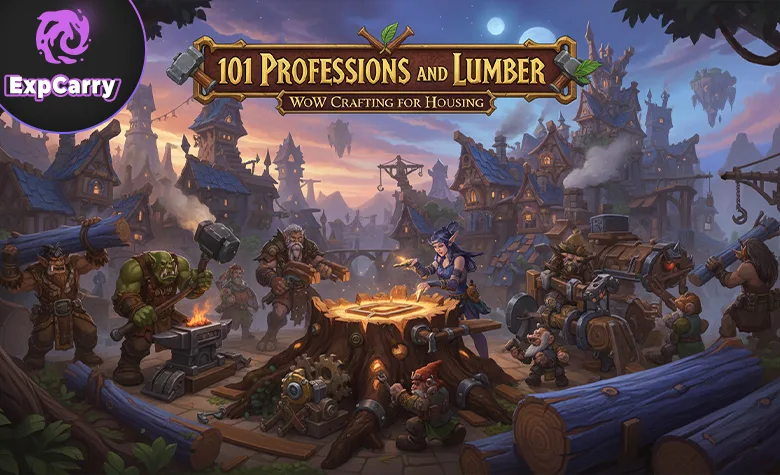
Housing crafting in World of Warcraft is not a side gimmick. In Housing Early Access, it is one of the cleanest ways to grow your decor catalog on your own schedule, because it turns materials you already own into permanent options you can reuse across builds and characters. This guide is built to match the informational intent behind searches like "WoW housing crafting recipes" and "housing lumber farming guide." It focuses on what you can do right now in early access, what is expected to expand later in Midnight, and how to set up a repeatable pipeline so you can craft housing items WoW players actually place instead of filling your bags with random clutter. The big idea is simple: you do not need every recipe. You need a themed, repeatable system that converts old mats for housing items into a catalog you will use. If you do that, crafting becomes the fastest way to close catalog gaps: lighting, shelves, rugs, fences, storage, and small props that make a room look finished.
What Is Live Right Now (Housing Early Access) And What Is Not
Housing Early Access is the "start building now" phase. If you own Midnight on the license you play on, you can claim a house, enter build mode, and place decor in Player Housing.
If you do not own Midnight yet, you cannot claim a home. However, you can still prepare in ways that matter: build your decor collection, stockpile reagents, and set up your crafting lanes so your catalog growth is ready the moment you unlock housing ownership. In the current early access rules, you may also be able to access the housing hubs and start the Lumber pipeline through early quests (for example the "Lumber for You" quest), even before you can claim a home.
For planning, the safest early access mindset is this: treat crafting as your consistent lane, and treat long-term community progression lanes as "later" unless you can confirm they are active in your client today. Early access is intentionally limited compared to a full expansion launch, so the long-term neighborhood cadence is not the center of your progress yet.
In practice, that means you should not build your current crafting plan around future systems you cannot rely on. Build your plan around what is stable: your crafting professions">professions, your material stockpiles, the Lumber pipeline, and the ability to craft a baseline set of staples you will place in every build.
How Housing Crafting Works: Every Profession Can Feed Your Decor Catalog
Housing crafting is designed as a cross-profession system. Instead of adding one new "housing profession," Blizzard has positioned decor crafting as something that comes from your existing crafting professions. That matters because it means your best choices depend on your theme and your inventory, not on chasing one hype profession.
Read the phrase "every profession can feed your decor catalog" as a builder-first idea, not a literal rule. Crafting professions make the decor. Gathering professions and world content feed the reagents and the Lumber that make crafting possible. The result is the same: your warband can grow a single reusable catalog by combining whatever your characters already do well.
Think of crafting as a catalog factory. You are not crafting a single item for a single character. You are crafting permanent options that your warband can reuse across builds. The best crafts are the ones you place over and over: lighting, wall fillers, shelves, rugs, fences, containers, and small props that create a lived-in vibe.
This is also why crafting beats pure RNG farming early on. If you want ten candles, you do not want to pray for ten drops. You want a recipe that converts common materials into repeatable staples. That is the core advantage of a crafting-first housing plan.
Lumber: The Resource That Controls Your Crafting Speed

Lumber is the housing-specific resource that shows up across the decor crafting ecosystem. Even if you are sitting on mountains of legacy reagents, Lumber is often the throttle that determines how fast you can turn those reagents into finished decor.
The right mindset is to treat Lumber as a restock step, not a constant interruption. You do not want to gather a little Lumber, craft one item, gather a little more, craft one item, and repeat. You want to gather Lumber in sessions, then craft in batches. That keeps your time productive and your progress predictable.
Because early access systems can change quickly, you should assume that Lumber availability and exchange options can be adjusted over time. If a specific Lumber type is temporarily awkward to farm, your best move is to look for an intended catch-up lever (a vendor, a quest exchange, or a temporary conversion) rather than brute-forcing a dead route.
Housing lumber farming guide: how to gather efficiently
Your goal with Lumber is not "farm forever." Your goal is "stay stocked enough to craft whenever you want." That means you want a route you can repeat without thinking, ideally in a zone you already enjoy playing in. The cleanest routine is to separate gathering and crafting. Do one focused Lumber session until you hit a target stack size that matches your next craft batch. Then stop gathering and switch to crafting. This avoids the worst housing trap: constant context switching, full bags, and the feeling that you are always missing one ingredient.
If you want to optimize further, track what your favorite decor consumes. If your builds are heavy on fences and structure pieces, your Lumber burn rate will be higher than a build that is mostly small props. Let your theme decide your stock target.
Lumber exchanges and missing types: what to do when a route feels blocked
During early access, it is normal for some resource loops to feel uneven. If a Lumber type that matches your target recipes is slower or less reliable than expected, do not assume you are doing something wrong.
The practical solution is to look for an official catch-up lever. As a real early access example (December 2025), Draenor trees were temporarily not gatherable, and the intended workaround was to farm Olemba Lumber in Outland and exchange it 1:1 for Shadowmoon Lumber at the neighborhood lumberjack. That kind of temporary exchange is the pattern you should watch for: if one type is blocked, Blizzard may provide a direct swap so you are not hard-stalled.
Use that as a stable planning rule: build your recipe plan around what you can reliably restock in your current client, not around a single perfect item that depends on a fragile gathering route.
Batch crafting with Lumber: the fastest way to grow your catalog
Batch crafting is how you keep housing fun. A good batch has a goal, not just a quantity. For example: "finish a cozy room starter set" or "build a workshop corner kit" or "produce three lighting styles plus wall shelves." When you craft in goal-based batches, you learn what you actually place. Some items look cool once and never get used again. Others become your staples. Your next batch should focus on the staples, because staples are what make future builds faster.
Batch crafting also improves gold efficiency. You waste less on impulse crafts, you avoid overbuying materials, and you stop chasing recipes that do not fit your theme.
Explore services related to this guide, selected from our World of Warcraft catalog.
View All World of Warcraft Services


Best Professions for Housing Decor: Pick By Theme and Inventory
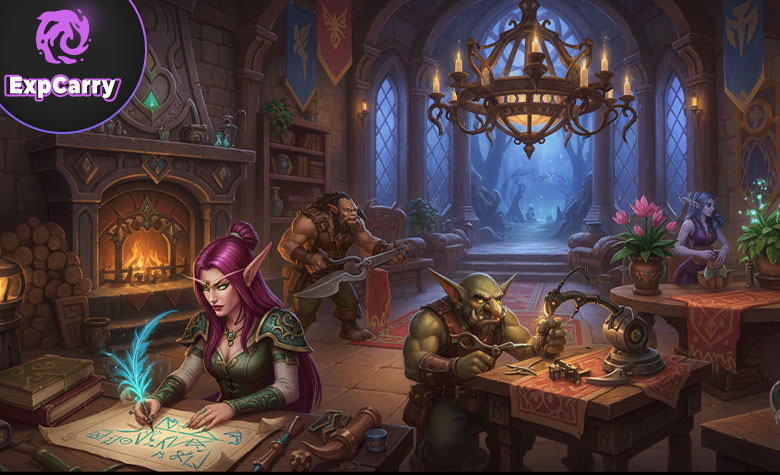
There is no single best profession for everyone. The best professions for housing decor are the ones that produce the objects you repeatedly place in your builds and that consume the materials you already have in bulk. A good housing crafting setup usually covers three roles: atmosphere (lighting and mood), structure (shelves, fences, anchors), and identity props (small themed details). You can cover these roles with one character, or spread them across alts and treat your warband as a catalog team.
Below is a practical way to think about profession output. The exact item names will evolve, but the categories are stable, and that is what matters for building a crafting plan that does not collapse when the meta shifts.
| Profession | Examples of crafted decor | Best use in builds |
|---|---|---|
| Alchemy | Candles, bottles, apothecary clutter, lab props | Cozy corners, potion shelves, workshop detail |
| Engineering | Gadgets, devices, tools, mechanical props | Workshop rooms, sci-tech themes, functional set pieces |
| Enchanting | Runes, magical lights, arcane objects, braziers | Mood lighting, mage themes, ritual corners |
| Inscription | Books, scrolls, shelving style props, study pieces | Libraries, studies, scholar rooms, wall fillers |
| Tailoring | Rugs, curtains, banners, fabric room accents | Making rooms feel finished fast, softening empty space |
| Leatherworking | Tents, straps, travel props, rugged furniture accents | Outdoor camps, hunter lodges, expedition themes |
| Blacksmithing | Metal fixtures, racks, stands, forged accents | Trophy rooms, armories, heavy structure anchors |
| Jewelcrafting | Sconces, decorative metalwork, refined accents | High-detail corners, elegant lighting variations |
A simple two-profession starter pick that works for most players
If you want the fastest visual improvement per hour, pair one atmosphere profession with one structure profession. Atmosphere fixes "flat rooms." Structure fixes "undefined rooms." When you solve both, your builds stop looking like empty shells with random furniture. For atmosphere, the safest categories are lighting and mood props. For structure, the safest categories are shelves, fences, posts, storage, and larger anchors that define a room. This pairing gives you the highest placement value per craft because you will reuse these pieces everywhere.
Then let your inventory decide your third role. If you have years of herbs, lean into Alchemy. If you have ore stacked, lean into forged and metal-accent crafts. Housing crafting is one of the few systems where being a long-term materials hoarder is a direct advantage.
Examples per profession: how to think like a builder, not a crafter
When a guide says "Alchemy makes candles" or "Engineering makes gadgets," the real point is not the specific object. The point is category coverage. Candles are not just decoration, they are lighting solutions. Gadgets are not just props, they are theme anchors.
So you should craft by category first: lighting, wall fillers, shelves, rugs, fences, storage, small clutter. Once you have baseline coverage, you craft by theme: tavern set, scholar set, workshop set, druid grove set, war room set. This is how you avoid wasted time. You are not crafting because a recipe exists. You are crafting because the item fills a known gap in your catalog and will be placed repeatedly.
Old Mats for Housing Items: A Bank Plan That Actually Works
Housing crafting pulls from reagents across many expansions. That sounds exciting until you open your bank and see hundreds of stacks. The correct play is not to farm everything. It is to convert your biggest piles first, then deliberately refill what your best recipes consume.
Start with a simple audit. Identify your top five material stacks by volume. Do not overthink it. Those piles are your first conversion targets because they let you craft a lot of decor without new farming. Then match those piles to the profession categories you actually want to place. If you are building cozy interiors, prioritize fabric and lighting categories. If you are building workshops and armories, prioritize structure and metal categories. Your theme decides what "waste" is.
Old mats audit: turning stockpiles into a usable starter set
Pick one theme and craft a complete starter set for that theme. Not one item. A set. A set means you can finish one room cleanly. For a cozy room, that means lighting options, at least one rug size, shelving, a few wall fillers, and small clutter to avoid dead corners. Once you can finish one room, you have a real benchmark. You will immediately notice what you are missing. That is when recipe hunting and profession progress becomes targeted instead of random.
Repeat the process for a second theme only after the first theme is stable. Most players fail here by trying to build five themes at once and ending up with half-finished rooms everywhere.
Buying versus crafting: when the Auction House is the smarter move
Not every player wants to level a profession just for decor. If crafted decor is tradable, buying can be the efficient choice, especially for baseline staples like rugs, shelves, and simple lighting. The smart rule is: craft what you want in volume, buy what you only want once. If you want ten candles and five shelves, crafting makes sense. If you want one niche accent piece, buying is often cheaper than leveling an entire profession lane.
This keeps your housing crafting plan practical. You spend your time where it has compounding value, and you spend your gold where it saves you hours.
Craft Housing Items WoW Players Actually Use: The Repeatable Pipeline
If you want crafting to feel clean and repeatable, use a simple pipeline that you can run every week without thinking.
Step one: define a theme and a room goal. Step two: pick professions that cover atmosphere and structure for that theme. Step three: stock Lumber in a dedicated session, then craft in batches with a clear category checklist. Step four: place the items immediately and note what you used most. Step five: your next batch doubles down on staples and drops the one-time novelty items.
This pipeline is how you build a catalog that stays useful as housing expands. You are building categories and themes, not chasing a fragile one-item meta.
Fast Start Option: When You Only Want to Decorate
Housing is designed to be a long-lasting journey, and that is great if you enjoy collecting, crafting, and progression loops. But if your goal is to get to the creative part immediately, there is a practical shortcut: you can outsource the time sinks. Services like ExpCarry can help with the slow parts that block decorating, such as stabilizing your Lumber routine, filling legacy reagent gaps, and pushing profession thresholds so you can craft the staples that make rooms look finished, so you spend your playtime building instead of grinding.
Use this option like a builder, not like a shopper. You keep control of the theme, the room goals, and the categories you want to unlock first: lighting and mood props, shelves and storage, rugs and soft accents, fences and structure pieces, and small clutter that removes dead corners. Then you remove the bottleneck that is slowing your pipeline down, so your next craft batch is about placement and iteration, not about farming one missing ingredient. If you treat housing crafting as an account-wide catalog factory, the pattern stays simple. Define a theme, stock Lumber in sessions, craft in goal-based batches, place immediately, and double down on the pieces you reuse everywhere. You can do the full loop yourself, or get help on the grindiest parts, and either way your catalog keeps growing as housing expands through The War Within and into Midnight.