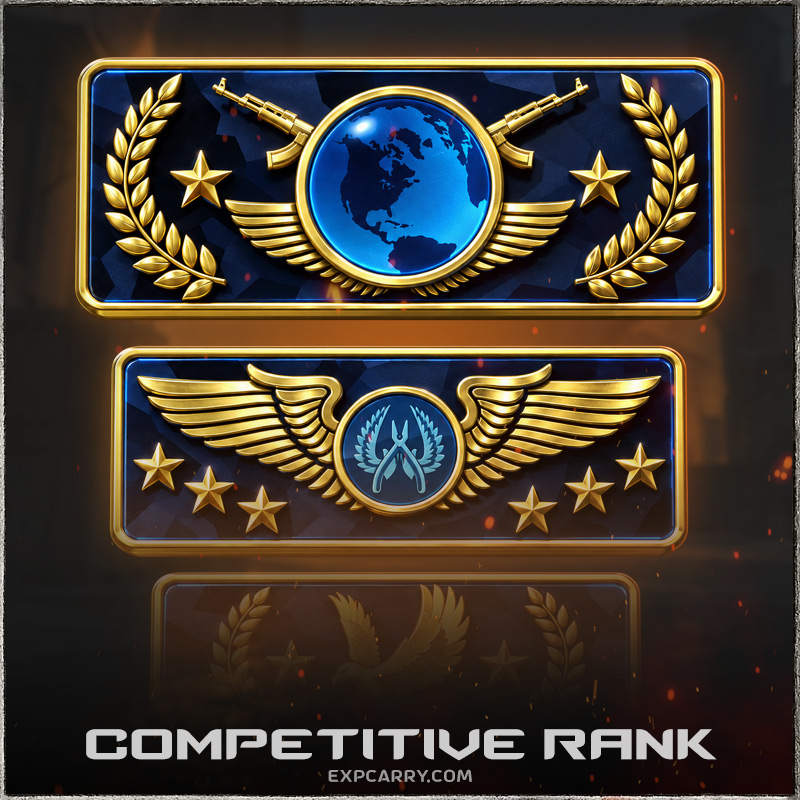
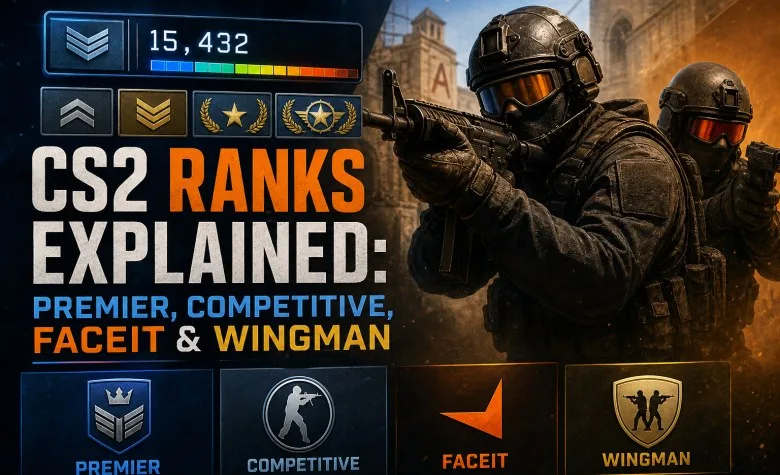
CS2 does not have one universal rank. Counter-Strike 2 currently uses several independent competitive ladders. Premier gives you one numerical CS Rating, Competitive assigns a separate Skill Group to every map, Wingman has its own 2v2 Skill Group, and FACEIT uses numerical Elo divided into Levels 1–10.
That distinction is the most important thing to understand before comparing CS2 ranks. One player can simultaneously have a 17,000 Premier CS Rating, Legendary Eagle on Mirage, a lower Competitive rank on Nuke, FACEIT Level 7 and a completely separate Wingman rank. Progress in one system does not automatically increase the others.
CS2 Ranking Systems at a Glance
| System | Rank Type | Scope | Highest Standard Milestone | Best Used For |
|---|---|---|---|---|
| Premier | Numerical CS Rating | One rating for Premier | 30,000+ Gold color band; rating can continue higher | Valve's main numerical ranked ladder |
| Competitive | 18 Skill Groups | Separate rank for each map | The Global Elite | Map-specific 5v5 progression |
| FACEIT | Elo + Levels 1–10 | FACEIT matchmaking | Level 10 at 2001+ Elo; Challenger is leaderboard-based | Precise third-party competitive progression |
| Wingman | Skill Group | Separate 2v2 ladder | The Global Elite | Ranked 2v2 progression |
| Profile Rank | XP level | Account progression | Level 40 before Service Medal reset | XP and account progression, not skill comparison |
What Is the Highest Rank in CS2?
There is no single answer because each CS2 ranking system has a different top milestone.
In Competitive and Wingman, the highest standard Skill Group is The Global Elite. On FACEIT, the highest numbered Skill Level is Level 10, beginning at 2001 Elo. FACEIT Challenger is not Level 11; it is a leaderboard status for the Top 1000 Level-10 players.
Premier works differently. It does not end at Global Elite or another named rank. Premier uses an open numerical CS Rating. Ratings are displayed using recognizable color bands, with the Gold band beginning at 30,000.
How CS2 Premier Ranks Work
Premier replaces the classic Silver-to-Global-Elite badges with one numerical CS Rating. Valve uses that rating to show where you stand within Premier and on eligible regional and global leaderboards.
Your Premier rating belongs to the entire Premier mode rather than one individual map. This makes Premier fundamentally different from Competitive, where every map has a separate Skill Group.
CS2 Premier Rating Colors
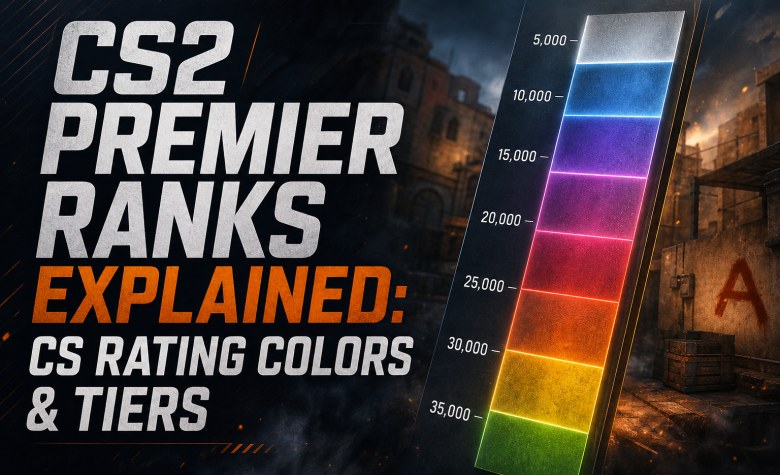
The CS Rating ladder is visually divided into seven familiar color bands at 5,000-point intervals. The color names below are common community labels for the colors shown in the game; they are not separate named ranks in the same sense as Gold Nova or Global Elite.
| CS Rating | Color Band | Next Major Milestone |
|---|---|---|
| 0–4,999 | Gray | 5,000 |
| 5,000–9,999 | Light Blue | 10,000 |
| 10,000–14,999 | Blue | 15,000 |
| 15,000–19,999 | Purple | 20,000 |
| 20,000–24,999 | Pink | 25,000 |
| 25,000–29,999 | Red | 30,000 |
| 30,000+ | Gold | No fixed final ceiling |
The exact number matters more than the color. A player at 15,100 and another at 19,900 are both inside the Purple band, but almost 5,000 CS Rating separates them. For serious comparison, always use the numerical rating first and the color only as a visual milestone.
How Do You Unlock Premier?
Premier is not immediately available to every new CS2 account. You need Prime Status and Profile Level 10 to access Premier. Prime accounts are also the accounts eligible to receive Competitive Skill Groups and Counter-Strike Ratings.
Profile Level 10 should not be confused with FACEIT Level 10. One comes from XP-based Steam/CS2 account progression; the other represents a high FACEIT Elo bracket.
Current Premier Context
Premier Season 5 began in July 2026. The ranking system itself still uses CS Rating, while seasonal changes can affect the Active Duty map pool, medal progression, recalibration and the way Premier matches are selected.
For that reason, this guide keeps the permanent ranking logic separate from season-specific map details. A future Premier Season guide can cover the current pool and seasonal mechanics without making this rank reference obsolete every time Valve changes a map.
If your goal is an exact numerical Premier target rather than understanding the system, see our CS2 Premier Rating Boost.
Explore services related to this guide, selected from our Counter Strike 2 catalog.
View All Counter Strike 2 Services


How CS2 Competitive Ranks Work
Competitive retains the 18 classic Skill Groups inherited from Counter-Strike's traditional matchmaking system, but CS2 changed how they apply: Competitive Skill Groups are assigned separately for each map.
This means the same account can be Master Guardian II on Mirage, Gold Nova II on Inferno and Silver Elite on a map it rarely plays. There is no single Competitive Skill Group that automatically covers every map.
All 18 CS2 Competitive Ranks in Order
| # | Skill Group | Rank Family |
|---|---|---|
| 1 | Silver I | Silver |
| 2 | Silver II | Silver |
| 3 | Silver III | Silver |
| 4 | Silver IV | Silver |
| 5 | Silver Elite | Silver |
| 6 | Silver Elite Master | Silver |
| 7 | Gold Nova I | Gold Nova |
| 8 | Gold Nova II | Gold Nova |
| 9 | Gold Nova III | Gold Nova |
| 10 | Gold Nova Master | Gold Nova |
| 11 | Master Guardian I | Master Guardian |
| 12 | Master Guardian II | Master Guardian |
| 13 | Master Guardian Elite | Master Guardian |
| 14 | Distinguished Master Guardian | Master Guardian |
| 15 | Legendary Eagle | Eagle |
| 16 | Legendary Eagle Master | Eagle |
| 17 | Supreme Master First Class | Supreme |
| 18 | The Global Elite | Highest Skill Group |
Why Can Your Competitive Rank Be Different on Every Map?
Valve calculates and displays Competitive Skill Groups on a per-map basis. That lets the matchmaking system separate your performance on a map you know extremely well from your performance on a map you barely play.
For example, strong Mirage knowledge does not automatically prove that you understand Nuke rotations, Ancient utility or Inferno timings at the same level. The per-map system allows those differences to appear in your visible ranks.
Why Did My Competitive Rank Disappear?
A Competitive Skill Group can stop being visible after an extended period of inactivity. Steam Support states that if you previously had a Skill Group and it disappears because of inactivity, winning one Competitive match is required for the system to reassess and issue it again.
Your Competitive wins and Skill Group can also be adjusted if players from recent parties are permanently banned for cheating. Skill Groups are calculated automatically and cannot simply be edited manually.
If your goal is a specific map rank from Silver to Global Elite, see our CS2 Competitive Rank Boost.
FACEIT Levels and Elo Explained
FACEIT is an independent competitive platform rather than another Valve matchmaking mode. It uses numerical Elo as the core rating, and your Elo determines which visible Skill Level you receive.
The exact Elo number is more informative than the Level alone. A player at 2,010 Elo and another at 3,000 Elo are both Level 10, but their actual rating difference is substantial.
Current FACEIT CS2 Levels and Elo
| FACEIT Level | CS2 Elo Range | Elo Needed for Next Level |
|---|---|---|
| Level 1 | 100–500 | 501 |
| Level 2 | 501–750 | 751 |
| Level 3 | 751–900 | 901 |
| Level 4 | 901–1,050 | 1,051 |
| Level 5 | 1,051–1,200 | 1,201 |
| Level 6 | 1,201–1,350 | 1,351 |
| Level 7 | 1,351–1,530 | 1,531 |
| Level 8 | 1,531–1,750 | 1,751 |
| Level 9 | 1,751–2,000 | 2,001 |
| Level 10 | 2,001+ | No fixed upper level threshold |
What Is FACEIT Challenger?
Challenger is not an eleventh Skill Level. It is a leaderboard distinction awarded to the Top 1000 players at Level 10. Because the leaderboard constantly changes, Challenger does not have one permanent Elo requirement.
A fixed statement such as “2,500 Elo always equals Challenger” would therefore be wrong. The required Elo depends on where the Top-1000 cutoff sits at that moment.
How Does FACEIT Elo Change?
FACEIT Elo changes through wins and losses. FACEIT states that the amount gained or lost is connected to the perceived probability of each team winning. This is why the system should be treated as an Elo ladder rather than a fixed “X wins = one Level” progression model.
Crossing a Level boundary changes the visible Skill Level. For example, moving from 2,000 to 2,001 Elo moves the account from Level 9 into Level 10.
What Elo Does a New FACEIT Account Start At?
FACEIT no longer places every eligible new CS2 user at exactly the same starting rating. If a new user meets FACEIT's requirements, including Prime and sufficient recent Premier history, FACEIT can translate the account's recent Premier performance into starting Elo using its own private formula.
If the required Premier data or win threshold is not available, FACEIT uses 1,000 Elo as the default starting value.
The conversion formula is not public, which is another reason not to trust websites claiming an exact universal Premier-to-FACEIT conversion.
If your objective is an exact FACEIT rating rather than general improvement, see our CS2 FACEIT Elo Boost.
How CS2 Wingman Ranks Work
Wingman is a separate 2v2 competitive mode with its own Skill Group. It uses the familiar Silver-to-Global-Elite rank structure, but Wingman progression is independent from Competitive, Premier and FACEIT.
A Global Elite Wingman rank therefore does not make the same account Global Elite on a Competitive map. It also does not increase Premier CS Rating or FACEIT Elo.
The 2v2 format changes what matters inside a match. With only one teammate, trading, spacing, utility timing, clutch decisions and communication have a proportionally larger impact than they do inside a five-player lineup.
If your target is specifically the 2v2 ladder, see our CS2 Wingman Rank Boost.
Profile Rank Is Not a Matchmaking Rank
Counter-Strike 2 also displays a Profile Rank, but it should not be used to judge competitive skill.
Profile Rank increases through match XP and can reach Level 40. After reaching the maximum, eligible players can receive a Service Medal and reset their Profile Rank back to Level 1.
That reset does not reset your Competitive Skill Group or remove Prime matchmaking eligibility. Premier CS Rating, Competitive Skill Groups and Profile Rank are separate systems.
| Value | What Changes It | What It Measures |
|---|---|---|
| Premier CS Rating | Premier match results | Premier performance |
| Competitive Skill Group | Competitive results on that map | Map-specific matchmaking level |
| FACEIT Elo | FACEIT wins and losses | FACEIT competitive rating |
| Wingman Skill Group | Wingman match results | 2v2 matchmaking level |
| Profile Rank | Match XP | Account progression |
Can You Convert Premier Rating to Competitive or FACEIT?
There is no official universal conversion table. Valve does not publish a rule saying that 15,000 Premier equals Legendary Eagle, and FACEIT does not publish a table saying that a particular Premier rating always equals one FACEIT Level.
The systems use different player pools, matchmaking logic and rating structures. Competitive is also map-specific, making it especially unsuitable for a simple one-number conversion against Premier.
FACEIT itself does use Premier history when assigning starting Elo to some eligible new accounts, but it describes that conversion as a private bespoke formula developed by its data team. The formula is not public.
Why There Is No Fixed Number of Wins for Every Rank-Up
Another common mistake is assuming that a specific number of wins always creates one promotion. The major CS2 ladders do not work that way.
Premier: rating changes are numerical, and the client shows the rating outcome currently at stake. There is no simple public formula that predicts every future change from a fixed number of wins.
Competitive: the internal numerical values behind visible Skill Groups are not published. Valve can also recalibrate the underlying system, so “three wins always equals one rank” is not a valid rule.
FACEIT: Elo gained or lost depends partly on expected win probability. A run of wins can move you through a Level boundary, but the Level itself is just a wrapper around the underlying Elo.
Wingman: the visible Skill Group is not accompanied by a public numerical rating that lets players calculate an exact number of wins to the next promotion.
Which CS2 Ranking System Should You Focus On?
| Your Goal | Best System to Track | Why |
|---|---|---|
| Measure overall Premier progression with one number | Premier | One numerical CS Rating across Premier |
| Master or rank up on one specific map | Competitive | Every map has its own Skill Group |
| Track exact third-party competitive progression | FACEIT | Elo gives precise numerical movement |
| Focus on ranked 2v2 | Wingman | Independent ladder for the smaller format |
| Track XP and account progression | Profile Rank | Useful for account level, not skill comparison |
How to Compare Two CS2 Players Correctly
Before saying that one player has a “higher rank,” first identify which ladder you are comparing.
- Compare the same system. FACEIT Level 8 cannot be directly compared with a 15,000 Premier rating.
- For Competitive, compare the same map. Mirage and Nuke ranks are independent.
- Use exact numbers where available. Premier CS Rating and FACEIT Elo provide more detail than color bands or Level labels alone.
- Check whether the displayed rank is active. Competitive ranks can disappear after inactivity and require reassessment.
- Do not use Profile Rank as a skill metric. It measures XP progression.
Common CS2 Rank Mistakes
- Calling Premier colors official named ranks instead of visual CS Rating bands.
- Assuming Global Elite is the highest rank across every CS2 system.
- Treating one Competitive rank as account-wide when CS2 ranks Competitive per map.
- Assuming FACEIT Level 10 ends at a fixed Elo value.
- Treating Challenger as Level 11.
- Using Profile Level to compare player skill.
- Publishing Premier-to-FACEIT conversions as exact official equivalents.
- Using third-party rank-distribution percentages without naming the dataset, date and sample.
Last verified: October 2026. Official mechanics and thresholds were checked against current Steam/Valve and FACEIT documentation. Third-party rank-distribution percentages are intentionally excluded because Valve does not publish a complete official distribution dataset.