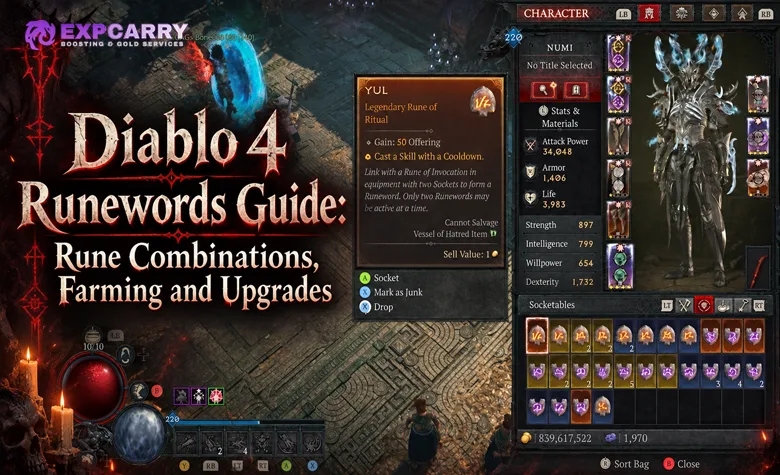
Diablo 4 Runewords turn two socketed Runes into one repeatable combat effect. A Rune of Ritual defines what your character must do to generate Offering, while a Rune of Invocation spends that Offering to trigger damage, utility, defence, mobility, resource recovery, or a Skill borrowed from another class. The strongest combination is therefore not automatically the pair with the rarest Runes. It is the pair whose trigger happens naturally inside your build and whose Invocation solves a problem the build actually has.
That distinction matters more than ever in the current game. Rune balance has changed repeatedly since Vessel of Hatred launched, Lord of Hatred added the Horadric Cube as a more targeted Rune-transformation tool, and current patches have changed several popular Invocations. This guide explains the live Runeword system, practical Rune combinations for different build behaviours, the best farming routes, how to use Offering and Overflow correctly, and which Runes should be saved instead of consumed in upgrades.
How Diablo 4 Runewords Work
Runewords are a Vessel of Hatred system. To build one, socket one Rune of Ritual and one Rune of Invocation into the same eligible two-socket item. Blizzard's original Runewords system explanation established the core rules that still define the mechanic: Ritual Runes generate Offering from a condition, Invocation Runes consume Offering to produce an effect, and excess Offering can strengthen Invocations through Overflow.
Rune of Ritual is the trigger
A Ritual Rune describes an action or condition your build must perform. Bac generates Offering from movement. Cir rewards repeated Skill use before entering a short exhausted period. Moni reacts to Mobility or Macabre Skills. Igni stores Offering over time and releases it when you cast a non-Basic Skill. Nagu rewards maintaining Summons. Other Rituals are built around resource spending, cooldown Skills, potion use, avoiding health damage, or similar behaviours.
The most important selection rule is trigger frequency. A Ritual can look strong on paper but be weak for your character if its condition occurs only occasionally. If your build naturally performs the trigger every few seconds, Offering arrives without changing your rotation. If you must press an otherwise useless Skill purely to feed the Runeword, the combination has an opportunity cost that should be compared with a simpler pair.
Rune of Invocation is the payoff
Invocation Runes spend the accumulated Offering. Some add utility such as movement speed, crowd control, Barrier, damage reduction, resource recovery, or cooldown reduction. Others invoke Skills from specific classes, such as War Cry, Earthen Bulwark, Petrify, Vortex, Spirit Wolves, or Dark Prison. The player does not need to be that class to use an off-class Invocation.
There is an important same-class interaction. When a Rune invokes a Skill that your current class can normally learn, the invoked version can benefit from that Skill's ranks and upgrades. If another class invokes the Skill, it uses the applicable base version instead. This can make the same Invocation much more valuable on one build than another even though the Rune itself is identical.
Offering controls activation frequency
Think of Offering as the bridge between trigger and payoff. The Ritual fills the pool; the Invocation waits until enough Offering is available; then the Invocation consumes what it needs and activates. A low-cost utility Invocation can trigger very often from a modest Ritual, while a high-cost Invocation needs either a high-output Ritual or time to accumulate enough Offering.
Do not judge a pair by the Invocation alone. A powerful effect with poor Offering generation may activate so rarely that a weaker but frequent effect produces more value over an entire dungeon or boss fight.
Overflow rewards excess Offering
Overflow applies when an Invocation activates with more Offering available than its base requirement. Blizzard expanded the system so every Invocation Rune has an Overflow interaction. Depending on the Rune, excess Offering can increase duration, size, damage, Skill ranks, Maximum Life, or another part of the effect.
This means the ideal Ritual does not always match the Invocation cost exactly. If the Invocation has a valuable Overflow bonus, intentionally generating excess Offering can be part of the build. If Overflow adds little to your goal, a faster low-output trigger may be more efficient.
| Runeword layer | What it does | What to check before using it |
|---|---|---|
| Rune of Ritual | Generates Offering from a specific action or condition | Does your normal rotation trigger it frequently without extra work? |
| Offering | Accumulates toward the Invocation requirement | How long does the build take to generate enough during real combat? |
| Rune of Invocation | Consumes Offering and creates the Runeword effect | Does the effect solve damage, defence, mobility, control, cooldown, or resource needs? |
| Overflow | Improves the Invocation when excess Offering is available | Is generating excess Offering actually useful for this Invocation? |
| Cooldown | Limits how often some Invocations can activate | Can your Ritual generate Offering faster than the Invocation can use it? |
When testing a Runeword, watch the real cadence rather than only the tooltip. The best pair is one where Offering generation, Invocation cost, Overflow, and cooldown fit the tempo of your build.
Runeword Equipment Rules and Socket Limits
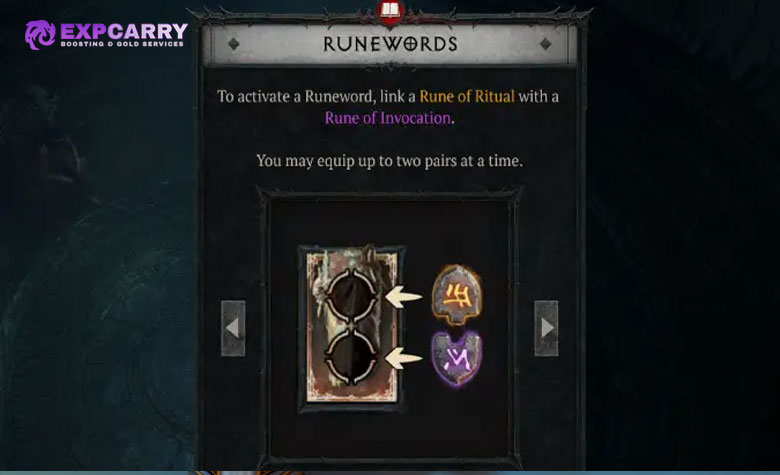
Runewords use two sockets, so they compete directly with Gems for socket space. The established eligible slots are Helm, Chest Armor, Pants, and Two-Handed Weapons because those slots can support the two-Rune pairing required by the system. One-handed weapons, jewellery, gloves, and boots do not become Runeword slots simply because they can interact with other socket systems.
You can equip two Runewords at once
The normal limit is two active Runewords, which means four equipped Runes total. You also cannot equip the same Rune twice. That restriction matters when planning combinations: two attractive pairs that both require Bac cannot be equipped together. Choose which Invocation gets the trigger and build the second pair around another Ritual.
Runes are tradeable and stack in the socketable inventory. Gems and Runes can also be swapped without an unsocketing Gold cost under the current socket rules, which makes testing combinations much easier than it was at launch.
Choose the socket slot after checking your Gems
A Runeword works the same because of the Runes, not because it sits in a particular eligible item. Slot choice is therefore an opportunity-cost decision. If your weapon Gems provide a major offensive bonus, it may be better to keep those Gems and place Runewords in armor. If armor Gems are carrying an important defensive breakpoint, a Two-Handed Weapon can become the better Runeword home.
Do not copy another build's socket location without checking why it was chosen. The same Runeword can be correct in two different slots depending on which Gem bonuses the character is least willing to lose.
How to Choose a Rune Combination for Your Build
Start with the Ritual, not the Invocation. Write down what your character already does constantly: move, cast Core Skills, spend Primary Resource, use cooldown Skills, keep Summons active, Evade, or cycle Mobility Skills. Then choose an Invocation that converts that behaviour into a useful effect.
If you are still missing the required pair rather than testing combinations manually, ExpCarry's Diablo 4 Runewords service is the directly related acquisition option. For self-play, the same rule applies: collect broadly first, then target the Ritual and Invocation that match the actual build loop.
Trigger consistency is more important than Rune rarity
Magic, Rare, and Legendary Runes are not a simple progression where every Legendary is automatically better. Blizzard deliberately reduced the power gap between rarity tiers so utility Runes remain competitive. A Magic Invocation that gives your build constant movement speed can be more useful than a Legendary effect that activates too rarely or duplicates a buff you already maintain.
Evaluate the pair by effective uptime. If one Runeword activates every few seconds during normal play and another triggers once per pack, the first can create more practical value even with a lower-rarity component.
Match the Invocation to a missing build function
Damage is only one reason to use a Runeword. A build with excellent damage may gain more from Barrier, Unstoppable, movement speed, crowd control, cooldown reduction, or resource recovery. Conversely, an extremely durable build may use its Runeword slots to add a damage window or Skill-rank burst.
Before socketing an Invocation, name the problem it solves. If you cannot identify one, keep the Rune for another build rather than forcing it into the current setup. This also makes upgrades easier to judge: replace a utility Rune only when the new pair improves the same job or removes a more important bottleneck.
Explore services related to this guide, selected from our Diablo IV catalog.
View All Diablo IV Services

Useful Diablo 4 Rune Combinations
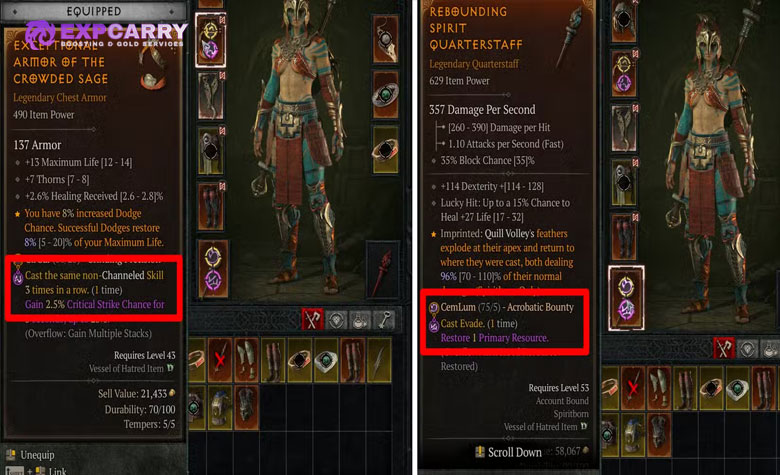
The combinations below are practical templates rather than a universal tier list. Balance patches can change Rune costs and effects, and different builds trigger Rituals at very different rates. Use the pair whose condition happens naturally and whose Invocation improves the content you are farming.
| Combination | Best fit | Why it works | Main caution |
|---|---|---|---|
| Bac + Jah | Speed farming and mobility | Bac rewards movement; Jah converts the stored Offering into a Teleport-style Evade with Unstoppable utility. | Do not spend Bac on this pair if another Runeword needs the same Ritual more. |
| Moni + Qua | Mobility-heavy or Macabre rotations | Moni generates Offering from repeated Mobility or Macabre use; Qua adds stacking Movement Speed. | Weak on builds that rarely use the required Skill categories. |
| Cir + Vex | General active-skill builds | Cir generates 300 Offering after five Skill casts before its exhausted period; current Vex also requires 300 Offering and grants +1 to all Skills, with stronger ranks possible through Overflow. | Cir has an internal exhausted period, so this is a recurring burst rather than permanent +Skills. |
| Igni + Vex | Slower burst rotations | Igni stores Offering over time and releases it on a non-Basic Skill, letting Vex turn stored Offering into a Skill-rank window. | Fast builds may prefer a trigger tied directly to their rotation instead of waiting for storage. |
| Nagu + Ceh | Summon and Companion builds | Nagu rewards maintaining Summons; Ceh adds Spirit Wolves that benefit from Summon and Companion bonuses. | Ceh no longer applies Vulnerable, so the build needs another Vulnerable source if it depends on that status. |
| Yul + Eom | Cooldown-heavy builds | A Ritual based on using cooldown Skills feeds an Invocation that trims active cooldowns, reinforcing the same loop. | Low-value if your important Skills are already ready whenever needed. |
| Poc + Lum | Primary-resource spenders | Resource spending generates Offering and Lum restores Primary Resource, smoothing demanding rotations. | Do not use it if resource generation is already solved and another Invocation adds more value. |
| Tam + Ohm | Non-channeled Core Skill builds | Frequent Core casts generate Offering toward War Cry, adding a recurring offensive and movement window. | The cadence depends heavily on Core-skill frequency and the current Offering balance. |
| Igni + Prid | Control and setup builds | Igni can bank a large amount of Offering before a non-Basic cast; Prid spends a large requirement to invoke Dark Prison. | Prid currently costs 500 Offering, so weak Offering generation makes the effect too infrequent. |
The table intentionally mixes low-rarity utility with Legendary effects. That is how Runewords should be evaluated: by interaction quality, not by color. A pair that improves every map pack can outperform a rarer pair that only looks impressive during an occasional cooldown window.
Bac plus Jah remains the clean mobility template
Bac plus Jah was Blizzard's own early demonstration of the system because the logic is easy to understand: movement feeds Offering, then Jah replaces an Evade with a Sorcerer-style Teleport and provides Unstoppable. The pair is useful when speed and repositioning matter more than another direct damage proc.
It is particularly comfortable in open-world farming and dungeon routes where movement itself continually charges the effect. A stationary or channel-heavy build may get less value because it does not generate Bac Offering as naturally.
Cir plus Vex is a predictable Skill-rank cycle
Cir now generates 300 Offering after five Skill casts and then becomes exhausted for three seconds. Current Vex requires 300 Offering after its latest live increase. That creates a simple one-cycle relationship for builds that press Skills frequently: complete the Ritual condition and receive the Vex Skill-rank window without needing another Offering source.
Vex is powerful because +All Skills can improve several active parts of a build at once, but do not evaluate it using old guides that show a 100 or 150 Offering requirement. The live requirement is 300, and the actual value depends on how much of your damage and utility scales with Skill ranks.
Nagu plus Ceh is for real summon investment
Nagu is attractive when the character already maintains multiple Summons, while Ceh creates Spirit Wolves that benefit from Summon and Companion bonuses. This makes the pair coherent for minion-oriented characters rather than simply adding a random summoned effect to a non-summon build.
Current balance matters here. Ceh was changed so Spirit Wolves no longer make enemies Vulnerable, their Chill per leap was reduced, and their maximum count was lowered to six. Treat the Wolves as summon damage and control, not as a free permanent Vulnerable engine.
Use utility Invocations when damage is already solved
Qua for movement, Que for Barrier, Lac for damage reduction, Ner for Concealment and Unstoppable utility, Thul for Freeze control, Kry for grouping, and resource-oriented effects can all be more valuable than another damage proc when the build already kills quickly. The best Invocation is often the one that removes the reason you stop moving or die.
This is also why copying a class-specific Runeword from another build can fail. The other build may be solving a resource problem or defensive weakness your character does not have.
Current Rune Changes You Should Know
Runewords have received enough balance changes that an old combination list can be actively misleading. Recent live patches include several Rune corrections that directly affect pairing decisions, so always compare an old guide with the current tooltip before committing valuable Runes.
Vex now requires 300 Offering
Vex currently requires 300 Offering. Its effect grants +1 to all Skills for ten seconds, and Overflow can increase the Skill-rank benefit up to the Rune's cap. Guides built around the old 100 or 150 Offering versions will show a much faster activation cadence than the live game.
This is one reason Cir + Vex is easy to reason about in the current system: Cir's 300-Offering cycle can meet Vex's current base requirement cleanly. If the build does not cast five Skills quickly, however, Vex may still be a poor choice; the exact cost is only useful when the Ritual condition is natural for the rotation.
Ceh no longer supplies Vulnerable
Ceh's Spirit Wolves no longer make enemies Vulnerable. The current Rune also caps the wolf count at six and applies less Chill per leap than the earlier version. If a build guide uses Ceh as its only source of Vulnerable, that part of the setup is outdated.
Summon builds can still value Ceh because the wolves benefit from Summon and Companion bonuses. The change removes one utility function; it does not make the Rune unusable. Recheck the rest of the build after equipping it, because any guide that budgeted no separate Vulnerable source is now missing a damage condition.
Prid and Yom also changed
Prid's Dark Prison Invocation currently costs 500 Offering, so it belongs with Rituals that can build a large Offering pool reliably. Yom's Petrify effect no longer restores Primary Resource. Current Petrify stuns enemies and increases the Critical Strike Damage you deal to affected targets.
These changes are exactly why Runewords should be built from the live tooltip outward. A combination may keep the same Rune names while its actual role changes. For Prid, prioritize a Ritual that can bank Offering reliably; for Yom, judge Petrify by Stun and Critical Strike synergy rather than by resource sustain.
Ur, Ono, and Met are removed; Kaa is active again
Ur, Ono, and Met remain removed from the intended live Rune pool. Kaa appeared alongside them on Blizzard's old removal list, but it is present again in current Season 14 game data as a Rare Rune of Ritual. Its current trigger grants 50 Offering when the character loses 25% of Maximum Life, so guides that still classify Kaa as unobtainable are outdated.
Ur should still be treated as removed. Patch 3.1.3 explicitly fixed a leftover Yul crafting recipe that incorrectly required Ur and replaced it with Moni, and Blizzard also fixed Ur still appearing from Duriel's Cache. If an external database still treats Ur, Ono, or Met as normal obtainable Runes, verify its data before planning a build or crafting route.
How to Farm Runes Efficiently
Runes can appear across Sanctuary, but targeted methods are much better than waiting for random monster drops. The most direct repeatable route is Kurast Undercity, while Lair Bosses are attractive when you want Legendary Runes and targeted Unique farming at the same time. Other recurring Rune sources are useful when they overlap content you already need.
Kurast Undercity is the most direct repeatable Rune farm
Blizzard's 2.3 Rune loot update made every successful Kurast Undercity run reward at least one Rune. Rune-focused Tributes reward more Runes as Attunement increases, and the reward scales with Torment level. That makes Undercity the clearest activity when the objective is Rune volume rather than a specific boss item.
The practical route is to run the highest Torment you can clear quickly, maximize Attunement without risking failed runs, and spend Rune-oriented Tributes when available. A failed high-Torment run produces less value than a clean lower-tier clear, so treat Rune farming like any other efficiency farm rather than automatically choosing the maximum difficulty.
If the repetitive route itself is the bottleneck, ExpCarry's Diablo 4 farming service can be used for goal-driven farming sessions. For self-play, prioritize Undercity whenever you have a Rune-focused Tribute and enough damage to reach high Attunement consistently.
Lair Bosses combine Rune farming with Unique targeting
Lair Bosses received an additional small chance to drop a Legendary Rune. That does not make them the best pure Rune-per-minute farm, but it makes boss farming efficient when you already need a Unique from a boss pool or are spending Lair Boss Keys to open their Hoards for another progression target.
This is a good example of stacking goals. One session can target a Unique, produce boss loot, and add chances at Legendary Runes instead of spending separate hours on each objective. Choose the boss based on the Unique pool first and treat Runes as additional value rather than spending Lair Boss Keys only for the small Legendary Rune chance.
Whispers, World Bosses, Strongholds, and campaign progression can supplement Rune farming
Blizzard introduced Vessel of Hatred campaign bosses, Whisper Caches, World Bosses, and first-time Stronghold rewards as Rune sources when the live Runeword system launched. In the current game, these are best treated as supporting activities that can add Rune income while you pursue other objectives rather than as the primary dedicated farming route.
Do not repeatedly run Strongholds expecting the first-clear Rune reward to repeat. Whispers are the better recurring overlap activity when you are already collecting Grim Favors, while Kurast Undercity remains the clearer dedicated repeatable Rune farm.
Season Rank and expansion endgame can add Rune income
Current Season Rank caches can contain Runes alongside other materials. Lord of Hatred endgame routes can also overlap Rune farming with War Plans, Undercity, Lair Bosses, Whisper objectives, and Horadric Cube material farming. ExpCarry's War Plans guide covers how to route those activities without turning every resource into a separate farm.
The key is overlap. If your build needs boss Uniques, Rune transformations, and Cube materials, a route that includes bosses and Undercity can be more efficient than repeating the nominally highest Rune source while ignoring the other bottlenecks.
Rune Crafting and Upgrades
There are now two main ways to turn spare Runes into progress. The Jeweler provides the broad three-for-one conversion system, while the Horadric Cube from Lord of Hatred gives much better control over Rune transformations and can create specific Legendary Runes. Use the Jeweler for surplus duplicates; use the Cube when a particular target matters enough to justify directed crafting.
The Jeweler is best for surplus duplicates
The basic Rune conversion uses three Runes with the same name to create a different Rune. When non-Legendary Runes are used, the result can upgrade to the next rarity. This makes duplicate low-value Runes useful, but it is still a random conversion.
Do not convert the only copy of a Rune used by your current build. Also avoid feeding scarce Runes into random conversion merely because their rarity is low. A Magic Rune can be central to a very strong utility pair, and the rarity rebalance intentionally reduced the assumption that Legendary always means better.
The Horadric Cube is for targeted Rune progress
Lord of Hatred added the Horadric Cube, unlocked through its campaign and permanently available in Temis. The Cube gives much better control over Rune transformations and can create specific Legendary Runes for Runewords and Mythic Unique crafting. This is the preferred direction when you are missing one exact Legendary rather than simply trying to turn a pile of duplicates into something different.
Exact Cube recipes and ingredient routes are a separate crafting system, so the ExpCarry Horadric Cube guide covers them in detail. For Runewords, the important priority is to identify the target Invocation or Ritual first, then compare the directed Cube cost with the value of continuing to farm or trade.
Do not destroy Mythic-crafting Runes without checking the recipe
Rune value is no longer limited to Runewords. In the current live Season 14 system, Mythic Unique crafting becomes available from level 70 in Torment difficulty. The Jeweler route requires an Item Power 850+ Unique occupying the target equipment slot, 18 specific Runes, and 3 Resplendent Sparks. The older launch-era Mythic recipes used a different Rune-and-Spark structure and should not be used for current crafting decisions.
Before converting a Legendary or Rare Rune, check whether it appears among the specific Runes required for a Mythic craft you intend to use. A duplicate that seems useless for your Runeword can be part of a much more expensive Mythic target.
Best Rune Upgrade Priorities
The safest upgrade order protects functional builds first and gambling value second. Runes are easy to waste because the Jeweler lets you turn duplicates into another result immediately, but a good inventory strategy leaves room for alternate builds and later Mythic crafting.
- Complete one functional Runeword first. Do not consume a useful Ritual or Invocation while the character still lacks a working pair.
- Complete the second Runeword. Because two Runewords can be equipped, stabilize both socket pairs before aggressive conversion.
- Keep one spare copy of important utility Runes. Movement, Barrier, cooldown, resource, and crowd-control options can become valuable after a build change.
- Protect current Legendary targets. Do not randomly reroll a Rune that the Horadric Cube can use toward the exact Legendary you need.
- Check Mythic crafting requirements. Save specific Runes needed for the Mythic Unique recipe you are pursuing.
- Convert true surplus duplicates. Use the Jeweler's three-for-one system on Runes that are not part of current, planned, Cube, or Mythic targets.
- Trade before gambling scarce Runes. Because Runes are tradeable, market exchange can be more deterministic than repeated random conversion.
This order is deliberately conservative. The value of a Rune is not just its current Runeword effect; it can also be a trade asset, crafting input, alternate-build component, or Mythic reagent. If your upgrade plan already includes repeated Lair Boss kills for a target Unique, ExpCarry's Diablo 4 Bosses category is the related service route; for self-play, keep the boss target primary and treat Legendary Rune chances as extra value.
How to Test a Runeword Before Committing to It
A Runeword should be tested in the content it is meant to improve. A mobility pair can feel excellent in Helltide and irrelevant on a stationary boss. A high-Offering damage Invocation can feel strong in a long boss fight but activate too rarely during fast mapping. Testing should reproduce the problem the pair is supposed to solve.
Measure activation cadence
Run the same dungeon or boss with the Runeword equipped and pay attention to how often the Invocation actually triggers. If the effect is supposed to support every elite but activates once every several packs, the Ritual is a poor match or the Invocation requirement is too expensive for the build.
Then try a lower-cost utility Invocation with the same Ritual. If it provides near-constant value, the Ritual may be correct while the original Invocation was not. This isolates the problem without changing two variables at once and makes it easier to decide whether you need more Offering or a different payoff.
Check whether Overflow is real value
Do not chase Overflow because the tooltip highlights it. If excess Offering extends a buff that already lasts long enough, a Ritual that activates the effect more often can be better. If Overflow grants extra Skill ranks, Maximum Life, damage, size, or duration that materially changes a boss window, intentionally generating excess Offering can be worth it.
Compare normal activation and Overflow activation in the same content. The stronger-looking pair should remain only if the Overflow benefit actually changes clear speed, boss time, survival, or resource stability.
Test the opportunity cost of the socket
Every Runeword replaces two Gem sockets. Remove the Runeword and restore the Gems you would otherwise use, then compare the complete character. A Runeword that adds damage but forces you to lose more damage or defence from Gems can be a net downgrade.
This test is especially important on Two-Handed Weapons because offensive Gem effects can be valuable there. Socket location is part of the combination, not an afterthought. If moving the same Runeword from weapon to armor lets you restore a stronger weapon Gem setup without breaking defenses, the Runeword itself did not change but the full build improved.
Common Diablo 4 Runeword Mistakes
Most Runeword problems come from stale information, poor trigger matching, or treating Rune rarity as a tier list. The system works best when every pair is built around the character's normal rotation. Before following an older setup, compare it with the current Diablo 4 live patch notes and the in-game Rune tooltip.
Using two Ritual Runes or two Invocation Runes.
A Runeword requires one Ritual and one Invocation in the same eligible two-socket item. Two Runes of the same category do not form the intended trigger-and-payoff system.
Trying to equip the same Rune twice.
The same Rune cannot be equipped twice, even when it would belong to two different Runewords. Build the second pair around another Ritual or Invocation.
Copying an old Vex setup.
Current Vex requires 300 Offering. Old 100- or 150-Offering rotations can activate far less often now.
Using Ceh as the only Vulnerable source.
Ceh Spirit Wolves no longer apply Vulnerable. The build needs another source if Vulnerable is part of its damage engine.
Expecting Yom to restore resource.
Current Yom invokes Petrify for Stun and increased Critical Strike Damage against affected enemies rather than Primary Resource restoration.
Planning around removed Ur, Ono, or Met, or treating Kaa as removed.
Ur, Ono, and Met are not part of the intended live Rune pool. Kaa is present again in current Season 14 game data and should not be grouped with those removed Runes.
Converting every duplicate immediately.
Duplicates can be future Runeword pieces, trade assets, Cube inputs, or Mythic-crafting Runes. Check all four uses before random conversion.
Choosing the rarest pair instead of the fastest useful pair.
A frequent Magic utility Invocation can produce more value than a Legendary effect that almost never receives enough Offering.
Diablo 4 Runewords FAQ
These answers cover the main questions players encounter when building, farming, and upgrading Runewords in the current game.
Do I need Vessel of Hatred to use Runewords?
Yes. Runewords are tied to Vessel of Hatred access. Lord of Hatred includes Vessel of Hatred, so players who own Lord of Hatred also meet that requirement. Lord of Hatred additionally adds the Horadric Cube and further Rune-related crafting options.
How many Runewords can I equip?
You can equip up to two Runewords, which means four Runes total. You cannot equip the same Rune twice.
Can any Ritual Rune be paired with any Invocation Rune?
Yes at the system level. The practical question is whether the Ritual generates Offering at a useful rate for that Invocation and whether the effect fits your build.
What happens when I generate too much Offering?
Offering beyond the Invocation's base requirement can activate its Overflow bonus. The exact bonus depends on the Invocation and can improve duration, damage, size, Skill ranks, Maximum Life, or another effect.
What is the best way to farm Runes?
Kurast Undercity is the most direct repeatable source because every successful run awards at least one Rune, and Rune-focused Tribute rewards scale with Attunement and Torment. Lair Bosses are efficient when you also need targeted Unique drops because they have an additional chance for Legendary Runes.
Can I trade Runes?
Yes. Runes are tradeable outside modes such as Solo Self Found, so trading can be more efficient than repeatedly using random three-for-one crafting when you need one specific result.
Should I upgrade every Magic or Rare Rune?
No. Lower-rarity Runes can provide excellent utility and can be part of current Runewords or Mythic recipes. Convert only genuine surplus after protecting the Runes your builds and crafting plans need.
Does Vex still cost 150 Offering?
No. Current live Vex requires 300 Offering. It grants +1 to all Skills for its base effect, with additional Skill-rank benefit available through Overflow.
Conclusion
Diablo 4 Runewords are best built from the trigger outward. Choose a Rune of Ritual that your character activates naturally, pair it with an Invocation that solves a real damage, defence, mobility, control, cooldown, or resource problem, and then check whether the Offering rate and Overflow bonus produce useful uptime in actual content. Two complete, well-matched Runewords are more valuable than four rare Runes chosen only for their rarity.
For progression, use Kurast Undercity when Rune volume is the main goal, overlap Lair Boss farming with Unique targets when you want Legendary Rune chances, and keep Whisper, World Boss, Season Rank, and War Plan rewards as supporting sources. Protect build-defining and Mythic-crafting Runes before using random conversions, and use the Horadric Cube when targeted Legendary transformation is worth the materials. Most importantly, recheck live tooltips after balance patches: Vex, Ceh, Prid, Yom, and the changed status of older Runes such as Kaa and Ur already show how quickly an old Runeword recommendation can become inaccurate.