Soul Splinters are one of the most important systems shown for Diablo 4 Season 15, but they are not ordinary gems with free power attached. Each Splinter combines a strong benefit with a drawback or risk that can alter resource costs, movement, survivability, Critical Strike Chance or even Monster Power. The right choice can reshape a build; the wrong one can quietly break the resource loop or defensive plan that made the build work.
This guide covers every Soul Splinter listed for patch 3.2.0, how the socket and upgrade system is supposed to work, the best uses for each effect and the questions Blizzard has not answered yet. The information comes from the official Diablo 4 PTR 3.2.0 overview. The August PTR ended on August 11, 2026, so every value below should still be treated as pre-release Season 15 data rather than final live balance.
Diablo 4 Soul Splinters at a Glance
| Question | Current answer |
|---|---|
| What are Soul Splinters? | Socketable items previewed for Season 15 that grant resistance or stats and a powerful effect paired with a drawback or risk. |
| Where do they go? | Blizzard says they can be socketed into jewelry. The official preview does not state a separate equip limit. |
| How many types are there? | Eight were listed for the 3.2.0 PTR. |
| What rarities exist? | Common, Magic, Rare, Legendary and Unique. |
| How are they upgraded? | Through the Horadric Cube. Blizzard has not published the final recipe, material cost or duplicate requirement. |
| How are they obtained? | The PTR vendor could grant them for testing. Their normal Season 15 acquisition sources have not been officially detailed. |
| Are the values final? | No. The system was tested on PTR, and Blizzard said feedback could lead to changes before Season 15 goes live. |
The key design rule is simple: judge the penalty before the reward. A 100% damage bonus is not automatically an upgrade if the build depends on critical hits, and 40% Damage Reduction is not automatically comfortable if losing 30% Movement Speed ruins every farming route. Soul Splinters reward builds that can absorb or work around their downside, not builds that merely like the positive number.
How Soul Splinters Work in Diablo 4 Season 15
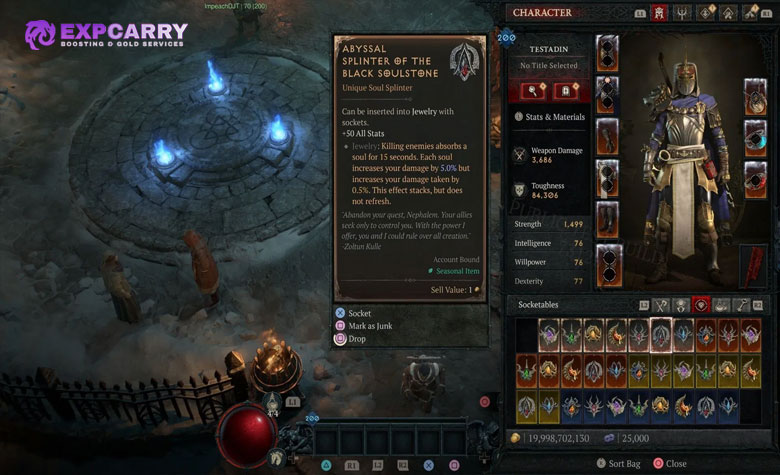
Blizzard describes Soul Splinters as unique socketables for jewelry. They provide elemental or physical resistance, except the Splinter of the Black Soulstone, which grants All Stats. Blizzard states that the published values scale between Item Quality tiers, but the preview does not provide a complete quality-to-value mapping for every effect.
Do not treat the word "Unique" in this description as proof that every Splinter is a Unique-rarity item from the moment it drops. Blizzard lists five available rarities: Common, Magic, Rare, Legendary and Unique, and separately confirms that Soul Splinters can be upgraded in the Horadric Cube. The preview does not explain exactly how the five rarity tiers correspond to the four numerical stages printed for most effects.
The jewelry wording also leaves several practical questions open. The PTR article does not confirm whether multiple copies of one Splinter can be equipped, whether every jewelry socket accepts one without restriction or how removal and replacement will work on live servers. Those rules matter for build planning, so avoid building an entire jewelry setup around an assumed stacking interaction before the final live rules can be tested.
How to Get and Upgrade Soul Splinters
During PTR 3.2.0, the fast route was the test vendor Mrak. Blizzard included a "Grant Seasonal Items" option so testers could receive Soul Splinters without playing through the normal seasonal loop. That was a PTR convenience feature, not evidence that a vendor will hand out the items on live servers.
For the live version of Season 15, the exact acquisition route remains unannounced. Blizzard has not identified a seasonal activity, boss, cache or general loot pool as the final source. Guides that already promise a specific best farm are moving beyond the official information. The safe plan is to progress normally and wait for the final Season 15 documentation to identify the repeatable source before committing hours to an assumed route.
Upgrading is confirmed to happen in the Horadric Cube, but the Soul Splinter recipe is not. Blizzard's official Horadric Cube overview explains that the station can create socketable items and upgrade item types, while the PTR 3.2.0 overview specifically confirms that Soul Splinters can be upgraded there. No official Soul Splinter cost in gold, materials or duplicate Splinters has been provided. Players preparing a fresh seasonal character can still remove the ordinary leveling bottleneck through Diablo 4 leveling support, but that should not be confused with a guaranteed way to obtain Soul Splinters. The seasonal acquisition and upgrade rules must come from the live game or a later Blizzard update.
There is one more documentation problem worth knowing before reading any numerical tier list. Blizzard names five rarities but prints only four values for most powers. Several resistance strings on the official PTR pages are also formatted in a way that cannot be mapped confidently to the five rarity tiers. Because the intended quality mapping is not explained, the comparison below preserves Blizzard's published effect progression without inventing missing resistance values.
Explore services related to this guide, selected from our Diablo IV catalog.
View All Diablo IV Services


All Diablo 4 Soul Splinter Effects
The following table preserves the readable PTR effect progression as Blizzard published it. The four values are shown from lowest to highest displayed stage, but they are not assigned to specific rarity names because the official article does not explain the missing fifth step. The official Soul Splinters section should remain the final reference if Blizzard edits the numbers.
| Soul Splinter | Resistance or stat | PTR benefit | Drawback or risk | Best early use |
|---|---|---|---|---|
| Splinter of Anguish | Fire Resistance | 15/20/25/35%[+] Critical Strike Chance and Attack Speed | Primary Resource Costs increase by 30% | Fast critical builds with reliable resource generation |
| Splinter of Sin | Lightning Resistance | 10/20/30/40%[x] Maximum Health | Maximum Primary Resource falls by 30% | Life-scaling or cooldown-led builds that need a smaller resource pool |
| Splinter of Lies | Cold Resistance | 40/60/80/100% increased Gold and Crafting Material Drop Rate, plus 25% Bonus Experience in the English PTR description | The character is always Weakened and Vulnerable | Easy-content leveling and material farming |
| Splinter of the Black Soulstone | 7/20/30/50 All Stats | Kills absorb a soul for 15 seconds; each soul adds 2/3/4/5%[x] damage | Each soul also increases damage taken by 0.5%; stacks do not refresh | Dense speed-farming routes with continuous kills |
| Splinter of Pain | Poison Resistance | 10/20/30/40% Damage Reduction | Movement Speed falls by 30% | Bossing and difficult pushes where survival matters more than travel speed |
| Splinter of the Mother | Physical Resistance | Grants Unhindered; touching an enemy makes it Vulnerable for 10 seconds | After touching 100/150/200/250 enemies, the character is Stunned for 4 seconds | Mobile melee builds that can manage the self-stun cycle |
| Splinter of Hellfire | Resistance to All Elements | 40/60/80/100%[x] increased damage | The character loses 100% Critical Strike Chance | Non-critical damage and damage-over-time builds |
| Splinter of Damnation | Shadow Resistance | Killing an Elite Pack raises Monster Power by 1 for 10/15/20/25 seconds | The official Splinter description does not explain a direct reward benefit from the added Monster Power | Experimental high-risk routing after the live Monster Power interaction is known |
Splinter of Lies has a localization discrepancy worth flagging. The English PTR article lists scaling Gold and Crafting Material Drop Rate plus a fixed 25% Bonus Experience, while the official German localization applies its 40/60/80/100% wording to gold, crafting materials and bonus experience from kills. Because the two official versions conflict, this guide follows the English source for the numerical table and recommends checking the final live tooltip before planning around the experience bonus.
Best Soul Splinters for Damage, Defense and Farming
The strongest Soul Splinter depends less on class name than on what the build can afford to lose. Offensive Splinters are valuable only when their resource or Critical Strike penalties do not disable key mechanics, while defensive and farming options become worthwhile when their movement or survivability costs fit the content being played.
Hellfire and Anguish lead offensive build planning
Splinter of Hellfire has the largest clean damage multiplier on the PTR list, reaching 100%[x] at the highest displayed stage. It is an obvious first test for Burning, Poison, Bleed and Shadow damage-over-time builds because standard damage-over-time effects do not normally depend on direct Critical Strikes. The catch is broader than the tooltip appears: any aspect, passive, resource engine or triggered effect that requires a Critical Strike can also stop contributing. "Non-crit build" therefore means the whole build must tolerate the penalty, not merely its main damage skill.
The wording says the character loses 100% Critical Strike Chance; it does not say that every possible source of critical behavior is universally disabled. PTR interactions should therefore be treated as test behavior rather than a live guarantee. For ordinary build planning, use Hellfire only if losing 100 percentage points of Critical Strike Chance does not disable important mechanics.
Splinter of Anguish is the safer offensive choice for conventional critical builds. Critical Strike Chance and Attack Speed improve both damage consistency and tempo, but 30% higher Primary Resource Costs can turn a smooth rotation into repeated empty-resource pauses. Anguish becomes excellent only after regeneration, cost reduction, refunds and generator uptime are already solved. It is a finishing piece, not a repair tool for an incomplete build.
Sin and Pain offer powerful defense with different costs
Splinter of Sin is the strongest Maximum Health multiplier shown, making it attractive to builds whose defenses, barriers, Fortify or healing benefit from a larger life pool. Its 30% reduction to Maximum Primary Resource is less painful for Basic Skill, cooldown-heavy and low-cost setups. It is much worse for rotations that need a large starting pool, maintain expensive channels or store resource for burst windows.
Splinter of Pain gives up to 40% Damage Reduction in exchange for 30% Movement Speed. That exchange can be reasonable in a boss arena, a difficult Challenge Dungeon or another activity where survival matters more than travel time. It is far less appealing in Helltides, open-world routes or speed farming, where movement is part of the reward rate. Dashes and teleports can reduce the discomfort, but they do not automatically erase every effect of lower movement speed.
Lies and the Black Soulstone are farming tools for different content
Splinter of Lies is the clearest economy pick shown on PTR. More gold, more crafting materials and an experience bonus make it attractive while leveling or clearing content that is already safe. Being permanently Weakened and Vulnerable is a serious defensive cost, especially in Hardcore or while pushing above the build's comfortable difficulty. Use Lies when the run is limited by reward density, not when survival is already uncertain.
The Black Soulstone rewards constant killing. Each new soul provides a multiplicative damage stack for 15 seconds, while also adding 0.5% damage taken. Because the stacks do not refresh, the effect naturally rises and falls as individual souls expire. It should perform best in dense routes with enough targets to keep feeding the effect and worse against isolated bosses with no adds. The official description provides no maximum stack count, so any claimed cap should be tested rather than assumed.
Best Soul Splinters by Class and Build Type

There is no honest class-wide winner because every class supports several resource and damage models. Choose by the actual build engine first, then use class identity as a shortcut. If changing Splinters forces a full rebuild, Diablo 4 build assistance can help organize gear, aspects and progression around the intended setup rather than treating the seasonal socket as an isolated upgrade.
- Barbarian: Hellfire is an early test for Bleed or Burning variants that can abandon crit-dependent bonuses. Anguish suits fast critical builds only when Fury generation can absorb the higher costs. Sin can work for low-cost or Basic Skill setups that value Maximum Health.
- Druid: Anguish fits fast Storm or shapeshifting builds with stable Spirit recovery. Hellfire is more natural for non-critical Poison or other damage-over-time plans. Pain is usable for durable pushing, but slower travel can make open-world farming feel much worse.
- Necromancer: Hellfire deserves testing in Shadow damage-over-time builds, while the Black Soulstone favors dense clearing routes with many kills. Do not assume that every player damage modifier or penalty transfers to Minions in the same way; verify the final interaction before building around it.
- Rogue: Anguish can be excellent for rapid critical setups, provided Energy recovery remains comfortable. Poison-focused non-crit builds can test Hellfire. Pain is usually a poor farming choice for a class that converts mobility into clear speed, while Lies belongs only in content the Rogue already survives easily.
- Sorcerer: Burning damage-over-time builds are natural Hellfire candidates. Direct-damage critical builds should look at Anguish but must solve Mana costs first. Teleport helps Pain feel less restrictive, though it does not make the movement penalty disappear between casts.
- Spiritborn: Poison and other non-critical damage plans can test Hellfire, while high-frequency critical variants can use Anguish if Vigor sustain is already strong. The class's natural mobility can make Pain easier to tolerate, but losing speed still reduces farming tempo.
- Paladin: Cooldown-led, Basic Skill or life-focused setups may get more from Sin than resource-hungry rotations. Anguish fits fast critical attacks with a stable resource loop. Patch 3.2.0 removes Damage Over Time affixes from Paladin items, so Hellfire should not be presented as a generic DoT recommendation for the class.
- Warlock: Hellfire is worth testing for damage-over-time setups that do not rely on critical triggers. Anguish can support faster direct-damage builds if resource costs remain manageable. Players preparing the class can use the related Diablo 4 Warlock guide to separate its class mechanics from the seasonal Soul Splinter system.
Splinter of the Mother and Splinter of Damnation do not have simple class assignments. Mother favors contact-heavy movement, but a four-second self-stun can be lethal regardless of class. Damnation changes Monster Power after Elite Pack kills, so its final value depends on how Monster Power interacts with Season 15 content. Blizzard's Splinter description does not attach a direct reward bonus to this effect, which makes it an experimental choice rather than an automatic endgame pick.
Which Soul Splinters Should You Upgrade First?
Upgrade the Splinter whose drawback your build has already neutralized or can comfortably absorb. The best priority is conditional, but the decision order below prevents valuable Cube resources from going into a socketable that looks powerful only on paper.
- Start with the build-defining offensive option. Upgrade Hellfire first for a genuinely non-critical damage build or Anguish first for a critical build with solved resource sustain. These Splinters have the clearest path from higher displayed values to faster clears.
- Strengthen the defense that fixes your real failure. Choose Sin if Maximum Health improves several defensive layers and the smaller resource pool does not break the rotation. Choose Pain if deaths, not travel time, are stopping progression.
- Invest in the farming socket after the build is safe. Lies improves the return from easy content, while the Black Soulstone improves damage in dense runs. Neither should replace a defensive fix when the character is already dying.
- Delay Mother and Damnation until their live rules are clear. Self-stun behavior, Monster Power interactions, stacking rules and final tuning can determine whether these are clever tools or unnecessary risk.
Do not pre-spend every crafting resource based on PTR numbers. The Soul Splinter Cube recipe is still unknown, and the live version may change upgrade costs or effect values. Gold will remain useful for the surrounding gearing process even if the Soul Splinter recipe changes, so players planning several experimental setups can prepare their normal reroll and crafting budget through Diablo 4 gold support without assuming that gold alone upgrades a Splinter.
Common Soul Splinter Build Mistakes
- Reading only the benefit: Most listed Splinters change the build in another direction. Resource, speed and defensive penalties must be calculated before the positive effect.
- Calling Hellfire a guaranteed double-damage gem: Its multiplier is enormous, but losing Critical Strike Chance can remove damage, resource generation and conditional procs elsewhere in the setup.
- Using Lies in the hardest available content: Farming bonuses have little value during repeated deaths. Lower the difficulty or switch to a defensive Splinter when the permanent debuffs become dangerous.
- Using the Black Soulstone for a clean single-target boss: It needs kills to create souls. A boss without adds may provide nothing to start or maintain the effect.
- Assuming Pain is free on a mobile class: Mobility skills help, but lower walking speed still affects positioning, looting and travel between packs.
- Treating PTR quality values as a complete upgrade chart: Blizzard published five rarities and four displayed effect values for most Splinters. Any exact rarity-to-value map requires later documentation or live testing.
- Assuming Leoric's Crown automatically amplifies Soul Splinters: The Crown says it strengthens a gem socketed into the helm, while Blizzard describes Soul Splinters as socketables. The official PTR article does not establish that Soul Splinters receive the Crown's gem multiplier, so the interaction should not anchor a build until it is confirmed.
What Can Still Change Before Season 15?
Nearly every implementation detail can still move: values, drawbacks, resistance numbers, Cube costs, drop sources, equip limits and item interactions. Blizzard explicitly framed PTR 3.2.0 as a test and said player feedback would be used for adjustments. The PTR ran from August 4 through August 11, 2026, and Season 15 was not yet live when this guide was updated on August 27, 2026.
The biggest known gaps are not minor. Five rarities do not currently match the four published value steps for most effects. Several resistance strings do not provide a clear five-tier mapping. The live acquisition loop and specific Soul Splinter upgrade recipe are absent. Splinter of Damnation names Monster Power without explaining a direct reward interaction, and item interactions such as Leoric's Crown still require confirmation.
These gaps are why this guide ranks possible uses rather than declaring a permanent universal tier list. Once Blizzard publishes final patch notes, compare the live tooltip against the PTR table before upgrading. Players who want to review test-era reports can use the official Diablo 4 PTR feedback forum, but community reports should not replace final live-game verification.
Soul Splinters are also separate from the Season 15 Mythic changes. Both systems can involve the Horadric Cube, but upgrading a Soul Splinter is not the same process as converting or crafting Mythic equipment. The related Diablo 4 Mythic Uniques 3.0 guide covers that item path without mixing the two systems.
Diablo 4 Soul Splinters FAQ
What are Soul Splinters in Diablo 4?
Soul Splinters are socketable items previewed for Season 15 that fit into jewelry. Each one grants resistance or stats plus a major effect, but most also introduce a drawback or risk that the build must manage.
How many Soul Splinters are in Season 15?
Blizzard listed eight types in the 3.2.0 PTR preview: Anguish, Sin, Lies, the Black Soulstone, Pain, the Mother, Hellfire and Damnation.
How do you get Soul Splinters?
The PTR vendor could grant them for testing. Blizzard has not yet published the final Season 15 drop source or target-farming route, so claims about a specific live farm remain unconfirmed.
How do you upgrade Soul Splinters?
Blizzard confirms that they can be upgraded in the Horadric Cube. The official preview does not provide the final Soul Splinter recipe, material cost, gold cost or number of duplicates required.
What is the best Soul Splinter?
Hellfire is the strongest early candidate for a truly non-critical damage build, while Anguish is the most broadly useful offensive option for critical builds with strong resource sustain. Lies is the obvious farming candidate, Pain provides direct Damage Reduction and the Black Soulstone is built around continuous kills in dense content.
Is Splinter of Hellfire only for damage-over-time builds?
No. Any build that can function after losing 100% Critical Strike Chance may test it. Damage-over-time setups are simply some of the clearest candidates. Check every crit-triggered passive, aspect and resource effect before switching.
Does Splinter of Lies increase experience?
Yes, but Blizzard's official localizations currently disagree on the scaling. The English PTR article lists 25% Bonus Experience alongside scaling gold and crafting material drop rates, while the German version presents the experience bonus as part of the scaling line. Verify the final live tooltip before planning a leveling route around it.
Can Soul Splinters be used on the Eternal Realm?
The PTR Boost menu categorizes Soul Splinters under Seasonal items. Blizzard has not clearly documented an Eternal Realm version of the system, so they should be treated as a Season 15 seasonal feature unless the final Season 15 announcement states otherwise.
Do Soul Splinters work with Leoric's Crown?
That interaction should not be assumed. Leoric's Crown refers specifically to a gem socketed into the helm, while Blizzard describes Soul Splinters as socketables. The PTR overview does not confirm that the Crown multiplies Soul Splinter effects, so verify the live interaction before building around it.
Conclusion
Diablo 4 Soul Splinters turn a jewelry socket into a build decision rather than a routine resistance slot. Hellfire offers the largest displayed damage multiplier for setups that can abandon critical hits. Anguish rewards fast critical builds that already control resource costs. Sin and Pain provide different defensive answers, Lies improves safe farming, the Black Soulstone rewards dense clears, and Mother and Damnation demand more testing before they deserve early upgrade materials.
The most important Season 15 priority is not chasing a universal best Splinter. Match the drawback to a weakness your build can already absorb, then upgrade the effect that improves the content you actually run. Keep the PTR limits in view: final drop sources, Cube costs, rarity mapping and several interactions remain unresolved. Use the current list to prepare a decision, but let the final Season 15 tooltip and patch notes decide the investment.