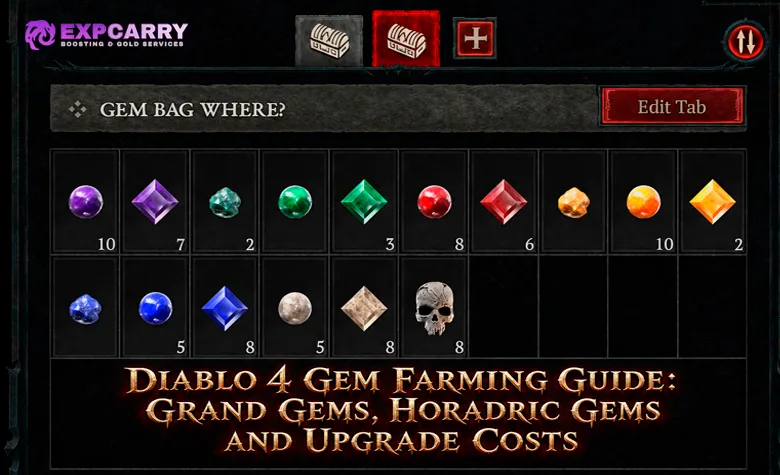
You can have hundreds of thousands of Gem Fragments in Diablo 4 and still be nowhere near the upgrade you want. One Grand Ruby takes a million Ruby Fragments. A Horadric Ruby needs five Grand Rubies. Want the Flawless Horadric version? That is 25 Grand Rubies of the same color, before you even start thinking about your other sockets.
The good news is that you do not have to craft every gem from scratch. Season 15 has several ways to pick up completed Royal and Grand Gems, target specific fragment colors, and turn your War Plans into a steady supply of crafting materials. The bad news is that some popular farming videos show rewards Blizzard has already fixed.
This guide uses the live Season 15 rules through patch 3.2.4. The goal is simple: get the gems your build needs without burning Gold, Forgotten Souls, or hours on the wrong activity.
Short answer: Run color-specific Gem Reserve Nightmare Dungeons for fragments, use Tree of Whispers Gem Caches and high-Torment elites for completed gems, and consider the Three Ancients or Cabochon Merchant as additional options. Crafting one Grand Gem costs 1,000,000 matching fragments, 50 Forgotten Souls, and 10 million Gold. A Flawless Horadric Gem takes 25 matching Grand Gems.
Best Gem Farming Methods in Diablo 4 Season 15
There is no single route that wins every time. A player who needs five million Emerald Fragments has a different problem from someone who has enough fragments but cannot afford the Grand Gem crafts. Pick the method that solves your current shortage.
| Farm | What you get | When to run it | Main drawback |
|---|---|---|---|
| Nightmare Dungeons with a named Gem Reserve | Fragments of the selected gem type | You need millions of one specific color | You need the right Reserve affix on the dungeon. |
| Tree of Whispers Gem Caches | Gem Fragments plus a Royal or Grand Gem based on difficulty | You want steady gem rewards alongside other farming | The completed gem's color is not guaranteed. |
| Worldstone Keep: Three Ancients | Royal Gem drops reported by players | You want to test a quick completed-gem route | Reported yields are not an official permanent guarantee. |
| Kurast Undercity: Cabochon Merchant | Purchasable Royal and Grand Gems when stocked | You have plenty of Gold and need completed gems | Random stock, setup requirements, and very high prices. |
| Torment X+ elite-heavy content | More Gem Fragments and a better chance at random Royal Gems | Your build clears high Torment quickly | Higher difficulty can lower rewards per hour if kills are slow. |
For most players, the best setup combines two farms: one dependable source of the exact fragments you need and one source of completed gems. You can then use Whispers, Undercity rewards, and normal loot to cover the remaining Gold and Forgotten Souls.
Which Gem Color Does Your Build Actually Need?
Do this check before starting a long farm. Gems do not give the same bonus in every slot, and picking a color because it looks right for your class can leave you with an expensive stone you do not want to equip.
| Gem | Weapon bonus | Armor bonus | Jewelry bonus |
|---|---|---|---|
| Ruby | Fire and Holy Damage | Strength | Fire Resistance |
| Sapphire | Cold Damage | Willpower | Cold Resistance |
| Emerald | Poison Damage | Dexterity | Poison Resistance |
| Topaz | Lightning Damage | Intelligence | Lightning Resistance |
| Amethyst | Shadow Damage | Barrier Generation | Shadow Resistance |
| Diamond | All Damage | All Stats | All Resistances |
| Skull | Physical Damage | Healing Received | Physical Resistance |
For example, a Fire-focused build may want a Ruby in its weapon, but that does not mean every armor socket should also hold a Ruby. Armor gives Strength from Rubies, while Topazes give Intelligence and Diamonds give All Stats. The right choice depends on what your build scales with and whether you are short of an attribute threshold.
Likewise, do not automatically put a Diamond in every weapon. Its All Damage bonus can work well for builds using several damage types, but a build centered on one element should compare the relevant elemental gem first.
Set one priority color before farming
Check your equipped gems, planned upgrades, and spare copies. If your next craft is a Grand Sapphire, write down how many Sapphire Fragments you have and how many you still need. Keep enough other colors for your active sockets, then direct your farming and conversions toward that one target.
There is no benefit in crafting a Grand Gem merely because you happen to have enough fragments. The expensive part is collecting enough of the right fragments for the sockets you intend to keep.
How to Farm Specific Gem Fragments in Nightmare Dungeons
If you are missing one color, this is the farm to start with. Nightmare Dungeon Sigils can have Reserve affixes that add special chests. A named Reserve lets you look for the fragments you need instead of relying entirely on random enemy drops.
Ruby Reserve, Diamond Reserve, and Other Color-Specific Affixes
Read the positive affix before using a Nightmare Sigil. A Ruby Reserve is the one to keep when you need Ruby Fragments. A Diamond Reserve is useful for Diamonds. The same idea applies to other named gem reserves.
A regular Gem Reserve can still be profitable, but it is less focused. If your stash already contains plenty of everything except Sapphires, a generic gem chest is not necessarily helping you finish that Grand Sapphire.
The farming loop
Do not turn this into a full-clear marathon. Your objective is the Reserve loot and a quick completion, not squeezing every ordinary monster out of the map.
- Check your Sigils. Separate the ones with your desired color Reserve from generic Gem Reserve Sigils.
- Run the target-color Sigils first. Clear the objectives and collect the Reserve chests. Watch the minimap and nearby side paths so you do not walk past the loot you came for.
- Kill elites on the way. They add fragments and can contribute completed gems, particularly at higher Torment difficulties.
- Do not backtrack across the entire dungeon for ordinary trash. Once the valuable chests and completion rewards are secured, move on.
- Compare your gains after several runs. If you have no useful Reserve Sigils left, switch to Whispers or a completed-gem route instead of forcing bad dungeons.
Escalation Nightmare Dungeons are also worth checking because later stages can provide additional rewards and affix opportunities. Those extra opportunities are randomized; getting a useful color Reserve on one floor does not mean every subsequent floor will match it.
One small habit that saves time: Check a Sigil's affixes again before using it, especially if you have stored it for a while. Players previously reported specific Reserve affixes changing to generic Gem Reserve while Sigils were in the stash. Inspect the actual item rather than trusting how you originally sorted it.
Explore services related to this guide, selected from our Diablo IV catalog.
View All Diablo IV Services


Worldstone Keep: Farming the Three Ancients for Royal Gems
When you need completed Royal Gems instead of a mountain of loose fragments, Worldstone Keep gives you a different kind of run. Season 15 players have used the Three Ancients encounter as a repeatable gem farm, stopping after the encounter rather than continuing through all the available content.
How the reported route works
Worldstone Keep is south of Kyovashad and is associated with the Season 15 Waking Nightmare content. Community farming reports describe running it on Torment IV or higher without spending a separate dungeon key.
- Enter Worldstone Keep on an eligible difficulty.
- Push through to Arreat Summit and the Three Ancients encounter.
- Kill the Ancients and collect the gem drops.
- If your goal is only Royal Gems, leave and reset the dungeon instead of continuing toward the later boss encounters.
- Repeat only while the rewards justify the time.
Several players reported receiving two Royal Gems from each Ancient, or six across the encounter. That is a useful observation, but not an officially guaranteed drop count. Test the current reward behavior in your game before committing to a long farming session.
The main advantage is simple: you are chasing completed gems rather than hoping fragments eventually add up. The downside is that you do not control their color. If you need one precise gem type, compare what the run gives you against a named Reserve Nightmare Dungeon.
What about Seer's Reach and Refuge of the Lost?
Be careful with older speed-farming videos. Blizzard specifically fixed an issue that let Royal Gems repeatedly drop from Seer's Reach dungeon completions. That old reward loop is not a dependable Season 15 strategy.
You may also find guides recommending other short dungeon boss resets, including Refuge of the Lost. Check their current returns before treating them as the best farm. A route built around an old boss-drop interaction can lose most of its value after one patch.
Tree of Whispers: How to Get More Gem Caches
Whispers are a strong way to collect gems while doing other endgame content. Season 15 increased Gem Fragment rewards from Gem Caches and changed their completed-gem reward to a Royal or Grand Gem, depending on difficulty.
That makes a Gem Cache useful even when its fragments are not the color you wanted. A completed Royal or Grand Gem can save a substantial amount of crafting work, provided you can use the color or have a worthwhile plan for the extra stone.
Use the Tree of Whispers Activity Tree
War Plans give you more control over the kinds of Whisper rewards you see. This system requires the Lord of Hatred expansion and its War Plans unlock; without it, you can still farm regular Whispers. Two important options are:
- Material Wealth: changes the Tree's choices so they offer Material Collections.
- Simple Gifts: restricts the choice to one reward that will be a Material Collection or Collection of Chaos.
These are exclusive choices, so do not plan around having both active together. If your current goal is fragments, Material Wealth is the more relevant option to examine. Look for Material Collection of Gem Fragments among the available rewards.
You still cannot force every individual reward to contain one specific gem color. Think of Whispers as your steady material-and-completed-gem farm, with Reserve Nightmare Dungeons handling the precise color targeting.
For the broader system and how activity trees fit into a War Plan, see our Diablo 4 War Plans Guide.
Cabochon Merchant: Buying Grand Gems in Kurast Undercity
There is another way to get completed gems if Gold is not your problem: the Cabochon Merchant in Kurast Undercity. He can sell high-quality gems, including Grand Gems, but he does not stand in the same fixed spot waiting for you on every run.
Set up Gutter Filth and Bauble Day
The relevant Undercity War Plan nodes are Gutter Filth and Bauble Day. They work together:
- Gutter Filth: activating a Beacon has a small chance to summon a Portal Prankster.
- Bauble Day: if you kill a Portal Prankster during the run, the Cabochon Merchant appears after you defeat the District Boss.
With these nodes active, enter the Undercity, activate Beacons, and watch for a Portal Prankster. If one appears, kill it and finish the run by defeating the District Boss. The merchant should then appear after the District Boss is defeated.
The Prankster spawn itself is not guaranteed just because you selected Gutter Filth. Bauble Day controls what happens after you successfully kill one.
Are the merchant's gems worth the Gold?
The shop's inventory varies, so a visit may show useful Runes, seasonal items, Royal Gems, Grand Gems, or something you do not need. You cannot count on a specific Grand Ruby appearing every time.
Season 15 player reports describe Royal Gems priced around 50 million Gold and Grand Gems around 500 million Gold. Treat those as observed shop prices rather than a permanent promise for every patch or inventory. Read the price displayed by your own merchant before buying.
That is expensive compared with the Jeweler's direct Gold fee. The merchant's appeal is that a completed Grand Gem saves the massive fragment requirement and the Forgotten Souls you would otherwise spend crafting it.
When to skip the merchant: If you are struggling to afford ordinary crafting, paying hundreds of millions for one Grand Gem is not your solution. Use Cabochon when you have excess Gold and want to trade it for time or scarce fragments. Do not burn valuable resources refreshing a random inventory without deciding what you are willing to spend.
Gem Crafting Costs: Crude, Chipped, Royal, and Grand
The Jeweler lets you craft gems directly from fragments of the corresponding type. You do not need to craft a pile of Crude Gems, turn them into Chipped Gems, and keep combining physical stones until you reach Grand.
The six standard quality levels are Crude, Chipped, the ordinary gem without a quality prefix, Flawless, Royal, and Grand.
| Gem tier | Matching fragments | Gold | Forgotten Souls |
|---|---|---|---|
| Crude | 10 | 1,000 | 0 |
| Chipped | 100 | 10,000 | 0 |
| Regular | 1,000 | 100,000 | 0 |
| Flawless | 10,000 | 1,000,000 | 0 |
| Royal | 100,000 | 10,000,000 | 10 |
| Grand | 1,000,000 | 10,000,000 | 50 |
These are the materials for crafting the listed tier directly, not a running total of every preceding tier. The Forgotten Soul values reflect Season 15 patch 3.2.1. The Jeweler's live recipe preview should be checked before a large crafting batch.
The biggest recent change concerns Forgotten Souls. Blizzard reduced the Royal Gem cost from 30 to 10 Forgotten Souls and the Grand Gem cost from 300 to 50 Forgotten Souls. That is a major difference if you are calculating materials for several Horadric upgrades.
Another important distinction: ten completed Royal Gems are not automatically an ingredient recipe for one Grand Gem. The Jeweler uses fragments for the direct Grand craft. If you intend to salvage spare Royals, inspect the fragment return before committing them. Do not confuse the value of ten Royal crafting recipes with a guaranteed ten-to-one physical-gem upgrade.
How to Craft Horadric and Flawless Horadric Gems
Grand is the Jeweler's highest standard gem tier, but the Horadric Cube takes the system further. These higher upgrades use Amalgamation and consume matching completed gems.
Grand to Horadric
To make one Horadric Gem, bring five Grand Gems of the same type to the Horadric Cube and use the matching Amalgamation recipe. Five Grand Emeralds produce a Horadric Emerald; a mixture of Grand Emeralds and Grand Rubies will not work.
Horadric to Flawless Horadric
The next step takes five Horadric Gems of the same type. Since every Horadric Gem consumes five Grand Gems, one Flawless Horadric Gem requires 25 Grand Gems altogether.
That is why it pays to settle on your desired color before crafting. A last-minute build change after converting your Grand Gems can be extremely expensive.
| Target gem | Grand Gems consumed | Matching fragments | Forgotten Souls | Gold |
|---|---|---|---|---|
| 1 Grand Gem | 1 | 1,000,000 | 50 | 10,000,000 |
| 1 Horadric Gem | 5 | 5,000,000 | 250 | 50,000,000 |
| 1 Flawless Horadric Gem | 25 | 25,000,000 | 1,250 | 250,000,000 |
The totals assume every Grand Gem is crafted directly at the Jeweler. They exclude any additional charge shown by the Cube and any savings from Grand Gem drops, purchased gems, or existing inventory.
A real crafting-budget example
Say you want a Horadric Topaz and already own two Grand Topazes. You still need three matching Grand Gems, not five. Crafting those three directly would require 3,000,000 Topaz Fragments, 150 Forgotten Souls, and 30 million Gold. Then you can combine your five Grand Topazes in the Cube.
If one of those remaining Grand Topazes drops from a Gem Cache, that cuts another million fragments, 50 Souls, and 10 million Gold from the direct-crafting bill.
The same math scales to the Flawless Horadric tier. Count your existing matching Grand and Horadric Gems before planning a farm from zero.
The Horadric Cube belongs to the Lord of Hatred expansion and must be unlocked through its progression. If you need the broader recipe system, our Diablo 4 Horadric Cube Guide covers Amalgamation and other Cube functions.
Do not mix up the names: Current Horadric Gems are not the old seasonal Horadric Jewels crafted with Horadric Phials and Tomes. Season 15 Soul Splinters are another separate socketable system. Neither uses the Grand-to-Horadric gem calculation above.
How to Convert Unwanted Gem Fragments
Every gem farmer ends up with the same problem: millions of fragments across the wrong colors. The Jeweler's conversion recipes help, but you should not empty your entire stash without checking your other gear.
The updated system uses two specified input gem types for a conversion rather than the older three-type setup. A standard conversion exchanges 100 fragments from each required input type for 200 fragments of the selected output type.
The required input colors are set by the recipe. You cannot simply pick any two colors you dislike and assume the Jeweler will turn them into Diamonds. Open the relevant conversion entry and check its ingredients.
When conversion is the right move
If you are 80,000 Ruby Fragments short of your next Grand Ruby and have large surpluses in the colors required by the conversion recipe, converting can finish the craft without another dungeon. That is exactly what the system is useful for.
What you should avoid is converting all spare colors whenever one becomes available. You may need those fragments for a second loadout, resistance gems, or another character. Keep a working reserve before moving excess fragments into your primary color.
And remember that color conversion solves only the fragment problem. It does nothing about missing Forgotten Souls or Gold.
Forgotten Souls and Gold: The Other Half of the Grind
You can finish the fragment farm and still be stuck at the Jeweler. The Grand recipe needs 50 Forgotten Souls per gem, and converting 25 of those into a Flawless Horadric Gem means budgeting 1,250 Souls from direct crafting alone.
Where to get Forgotten Souls
Season 15 gives you several routes that fit around normal endgame progression:
- Kurast Undercity Tributes: Tribute of Refinement and Greater Tribute of Refinement reward Forgotten Souls.
- Undercity Unfortunate Souls node: In the Undercity Activity Tree, this node allows Invasion Portals to summon Wisps. Keeping the Wisps alive rewards Forgotten Souls and other crafting materials at the end of the run.
- Tree of Whispers Salvage Caches: Season 15 increased salvage-material rewards, with larger Forgotten Soul gains at higher Torment difficulties.
- Alchemist conversion: Baleful Fragments can be converted into Forgotten Souls under the current crafting system.
The Undercity is particularly useful when you are already running it for Tributes, Runes, or other rewards. Decide whether your next runs are meant to produce Forgotten Souls or reach Cabochon; those goals can call for different War Plan choices.
Where to get enough Gold
The Tree of Whispers also received a major Gold Cache buff in Season 15. Blizzard increased Gold Cache rewards by roughly three times; its patch notes give an approximate Torment XII example rising from 35 million to 100 million Gold.
That does not mean every cache at every difficulty pays 100 million. The useful point is that Whispers can now help cover the Gold bill while you are collecting materials.
The Cabochon Merchant is a separate, far more expensive Gold sink. Do not confuse the 10-million-Gold direct Grand crafting fee with a player-reported 500-million-Gold Grand Gem in his shop. One buys a craft using your materials; the other buys a completed gem when the merchant stocks it.
Our Diablo 4 Gold Sinks Guide explains how to keep expensive crafting from draining everything else you need for your build.
Best Farming Order: From Your First Grand to Flawless Horadric
Do not start by planning 25 Grand Gems if your character still has missing basic sockets or a build you are likely to replace. Work through the upgrades in stages so that every farming session moves you toward something you can actually use.
Stage 1: Finish the important Grand Gems
Choose the weapon and armor sockets that give your build the biggest benefit. Run targeted Reserve Nightmare Dungeons for the missing color, collect useful Whisper Gem Caches, and craft the Grand Gems you can immediately equip.
At this stage, ignore the temptation to stockpile materials for every possible Horadric upgrade. A Grand Gem you can use now has more practical value than an unfinished plan for several Flawless Horadric Gems.
Stage 2: Build one Horadric Gem
Once your essential Grand Gems are in place, pick the single socket where the Horadric upgrade matters most. You need five matching Grands, so count drops and crafted stones together.
If fragments are your bottleneck, return to color-specific Reserve runs. If you already own enough fragments but lack Souls, run Undercity material routes or Salvage Caches. If you have plenty of Gold, checking Cabochon after an Undercity run may save more farming.
Stage 3: Decide whether Flawless Horadric is worth 25 Grands
This is the long-term min-max target, not a cheap routine upgrade. Before committing, compare the next tier's actual socket bonus with what your build already gets from its current Horadric Gem. Then decide whether those resources would improve your character more if spent on another item or system.
If you are committed to Flawless Horadric, farm in batches. Keep track of matching Grand and Horadric Gems rather than crafting at random whenever your fragment total crosses a million.
Gem Farming Mistakes That Waste Hours
Most lost time comes from chasing the wrong reward or spending a valuable material before checking what it is needed for next.
- Running generic Gem Reserve when you need one color: A named Reserve is more useful for a targeted fragment shortage.
- Using old Seer's Reach reset guides: Blizzard fixed the repeated Royal Gem completion reward.
- Assuming every Three Ancients run guarantees six Royal Gems: That figure comes from player reports. Check what the encounter currently drops.
- Expecting Cabochon to sell your chosen gem every visit: His stock varies, and the required Portal Prankster must appear first.
- Using the Season 14 Forgotten Soul bill: The current Royal and Grand costs are 10 and 50 Souls, not 30 and 300.
- Crafting lower-tier gems only to salvage them again: Use direct Jeweler crafting when possible and inspect salvage returns before destroying completed gems.
- Salvaging an expensive Horadric upgrade blindly: Check the current salvage preview. Older reports described gem salvage returning less value than players expected.
- Pushing Torment too high: A better theoretical drop table is useless if every pack takes too long to kill.
- Spending all fragments of secondary colors: Keep enough for the other sockets and characters you actually use.
Diablo 4 Gem Farming FAQ
These are the remaining practical questions that tend to come up once the basic farming loop is working.
Can you obtain Grand Gems without crafting them?
Yes. Grand Gems can appear through appropriate Gem Cache rewards and in sources such as the Cabochon Merchant's stock. Availability, color, and requirements depend on the source.
Can the Cabochon Merchant sell exactly the gem color you need?
His inventory is randomized. A specific color is possible, but there is no reliable promise that it will appear on your next visit.
Are Horadric Gems available to base-game-only characters?
The Horadric Cube belongs to the Lord of Hatred expansion. You need access to that system and its unlock requirements to use the Amalgamation upgrade recipes.
Should you keep Royal Gems after getting Grand Gems?
Keep useful colors for alternate gear and future needs. For extras, compare their actual salvage return with your missing fragment total before deciding to break them down.
Conclusion
If you need a specific Grand Gem, start with its color and farm the right Reserve Sigils. If you need completed gems, add Whispers and test the Three Ancients route. If you are rich in Gold but short on fragments, Cabochon is worth checking. And if you are aiming for Flawless Horadric, count all 25 Grand Gems before spending the first one. The fastest farm is the one that fixes your actual shortage, not the one with the flashiest loot clip.