A great Diablo 4 drop is only the beginning. The expensive mistakes happen after it reaches your inventory: enchanting the wrong Greater Affix, chasing a perfect Temper before the item is worth finishing, paying to imprint a base that will soon be replaced, or Masterworking an item whose affix package is still unfinished. This guide explains the safest live upgrade order for patch 3.1.3, how current Tempering recipes and charges work, what Masterworking Quality and the Capstone Bonus actually do, and which affixes deserve your final investment.
The most important warning is that many search results still describe the old 12-rank Masterworking system with critical upgrades at ranks 4, 8, and 12. That system is obsolete. The live version uses Quality up to 25, followed by one random 50 percent Capstone Bonus that can be rerolled without resetting Quality. Tempering has also changed: you select the learned affix you want, then roll its value. Use this page for the current system, not an old triple-crit calculator.
Diablo 4 Gear Upgrade Order at a Glance
The safe order is to validate the base, make the item function, and only then spend scarce endgame materials. Imprinting has little effect on crafting risk, but Enchanting and Tempering decide whether the affix package is worth finishing. Masterworking belongs near the end because it amplifies a decision you should already be confident about. If you intend to use Transfiguration through the Horadric Cube, leave that step until ordinary crafting is complete because Transfiguration can leave an item Unmodifiable.
| Step | Action | Why it comes here | Stop condition |
|---|---|---|---|
| 1 | Compare the untouched drop | Check Item Power, inherent properties, Unique power where applicable, Greater Affixes, and all natural affixes before spending anything. | Salvage or sell it if the base already misses more essential stats than the available crafting options can reasonably repair. |
| 2 | Enchant one replaceable affix | Prove that the item can reach the required stat package before paying for its full finish. Patch 3.1 also allows eligible Unique, Mythic Unique, and Iconic Mythic items to have affixes altered through Enchanting. | Stop when escalating gold costs exceed the value of the base or the available replacement pool cannot produce what the build needs. |
| 3 | Temper the exact required affix | The live system lets you choose a learned Temper affix, so the remaining RNG is primarily its value. On eligible Ancestral items, the Tempered affix can also become a Greater Affix. | Accept a functional roll on a temporary item. Save perfection chasing for a near-final base. |
| 4 | Imprint the correct Aspect | An Aspect can be changed later on an eligible Legendary item, but there is little reason to pay the full imprint cost before the affixes pass inspection. | Use the Codex version while testing if a valuable perfect Aspect roll should be preserved. |
| 5 | Add sockets and gems | Finish the ordinary, reversible preparation before expensive refinement or a potentially item-locking final operation. | Check the build's resistance, armor, resource, and damage breakpoints. |
| 6 | Masterwork to Quality 25 | Quality strengthens the finished item and should be prioritized on gear likely to stay equipped. | Pause on transition gear if another slot represents a much larger upgrade. |
| 7 | Apply and reroll the Capstone Bonus | The final Masterworking roll grants 50 percent more power to one random eligible affix and can later be rerolled without removing Quality. | Stop when it lands on an affix that meets the build's real breakpoint or priority. |
| 8 | Use Transfiguration last if the build needs it | Horadric Cube Transfiguration can leave an item Unmodifiable, so it should not interrupt the normal correction loop. | Verify every applicable affix, Aspect, Temper, socket, gem, Quality level, and Capstone target before committing the item. |
This order is designed to minimize sunk cost, not to claim that every menu has a hard dependency. Blizzard explicitly removed the old requirement to Temper an item before Masterworking it. You can technically Masterwork first, and changing an eligible affix later does not mean you should deliberately fund an unfinished base. Finish the affix plan before paying for the final polish. Blizzard's official 2.5 crafting rework notes established the redesigned Tempering and Masterworking foundation used by the current system.
Gold is one of the first resources likely to punish repeated experimentation because Enchanting costs rise with rerolls and other finishing operations also consume currency. If farming that budget is the bottleneck, the verified Diablo 4 Gold service is directly relevant to the Enchanting, Imprinting, and finishing steps described here.
How Tempering Works in the Current Live Game
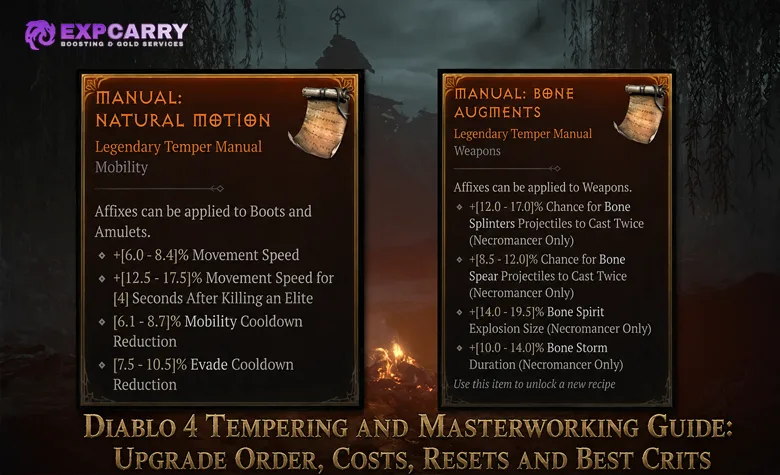
Tempering now separates affix choice from roll quality. At the Blacksmith, select the item, choose a learned Temper affix that the item can accept, and apply it. The game no longer picks a random affix from the selected Tempering Manual. It gives the exact eligible affix you selected, while the number inside that affix's allowed range still rolls randomly.
Tempering Manuals and Recipes
Tempering Manuals permanently teach their recipes. Once learned, eligible Temper affixes appear in the Blacksmith's Tempering interface. A manual is therefore an account progression unlock, not a consumable that must be found again for every item. If a guide tells you to choose a manual category and hope for one of several affixes, it is describing the old Tempering system.
- Open the Blacksmith and select Tempering.
- Insert an eligible item and inspect the available learned affixes.
- Select the exact affix required by the build, not merely a broad manual family.
- Preview the value range with Advanced Tooltip Information enabled.
- Apply the Temper and decide whether the result is functional, strong, or worth rerolling.
A missing recipe is not a bad-roll problem. It generally means the relevant Tempering recipe has not been learned, the affix is not valid for that slot, or the item is not eligible for that operation. Unlock the required recipe first instead of spending resources on a substitute Temper that the build does not use.
Tempering Charges and Scrolls of Restoration
Rare items receive one Temper charge. Legendary items and higher rarities receive three charges, plus one additional charge for each Greater Affix already on the item. Each attempt consumes a charge. A Scroll of Restoration restores one charge, and the redesign removed the old per-item limit on Scroll use. That means a valuable item is no longer permanently bricked simply because its Temper charges reached zero, although repeated attempts can still become extremely expensive.
- Rare item: one starting Temper charge. Treat most Rare bases as short-term gear unless they have a clear upgrade path.
- Legendary with no Greater Affix: three starting charges. Target a functional value, then stop if the item is temporary.
- Legendary with one Greater Affix: four starting charges. The extra attempt helps, but it does not make a mediocre base worth unlimited investment.
- Legendary with multiple Greater Affixes: three starting charges plus one per Greater Affix. Set a material budget before chasing a perfect result.
- Scroll of Restoration: restores one Temper charge on an eligible item and can be used repeatedly.
The right stopping rule depends on item lifespan. On leveling or transition gear, the correct affix at an average value is usually enough. On a near-final Ancestral base, a high roll may justify additional attempts. On eligible Ancestral gear, the Tempered affix can itself become a Greater Affix. Blizzard has not published a dependable public probability for that outcome, so do not build a budget around an invented percentage.
Current Tempering Costs
The official crafting rework established fixed material packages by rarity instead of scaling the material bill with Item Power. Rare Tempering costs 25 Common Salvage and 5 Veiled Crystals. Legendary Tempering costs 15 Veiled Crystals and 5 Legendary Salvage. Ancestral Legendary Tempering costs 25 Legendary Salvage and 25 Forgotten Souls. The exact Legendary Salvage type depends on the equipment slot, so use the Blacksmith preview to confirm the material being consumed.
Patch 3.1 broadened crafting access for Unique, Mythic Unique, and Iconic Mythic itemization. These items can now have eligible affixes altered through Enchanting, while affixes added to a Mythic Unique through Enchanting, Transfiguration, or Tempering are applied at their maximum roll. Eligibility for a specific operation still depends on the item and recipe, so always treat the live crafting interface as authoritative before modifying premium gear.
When to Reroll a Temper
Reroll when the current value misses a meaningful breakpoint, not simply because the number is below maximum. A cooldown roll that enables permanent uptime can be worth more than a cosmetically higher damage number. A chance for a core skill to hit twice or deal double damage can be a priority when the build directly scales that mechanic. A minor additive damage increase may not justify spending additional Scrolls on an otherwise replaceable item.
- Ask whether the current roll changes the number of casts, resource cycle, cooldown loop, defensive uptime, or attack sequence.
- Compare the gain with the cost of another attempt and any Scroll needed to restore a charge.
- Decide how many additional attempts the item is allowed to consume before starting.
- If an eligible Ancestral Temper becomes a Greater Affix on the correct stat, strongly consider stopping unless a tested breakpoint still requires something better.
Forgotten Souls appear in high-value Ancestral crafting and can disappear quickly across multiple candidates. Players who want to reduce Helltide material farming can use the verified Diablo 4 Forgotten Souls farming service, but the same budgeting rule still applies: fund final bases, not every plausible sidegrade.
How Masterworking Works Now
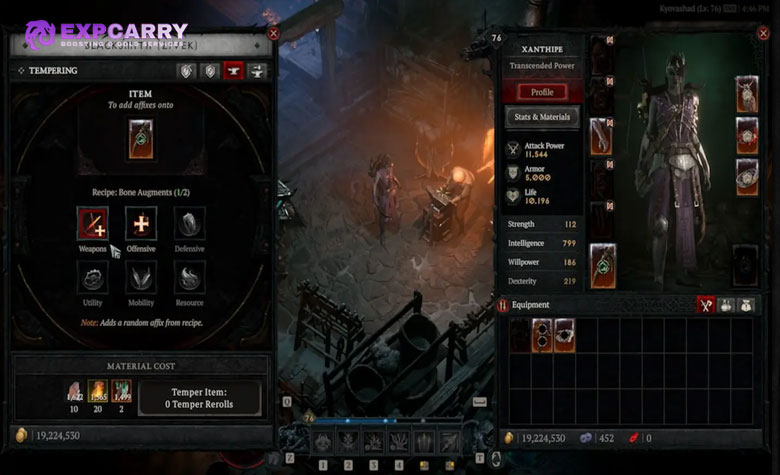
Masterworking is the endgame refinement layer at the Blacksmith. The current system increases an item's Quality until it reaches 25. Each Masterworking action adds a random 2 to 5 Quality levels, and Quality increases affix values by 1 percent per level while also improving relevant base damage, armor, or resistance. Once Quality 25 is reached, one additional roll applies the Capstone Bonus to a random eligible affix.
The base-property increase matters. Weapon damage, armor, and intrinsic resistance can benefit from Quality in addition to the affix improvements, so a Quality 25 item already gains meaningful value before its Capstone target is perfect. Masterworking costs scale with current Quality, and the exact payment for the item should be read from the Blacksmith before confirming each step rather than copied from an outdated calculator.
Quality 25 and the Capstone Bonus
After the item reaches Quality 25, one additional Masterworking action applies the Capstone Bonus. This gives 50 percent more power to one random eligible affix, including Greater Affixes. Blizzard's official item journey explanation corrected the earlier wording and confirms both the Quality 25 cap and the 50 percent bonus.
A Capstone Bonus is not the same thing as a Greater Affix and does not convert a normal affix into one. A Greater Affix is a distinct enhanced affix state, while the Capstone is a separate 50 percent Masterworking bonus. If the Capstone selects an existing Greater Affix, both benefits apply to the same stat. That interaction is why a strong natural Greater Affix is often an excellent Capstone target.
Masterworking Reset and Reroll Rules
The current system does not use the old full reset loop that erased ranks 1 through 12 and forced you to start over. Quality remains on the item. Once the Capstone has been applied, the Blacksmith allows you to reroll which eligible affix receives the final bonus without resetting Quality. Blizzard specifically identifies Obducite and Neathiron as reroll resources; use the live Blacksmith confirmation panel for the complete current payment before confirming the roll.
Material tuning can change between updates, which makes old fixed-cost calculators unreliable. Insert the actual item at the Blacksmith and read the confirmation panel. The live interface reflects the current patch, the item's Quality, and the relevant item-specific crafting rules. Use the displayed payment as the final cost instead of assuming that an older guide's total still applies.
- Normal Masterworking attempt: uses the payment shown by the Blacksmith, with the required Obducite increasing as Quality rises. Each action adds 2 to 5 Quality levels until the item reaches Quality 25.
- Initial Capstone Bonus: becomes available at maximum Quality and randomly selects an eligible affix for the 50 percent bonus.
- Capstone reroll: keeps Quality intact and rolls a new eligible target. Blizzard specifically identifies Obducite and Neathiron as materials used for this reroll.
- Full Quality reset: is not part of the current optimization loop. Do not use legacy rank-reset guides for the Quality 25 system.
Obducite is the main recurring Masterworking material, so reserve large investments for a weapon and other build-defining slots before polishing minor utility upgrades. Spread early Quality upgrades across obvious long-term pieces, then concentrate expensive Capstone rerolls on items where one target produces a decisive gain.
Explore services related to this guide, selected from our Diablo IV catalog.
View All Diablo IV Services


Best Masterworking Crits and Capstone Targets
Some players still call a successful final roll a Masterworking crit, but the live mechanic is one Capstone target rather than three separate critical ranks. The best target is the affix with the greatest effect on the build's limiting factor. That is often a damage multiplier, skill rank, cooldown breakpoint, resource engine, or key defensive stat. It is not automatically the stat with the largest visible number.
| Priority | Affix type | Why it can be best | When to accept it |
|---|---|---|---|
| Very high | Build-defining skill ranks or a direct skill multiplier | Can scale the main damage engine and sometimes improve secondary effects tied to the skill. | The build and live tooltip show a clear gain with no relevant cap already reached. |
| Very high | Cooldown reduction, resource generation, or cost reduction | Can complete an uptime or resource breakpoint that changes how the build plays. | The bonus removes downtime or makes the intended rotation stable. |
| High | Existing Greater Affix on a core stat | The Capstone's 50 percent bonus can apply to a Greater Affix, concentrating both benefits on a valuable stat. | The Greater Affix is already one of the item's most important stats. |
| High | Tempered chance for a key skill to hit twice or deal double damage | Directly scales the central skill when the build supports that mechanic. | The chance remains valuable and is not already effectively capped. |
| Situational | Maximum Life, Damage Reduction, Armor, or Resistance | Survival can be the real progression wall even when an offensive roll looks better on paper. | The target closes a defensive breakpoint without wasting most of the value to overcap. |
| Low | Generic additive damage or surplus utility | Often produces less practical output than a multiplier, rank, or important breakpoint stat. | Keep it on a temporary item or when several possible affixes provide similarly useful results. |
Use Advanced Tooltip Information and test the item in the same content tier you actually play. A stat can look larger in town while producing less boss damage or worse resource stability. For a deeper explanation of why one damage line may outperform another, see the internal Diablo 4 damage buckets and scaling guide.
Which Greater Affixes Should You Protect?
Protect a Greater Affix when it is both valuable on that slot and central to the build. Skill ranks, important multipliers, cooldown breakpoints, resource mechanics, and high-value defensive rolls usually deserve more protection than generic additive damage. A Greater Affix on the wrong stat is still the wrong stat for that build.
- Do not Enchant away a valuable Greater Affix merely to preserve the appearance of a multi-Greater-Affix item.
- Use Enchanting on the weakest replaceable affix, not on the stat that made the item valuable in the first place.
- If an eligible Ancestral Temper becomes a Greater Affix on the correct stat, consider stopping unless the result still misses a tested breakpoint.
- Prefer the Capstone on an already valuable Greater Affix when concentrating more power into that stat produces the largest real gain.
- Do not protect a capped or heavily overcapped stat. Excess Armor, Resistance, chance, or cooldown value can be worth less than a non-Greater alternative.
Current Unique itemization is more flexible than older guides suggest. Patch 3.1 allows Unique, Mythic Unique, and Iconic Mythic items to interact with expanded crafting rules, including Enchanting, while newly added affixes on Mythic Uniques receive special maximum-roll treatment. A powerful Unique effect still does not make every affix on the item equally valuable. Evaluate the whole package. The internal Diablo 4 Mythic Uniques 3.0 guide explains the current rarity and crafting context around these premium bases.
Diablo 4 Masterworking Calculator
A useful calculator should estimate resource risk, not promise an RNG result. Blizzard has not published affix-selection weights for the Capstone. If every eligible affix is equally likely and each reroll is independent, an item with N eligible affixes and D acceptable targets has an estimated success chance of D divided by N per roll. The expected number of rolls is N divided by D. Treat this strictly as a planning model, not an official probability guarantee.
| Eligible affixes | Acceptable targets | Estimated chance per roll | Estimated average attempts | Chance within 5 rolls |
|---|---|---|---|---|
| 5 | 1 | 20 percent | 5 | About 67 percent |
| 5 | 2 | 40 percent | 2.5 | About 92 percent |
| 6 | 1 | About 16.7 percent | 6 | About 60 percent |
| 6 | 2 | About 33.3 percent | 3 | About 87 percent |
For a custom budget, count every affix that the Blacksmith can currently select, count every result you would genuinely keep, then combine the estimated number of rolls with the reroll cost displayed for that item. Budget for variance above the average. Five expected attempts does not mean the fifth roll is guaranteed, and repeated rolls can return the same target.
Do not use a calculator that asks for ranks 4, 8, and 12 or shows three 25 percent critical upgrades. That is a legacy tool. A current calculator must reflect Quality 25, one 50 percent Capstone Bonus, rerolling without a Quality reset, and the current Blacksmith cost for the actual item.
Where to Farm Tempering and Masterworking Materials
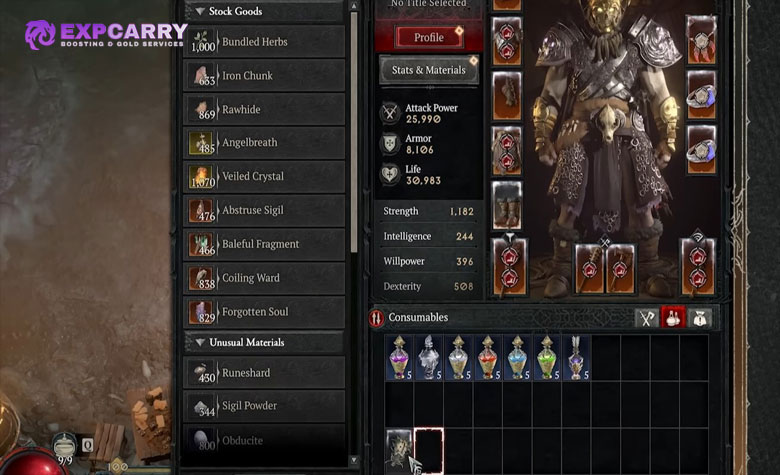
Salvaging unwanted gear is a core source of Common Salvage, Veiled Crystals, and Legendary Salvage, while high-end Ancestral crafting can consume large amounts of Forgotten Souls. Masterworking repeatedly consumes Obducite, and Capstone rerolls use Obducite together with Neathiron under the current system. Gold remains relevant across the wider crafting process, especially repeated Enchanting and other finishing steps.
- Salvage unwanted Rare and Legendary drops instead of selling everything when Veiled Crystals or Legendary Salvage are the immediate bottleneck.
- Run Helltides and use current Torment reward sources, including eligible Whisper Caches, when Forgotten Souls are limiting your crafting.
- Use Nightmare Dungeons, Infernal Hordes, Kurast Undercity, and other current endgame reward routes when their live reward tables provide the Obducite you need.
- Secure enough Neathiron from current late-game sources before starting a long sequence of Capstone rerolls, and verify the active reward sources in the live game rather than relying on a route from an older season.
- Sell high-value unwanted gear and prioritize gold-producing rewards when Enchanting or other currency costs, rather than materials, are blocking progress.
Players whose bottleneck is refinement material rather than item quality can use the verified Diablo 4 Obducite service. Patch balance can change the value of a specific Temper or the efficiency of a farming route, so the current Diablo 4 patch notes remain the official place to check live fixes. Patch 3.1.0, for example, fixed excessive Resolve Temper scaling across item types and Masterworking ranks and corrected Life on Hit scaling on two-handed weapons. Those fixes are part of the current 3.1 ruleset, but they should not be mistaken for changes introduced specifically by patch 3.1.3.
Common Tempering and Masterworking Mistakes
Most wasted resources come from following an old guide or optimizing the wrong base. The live systems are more recoverable than their older versions, but repeatable Scroll use and Capstone rerolls do not make repeated optimization cheap.
- Using an old Temper manual guide: you now choose the learned eligible affix directly. Its value is still rolled.
- Expecting two Temper affixes: the redesigned system normally adds one selected Temper affix, not the former two-affix package.
- Assuming every Temper can become Greater: the current Greater Temper possibility applies to eligible Ancestral items.
- Calling the Capstone a new Greater Affix: the Capstone is a separate 50 percent bonus and can apply to an existing Greater Affix.
- Looking for a 12-rank reset: current Masterworking keeps Quality and lets you reroll the final Capstone target.
- Masterworking transition gear: the upgrade itself is predictable in direction, but the item can still be replaced before the investment pays off.
- Rerolling a correct Temper without a budget: Scrolls restore another attempt, not the materials already spent.
- Using Transfiguration too early: finish ordinary crafting first because Transfiguration can leave the item Unmodifiable.
Tempering and Masterworking FAQ
Should I Temper or Masterwork first?
Temper first in a normal upgrade workflow because it proves the final affix package before you commit more Obducite. The game no longer requires Tempering before Masterworking, but refining an unfinished base first is usually economically backward.
Should I Enchant before Tempering?
Usually yes. Confirm that the weakest eligible affix can become the replacement the build needs, then add the exact Temper. If the Enchanting cost escalates beyond the base's value, stop before investing further.
When should I imprint an Aspect?
On an item that uses a Legendary Aspect, imprint after the base passes its Enchanting and Tempering check. Imprinting can be changed later on eligible gear, so it is not the main risk point, but delaying it avoids paying to finish a rejected base.
Can Tempering still brick an item?
Not permanently through exhausted Temper charges alone. Scrolls of Restoration restore one charge and have no per-item use limit. A bad chase can still destroy the item's economic value to you because every additional attempt consumes resources.
Can a Tempered affix be a Greater Affix?
Yes, on eligible Ancestral items a Tempered affix can become a Greater Affix. Blizzard has not published a reliable public rate, so do not trust calculators that claim a guaranteed number of attempts.
Does Masterworking create a Greater Affix?
No. The current Capstone applies a separate 50 percent bonus to a random eligible affix, and that target can already be a Greater Affix. The Capstone itself does not convert a normal affix into a Greater Affix.
Can I reset Masterworking to zero?
The current optimization loop does not require or use the old rank-zero reset. Quality remains on the item while you reroll the final Capstone target.
What is the best Masterworking crit?
The best Capstone result is the stat that most improves the build's limiting factor. Skill ranks, direct multipliers, cooldown or resource breakpoints, and valuable existing Greater Affixes are common priorities. There is no universal best target for every build.
Why does my Masterworking cost differ from a guide?
Masterworking costs scale with current Quality and can be affected by the live crafting rules for the item. Use the Blacksmith's confirmation panel for the exact current payment instead of treating an older guide or calculator as authoritative.
Can I Enchant after Masterworking?
Yes, if the item and affix are eligible for Enchanting under the current rules. However, Enchanting first is usually safer because it validates the item before the expensive finish. If the Capstone is already applied and you alter the affix package, inspect the finished item again before spending more resources.
Conclusion
The safest Diablo 4 upgrade order is straightforward: judge the base, Enchant the replaceable affix, Temper the exact build requirement, imprint the Aspect where applicable, finish sockets and gems, Masterwork to Quality 25, then reroll the 50 percent Capstone Bonus until it lands on an acceptable target. If the item also needs Horadric Cube Transfiguration, leave that potentially item-locking operation until ordinary crafting is complete. This sequence minimizes the chance of pouring Gold, Forgotten Souls, Obducite, and Neathiron into an item that was never truly ready.
Protect Greater Affixes because they serve the build, not because the icon looks rare. Stop Tempering when the result clears a real breakpoint. Stop Capstone rerolls when the selected affix delivers enough value for the content you are pushing. Most importantly, ignore legacy 12-rank and triple-crit advice: current Masterworking uses Quality up to 25 followed by one rerollable 50 percent Capstone target, and the live Blacksmith interface remains the final authority on the cost of each operation.