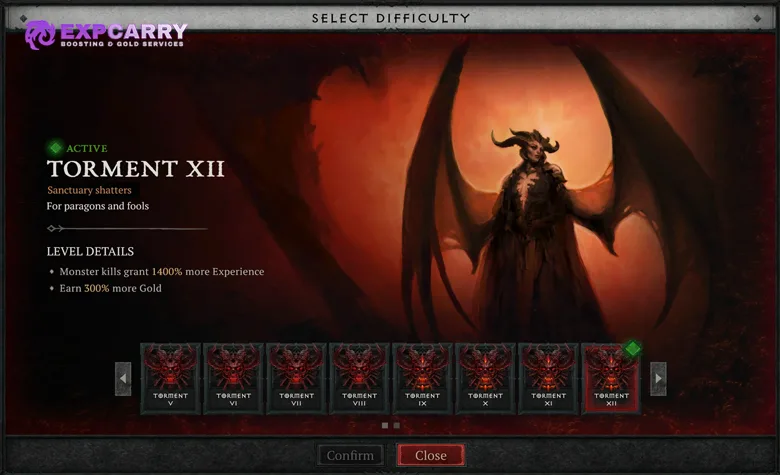
Diablo 4 Torment difficulty is not a ladder you should climb simply because the next tier is unlocked. The current endgame has twelve Torment tiers, and each step increases enemy pressure while improving experience, gold, drop rates, and selected reward categories. The best Torment tier for farming is therefore the highest difficulty where your character can still clear normal packs, elites, bosses, and activity objectives quickly enough that the extra rewards are not cancelled out by slower runs or repeated deaths.
The modern Diablo 4 Torment system is tied to The Pit. Reach the current level cap, complete the required Pit tier, and the corresponding Torment difficulty becomes available. That Pit clear proves you can finish one timed push at that level; it does not prove that the new Torment is your best farming difficulty. This guide separates Torment unlock progression from farming efficiency, shows the current Torment I-XII Pit requirements, explains how to judge character readiness, and gives a repeatable way to choose the tier that produces the most useful rewards per hour.
How Diablo 4 Torment Tiers Work
The old World Tier III and IV progression is obsolete. Diablo 4 now uses Normal, Hard, Expert, and Penitent as the standard difficulties, followed by Torment I through Torment XII for the endgame. Lord of Hatred expanded the Torment ladder from four tiers to twelve and raised the character level cap to 70 for all players. Blizzard describes higher Torment tiers as progressively more dangerous while also providing stronger experience and gold bonuses and better drop rates for desirable gear and materials.
The current system matters because many older Diablo 4 Torment guides still describe level 60, Torment I-IV, fixed Armor and Resistance penalties, or the original Pit 20/35/50/65 unlocks. Those values belong to previous versions of Diablo 4. The live Lord of Hatred structure uses a level-70 entry point and a twelve-tier Torment ladder. Blizzard's Lord of Hatred progression overview confirms the level-cap increase and expansion to Torment XII.
Diablo 4 Torment Tiers Are an Endgame Difficulty Ladder
Unlocking a Torment tier gives you permission to enter it. It does not guarantee that your build is ready to farm it efficiently. The Pit tests whether the character can complete a timed challenge with a boss at the end, while normal endgame farming asks a different question: can the character repeat the chosen activity quickly, safely, and without long recovery periods?
This distinction is the foundation of efficient Torment farming. A character that barely clears the Pit requirement for Torment VIII may earn more per hour farming Torment VII because monsters die much faster there. The new tier only becomes the better farming choice when its improved rewards outweigh the additional time and risk added to each run.
Torment No Longer Applies Armor and Resistance Penalties
Older Torment guides often tell players to add a fixed amount of Armor and elemental Resistance every time they increase difficulty. That advice is outdated. Blizzard removed the Armor and Resistance penalties per Torment tier during the defensive systems overhaul and changed Armor and Resistances into rating systems with diminishing returns. Armor now contributes against both Physical and Non-Physical damage, and the character sheet includes Toughness to summarize defensive capacity.
The official defensive-system update specifically states that the old Torment penalties were removed. This means Torment readiness should be judged from current Toughness, individual damage-type defenses, Life, barriers, healing, class mitigation, and actual combat performance rather than by adding a legacy resistance tax from an outdated chart.
Diablo 4 Torment Unlock Requirements
The Pit is the progression gate for Diablo 4 Torment difficulty. Torment I requires the current level cap and an entry Pit clear; higher Torment tiers require increasingly deeper Pit completions. The live interface remains the final authority after patches, but the current Season 14 Torment unlock requirements used across the Lord of Hatred endgame are shown below.
| Difficulty | Current unlock requirement | Practical progression stage |
|---|---|---|
| Torment I | Reach level 70 and clear Pit Tier 10 | Entry into Ancestral gearing and the full Torment endgame |
| Torment II | Clear Pit Tier 15 | Early Torment progression |
| Torment III | Clear Pit Tier 20 | Early build refinement |
| Torment IV | Clear Pit Tier 25 | Mid-early Torment progression |
| Torment V | Clear Pit Tier 30 | Final five-tier Pit step |
| Torment VI | Clear Pit Tier 40 | First ten-tier Pit step |
| Torment VII | Clear Pit Tier 50 | Developed endgame build |
| Torment VIII | Clear Pit Tier 60 | High Torment progression |
| Torment IX | Clear Pit Tier 70 | High-end optimization |
| Torment X | Clear Pit Tier 80 | Major late-endgame reward breakpoint |
| Torment XI | Clear Pit Tier 90 | High-end XP and difficulty push |
| Torment XII | Clear Pit Tier 100 | Highest world difficulty |
The early Torment ladder uses smaller Pit gaps: Torment I starts at Pit 10, and each new tier through Torment V requires another five Pit levels. From Torment VI onward, the requirement rises in ten-tier steps until Torment XII at Pit 100. In practice, the later climb demands a much more complete build, stronger Glyphs, better item quality, and more consistent defenses.
How to Unlock Torment I: Reach Level 70 and Clear Pit 10
The current character level cap is 70, and Torment I is the entry point to the Torment endgame. Under the live Lord of Hatred system, treat level 70 and Pit Tier 10 as the combined Torment I requirements. If a future patch changes the progression path, the in-game difficulty selector and Pit interface should be treated as the final authority.
If the only obstacle is the actual unlock clear rather than farming the tier afterward, ExpCarry's verified Diablo 4 Difficulty Tiers Unlock service covers that progression gate. The distinction still matters: paying or grouping for an unlock does not make an underprepared character efficient in the newly opened Torment tier.
Do Capstone Dungeons Unlock Torment Tiers?
Capstone Dungeons have returned in modern Diablo 4 as part of Season Rank and progression objectives, but they are not the old World Tier III and IV unlock system. Do not use a pre-Lord of Hatred guide that tells you to clear Cathedral of Light or Fallen Temple to unlock the current Torment ladder.
The permanent Torment progression gate is The Pit. Seasonal objectives can add separate Capstone Dungeon requirements for Season Rank, but those are different progression tracks. When checking why a Torment tier is locked, use the live difficulty tooltip and Pit requirement rather than an old campaign or Capstone checklist.
Diablo 4 Torment Tier Rewards and Breakpoints
Higher Torment tiers are valuable because they improve several reward layers at once. Blizzard's Lord of Hatred overview confirms that increasing Torment improves experience and gold bonuses as well as drop rates for desirable gear and materials. The important detail is that not every Torment tier unlocks a completely new item category. Some tiers improve the frequency of specific drops, while others mainly increase general rewards and monster-kill experience.
Ancestral Gear and Greater Affixes Start at Torment I
Torment I is the first major endgame breakpoint because Ancestral-quality items become available. The Lord of Hatred itemization system also changed the old rule where lower-rarity drops effectively disappeared from Torment. Common, Magic, and Rare items can still drop and can serve as Horadric Cube crafting bases; they can also be Ancestral and can contain Greater Affixes under the current item system.
That means a higher Torment does not simply replace every low-rarity item with a Legendary. Use the Loot Filter to hide irrelevant bases only after you understand which lower-rarity Ancestral items your crafting plan may still want. Farming efficiency is partly about seeing the useful drops without stopping to inspect everything else.
Torment III, VI, VIII, and X Are Key Reward Breakpoints
Current Torment progression has several important drop-rate breakpoints. Set Charms drop more frequently from Torment III, Neathiron from Torment IV, Legendary Runes from Torment V, Greater Lair Keys from Torment VI, Volatile Primordial Dust from Torment VII, Unique Charms from Torment VIII, Kulle's Tuning Prisms from Torment IX, and Mythic Horadric Seals from Torment X. These are especially important when one of those resources is the main target of your farming session.
Do not automatically read every breakpoint as a hard availability gate. The current difficulty descriptions frequently use wording such as "drop more frequently," which means the tier improves the farming rate rather than necessarily being the first place the item can exist. If a reward has a documented minimum difficulty, reach that minimum first; otherwise compare whether the improved drop rate is worth the slower clears.
Is Torment X or Torment XII Better for Farming?
Torment XII is the highest world difficulty, but Torment X is an important practical breakpoint. Torment X is the last tier with a named reward-rate milestone in the current difficulty progression, with Mythic Horadric Seals dropping more frequently, while the gold bonus reaches 300%. Torment XI and XII continue raising monster-kill experience to 1300% and 1400% respectively, but they do not add another named reward category in the standard Torment progression.
Current Season 14 tuning adds other activity-specific high-tier bonuses. Gem Fragment drops were significantly increased at Torment X and above, while War Plan experience rewards increase from Torment VIII upward. For many characters, a fast Torment X farm can therefore be more productive than forcing Torment XII. Move to XI or XII when your build can maintain nearly the same pace or when maximum monster-kill experience and challenge are the priority.
Explore services related to this guide, selected from our Diablo IV catalog.
View All Diablo IV Services


How to Know If You Are Ready for the Next Torment Tier
The correct Torment readiness test combines offense, defense, sustain, and speed. Do not use one Attack Power number or one Toughness number as the entire answer. Blizzard added recommended Toughness information to the difficulty interface because defense matters more as tiers rise, but actual build performance still depends on how your class converts those stats into mitigation, barriers, healing, crowd control, and damage uptime.
| Readiness check | Ready to move up | Stay and farm |
|---|---|---|
| Normal packs | Die while you maintain normal movement and rotation | Require repeated full rotations or frequent stops |
| Elites | Die in one short damage cycle | Survive long enough to stall the route repeatedly |
| Bosses | Fight is controlled and mechanics remain manageable | Boss consumes most of the activity time |
| Survival | Deaths are rare and caused by clear mistakes | Ordinary elite combinations can kill you unpredictably |
| Resources | Main rotation is sustainable | Mana, Fury, Essence, Spirit, Energy, cooldowns, or another resource repeatedly collapses |
| Movement | Travel time remains the main downtime | Combat itself slows the route more than navigation |
| Pit unlock | Required tier is a controlled clear | Unlock required repeated lucky attempts or a carry |
The final row is especially important. A lucky Pit completion can open the next difficulty while hiding a real farming problem. If the unlock boss took several minutes and you finished with seconds left, treat the new Torment as a testing tier, not an automatic farming tier.
Use Toughness to Check Diablo 4 Torment Readiness
Toughness summarizes how much raw damage the character can take after mitigation and can be inspected by damage type. It is useful for spotting a defensive collapse after changing gear. If a new offensive item increases damage but sharply lowers one damage-type Toughness value, the next Torment tier may expose that weakness immediately.
Do not copy an arbitrary Toughness number from another class or build and assume it is mandatory. Barrier uptime, Dodge, Block, Fortify, healing, crowd control, immunity, mobility, and class mechanics can change how two characters with similar displayed Toughness survive actual combat.
Boss Kill Time Shows When Your Damage Is Too Low
If normal monsters still die quickly but a boss takes dramatically longer after moving up, your build has reached a single-target damage wall. Check multiplicative damage sources, resource uptime, cooldown overlap, Vulnerable or crowd-control conditions, boss-specific stagger plans, and whether important buffs only work after killing normal enemies.
Do not solve every boss problem by dropping difficulty immediately. If one gear upgrade or Glyph rank fixes the single-target bottleneck, the higher Torment may become efficient quickly. Until that upgrade exists, however, farming one tier lower usually gives you more attempts at obtaining it.
Random Deaths Reduce Torment Farming Efficiency
Even in Softcore, deaths have a time cost. They interrupt combat, force movement back to the fight, can waste activity timers, and reduce the value of high-tier content. If ordinary elite packs can kill the character without a clear mechanical mistake, the new Torment is probably not a stable farming tier.
Fix the specific weakness instead of adding generic defense blindly. Compare Physical, elemental, and other Toughness values, Life, barriers, recovery, healing, class mitigation, and dangerous status effects. The modern defensive system is designed around layered survival rather than one old Armor cap plus a fixed resistance penalty.
Best Torment Tier for Farming in Diablo 4
Torment farming efficiency can be reduced to one calculation: useful rewards per run multiplied by completed runs per hour. Higher difficulty improves the first number. Slower kills, deaths, long boss phases, and more cautious movement reduce the second. The best Torment tier is where the product is highest for the resource you actually want.
You do not need a spreadsheet to use this idea. Run the same activity on two adjacent Torment tiers and compare time, deaths, and useful rewards. The test should use a repeatable activity such as Helltide routes, Nightmare Dungeons, Infernal Hordes, Lair Bosses, or a War Plan chain rather than two completely different pieces of content.
Compare Two Torment Tiers for Rewards per Hour
Choose your current comfortable tier and the next unlocked tier. Run a similar route on each and record total time, deaths, boss time, and the target resource. Ignore random jackpot drops such as one exceptional Mythic Unique; you are measuring repeatable farming efficiency, not luck.
- Start with a representative farm. Use the activity you actually plan to repeat.
- Measure the lower tier. Record total completion time and the target rewards.
- Repeat one tier higher. Keep the route and objective as similar as possible.
- Compare runs per hour. Include town time, deaths, and boss resets instead of timing only combat.
- Compare target rewards. Focus on the material, keys, XP, or gear category you actually need.
- Farm the better result. Test the higher tier again after the next meaningful build upgrade.
This method avoids false conclusions from one lucky drop. If the higher tier improves reward rates but cuts your run count nearly in half, the lower tier may still win over a long session. Repeat the comparison after a major weapon, Glyph, Masterworking Quality, or defensive upgrade because the same character can cross an efficiency breakpoint without unlocking another difficulty.
Pit Push Difficulty Is Not the Same as Farm Difficulty
The Pit is designed to let you push beyond comfortable farming content. That makes it a good build test and Torment gate, but the deepest Pit tier you can barely clear should not become the default difficulty for every Helltide, boss, or War Plan objective.
If you want to raise Glyph ranks or unlock the next difficulty without spending repeated sessions on failed timers, ExpCarry's Diablo 4 The Pit service is the directly related option. After the unlock, test the new Torment yourself before moving all of your farming there.
Best Diablo 4 Torment Tier by Farming Goal
The optimal Torment tier changes with the target. Experience, broad gear farming, boss rewards, Uniques, Glyph progression, and expansion systems reward different activity patterns. Start from any true minimum difficulty required by the reward, account for the tier where its drop rate improves, and then go as high as your clear speed can support.
Best Torment Tier for XP and Paragon Farming
Higher Torment directly improves monster-kill experience, so XP and Paragon farming benefit strongly from moving up while kill speed remains high. The trap is staying in a tier where every elite takes too long. A larger experience bonus does not compensate if ordinary packs consume most of the session.
Dense activities are ideal tests because kills per minute are easy to compare. If the higher Torment turns a fast Helltide or War Plan route into slow elite-by-elite combat, return to the lower tier until Paragon, Glyphs, item quality, or build changes restore the pace.
Best Torment Tier for Ancestral and Greater Affix Farming
Torment I opens access to Ancestral gear, while higher Torment tiers improve the overall chances for desirable gear and materials. The practical goal is not to reach the highest difficulty before farming gear; it is to reach an Ancestral-eligible tier where you can generate a large number of useful item rolls quickly.
Once the build has a stable Ancestral base set, move higher when the improved high-end drop rates begin to outweigh the slower activity cycle. Use the Loot Filter to reduce inspection time, especially because Common, Magic, and Rare Ancestral crafting bases can still matter in the current Horadric Cube system.
Best Torment Tier for Lair Boss and Unique Farming
Lair Boss farming has a strong reason to increase Torment because higher difficulties improve the broader reward environment, but boss kill time can dominate the efficiency calculation. A tier that turns a quick repeated kill into a multi-minute fight can sharply reduce the number of Hoards you open during the same play session.
Farm the highest Torment where the boss remains controlled. If the reward you want has a documented minimum difficulty or an improved-rate breakpoint, account for that first. Then optimize for kills per hour instead of forcing a tier where the boss spends more time alive than the rest of the route combined.
Best Torment Tier for War Plans and Mixed Farming
War Plans are particularly sensitive to difficulty because a board can chain several activity types. A build that is excellent in dense Helltides may be slower in a Lair Boss step or Pit objective, and one weak activity can slow the entire board. ExpCarry's War Plans guide explains how to choose activity chains around the resource you need.
Current live tuning increases War Plan experience rewards at Torment VIII and above. Blizzard's current live patch notes also significantly increase Gem Fragment drops in Torment X and above, showing how individual reward sources can have their own high-tier breakpoints. These bonuses matter only if the whole route remains efficient. Do not select Torment VIII or X for one bonus if a required boss or dungeon step takes dramatically longer than it did one tier lower.
When to Move to the Next Torment Tier
Raise difficulty after the build gains a meaningful power spike, not after every minor item improvement. The best moments are after a weapon or core Unique upgrade, a major Greater Affix, several Masterworking Quality increases, an important Glyph breakpoint, a Paragon improvement, or a defensive change that removes repeated deaths.
Test the Next Torment After a Major Power Spike
Do not wait until the character feels absurdly overpowered. If the current tier has become trivial, enter the next one and test a representative activity. You are checking whether kill time and incoming damage increased enough to reduce your hourly output.
If the higher tier still feels smooth, stay there. If elites and bosses become a wall, drop back down and identify the next upgrade. Difficulty should work as a feedback tool: it tells you whether the build has converted its new gear and Paragon power into enough real performance.
Move Up When Your Current Torment Becomes Too Easy
The opposite mistake is farming a tier far below the character's power because it feels fast. If enemies disappear instantly and travel time is most of the run, increase difficulty. At that point, the lower tier cannot become much faster, while the higher tier can improve experience and reward rates.
The ideal farming difficulty is not the safest possible tier. It is the highest one that remains fast. A strong build should spend most of its time moving toward the next pack or objective, not fighting one ordinary monster or waiting through repeated death recovery.
How to Progress When the Next Torment Tier Is Too Hard
Failed Torment progression is easier to solve when you identify which part of the run slowed down. The Pit gate and the new Torment test expose different weaknesses. Treat the failure as a diagnostic result rather than as proof that the entire build is bad.
Trash packs are slow, but bosses are manageable.
Your area damage, movement, targeting, cooldown frequency, or resource generation is probably the bottleneck. Improve clear speed before adding more single-target damage.
Trash is fast, but bosses take too long.
Improve sustained single-target damage, boss-condition uptime, Glyphs, resource stability, and damage multipliers that remain active without normal enemies.
You die to ordinary elites.
Check Toughness by damage type, Life, barriers, healing, class mitigation, defensive skill uptime, and dangerous status effects. One missing defensive layer can make the whole tier feel impossible.
You survive, but the rotation constantly stops.
Fix resource generation, cooldown reduction, attack or cast speed balance, and any trigger conditions required by the build. A technically strong build is inefficient when it waits for resources between packs.
The Pit timer is the only problem.
Improve movement and density handling as well as damage. The Pit measures route speed, not only boss DPS, so a slow traversal build can fail a tier that it would survive comfortably in ordinary endgame content.
The new tier feels fine except for one activity.
Farm the higher Torment for content the build handles well and lower the difficulty for the activity that becomes inefficient when the game allows it. One weak matchup does not always justify lowering every farm.
Diablo 4 Torment Farming Progression
A new level-70 character should climb Torment in stages instead of rushing directly to XII. Each stage has a different job: establish Ancestral gear, develop Glyphs and item quality, reach stronger reward-rate breakpoints, and then optimize XP, rewards, and clear speed.
| Stage | Main goal | Move higher when |
|---|---|---|
| Penitent to Torment I | Assemble a coherent Legendary build and clear Pit 10 | Torment I elites and bosses are stable rather than a survival wall |
| Torment I-V | Replace temporary gear with useful Ancestral bases and establish core Uniques | Normal content is fast and the next Pit gate is controlled |
| Torment VI-VIII | Develop Glyphs, Masterworking, Charms, boss farming, and stronger Greater Affix gear | High-density farms and bosses remain efficient |
| Torment IX-X | Reach the final named reward-rate breakpoints and optimize the build | Most routine content dies without slowing the route |
| Torment XI-XII | Maximize monster XP and high-end challenge | The extra enemy health does not materially reduce runs per hour |
This is an efficiency framework rather than a requirement to spend equal time in every tier. A strong build can move through several difficulties quickly. A weaker or less optimized build can stay longer in one tier and still progress efficiently because it completes more activities per hour there.
Farm the Activity That Fixes Your Current Bottleneck
If the problem is Glyph power or the next Torment unlock, run The Pit. If the problem is Masterworking materials, use the current activities that reward those materials efficiently. If the build needs one Unique, target its Lair Boss. If several gear slots are weak, broad farming such as Helltide and Whispers can be better than one narrow target farm.
The ExpCarry Diablo 4 Endgame Progression guide maps those activity choices in detail. This Torment guide stays focused on difficulty selection: once you know which activity you need, run it at the tier that maximizes useful output instead of automatically selecting the largest Roman numeral.
Compare Rewards per Hour When You Need Multiple Resources
When the build needs experience, gold, crafting materials, and broad loot simultaneously, evaluate a full hour instead of one dungeon chest. Mixed routes can hide efficiency gains because one tier can provide more of several resources even when no single reward increase looks dramatic.
Players who want a goal-driven farm rather than a specific Pit or unlock carry can use ExpCarry's Diablo 4 Hourly Driving service. For manual farming, apply the same principle: define the target resources before the session and judge the tier by what the hour actually produced.
Common Diablo 4 Torment Progression Mistakes
Most inefficient Torment progression comes from using outdated rules or treating difficulty as a prestige setting. The modern Diablo 4 Torment system rewards measured progression instead.
- Using old Torment I-IV unlock guides: the current ladder has twelve tiers and a level-70 entry point.
- Stacking legacy resistance penalties: fixed Torment Armor and Resistance penalties were removed in the defensive overhaul.
- Assuming an unlock equals farm readiness: one successful Pit clear can be much slower than a repeatable endgame route.
- Treating every reward breakpoint as a hard unlock: several current Torment descriptions say specific items drop more frequently rather than becoming exclusively available at that tier.
- Forcing Torment XII for every activity: the final named standard reward-rate breakpoint is already reached at Torment X.
- Ignoring boss time: one slow Lair Boss can erase the efficiency gained from higher reward rates.
- Ignoring deaths in Softcore: deaths still reduce runs per hour and can damage timed activities.
- Farming below your power: when combat is already instant, raising difficulty improves rewards without much loss of speed.
- Using PTR values as live requirements: Season 15 systems tested on the concluded 3.2.0 PTR are not the current Season 14 Torment baseline until Blizzard publishes and releases the final live implementation.
The last point matters because Blizzard is actively developing the next season. Challenge Dungeons tested on the 3.2.0 PTR can include encounters beyond the current world-difficulty progression, but their test values should not be used to rewrite the permanent Torment unlock table before the final Season 15 implementation is live.
Diablo 4 Torment Tiers FAQ
These answers cover the Diablo 4 Torment questions that most often cause players to follow outdated progression advice or farm an inefficient tier.
How do I unlock Torment I in Diablo 4?
Reach the current level cap of 70 and complete Pit Tier 10 under the live Lord of Hatred difficulty system. Use the in-game difficulty tooltip if a future patch changes the gate.
How many Torment difficulties are there now?
There are twelve Torment tiers, Torment I through Torment XII. The four-tier Torment system belongs to an older version of Diablo 4.
What Pit tier unlocks Torment XII?
The current live progression uses Pit Tier 100 as the Torment XII unlock requirement.
Should I always farm the highest Torment I have unlocked?
No. Farm the highest tier where clear speed, boss time, survival, and resource uptime remain efficient. A lower tier can produce more useful rewards per hour if the higher tier makes runs much slower.
Do higher Torment tiers still reduce my Armor and Resistances?
No. Blizzard removed the old per-Torment Armor and Resistance penalties during the defensive overhaul. Use the current Toughness and defensive ratings shown on the character sheet instead of an old penalty table.
When should I move to the next Torment?
Test after a meaningful power increase such as a weapon upgrade, important Unique, Greater Affix, Glyph breakpoint, Masterworking Quality improvement, or defensive upgrade. Stay if the new tier remains fast; drop back if elite, boss, or death time sharply reduces hourly output.
Is Torment XII required for the best endgame rewards?
No. Torment XII provides the highest world difficulty and maximum monster-kill experience bonus, but important reward-rate breakpoints occur earlier and the final named standard breakpoint is at Torment X. The most efficient farming tier is not always the maximum difficulty.
Diablo 4 Torment Difficulty: Final Farming Rule
Diablo 4 Torment progression now runs from Torment I through Torment XII, with The Pit serving as the unlock ladder and level 70 forming the entry point for Torment I. The current path starts with Pit 10 and rises through Pit 100 for Torment XII. Higher difficulties improve experience, gold, gear, and material opportunities, but the old fixed Armor and Resistance penalties no longer apply. Torment readiness is better judged through Toughness, sustained damage, recovery, resource stability, boss time, and actual clear speed.
The farming rule is simple: unlock as high as your build can push, but farm only as high as it can remain efficient. Account for any true minimum difficulty and important drop-rate breakpoint for the reward you need, compare adjacent Torment tiers on the same activity, and choose the one that produces the most useful rewards per hour. When a power spike makes the current tier trivial, test the next one again. That approach turns Torment from a prestige ladder into what it is designed to be: a controllable balance between challenge and reward.