LoL Classic builds in Patch 26.20 require the right combination of legacy items, 30-slot rune pages, mastery trees and champion-specific skill orders. Modern League of Legends builds cannot simply be copied into Classic: champions use older abilities, items have different effects, and the pre-Reforged rune system replaces modern keystones. Patch 26.20 added Aatrox, Caitlyn, Irelia, Karma and Quinn to the Classic roster. Fiora, Graves and Fizz received nerfs, Nautilus gained defensive buffs, and several tank items received more health regeneration. This guide provides practical setups across top, jungle, mid, ADC and support, including starting purchases, core items, summoner spells and matchup adjustments. Use these builds after choosing your champion; the separate Classic Tier List focuses on champion selection rather than itemization.
Short answer: Build your Classic champion around its original abilities and the Patch 26.20 item pool. Prepare a complete 30-slot rune page, select an appropriate 30-point mastery allocation and establish a realistic first-item path. Adjust boots, defenses and damage purchases according to the enemy composition instead of following a fixed six-item inventory.
Best LoL Classic Builds for Patch 26.20
The most reliable Classic build is not necessarily the one containing the most expensive completed items. Early recalls, affordable components and defensive choices often determine whether a champion survives lane long enough to reach an important damage or utility spike. A useful build therefore requires a starting setup, a practical purchase order and a plan for responding to enemy threats.
The recommendations below combine Riot's confirmed Classic balance changes with Classic-specific item and champion references. They are practical starting configurations, not statistically proven best-in-slot builds for every matchup. The champion sections explain when to change the standard route rather than presenting six completed items as an inflexible shopping list.
| Role | Champion | Main Build Direction | Key Strength |
|---|---|---|---|
| Top | Fiora | AD duelist / Hydra and Trinity Force | Repeated trades and side-lane pressure |
| Top | Irelia | Trinity Force / on-hit bruiser | Sustain and extended melee fights |
| Top | Garen | Durable fighter / armor and health | Simple trading and frontline presence |
| Jungle | Rammus | Armor tank / Thornmail | Anti-AD ganks and initiation |
| Jungle | Warwick | Sustain / attack-speed fighter | Safe clearing and targeted lockdown |
| Mid | Fizz | AP assassin / Lich Bane | Mobility and burst windows |
| Mid | Annie | AP burst / crowd control | Reliable stun combinations |
| Mid | Malzahar | Damage over time / utility AP | Wave control and suppression |
| ADC | Graves | AD burst / critical strike | Short-range damage and durability |
| ADC | Caitlyn | Critical strike / attack range | Lane pressure and safe attacks |
| ADC | Kog'Maw | Attack speed / on-hit damage | Extended damage against frontline targets |
| Support | Janna | Utility / shielding and disengage | Carry protection |
| Support | Nautilus | Defensive tank / engage | Reliable crowd control |
| Support | Karma | AP utility / shields and damage | Flexible lane pressure |
| Support | Sona | Utility / sustain and team buffs | Low-economy teamfighting |
The champions listed here are build examples, not a new tier ranking. If you are deciding which champion belongs in your pool, the League Classic Tier List covers champion selection and role strength. Its published 26.19 assessment predates the 26.20 balance changes, so the older rankings should not be interpreted as an exact current-patch ordering.
How Classic Runes, Masteries and Items Work Together
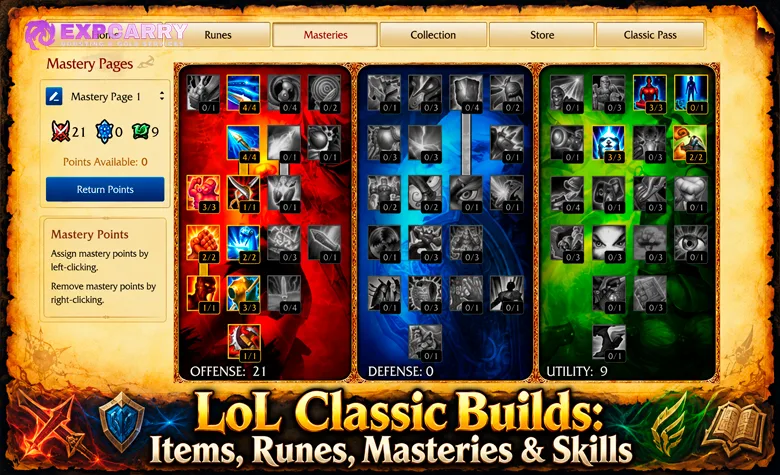
League Classic brings back the original-style rune and mastery systems, with adjustments introduced during its 2026 run. A complete rune page contains nine Marks, nine Seals, nine Glyphs and three Quintessences. Masteries use 30 points distributed between Offense, Defense and Utility. Neither system is interchangeable with modern League's rune keystones or champion mastery progression.
Each build below specifies all four rune categories and an overall mastery-tree allocation. These are complete rune configurations rather than partial lists, assuming the required runes have been unlocked. Mastery splits describe where the points go across the three trees; individual nodes should match the champion's damage type, role and matchup. A split alone is not a complete node-by-node mastery page.
| Component | How It Works | Practical Use |
|---|---|---|
| 9 Marks | One rune category in the 30-slot page | Commonly Attack Damage, Attack Speed or Magic Penetration |
| 9 Seals | Second rune category | Commonly Armor, Health or defensive scaling |
| 9 Glyphs | Third rune category | Commonly Magic Resist, Ability Power or cooldown-related stats |
| 3 Quintessences | Large-stat rune slots | Attack Damage, Ability Power, movement, sustain or economy |
| Offense masteries | Damage-oriented mastery tree | Physical penetration, magic penetration and offensive scaling |
| Defense masteries | Survivability-oriented mastery tree | Health, resistances and damage reduction |
| Utility masteries | Economy, movement and resource-oriented tree | Mana, gold generation, mobility and summoner-spell utility |
A mastery allocation written as 21/9/0 means 21 points in Offense, nine in Defense and zero in Utility. A 0/21/9 configuration emphasizes Defense with additional Utility. These are Classic mastery trees, not modern rune pages.
The League Classic Runes and Masteries Guide contains the complete rune and mastery reference, including individual effects and purchasing considerations. This build hub applies those systems to individual champions without repeating the entire reference database.
How to Adjust Runes for an Enemy Matchup
The correct rune page depends partly on the opponent. Flat Armor helps against repeated physical attacks, while Magic Resist is more valuable against threatening magic damage. Movement Speed Quintessences can help melee champions approach ranged opponents, while offensive Quintessences are more attractive when the champion can trade safely.
For example, a physical top laner can start with Attack Damage Marks, Armor Seals, Magic Resist Glyphs and Attack Damage Quintessences. Against sustained magic damage, early Magic Resist becomes more valuable. Against ranged pressure, additional movement speed or sustain may help secure farm without repeatedly accepting unfavorable trades.
These swaps should address an actual matchup problem. Replacing defensive runes with damage against a stronger early opponent can make the lane harder even when the theoretical late-game setup gains extra offensive statistics.
How to Choose Classic Masteries
Offense-heavy pages suit carries who need damage and penetration. Defense-heavy pages help champions survive extended fights or dangerous jungle camps. Utility allocations offer movement, mana, economy and summoner-spell benefits, particularly for low-income supports.
Junglers should consider defensive nodes that reduce monster damage when their early clear is dangerous. Physical carries should select relevant offensive masteries rather than copying a magic-damage setup. Supports can invest in economy when their lane is safe, but additional Defense may matter more against aggressive engage compositions.
LoL Classic Top Lane Builds
Top lane is heavily influenced by early trading, defensive purchases and matchup-specific decisions. Duelists require enough damage to pressure their opponents, while tanks and durable fighters benefit from items that keep them in lane and useful during later fights. Fiora, Irelia and Garen represent three different approaches to top-lane combat.
Fiora Classic Build — AD Duelist
Fiora uses her original Lunge, Riposte, Burst of Speed and Blade Waltz abilities. She excels at favorable duels, repeated physical damage and maintaining contact with her target. Patch 26.20 reduced Riposte's bonus Attack Damage from 15–35 to 10–30, reducing her free damage at every ability rank.
Runes: 9 Attack Damage Marks, 9 Armor Seals, 9 Magic Resist Glyphs and 3 Attack Damage Quintessences.
Masteries: 21/9/0, prioritizing physical damage, penetration and basic durability. Summoner spells: Flash + Ignite. Skill order: Q → E → W, with R whenever available.
Starting item: Doran's Blade. Core build: Ninja Tabi → Ravenous Hydra → Trinity Force → Blade of the Ruined King. The Bloodthirster and The Black Cleaver are additional offensive choices, but an appropriate defensive item may be necessary before completing the entire damage path.
Matchup adjustments: Against a physical duelist such as Jax, defensive timing and Armor matter more than maximum damage on paper. Against a ranged opponent such as Teemo, movement speed and favorable approach windows become important. Against heavy crowd control, Mercury's Treads and a defensive purchase may provide more value than another offensive component.
Fiora's build should support repeated attacks and reliable access to melee range. Blade Waltz can help execute a duel, but it does not replace careful target selection or account for her reduced Riposte damage automatically.
Irelia Classic Build — Trinity Force Bruiser
Irelia joined Classic in Patch 26.20 with her original kit, including Hiten Style, Equilibrium Strike and Transcendent Blades. Her strength comes from sustained attacks, healing, Bladesurge mobility and surviving extended fights. This differs substantially from the modern Irelia's ability mechanics.
Runes: 9 Attack Damage Marks, 9 Armor Seals, 9 Magic Resist Glyphs and 3 Attack Damage Quintessences.
Masteries: 21/9/0, combining physical damage and penetration with lane durability. Summoner spells: Flash + Ignite. Skill order: W → E → Q, with R whenever available.
Starting item: Doran's Blade. Core build: Mercury's Treads → Trinity Force → Blade of the Ruined King → Wit's End. Ravenous Hydra and Frozen Mallet are additional choices for wave control, damage and extended fights.
Matchup adjustments: Against magic damage, early Magic Resist and Wit's End become more attractive. Against physical attackers, Ninja Tabi or Frozen Heart can be considered. Against ranged champions, preserve Bladesurge opportunities through minions instead of spending the dash without a safe follow-up.
Trinity Force complements Irelia's ability-based attacks, while Blade of the Ruined King improves sustained combat. Original Equilibrium Strike can stun an enemy whose percentage health is higher than Irelia's. W-first is the featured leveling route, but the original kit also supports other skill-max priorities depending on matchup and playstyle.
Garen Classic Build — Durable Physical Fighter
Garen offers straightforward top-lane trading. Decisive Strike provides target access and silence, Judgment deals area damage, and Courage increases durability. His build should provide enough protection to remain in combat while retaining meaningful physical damage.
Runes: 9 Attack Damage Marks, 9 Armor Seals, 9 Scaling Magic Resist Glyphs and 3 Attack Damage Quintessences.
Masteries: 21/9/0 for a physical-damage fighter, with a deeper defensive allocation available for difficult lanes. Summoner spells: Flash + Ignite. Skill order: E → Q → W, with R whenever available.
Starting items: Doran's Shield + Health Potion. Core build: Ninja Tabi → Sunfire Cape → The Black Cleaver → Warmog's Armor. Spirit Visage or Force of Nature can replace an early Armor purchase against significant magic damage, while Randuin's Omen is useful against repeated physical attacks.
Matchup adjustments: Against physical damage, prioritize Armor and health. Against an AP champion such as Kennen, Mercury's Treads and early Magic Resist may be more useful than an automatic Sunfire Cape rush. Against ranged poke, use defensive purchases and short trading windows rather than repeatedly approaching without a reliable way to reach the opponent.
Force of Nature and Warmog's Armor received health-regeneration buffs in Patch 26.20. These changes improve their defensive value but do not justify buying Magic Resist against a predominantly physical-damage matchup. Garen's item order should follow the threats he actually faces.
Explore services related to this guide, selected from our League of Legends catalog.
View All League of Legends Services


LoL Classic Jungle Builds
Classic jungle camps can punish weak early clears, so starting items, runes and defensive masteries are important before the first gank. Rammus and Warwick represent different approaches: durable crowd-control initiation and sustain-focused single-target fighting. Both use legacy jungle systems rather than modern jungle companions.
Rammus Classic Build — Armor Tank Jungle
Rammus is especially effective against teams that rely on physical damage and repeated basic attacks. Powerball allows him to approach enemies, Puncturing Taunt redirects their attacks, and Defensive Ball Curl increases his durability. His build must support safe clearing, effective ganks and survival during initiation.
Runes: 9 Attack Speed Marks, 9 Armor Seals, 9 Scaling Magic Resist Glyphs and 3 Movement Speed Quintessences.
Masteries: 9/21/0, emphasizing Defense and relevant monster-damage reduction nodes. Summoner spells: Flash + Smite. Skill order: E → W → Q, with R whenever available.
Starting items: Hunter's Machete + 5 Health Potions. Core build: Spirit of the Ancient Golem → Boots of Mobility → Thornmail → Sunfire Cape. Randuin's Omen and Force of Nature offer additional defenses depending on enemy damage types.
Matchup adjustments: Against physical attackers such as Master Yi, Armor and Thornmail support Rammus's defensive strengths. Against heavy magic damage or crowd control, Mercury's Treads, Banshee's Veil or another Magic Resist item may be necessary. Warmog's Armor is an option when additional health is needed and the existing resistances are sufficient.
Use vision and movement to approach from angles that make Powerball difficult to avoid. Rammus does not need maximum Armor against every composition; mixed-damage teams require balanced defenses, and finishing the jungle upgrade normally takes priority over rushing a late-game Armor item.
Warwick Classic Build — Sustain Jungle Fighter
Warwick is a practical Classic jungler because Hungering Strike provides sustain and his original Infinite Duress offers targeted lockdown. He can clear camps reliably and threaten vulnerable lanes, but he struggles when opponents deny access or interrupt his ability to remain on a target. Riot previously reduced his base Attack Speed in Patch 26.16, so older attack-speed assumptions should not be reused.
Runes: 9 Attack Speed Marks, 9 Armor Seals, 9 Scaling Magic Resist Glyphs and 3 Movement Speed Quintessences.
Masteries: 21/0/9 for aggressive fighting and resource utility. A more defensive allocation is reasonable against difficult early clears or frequent invades. Summoner spells: Flash + Smite. Skill order: Q → E → W, with R whenever available.
Starting items: Hunter's Machete + 5 Health Potions. Core build: Wriggle's Lantern → Berserker's Greaves → Madred's Bloodrazor → Blade of the Ruined King. Wit's End and Spirit Visage provide additional options for sustained fighting and defensive needs.
Matchup adjustments: Against magic damage, Wit's End or Spirit Visage can increase survivability. Against strong physical burst, prioritize suitable Armor instead of automatically extending the attack-speed build. Against opponents who can interrupt or punish Infinite Duress, surviving the approach matters more than purchasing another offensive component.
Wriggle's Lantern supports Warwick's clearing before he invests heavily in expensive on-hit items. Its attack-speed-oriented version was adjusted in Patch 26.17, so old Attack Damage values are not applicable. Plan ganks around reachable targets and teammates who can follow up on Infinite Duress.
LoL Classic Mid Lane Builds
Classic mid laners depend on older spell ratios, item actives and matchup-specific defensive purchases. Fizz emphasizes mobility and burst, Annie delivers reliable crowd control, and Malzahar combines damage over time with suppression. Legacy AP items such as Deathfire Grasp and Rod of Ages may have different roles and effects from similarly named modern items.
Fizz Classic Build — AP Assassin
Fizz entered Classic in Patch 26.19 and quickly became a strong mid-lane threat. Patch 26.20 reduced Urchin Strike's AP ratio from 60% to 40% and the active AP ratio on Seastone Trident from 35% to 20%. His mobility and Playful / Trickster untargetability remain valuable, but earlier burst calculations no longer apply.
Runes: 9 Magic Penetration Marks, 9 Scaling Health Seals, 9 Magic Resist Glyphs and 3 Ability Power Quintessences.
Masteries: 21/0/9, emphasizing AP damage, magic penetration and resource utility. Summoner spells: Flash + Ignite. Skill order: E → Q → W, with R whenever available.
Starting items: Doran's Ring + 2 Health Potions. Core build: Sorcerer's Shoes → Lich Bane → Deathfire Grasp → Zhonya's Hourglass. Rabadon's Deathcap and Void Staff provide additional damage or penetration when the matchup allows.
Matchup adjustments: Against physical burst, Seeker's Armguard and Zhonya's Hourglass can be more important than an immediate damage purchase. Against high Magic Resist, move Void Staff earlier. Against reliable crowd control, preserve Playful / Trickster for important enemy abilities instead of automatically spending it at the start of every trade.
The nerfs reduce Fizz's AP burst without removing his ability to eliminate vulnerable targets. His Classic Lich Bane interaction and Deathfire Grasp remain valuable offensive tools, but damage thresholds should be evaluated using Patch 26.20 values rather than older guides.
Annie Classic Build — AP Burst and Stun
Annie can prepare a stun through Pyromania and deliver it with a direct spell combination. She is valuable when her team needs dependable crowd control and burst rather than sustained mobility. Her build focuses on Ability Power, penetration and preserving the ability to engage or respond at the correct moment.
Runes: 9 Magic Penetration Marks, 9 Armor Seals, 9 Ability Power Glyphs and 3 Ability Power Quintessences.
Masteries: 21/0/9 for a standard offensive mage setup. A 9/0/21 Utility-oriented alternative can be considered when movement and resource management are more important than maximum burst. Summoner spells: Flash + Ignite. Skill order: Q → W → E, with R whenever available.
Starting items: Doran's Ring + 2 Health Potions. Core build: Sorcerer's Shoes → Rabadon's Deathcap → Deathfire Grasp → Void Staff. Rod of Ages, Zhonya's Hourglass and Morellonomicon are alternatives when durability, scaling or utility is needed.
Matchup adjustments: Against a mobile assassin such as Fizz, saving a prepared stun for the appropriate moment can matter more than immediately using it for damage. Zhonya's Hourglass protects against dangerous physical burst or dives. Against sustained spell damage, health and appropriate Magic Resist may be necessary before completing all offensive items.
Annie should use her burst to eliminate valuable targets or create teamfight openings without exposing herself unnecessarily. Manage Pyromania so that her stun is available when an opponent commits to an exchange.
Malzahar Classic Build — Damage Over Time and Suppression
Malzahar uses Malefic Visions for damage and wave pressure, while Nether Grasp provides targeted suppression. He performs well when enemies must enter his effective range, but poor positioning and interruption can reduce his contribution. His build should strengthen sustained spell damage while allowing defensive adjustments.
Runes: 9 Magic Penetration Marks, 9 Armor Seals, 9 Scaling Magic Resist Glyphs and 3 Ability Power Quintessences.
Masteries: 21/0/9, emphasizing AP damage and mana-related utility. Summoner spells: Flash + Ignite. Skill order: E → Q → W, with R whenever available.
Starting items: Doran's Ring + 2 Health Potions. Core build: Sorcerer's Shoes → Liandry's Torment → Rylai's Crystal Scepter → Rabadon's Deathcap. Rod of Ages and Archangel's Staff are scaling alternatives when additional health or mana is needed.
Matchup adjustments: Against early Magic Resist, move Void Staff forward when penetration becomes more valuable than flat Ability Power. Against physical dive, Zhonya's Hourglass provides useful protection. Against sustained lane pressure, Catalyst the Protector and Rod of Ages can improve survivability and resource management.
Malzahar's value comes from consistent pressure and choosing an important suppression target. Avoid walking too far forward to use Nether Grasp when nearby enemies can interrupt or punish the channel.
LoL Classic ADC Builds
Classic ADC builds rely on efficient Attack Damage, Attack Speed and critical-strike purchases. The correct itemization depends on the champion's damage pattern. Graves offers close-range burst with his original kit, Caitlyn uses range to control lane, and Kog'Maw specializes in sustained attacks and on-hit effects. These paths should not be copied directly from modern ADC guides.
Graves Classic Build — Pre-Rework ADC
Classic Graves uses his original Buckshot, Smoke Screen, Quickdraw and Collateral Damage abilities. Unlike modern jungle Graves, this version is a traditional bot-lane marksman with strong close-range burst and defensive bonuses from True Grit. Patch 26.20 lowered his base Attack Damage, AD growth, Attack Speed growth and the cone damage of Collateral Damage, while leaving the initial projectile damage unchanged.
Runes: 9 Attack Damage Marks, 9 Armor Seals, 9 Magic Resist Glyphs and 3 Attack Damage Quintessences.
Masteries: 21/9/0, emphasizing physical damage and basic durability. Summoner spells: Flash + Barrier. Skill order: Q → E → W, with R whenever available.
Starting item: Doran's Blade. Core build: Berserker's Greaves → Infinity Edge → The Bloodthirster → Last Whisper. Phantom Dancer is an additional critical-strike and Attack Speed option.
Matchup adjustments: Against heavy Armor, purchase Last Whisper earlier. Against assassins or strong engage, Guardian Angel or Quicksilver Sash may be more useful than additional Attack Speed. Against ranged poke, prioritize safe farming and sustain over repeated close-range trades while low on health.
Graves remains threatening when he approaches safely and lands Buckshot at a favorable distance. His 26.20 nerfs specifically weaken sustained output and part of his ultimate damage. True Grit increases durability but does not make him immune to concentrated enemy damage.
Caitlyn Classic Build — Range and Critical Strike
Caitlyn arrived in Classic in Patch 26.20 with her earlier kit, including the original Piltover Peacemaker, Yordle Snap Trap and 90 Caliber Net. Her long attack range helps pressure many traditional ADCs, but positioning remains essential against enemies who can close the distance.
Runes: 9 Attack Damage Marks, 9 Armor Seals, 9 Magic Resist Glyphs and 3 Attack Damage Quintessences.
Masteries: 21/9/0, emphasizing physical damage, critical strikes and lane durability. Summoner spells: Flash + Barrier. Skill order: Q → W → E, with R whenever available.
Starting item: Doran's Blade. Core build: Berserker's Greaves → Infinity Edge → Phantom Dancer → The Bloodthirster. Last Whisper, Runaan's Hurricane and defensive purchases can be considered according to enemy composition.
Matchup adjustments: Against an aggressive short-range ADC such as Graves, use attack range and traps to discourage close combat. Against high Armor, consider an earlier Last Whisper. Against dangerous assassins, Guardian Angel or another appropriate defensive item can prevent a single dive from deciding the fight.
Caitlyn is strongest when she controls space before enemies reach her. Piltover Peacemaker can pressure favorable positions, but repeatedly spending mana is unnecessary when maintaining range and securing farm already provides an advantage.
Kog'Maw Classic Build — On-Hit Hypercarry
Kog'Maw deals sustained damage through repeated attacks, with Bio-Arcane Barrage allowing him to threaten high-health opponents. His effectiveness increases when allies can protect him during extended fights. Attack Speed and on-hit effects are therefore important alternatives to a purely critical-strike-focused build.
Runes: 9 Attack Damage Marks, 9 Armor Seals, 9 Magic Resist Glyphs and 3 Life Steal Quintessences.
Masteries: 21/9/0, emphasizing Attack Speed, physical damage and basic survivability. Summoner spells: Flash + Barrier. Skill order: W → Q → E, with R whenever available.
Starting items: Dagger + 2 Health Potions. Core build: Berserker's Greaves → Blade of the Ruined King → Runaan's Hurricane → Madred's Bloodrazor. Guinsoo's Rageblade and Phantom Dancer offer additional sustained-damage options.
Matchup adjustments: Against durable frontlines, prioritize on-hit damage and enough Attack Speed to exploit Bio-Arcane Barrage. Against heavy dive, positioning and an appropriate survival item are more important than maximum theoretical damage. Against spread-out enemies, Runaan's Hurricane provides fewer opportunities to damage secondary targets.
Kog'Maw should attack from behind teammates whenever possible. Expensive offensive items offer little value if he cannot survive long enough to keep attacking during Bio-Arcane Barrage.
LoL Classic Support Builds
Classic supports operate with limited personal farm and a legacy item economy. Their builds should provide crowd control, shielding, sustain or vision without assuming access to expensive carry inventories. Janna and Sona emphasize utility, Nautilus offers initiation, and original Karma combines damage with protection.
Support purchases should reflect lane safety and vision needs. Gold generation is useful when the lane is stable, but Sight Wards, Vision Wards and Sightstone upgrades remain important. A support should not sacrifice essential vision simply to purchase an additional potion or early offensive component.
Janna Classic Build — Shielding and Disengage
Janna provides shielding, movement utility, interruption and disengage. Eye of the Storm protects allies and increases their Attack Damage, while Monsoon can displace opponents and heal teammates. She is most effective when she saves important spells for threats that can actually reach her carries.
Runes: 9 Minor Armor Marks, 9 Armor Seals, 9 Scaling Magic Resist Glyphs and 3 Gold Quintessences.
Masteries: 1/8/21, emphasizing Utility, support economy and some durability. Summoner spells: Exhaust + Flash. Skill order: E → W → Q, with R whenever available.
Starting items: Faerie Charm + 5 Health Potions + Sight Ward. Core build: Boots of Mobility → Ruby Sightstone → Shurelya's Reverie. Ardent Censer, Twin Shadows and Shard of True Ice are situational utility purchases.
Matchup adjustments: Against strong physical engage, prioritize Armor and health rather than maximum gold generation. Against an AP-heavy team, Magic Resist and careful positioning matter. Against assassins, preserve Howling Gale or Monsoon for disengage instead of using every ability for harmless poke.
Janna does not need high personal damage to contribute. Protecting a carry, placing useful vision and disrupting enemy initiation can decide a fight even with a smaller item inventory.
Nautilus Classic Build — Tank Engage Support
Nautilus provides multiple forms of crowd control. Dredge Line creates engagement opportunities, Staggering Blow immobilizes targets, and Depth Charge disrupts important opponents. Patch 26.20 increased Titan's Wrath damage, its bonus-health shield ratio from 10% to 15% and its shield duration from 9.75 to 10 seconds. Riot also fixed the shield's interaction with Armor and Magic Resist and corrected excessive critical damage from Staggering Blow.
Runes: 9 Minor Armor Marks, 9 Armor Seals, 9 Magic Resist Glyphs and 3 Armor Quintessences.
Masteries: 1/21/8, emphasizing Defense with limited Utility. Summoner spells: Flash + Ignite. Skill order: Q → W → E, with R whenever available.
Starting items: Boots of Speed + 2 Health Potions + Sight Ward. Core build: Mercury's Treads → Ruby Sightstone → Locket of the Iron Solari. Philosopher's Stone, Frozen Heart and Runic Bulwark are situational economy or defensive options.
Matchup adjustments: Against repeated physical attacks, Ninja Tabi and Frozen Heart may provide more useful defenses. Against AP damage and crowd control, Magic Resist and Mercury's Treads are valuable. Against sustained poke, prioritize durability and vision before repeatedly committing to aggressive hooks.
Nautilus's buffs improve his defensive effectiveness, but they do not guarantee successful engages. Start fights when teammates can follow and use Depth Charge against a valuable target rather than engaging solely because an opponent moves into hook range.
Karma Classic Build — Original AP Utility Support
Classic Karma uses her original Heavenly Wave, Spirit Bond and Soul Shield abilities. This is not the modern Karma kit: empowered Heavenly Wave can heal allies, Spirit Bond creates a movement-related tether, and empowered Soul Shield deals area damage. Her passive grants additional Ability Power as her health decreases, creating unusual risk-reward decisions.
Runes: 9 Minor Ability Power Marks, 9 Health Seals, 9 Magic Resist Glyphs and 3 Ability Power Quintessences.
Masteries: 21/0/9 for an aggressive AP-oriented support page. A deeper Utility or Defense investment is appropriate when vision, resources or survivability matter more than lane damage. Summoner spells: Exhaust + Flash. Skill order: Q → E → W.
Starting items: Faerie Charm + 3 Health Potions + 2 Sight Wards. Doran's Ring + 2 Health Potions is an aggressive alternative when early lane damage is prioritized and the team can cover vision. Core build: Ionian Boots of Lucidity → Ruby Sightstone → Twin Shadows → Ardent Censer. Shurelya's Reverie and Shard of True Ice are additional support choices.
Matchup adjustments: Against aggressive lanes, prioritize health and positioning instead of assuming offensive runes guarantee favorable trades. Against important crowd control, Mikael's Crucible can be useful when its active can remove the relevant effect. Against grouped opponents, empowered Soul Shield can create offensive pressure while protecting an ally.
Important skill-order exception: Original Karma starts with Mantra at Level 1 and does not spend normal ability points upgrading it. Do not use the standard Level 6/11/16 ultimate pattern. Allocate ordinary skill points to Q, E and W according to the lane matchup.
Sona Classic Build — Low-Economy Utility Support
Sona contributes damage, healing, defensive bonuses and movement support without requiring expensive offensive items. Hymn of Valor offers lane pressure, Aria of Perseverance provides defensive assistance, and Crescendo delivers area crowd control. She remains vulnerable to hard engage, making positioning and vision essential.
Runes: 9 Minor Armor Marks, 9 Armor Seals, 9 Magic Resist Glyphs and 3 Gold Quintessences.
Masteries: 1/13/16 for a mixed Defense and Utility setup. A deeper Utility allocation is appropriate when the lane is safe enough to sacrifice some durability. Summoner spells: Exhaust + Flash. Skill order: Q → W → E, with R whenever available.
Starting items: Faerie Charm + 5 Health Potions + Sight Ward. Core build: Ionian Boots of Lucidity → Ruby Sightstone → Shurelya's Reverie → Shard of True Ice. Ardent Censer and other utility purchases are situational additions.
Matchup adjustments: Against an engage support such as Nautilus, prioritize safe positioning and defensive purchases over maximum economy. Against poke, use Aria of Perseverance carefully and choose sustain or defensive components when needed. Mikael's Crucible is an option when removing an eligible disabling effect is important for protecting a teammate.
Sona's teamfight contribution depends on remaining alive long enough to cycle abilities. Preserve Crescendo for important enemies or defensive situations rather than automatically casting it on the first opponent in range.
How to Change Your Classic Build for Different Matchups
Build templates provide a starting plan, but the enemy composition determines which purchase is most useful next. Repeated physical attacks, sustained magic damage and dangerous crowd control require different defensive responses. Choosing an appropriate component can be more important than completing a preferred six-item build in the original order.
Do not rebuild your entire inventory after one difficult trade. Identify the actual damage source, which enemies are ahead and whether the next important fight requires offense, defense, penetration, vision or utility.
| Enemy Threat | Useful Classic Items | Why They Help |
|---|---|---|
| Repeated physical attacks | Ninja Tabi, Frozen Heart, Randuin's Omen, Thornmail | Armor and other defenses against physical attackers |
| Magic damage and crowd control | Mercury's Treads, Spirit Visage, Banshee's Veil, Force of Nature | Magic Resist, health and relevant defensive effects |
| High enemy Armor | Last Whisper, The Black Cleaver | Improved physical damage against armored targets |
| High enemy Magic Resist | Void Staff | Improved spell damage against magic-resistant targets |
| Dangerous targeted crowd control | Quicksilver Sash, Mikael's Crucible when appropriate | Tools for removing eligible disabling effects |
| Physical burst and dive against an AP carry | Seeker's Armguard, Zhonya's Hourglass | Armor and active protection during dangerous engagements |
| Sustained health and mana pressure | Catalyst the Protector, Rod of Ages, appropriate sustain items | Resources and survivability over longer periods |
| Low-income support utility | Ruby Sightstone, Shurelya's Reverie, Locket of the Iron Solari | Vision, movement and team protection |
Building Against Physical-Damage Teams
Against several physical attackers, tanks and bruisers can justify buying Armor earlier. Rammus benefits directly from defensive statistics, while Garen can adjust his build to survive repeated attacks before investing in additional offense.
For carries such as Graves or Caitlyn, defensive items involve a larger damage trade-off. Purchase enough protection to survive realistic threats without sacrificing all the damage needed for teamfights. The balance depends on whether enemy champions can actually reach you.
Building Against AP Burst and Crowd Control
Magic Resist becomes more valuable when enemy spells cause the most dangerous damage. Mercury's Treads can reduce the duration of applicable crowd-control effects, while Banshee's Veil provides a spell shield against an important incoming ability. Spirit Visage also benefits champions that rely on healing and regeneration.
Do not purchase the same defensive item simply because the opposing team has one AP champion. Consider who is currently strong, whether their damage reaches you and how your own role affects the balance between offense and survival.
Building Against Tanks and High Resistances
When physical carries struggle against Armor, penetration becomes increasingly important. Last Whisper and The Black Cleaver support different damage patterns and item paths. Mages can use Void Staff against meaningful enemy Magic Resist.
Kog'Maw approaches tanks differently because Bio-Arcane Barrage and on-hit effects support repeated damage against high-health targets. The correct anti-tank solution therefore depends on the champion rather than one universal purchase.
What Patch 26.20 Changed for Classic Builds
Patch 26.20 added five champions and adjusted several established picks. It also improved health regeneration on multiple defensive items. Fiora, Graves and Fizz received nerfs; Nautilus was buffed; and Kennen's Electrical Surge passive was changed to improve its bonus-AD interaction. These updates matter when comparing current builds with Patch 26.19 guides or historical Season 3 recommendations.
These are Classic-specific changes. The modern Summoner's Rift balance section of the same patch notes must not be automatically applied to Classic. Riot also announced on October 14, 2026, that the current Classic run will finish in January 2027; its support documentation specifies January 6. The builds below therefore describe the active 26.20 version, not a permanent unchanged game mode.
| Champion or Item | Confirmed Change | Build Impact |
|---|---|---|
| Aatrox, Caitlyn, Irelia, Karma, Quinn | Added to the Classic roster | New champion builds and matchup options |
| Fiora | Riposte bonus AD reduced by 5 at every rank | Less free physical damage during trades |
| Graves | Lower base AD, AD growth, Attack Speed growth and ultimate cone damage | Lower sustained output and reduced ultimate burst scaling |
| Fizz | Reduced Q and active W AP ratios | Lower AP burst from those abilities |
| Nautilus | Higher W damage, improved shield scaling and duration, plus bug fixes | More value from bonus health and better defensive effectiveness |
| Spirit Visage | Health regeneration per 5 seconds: 4 → 20 | Improved sustained defensive value |
| Force of Nature | Health regeneration per 5 seconds: 20 → 40 | Stronger regeneration for extended play |
| Warmog's Armor | Health regeneration per 5 seconds: 10 → 30 | Improved health-regeneration contribution |
Riot documented these changes in the official League of Legends Patch 26.20 notes. Consult the Classic section for champion abilities and item tuning. Riot also corrected Banshee's Veil's shop stat filter from Ability Power to Health; this was a shop categorization fix, not an item-stat buff.
Runaan's Hurricane is another important distinction. The change from 65% to 60% secondary-bolt AD damage appears in the modern Summoner's Rift item section, not the Classic item section. Do not apply it to Classic without a separately confirmed Classic change.
How This Classic Build Hub Fits the Other Guides
This page provides practical configurations after a champion has been selected. Champion rankings, complete rune-system documentation and individual item statistics address different questions. Keeping those subjects separate allows builds to be updated without turning every related article into another full champion ranking.
Use the Classic Tier List to compare champion strength and draft priorities. The Runes and Masteries Guide explains the legacy progression systems, while the Classic Items Guide covers item statistics, components and purchase timing. This hub combines those systems into champion-specific and matchup-specific setups.
How to Use a Build During Champion Select
Find your champion and role in this guide. Prepare the full rune page, select the mastery allocation and confirm the summoner spells. Evaluate the enemy lane matchup before deciding whether the default offensive or defensive setup fits the situation.
Once the match begins, make the listed starting purchase and work toward your first important item. Classic starts with 475 gold, so every opening must fit that budget. If an unexpected threat requires defenses, adjust component purchases rather than saving indefinitely for a planned completed item.
Reassess the build when teamfights become more important than lane trades. The appropriate late-game defensive purchase may be different from the item that helped survive the first ten minutes.
LoL Classic Builds FAQ
These answers cover common questions about using Classic builds and avoiding outdated Season 3 assumptions.
Can modern League of Legends builds be used in Classic? Not directly. Classic contains older champion kits, legacy items, 30-slot rune pages and separate mastery trees. Some item names overlap, but their effects and build paths may differ.
Do all Classic champions need 21/9/0 masteries? No. Carries often use Offense-heavy configurations, while tanks, junglers and supports may benefit from deeper Defense or Utility investments. The correct split depends on role and matchup.
Should you always finish the same six items? No. Enemy Armor, Magic Resist, crowd control, healing and damage threats can justify different boots, earlier penetration, defensive components and utility purchases.
Are the new Patch 26.20 champions using their modern abilities? No. League Classic restores earlier versions of their abilities. Caitlyn, Irelia and Karma are featured in this hub, while Aatrox and Quinn also joined the roster and must be evaluated using their original mechanics.
Conclusion
League Classic builds should combine the correct legacy rune page, mastery allocation, skill order and purchase path for the champion being played. Patch 26.20 changed several established champions and tank items, so older recommendations may be unreliable. The current Classic run is also scheduled to conclude in January 2027, making the patch context important. Start with the featured configurations, adapt to enemy damage and crowd-control threats, and prioritize purchases that help win the next important fight rather than following the same inventory in every matchup.