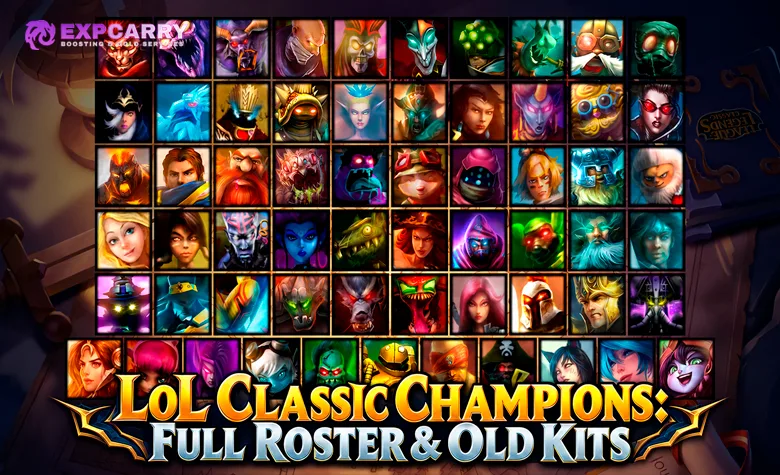
League of Legends Classic currently has 77 playable champions, including original versions of heavily reworked characters such as Aatrox, Fiora, Galio, Irelia, Karma, Poppy, Ryze and Sion. The mode launched with 60 champions and added 17 more through Patch 26.20. Classic is not a recreation of one exact historical patch: Riot selected champion kits from different periods of early League, using Season 3 as the foundation. Some champions retain familiar abilities with older effects, while others play almost nothing like their modern counterparts. Classic Graves is a traditional ADC, original Quinn can transform into Valor, and old Warwick uses a targeted suppression ultimate. This guide lists every currently available champion, identifies their Classic versions, explains the important differences from modern League of Legends and tracks new additions without turning the roster into another tier list.
Short answer: League Classic has 77 playable champions in Patch 26.20: 60 launch characters and 17 post-launch additions. Their kits come from different early League eras, so check each champion's Classic abilities rather than assuming the modern version plays the same way. Mordekaiser, Yorick, Hecarim and Lucian are announced for 26.21 but are not part of the current roster.
How Many Champions Are Available in League Classic?
League Classic launched on July 29, 2026, with 60 champions. Riot selected the original 40 League of Legends champions and 20 additional characters from the game's early years. Later updates expanded the roster through several releases rather than making every modern champion available immediately.
As of Patch 26.20, the current playable total is 77. The count includes champions added in 26.16, 26.18, 26.19 and 26.20. A champion appearing in a future announcement does not mean it can already be selected in Classic.
| Release | Champions Added | Total Playable |
|---|---|---|
| Launch / Patch 26.15 | 60 starting champions | 60 |
| Patch 26.16 | Akali, Kennen, Shen | 63 |
| Patch 26.18 | Fiora, Galio, Poppy, Shyvana, Xin Zhao | 68 |
| Patch 26.19 | Fizz, Graves, Nami, Nautilus | 72 |
| Patch 26.20 | Aatrox, Caitlyn, Irelia, Karma, Quinn | 77 |
Riot confirmed the starting roster in its League Classic developer overview. Subsequent additions are documented in official patch notes. The roster below covers playable characters through 26.20; announced future releases are listed separately.
Which Historical Version of League Does Classic Use?
Classic uses Season 3 as its general foundation, but the champion roster is a collection of historical versions from different periods. That distinction matters because some characters had already received major changes by 2013, while others were introduced around that time and later underwent extensive reworks.
Riot selected versions intended to recreate recognizable early-League gameplay rather than forcing every champion into a single historical snapshot. Original Karma, for example, comes from before her 2013 relaunch, while Fiora and Quinn use kits that remained available into 2015. Their presence together does not mean those exact versions all existed in the same live patch.
Classic also receives its own balance changes and bug fixes. An old ability can therefore be restored in its historical form while having damage, cooldown or other values adjusted for the 2026 mode.
Why Are Some Modern Champions Missing?
Classic intentionally has a smaller roster than modern League of Legends. Riot wanted the mode to preserve older combat pacing, clearer individual strengths and weaknesses, and abilities that defined the early years of the game.
Not every modern champion fits that design. Champions released in later years are not automatically eligible, even if players consider them familiar or iconic. Riot has continued adding selected older champions through patches, but the roster is curated rather than a complete copy of the modern collection.
Complete League Classic Champion Roster
The following reference covers all 60 launch champions and the 17 characters introduced afterward. The listed roles are representative positions, not exclusive restrictions or current strength rankings. Some Classic champions can be played in several roles depending on the team composition and strategy.
The comparisons focus on identifying abilities and gameplay differences. When a champion has retained much of its core kit, the entry says so instead of inventing a major rework. Classic balance values and historical item interactions can still differ even when the ability names are familiar.
Launch Champions: Ahri Through Fiddlesticks
These champions were part of the original 60-character Classic launch roster. Some use easily recognizable early versions, while others have abilities or passives that changed substantially over the following years.
| Champion | Common Role | Classic Version vs Modern League |
|---|---|---|
| Ahri | Mid | Earlier Orb of Deception, Charm and Spirit Rush gameplay; lacks the modern ultimate-reset structure |
| Alistar | Support | Legacy tank-support kit with Triumphant Roar's area healing instead of modern Trample |
| Amumu | Jungle | Familiar Bandage Toss and area control, but older Cursed Touch reduces Magic Resist rather than applying modern bonus true damage |
| Anivia | Mid | Familiar egg, wall and Glacial Storm gameplay with Classic-era spell values and interactions |
| Annie | Mid | Original stun-stacking and Tibbers-focused burst identity with historical tuning |
| Ashe | ADC | Original Focus passive and Frost Shot attack-slow system rather than modern Ranger's Focus |
| Blitzcrank | Support | Recognizable hook and knockup combination with older movement and ability tuning |
| Brand | Mid, Support | Legacy Blaze and spell-combination mechanics rather than the full modern passive-detonation system |
| Cho'Gath | Top, Mid | Earlier Feast stack rules and durability progression; modern stacking mechanics are different |
| Corki | ADC, Mid | Older attack-damage-oriented kit and passive, predating later modern Corki revisions |
| Dr. Mundo | Top, Jungle | Original Burning Agony and Masochism abilities instead of modern Heart Zapper and Blunt Force Trauma |
| Evelynn | Jungle | Pre-rework stealth assassin with Hate Spike, Dark Frenzy, Ravage and Agony's Embrace |
| Ezreal | ADC | Earlier Essence Flux behavior; no modern W mark-and-detonation mechanic |
| Fiddlesticks | Jungle, Support | Old targeted Drain and bouncing Dark Wind silence rather than the modern fear-and-effigy-centered rework |
Ashe, Dr. Mundo, Evelynn and Fiddlesticks are particularly important examples because the differences affect basic gameplay rather than merely damage values. A player who knows modern Fiddlesticks should not expect the old targeted Drain and Dark Wind to function like the current kit.
Launch Champions: Gangplank Through Morgana
This part of the starting roster includes several familiar champions alongside characters that received major gameplay updates after the Classic period. Gangplank, Katarina, Kayle and Master Yi are examples where modern guides can be misleading if applied to their older versions.
| Champion | Common Role | Classic Version vs Modern League |
|---|---|---|
| Gangplank | Top | Uses Raise Morale and older Parrrley mechanics instead of modern Powder Keg barrel combinations |
| Garen | Top | Recognizable silence, Judgment and execute gameplay with older passive and defensive tuning |
| Gragas | Jungle, Mid, Top | Earlier AP-oriented barrel and explosive-engage kit with historical ability behavior |
| Heimerdinger | Mid, Top | Older turret, rocket and grenade mechanics rather than the modernized setup |
| Janna | Support | Largely familiar shielding and disengage identity, with older ability values and utility interactions |
| Jarvan IV | Jungle, Top | Recognizable flag-and-drag engage, shield and Cataclysm with Classic-era tuning |
| Jax | Top, Jungle | Earlier Counter Strike and attack-oriented fighter mechanics; core dueling identity remains familiar |
| Karthus | Mid, Jungle | Familiar Lay Waste, Defile and Requiem identity using historical damage and resource values |
| Kassadin | Mid | Older Null Sphere and Riftwalk behavior, including historical spell interactions and range |
| Katarina | Mid | Pre-rework Sinister Steel and older reset mechanics; no modern ground-dagger pickup system |
| Kayle | Top, Mid | Pre-rework Righteous Fury and Intervention gameplay instead of the modern level-based transformation system |
| Kog'Maw | ADC | Older Bio-Arcane Barrage and artillery-oriented kit; core sustained-damage identity is recognizable |
| Lee Sin | Jungle | Recognizable Sonic Wave, Safeguard and Dragon's Rage kit with older spell and damage tuning |
| Leona | Support | Familiar engage and crowd-control abilities with historical values and interactions |
| Lulu | Support, Mid | Familiar Pix, polymorph, shielding and Wild Growth utility with older tuning |
| Lux | Mid, Support | Recognizable binding, shield, area damage and laser ultimate with earlier ability values |
| Malphite | Top | Familiar armor-based frontline and Unstoppable Force engagement with older mechanics and scaling |
| Malzahar | Mid | Older Malefic Visions and Nether Grasp kit with a substantially different passive and voidling system |
| Master Yi | Jungle, Top | Older Alpha Strike AP interactions and Wuju Style setup; pre-modern damage and ability mechanics |
| Miss Fortune | ADC | Older Impure Shots and Strut-related mechanics rather than the full modern ability configuration |
| Morgana | Mid, Support | Familiar Dark Binding, Black Shield and Soul Shackles identity with older passive and spell tuning |
Gangplank and Katarina are two of the clearest examples of why champion identity alone is not enough to understand Classic. Modern Gangplank strategies center heavily on barrels, while Classic Gangplank instead uses Raise Morale. Modern Katarina relies on dagger placement and pickup interactions, but Classic Katarina uses her earlier ability system.
For champions whose core abilities remain recognizable, the relevant differences may be mostly numerical or tied to old items and runes. That does not make their modern builds automatically valid in Classic.
Launch Champions: Nasus Through Zilean
The remaining starting champions include several major historical reworks, notably Nidalee, Nunu, Ryze, Sion, Skarner, Soraka, Taric, Tristana, Veigar and Warwick. Some of these versions have abilities that are no longer present in modern League.
| Champion | Common Role | Classic Version vs Modern League |
|---|---|---|
| Nasus | Top | Familiar Siphoning Strike stacking, Wither and Fury of the Sands with historical stack and ultimate behavior |
| Nidalee | Mid, Top | Older long-range spear and Cougar Form mechanics; no modern Hunted-mark combination system |
| Nunu | Jungle | Original targeted Ice Blast and Blood Boil support tools rather than modern snowball movement gameplay |
| Olaf | Top, Jungle | Earlier Vicious Strikes and Ragnarok mechanics; remains an aggressive axe-throwing fighter |
| Pantheon | Top, Mid | Original targeted Spear Shot, Aegis Protection and Grand Skyfall kit before his visual and gameplay rework |
| Rammus | Jungle | Original Tremors area-damage ultimate instead of modern Soaring Slam; familiar Powerball and taunt remain |
| Ryze | Mid, Top | Pre-rework spell-combo mage with Desperate Power instead of modern Realm Warp |
| Shaco | Jungle | Familiar stealth, traps and clone gameplay with historical ability and damage tuning |
| Singed | Top | Recognizable Poison Trail, fling and durability identity with Classic-era statistics and item interactions |
| Sion | Top, Mid | Original Cryptic Gaze stun, Death's Caress shield, Enrage and Cannibalism instead of modern charged attacks and unstoppable ultimate |
| Sivir | ADC | Recognizable Ricochet, Spell Shield and On the Hunt with older damage and passive behavior |
| Skarner | Jungle | Original Crystal Slash and single-target Impale suppression rather than the modern terrain-oriented rework |
| Sona | Support | Original aura-heavy healing, damage and movement-support gameplay with historical effects |
| Soraka | Support | Old Starcall and Infuse, including restoring an ally's mana, instead of the modern kit |
| Taric | Support | Original targeted Dazzle stun, Imbue healing and Shatter rather than modern linked crowd-control mechanics |
| Teemo | Top | Familiar poison attacks, Blinding Dart and mushroom traps with older trap and spell tuning |
| Tristana | ADC | Older Explosive Shot damage-over-time mechanic instead of the modern stacking bomb system |
| Tryndamere | Top | Recognizable Fury, Spinning Slash and Undying Rage gameplay with historical values |
| Twisted Fate | Mid | Recognizable Pick a Card and Destiny map control with older range, cooldowns and tuning |
| Twitch | ADC | Older Ambush stealth, Deadly Venom and Expunge interactions with historical ability tuning |
| Vayne | ADC, Top | Familiar Tumble, Silver Bolts, Condemn and Final Hour identity with older balance values |
| Veigar | Mid | Old Event Horizon timing and Primordial Burst interactions, including the earlier enemy-AP scaling design |
| Warwick | Jungle | Original Hungering Strike, Hunter's Call and targeted Infinite Duress suppression instead of modern abilities |
| Wukong | Top, Jungle | Older Decoy and single-cast Cyclone gameplay rather than modern expanded ultimate interactions |
| Zilean | Mid, Support | Original targeted Time Bomb and Rewind mechanics rather than the modern skillshot bomb system |
These 60 champions represent the launch roster rather than 60 characters that necessarily share one exact historical patch version. Several were repeatedly rebalanced across the early years of League. Their Classic identity is defined by the implementation used in the live mode, including its own 2026 adjustments.
Every Champion Added to League Classic After Launch
Seventeen additional champions joined Classic between Patches 26.16 and 26.20. These releases include some of the most dramatic differences from modern League, particularly Akali, Shen, Fiora, Galio, Poppy, Graves, Aatrox, Irelia, Karma and Quinn.
Riot documented their original ability mechanics directly in the patch notes, making it possible to identify the important historical versions without treating community memory as an official specification.
| Champion | Classic Debut | Historical Version and Main Difference |
|---|---|---|
| Akali | 26.16 | Pre-rework Twin Disciplines, Mark of the Assassin and three-charge Shadow Dance; no modern Five Point Strike and Perfect Execution kit |
| Kennen | 26.16 | Earlier Mark of the Storm and Slicing Maelstrom mechanics; core energy-mage identity remains recognizable |
| Shen | 26.16 | Original Vorpal Blade healing mark and Feint shield rather than modern Spirit Blade interactions |
| Fiora | 26.18 | 2012–2015 kit with Lunge, Riposte, Burst of Speed and untargetable Blade Waltz ultimate instead of Grand Challenge |
| Galio | 26.18 | 2010–2017 kit with Magic Resist-to-AP scaling, Bulwark, Righteous Gust and Idol of Durand taunt ultimate |
| Poppy | 26.18 | 2010–2015 kit with Diplomatic Immunity ultimate instead of modern Keeper's Verdict |
| Shyvana | 26.18 | 2011–2013 dragon fighter with original Fury of the Dragonborn and older Flame Breath armor-reduction interactions |
| Xin Zhao | 26.18 | 2012–2017 version with Battle Cry and older Challenge and Crescent Sweep mechanics |
| Fizz | 26.19 | Pre-late-2016 kit with missing-health damage over time on Seastone Trident and a different active W effect |
| Graves | 26.19 | 2011–2015 traditional ADC with Buckshot, attack-speed Quickdraw and stacking defensive True Grit |
| Nami | 26.19 | Early Nami kit; Tidecaller's Blessing enhances an ally's next three basic attacks, not ability damage |
| Nautilus | 26.19 | Early Nautilus with familiar hook, shield and Riptide; Depth Charge's traveling shockwave is less disruptive than its final impact |
| Aatrox | 26.20 | Near-release 2013 kit with Blood Well revival, health-cost mechanics and Massacre instead of The World Ender |
| Caitlyn | 26.20 | 2011–2015 version with older Headshot and Yordle Snap Trap mechanics, including a two-trap limit |
| Irelia | 26.20 | 2010–2018 kit with Hiten Style, Equilibrium Strike and Transcendent Blades rather than modern Defiant Dance and Vanguard's Edge |
| Karma | 26.20 | Original pre-2013 kit with Heavenly Wave, Spirit Bond, Soul Shield and two-charge Mantra available at Level 1 |
| Quinn | 26.20 | 2013–2015 Quinn and Valor, featuring Tag Team transformation into a melee Valor rather than modern Behind Enemy Lines |
These entries are available in the live Classic roster through Patch 26.20. The changes are documented in the 26.16, 26.18, 26.19 and 26.20 notes.
Explore services related to this guide, selected from our League of Legends catalog.
View All League of Legends Services
Which Classic Champions Are Most Different From Their Modern Versions?
Some Classic champions require only minor adjustments if you already know their modern kits. Others need to be learned almost from the beginning because their passives, ordinary abilities or ultimates function differently. The following examples highlight changes that materially affect how a champion is controlled and what an opponent should expect.
Classic Aatrox vs Modern Aatrox
Original Aatrox is an attack-focused fighter whose abilities interact with his own health and Blood Well. His basic abilities consume health to fill Blood Well, which provides bonus attack speed and allows him to revive when killed. Blood Thirst and Blood Price provide a toggle between periodic healing and additional attack damage at a health cost, while Massacre grants attack speed and attack range after damaging nearby enemy champions.
Modern Aatrox instead focuses on The Darkin Blade's multi-cast attacks, repositioning and The World Ender. The original version is not simply a lower-damage version of the modern champion. His sustained combat pattern and revival mechanics require different decisions.
Classic Fiora vs Modern Fiora
Classic Fiora's original ultimate is Blade Waltz. She becomes untargetable and repeatedly strikes nearby enemies, applying on-hit effects. Repeated hits on the same target deal reduced damage. Her other abilities emphasize targeted lunges, attack speed and parrying an incoming attack with Riposte.
Modern Fiora uses Duelist's Dance vital points and Grand Challenge, which emphasizes positioning around a chosen target. Classic Fiora does not require players to attack vital markers in the same way. Her ultimate and dueling rhythm are fundamentally different.
Classic Galio vs Modern Galio
Classic Galio converts a portion of Magic Resist into Ability Power through Runic Skin. His Bulwark grants an ally Armor and Magic Resist and heals Galio when the protected ally takes damage. Righteous Gust leaves a movement-speed path for allies, while his ultimate, Idol of Durand, channels an area taunt before dealing damage that increases with the hits Galio absorbs during the channel.
Modern Galio uses a different ability setup, including Hero's Entrance for long-range allied intervention. Classic Galio's main identity is his original spellcasting and defensive interactions rather than the modern kit's movement and engage patterns.
Classic Karma vs Modern Karma
Classic Karma has a particularly unusual kit because Mantra is available from Level 1 and holds two charges. Heavenly Wave deals cone damage and can heal allies when empowered, with healing based on missing health. Spirit Bond creates a tether that speeds up allies and slows enemies, with Mantra doubling its movement-speed effects. Empowered Soul Shield damages enemies around the shielded target.
Modern Karma uses a different Q, W and E configuration with Mantra enhancements. A player familiar with modern Inner Flame and Focused Resolve should read every Classic tooltip before playing. The old version has different healing, shielding and damage interactions.
Classic Quinn vs Modern Quinn
Classic Quinn's Tag Team ultimate replaces her with Valor, a fast melee combatant using modified versions of her ordinary abilities. Recasting the ultimate triggers Skystrike and returns Quinn to the battlefield.
Modern Quinn uses Behind Enemy Lines primarily for movement and roaming. The Classic transformation creates a different risk profile because Valor enters melee range instead of simply carrying Quinn around the map.
Classic Graves vs Modern Graves
Classic Graves is a traditional bot-lane ADC with ordinary ranged attack behavior, Buckshot, Smoke Screen and Quickdraw. His passive, True Grit, grants stacking Armor and Magic Resist while he remains in combat.
Modern Graves uses New Destiny's ammunition and shotgun mechanics and is commonly associated with jungle play. Classic Graves predates that rework, so modern reload management, attack patterns and jungle-oriented builds should not be assumed to apply.
Classic Irelia vs Modern Irelia
Classic Irelia uses Hiten Style for attack-based healing and bonus true damage. Equilibrium Strike slows or stuns depending on the target's percentage health compared with her own. Transcendent Blades fires four blades in sequence that damage enemies and restore health.
Modern Irelia relies on a different passive and a kit built around Defiant Dance, Flawless Duet and Vanguard's Edge. The Classic version rewards older attack-based trading patterns rather than the same modern mark and blade-combination gameplay.
Classic Poppy vs Modern Poppy
Classic Poppy's Diplomatic Immunity is one of the largest differences in the entire roster. She selects an enemy and, for a limited period, becomes immune to damage and crowd control from everyone except that target while dealing additional damage to the selected opponent. This allows her to choose a relatively harmless target and attack another enemy while protected.
Modern Poppy uses Keeper's Verdict to displace enemies and has a different defensive kit. Original Poppy's ultimate changes which opponents can interact with her, so both the Poppy player and the enemy team need to understand the selected target.
Ryze, Sion, Skarner and Warwick: Four More Major Reworks
These four champions also have major differences that affect how they are played:
- Ryze: Classic uses his earlier spell-combo mechanics and Desperate Power ultimate, not modern Realm Warp.
- Sion: Classic uses targeted Cryptic Gaze and his old Cannibalism ultimate instead of the modern charged Q and charging ultimate.
- Skarner: Classic retains Crystal Slash and the older single-target Impale suppression rather than the modern reworked kit.
- Warwick: Classic uses targeted Infinite Duress and older sustain abilities rather than the modern leaping ultimate and reworked combat tools.
These are champions worth testing before taking them into an unfamiliar matchup. Knowing a character's name or appearance is not enough to predict their old ability combinations.
How to Find Classic Champions by Role
The roster can be organized by familiar role categories, but those categories are not a strength ranking. League Classic has different jungle camps, itemization and champion behavior from modern Summoner's Rift, so a modern role assignment does not always predict the most useful Classic position.
The following examples help readers locate recognizable groups. The complete tables above remain the authoritative roster list within this article.
| Role | Champion Examples | Typical Gameplay Identity |
|---|---|---|
| Top | Garen, Jax, Nasus, Singed, Fiora, Irelia, Poppy | Solo farming, dueling and frontline or side-lane pressure |
| Jungle | Warwick, Rammus, Amumu, Skarner, Lee Sin, Shyvana, Xin Zhao | Camp clearing, ganks and neutral objective control |
| Mid | Annie, Anivia, Ahri, Katarina, Ryze, Fizz, Galio | Spell damage, wave control, roaming and burst opportunities |
| ADC | Ashe, Sivir, Vayne, Kog'Maw, Graves, Caitlyn, Corki | Farming, repeated attacks, burst or sustained damage |
| Support | Janna, Sona, Soraka, Taric, Leona, Nami, Nautilus, Karma | Protection, vision, utility and crowd control |
These groups are intentionally illustrative rather than exhaustive. Several champions can fill more than one position, and their usefulness may change after balance updates. The existing League Classic Tier List discusses comparative champion strength and draft priorities. This page instead establishes which champions and versions exist in the mode.
Which Champions Are Coming to League Classic Next?
Riot has confirmed additional League Classic champion releases for future patches. These announcements should be separated from the playable roster because an upcoming champion cannot be selected until the relevant content becomes available.
In its October 14 developer update, Riot identified Mordekaiser, Yorick, Hecarim and Lucian for Patch 26.21. It also stated that additional releases would continue through 26.23, including Volibear, Urgot and Udyr. Those champions are not included in the 77-character total for Patch 26.20.
| Champion | Announced Availability | Status Relative to 26.20 |
|---|---|---|
| Mordekaiser | Patch 26.21 | Announced, not yet in the current roster |
| Yorick | Patch 26.21 | Announced, not yet in the current roster |
| Hecarim | Patch 26.21 | Announced, not yet in the current roster |
| Lucian | Patch 26.21 | Announced, not yet in the current roster |
| Volibear | Among additions planned through 26.23 | Announced for a future update |
| Urgot | Among additions planned through 26.23 | Announced for a future update |
| Udyr | Among additions planned through 26.23 | Announced for a future update |
Riot's October 14 League Classic developer update is the official source for the announced releases. The schedule remains subject to later patch announcements and changes.
Will League Classic Remain Available in 2027?
Riot announced that the current League Classic run will end after Season 3, in January 2027. The developer team expressed an intention to bring Classic back in the future, likely as an event mode, but did not provide a confirmed return date.
Beginning with 26.21, Classic queue availability will also change in some regions. Japan and MENA will have custom matches only. Korea, Latin America North and South, Taiwan, Vietnam, Turkey, Southeast Asia, Oceania and Russia are scheduled to use limited queue windows, with weekday and weekend schedules based on server time. Riot stated that Classic custom games will remain available at all times during the current run.
This affects how players access the roster, but it does not change which champions are already part of the current 26.20 list. Future availability should be checked against the applicable Riot announcements rather than inferred from an older champion-count table.
How Do You Unlock Champions in League Classic?
Classic uses its own progression and purchasing systems for accessing the curated roster. Riot confirmed that champions already owned on a player's account are accessible in Classic when those champions are part of the Classic roster. Additional eligible champions can be obtained through Classic levels or the relevant shop options.
Not owning a champion is different from that champion being absent from the mode. A playable Classic champion may need to be unlocked on an account, while a character that has not been added to the roster is unavailable regardless of how many modern skins or builds exist for it.
The free champion rotation also provides opportunities to try available characters. Before spending resources, confirm that the character you want to learn has actually been released in Classic and that its historical kit matches the playstyle you expect.
Do Modern Champion Skins Change Classic Abilities?
Skins and cosmetics do not turn a Classic champion into its modern gameplay version. League Classic uses the ability implementation provided by the mode, even when a champion shares a name with its modern counterpart or has a familiar visual appearance.
Riot has also introduced Classic-specific cosmetic presentation and chroma arrangements, so cosmetic availability should not be assumed to match modern Summoner's Rift exactly. For gameplay purposes, the relevant distinction is the selected Classic champion's kit, not the visual appearance used in champion select.
How to Verify a Champion's Classic Version
Because Classic combines several historical eras, old community guides can disagree about which version of an ability should be present. A Season 1 article may describe mechanics that were already changed before the snapshot chosen for Classic, while a modern guide may refer to an ability that did not exist in the original kit.
Use the live Classic ability descriptions and official patch notes as the primary reference. The following checks help distinguish a real gameplay difference from an outdated guide or an unrelated modern balance adjustment.
- Confirm availability: Check whether the champion is in the current Classic roster rather than only announced for a later patch.
- Read the Classic ability descriptions: Compare the passive, Q, W, E and R against the modern version.
- Identify major reworks: Look for replaced abilities, altered targeting rules, older transformations and different ultimate effects.
- Check Classic patch notes: Confirm whether Riot adjusted the ability after the historical version was restored.
- Separate modern changes: Do not apply modern Summoner's Rift balance changes automatically to Classic.
- Use Classic-specific builds: Select items, runes and masteries designed for the restored kit.
For example, modern Graves uses ammunition mechanics that do not describe his original Classic ADC kit. Modern Karma's spell combinations are different from her original Mantra configuration. In both cases, knowing the current kit without checking Classic can lead to incorrect assumptions about what the champion can do.
The Classic Runes and Masteries Guide covers the older pre-game systems, while the Classic Items Guide explains the historical item pool. Those references support champion preparation without duplicating the roster or ranking characters by strength.
LoL Classic Champions FAQ
These answers address common questions about roster size, historical abilities and the distinction between League Classic and modern League of Legends.
Are all modern League of Legends champions available in Classic? No. Classic has a curated roster of 77 playable champions through Patch 26.20. Riot has announced additional characters for later patches, but the mode does not contain the complete modern League roster.
Are Classic champions exact copies of their Season 3 versions? Not always. Riot used Season 3 as a foundation and selected historical champion kits from different periods. Classic also receives its own balance changes, so a restored ability can have values different from a specific historical patch.
Why does my favorite champion have different abilities in Classic? The character may have received a major rework after its selected Classic version. Champions such as Sion, Poppy, Galio, Karma, Fiora and Warwick use older abilities or ultimates that differ substantially from the modern game.
Does the Classic roster determine which champions are strongest? No. Availability and competitive strength are separate questions. This article documents playable champions and their historical kits; current role rankings depend on balance changes, matchups and live Classic results.
Conclusion
League Classic currently features 77 champions drawn from several early periods of League of Legends. Some retain familiar abilities, while others restore entirely different passives, spells or ultimates. The most important step before selecting a champion is to identify which historical version Classic uses and whether it differs from modern gameplay. Keep future announcements separate from the live roster, and use current Classic ability descriptions when preparing for a match.