
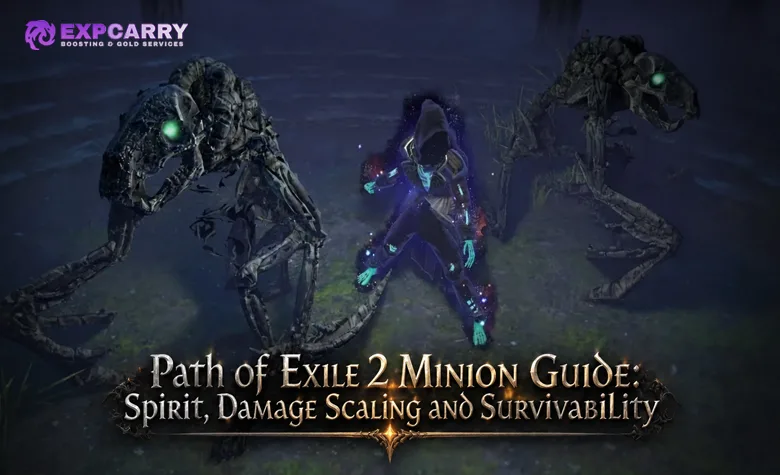
Path of Exile 2 minion builds in patch 0.5.5 are built around three separate resources: Spirit for persistent army capacity, minion-specific scaling for damage, and enough defensive investment to keep both the army and the player alive. A large minion count is not automatically a strong build. If too much Spirit is reserved on weak bodies, supports do not match the minions' real damage, or the army spends every boss fight waiting to revive, the build loses damage even when the tooltip looks impressive.
The reliable approach is to build the army in layers. Reserve Spirit for the minions that define the combat loop, scale those minions with gem levels and modifiers that explicitly affect Minions or Allies, add temporary minions and enemy debuffs only when they improve that loop, and then invest enough Life, Resistances, damage reduction, and revival tools to keep the army active. The core mechanics below remain current for PoE 2 0.5.5 and are explained without locking the guide to one class, Ascendancy, or single endgame build.
PoE 2 Minion Build Basics: How Minions Work
PoE 2 separates minions by how they are created and maintained. Persistent or reviving minions usually reserve Spirit and are configured through the Skills Panel. Temporary minions are created by an active skill or another effect and usually follow their own duration, limit, corpse, trigger, or resource rules. Item- and Ascendancy-granted minions can also have special conditions, so the final skill description in the Skills Panel is more reliable than assuming every summon follows the same Spirit rule.
Persistent and Reviving Minions: Your Core PoE 2 Army
Reviving minions are designed to return after death rather than forcing the player to cast the summon again each time. This makes them the natural core of many summoner setups: once enabled and given enough Spirit, they remain part of the army until the skill is disabled, the build loses the required resources, or another condition removes them.
The important trade-off is that death still matters. A reviving minion that is waiting to return is not attacking, applying ailments, using command abilities, blocking enemies, or contributing other utility. A build that loses half its permanent army every time a boss uses an area attack has an uptime problem, not merely a defensive inconvenience.
Temporary Minions Add Burst Damage and Utility
Temporary summons can add burst damage, bodies, crowd control, corpse interactions, or another source of hits without permanently reserving the same Spirit budget as a normal reviving army. Their value depends on the skill that creates them. Some are worth building around; others are better used as an extra layer behind the main army.
Do not assume a support that works on a persistent minion also works on every temporary summon. Read the actual Minion Skill tags and support restrictions. Path of Exile 2 has changed support compatibility several times, and the current game intentionally distinguishes effects that modify minions from effects limited to skills the player uses personally.
Minion Command Skills Add an Active Rotation
Several permanent minions grant command abilities that the player actively uses. These commands are a major reason to keep different minion types instead of filling every Spirit point with one unit. A defensive command can protect the army during a dangerous phase, while an offensive command can provide burst, area control, or a setup for another skill.
Because commands have their own cooldowns and tactical uses, losing the minion that grants the command can be more damaging than losing an ordinary body. The minion-removal rule introduced in 0.5.0 and still relevant in 0.5.5 prioritizes removing younger, newer minions first when resource changes such as weapon swapping force the game to remove part of the army. This helps preserve older minions whose cooldown abilities may already be available.
PoE 2 Spirit and Minion Reservation
Spirit is capacity, not a resource that is repeatedly spent like Mana. Persistent minions, auras, and other persistent skills reserve part of the available Spirit while enabled. If total reservation rises above available Spirit, something must be disabled or removed. That is why changing a Sceptre, weapon set, body armour, amulet, support, or another Spirit modifier can immediately change the number of minions the character can maintain.
The campaign provides permanent Spirit upgrades, while equipment and other systems can add more. ExpCarry's PoE 2 Spirit reservation guide owns the full acquisition and troubleshooting route. For a minion build, the practical question is not simply how to obtain Spirit, but how to divide the available amount between army size and other persistent effects.
How Much Spirit Does a PoE 2 Minion Build Need?
Start with the minions the build cannot function without. Allocate enough Spirit to keep that core active, test the resulting clear and boss damage, and only then spend the remaining Spirit on another minion type, aura, persistent utility skill, or extra copy of an existing unit. This prevents a common mistake where the player reserves everything immediately and later discovers there is no room for a defensive or offensive persistent effect that contributes more than one additional weak minion.
| Spirit use | Priority question | When it is worth reserving |
|---|---|---|
| Primary damage minions | Do these units carry clear or boss damage? | Reserve these first because losing them breaks the build's main combat loop. |
| Command or utility minions | Does the unit provide a command, buff, control effect, or defensive function the main army lacks? | Keep enough copies to make the utility reliable instead of adding them only for body count. |
| Additional copies of the main minion | Does one more body add more real damage than another persistent effect? | Add copies after core utility and survival are stable. |
| Auras and persistent buffs | Does the effect improve the whole army or solve a defence problem? | Reserve when the benefit across many minions is stronger than the value of another summon. |
| Special item or Ascendancy minions | Does the skill use normal Spirit reservation rules? | Read the Skills Panel because special granted minions can use different conditions. |
The best Spirit breakpoint is therefore build-specific. An extra minion is powerful when it adds meaningful attacks, projectiles, ailments, or commands. It is inefficient when the army already struggles to survive and the extra reservation prevents a defensive layer that would keep the existing damage minions active.
When More Spirit Actually Increases Minion Damage
Spirit itself is not a direct damage stat. More Spirit becomes offensive power only when the additional capacity can reserve another useful minion or persistent effect. This distinction matters when comparing gear. A large Spirit upgrade may be stronger than a small minion-damage modifier if it crosses an army breakpoint, but weaker if the extra capacity cannot be turned into anything valuable.
During campaign progression, build around breakpoints instead of chasing a theoretical endgame army. If a character is still unlocking important gems and passives, ExpCarry's PoE 2 leveling service is one way to move progression forward; for self-play, the same principle applies: upgrade the army only when the next Spirit breakpoint produces a real combat improvement.
How to Scale Minion Damage in PoE 2
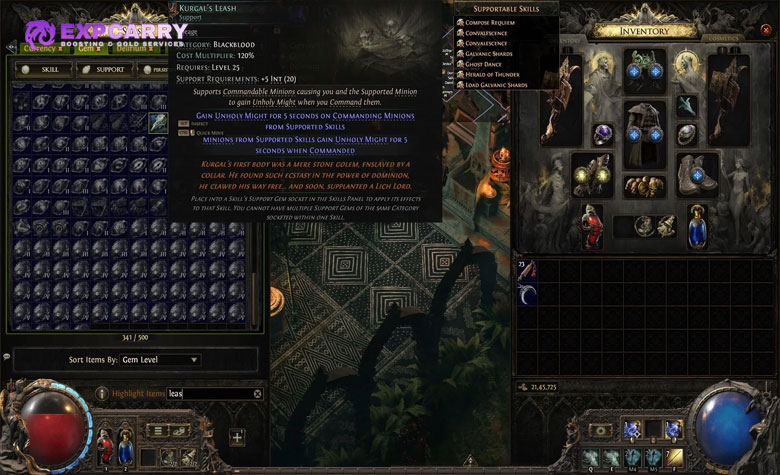
Minions are separate entities. Generic player modifiers such as ordinary increased Attack Damage, Spell Damage, or another offensive stat do not automatically scale a minion simply because the player summoned it. Look for wording that explicitly affects Minions, Allies, the relevant Minion Skill, or the enemy being attacked. This is the central rule that prevents wasted passive points and gear affixes.
Minion Skill Gem Levels Are a Core Scaling Layer
Keeping the main minion Skill Gem current improves the underlying skill rather than adding a conditional bonus around it. Higher minion skill levels can improve the minion's base values and are therefore valuable before more specialized scaling. Effects that grant levels to Minion Skills and the Minion Mastery Support are useful because they strengthen the skill at its foundation.
This does not mean every gem should be upgraded immediately. Higher levels can raise requirements, and support setups still need valid attribute capacity and compatibility. Upgrade the core damage minions first, then the command or support minions whose improved level actually changes their value.
Minion Damage Modifiers vs Player Damage Modifiers
After gem level, identify the exact damage profile of the minion. A physical melee minion, elemental projectile minion, spellcasting minion, and ailment-focused minion do not want the same support package. Minion damage, minion attack or cast speed, minion critical stats where relevant, and compatible damage-type supports are direct tools. Player-only offensive modifiers are not substitutes for them.
| Scaling layer | Does it help minions? | How to use it |
|---|---|---|
| Levels to Minion Skills | Yes | High priority for important minion gems because it improves the underlying skill. |
| Minions deal increased or more Damage | Yes | Direct army scaling when the wording applies to the minion. |
| Minion attack or cast speed | Yes when the minion uses the relevant action | Strong when it raises real action frequency without creating another bottleneck. |
| Generic player Spell or Attack Damage | Normally no | Do not allocate it for the minion unless another effect explicitly creates an interaction. |
| Allies in your Presence modifiers | Yes when the minions qualify as Allies in Presence | Common Sceptre-style support layer that can affect the army around the player. |
| Enemy curses, Exposure, Shock, or Armour reduction | Indirectly | Debuff the enemy so relevant minion hits or ailments deal more effective damage. |
| Additional useful minions from Spirit | Indirectly | More bodies increase output only when the extra unit attacks reliably and survives. |
The most useful test is to ask where the damage modifier lives. If it changes the minion, the Minion Skill, an Ally in your Presence, or the enemy's defences, it can contribute. If it only increases damage dealt by you, it usually does not.
More Minions vs Stronger Minions
Adding another minion is multiplicative with the quality of the army only when all units can reach targets, attack consistently, and survive. In narrow terrain or against mobile bosses, another body may contribute less than expected. Better gem levels, attack or cast speed, command timing, or a debuff can provide more real damage than maximizing head count.
A simple breakpoint test is to remove one marginal minion or persistent effect and compare clear speed, boss phase time, and army survival. If the build feels the same, the reserved Spirit may be better spent elsewhere. If damage drops sharply, that unit belongs in the core army.
Explore services related to this guide, selected from our Path of Exile 2 catalog.
View All Path of Exile 2 Services


PoE 2 Minion Survivability: How to Keep Minions Alive
Minion survivability is damage uptime. A support that lowers paper DPS but prevents repeated deaths can increase real boss damage because the minion stays active. Build defence around the damage pattern that actually kills the army: elemental hits, repeated physical hits, burst damage, or a mechanic that wipes several units at once.
Minion Life, Resistances, and Damage Reduction
Maximum minion Life increases the amount of damage a unit can absorb before dying. Elemental Resistances reduce elemental damage, while Chaos Resistance reduces chaos damage when the minion has access to those stats. Damage reduction and defensive supports can protect against large hits or repeated pressure. These layers work best together rather than trying to solve every encounter with a single large Life pool.
Elemental Army is a straightforward option when elemental damage is the problem because it grants elemental resistances to supported minions. Meat Shield I or II takes a more direct approach by reducing damage taken at the cost of supported minion damage. That trade can be excellent on a utility or command minion whose survival matters more than its personal DPS.
Balance Minion Damage and Survivability
Defensive investment should target the minions that are actually dying. If ordinary mapping never threatens the army but one boss mechanic causes a wipe, replacing every offensive support with defence can overcorrect the problem. Consider command skills, positioning, resistance support, a defensive Offering, or one dedicated recovery tool before dismantling the whole damage setup.
The opposite mistake is more common: stacking only damage until every difficult encounter creates a full revive cycle. If a minion spends a large part of a boss fight dead, remove one aggressive support and test a defensive replacement. A smaller tooltip with much higher uptime can be the stronger build.
Summoner Defences Still Matter
An army does not make the summoner invulnerable. Boss area effects, projectiles, ground hazards, teleports, and enemies that bypass the frontline can still kill the player. The character needs appropriate resistances, a real Life or Energy Shield plan, recovery, movement, and defensive layers for the content being attempted.
This creates a useful gearing priority: first make sure the player survives, then make sure the army survives, then spend the remaining budget on more damage. A dead minion eventually returns. A dead player ends the attempt.
PoE 2 Minion Revival and Recovery
Reviving minions return automatically after their death cycle, but automatic recovery is not the same as uninterrupted uptime. When several important units die together, the build can lose both damage and utility until enough of the army is back. Recovery tools exist to shorten or bridge that vulnerable period.
Grim Feast in PoE 2 Is a Minion Recovery Skill
Old PoE 2 guides can be misleading here. In the 0.3.0 Third Edict overhaul, Grim Feast was completely reworked. Dead Reviving Minions create remnants that Grim Feast can collect, and the active Grim Resurrection function can spend the stored life to revive minions immediately based on their maximum Life. The old Energy Shield overflow identity is obsolete.
This makes Grim Feast valuable when the build can predict army deaths and collect enough remnants to rebuild quickly. It is not a reason to ignore minion defence. If the entire army repeatedly dies before the recovery loop stabilizes, the build is spending too much time rebuilding instead of dealing damage.
Skeletal Cleric and defensive commands can stabilize the army
Skeletal Cleric is a recovery-oriented minion rather than a pure damage slot. Its value rises when preserving the rest of the army prevents a long downtime window. The same logic applies to defensive command abilities such as the Skeletal Frost Mage's Ice Armour command, which was updated to reduce hit damage taken by minions in its area.
These tools are strongest when used before or immediately after a dangerous boss pattern rather than on cooldown without context. Learn which mechanic kills the army, keep the defensive command ready for that mechanic, and let offensive supports handle phases where survival is already stable.
Sacrifice Slows Minion Revival
Sacrifice allows undead Reviving Minions to be used in corpse-style interactions, but the skill carries a real army-uptime cost. The official 0.4.0 patch notes list the current high-level penalty as Minions Revive 46-40% more Slowly at gem levels 14-20. That downside must be treated as part of the build, not as flavour text.
If Sacrifice is central to the damage engine, compensate with stronger minion defences, better recovery, or a combat plan that does not require every sacrificed unit to be immediately available. If Sacrifice is only providing marginal utility but repeatedly leaves the army empty during bosses, it may be costing more damage than it creates.
Best Support Gems for PoE 2 Minion Builds
Support selection should solve a specific army problem: more damage, faster clear, better target coverage, stronger mixed-army scaling, or survival. Since the 0.3 support overhaul, the old character-wide one-copy restriction is gone, so the same Support Gem can be used on more than one compatible skill. Compatibility and attribute capacity still have to be checked for each supported setup.
ExpCarry's PoE 2 Skill and Support Gems guide covers sockets, tiers, requirements, and the general support system. For summoners, the table below focuses only on what problem each minion-oriented support solves.
| Support or tool | Main purpose | Important trade-off or condition |
|---|---|---|
| Minion Mastery | Raises the level of the supported Minion Skill | Best on a minion where skill level materially improves the core unit. |
| Muster | Rewards an army using different types of Reviving Minions | Needs genuine army diversity; do not add weak minion types only to chase the bonus. |
| Feeding Frenzy I / II | Increases supported minion damage | Supported minions also take more damage, so it can worsen revive downtime. |
| Minion Splash I / II | Adds melee splash to compatible Strike minions | Clear-focused; only works for minion skills that satisfy the Strike support condition. |
| Elemental Army | Adds elemental resistance to supported minions | Defensive value depends on what damage is killing the army. |
| Meat Shield I / II | Reduces damage taken by supported minions | Also reduces their damage, making it better for utility or tank roles than every main DPS setup. |
| Last Gasp | Keeps a persistent minion fighting for a short fatal-wound window after reaching zero Life | It delays the loss rather than preventing death permanently; plan around the final window. |
Patch 0.5.0 added Minion Splash I and Minion Splash II and fixed several cases where supports meant for skills "you use yourself" incorrectly affected minions. Those support rules remain relevant in 0.5.5, so current support text matters more than an old build guide or a remembered interaction from an earlier patch.
Match Support Gems to the Minion's Actual Damage
A support can be tagged as valid and still be inefficient. Identify whether the minion uses Attacks or Spells, melee Strikes or projectiles, physical or elemental damage, hits or ailments, and whether it needs area coverage or single-target damage. Then choose the support that modifies the action that actually carries the build.
For players still assembling the correct support pool, ExpCarry's PoE 2 Uncut Support Gems service is a relevant acquisition option. For self-play, do not engrave every Uncut Support Gem immediately; keep enough flexibility to adjust the army after testing clear, bosses, and survival.
Feeding Frenzy and Meat Shield: Damage vs Survivability
Feeding Frenzy trades defence for damage, while Meat Shield trades damage for defence. Neither is automatically correct. A durable main damage minion can exploit an aggressive support. A Cleric, command unit, or other utility minion may gain more total build value from surviving than from dealing extra personal damage.
The cleanest setup often gives different jobs to different units. Damage minions receive offensive supports, while the units responsible for recovery, commands, or protection receive enough defence to remain available when the build actually needs them.
PoE 2 Minion Supporting Skills and Enemy Debuffs
A minion build is not limited to summoning more bodies. The player can increase army performance by weakening enemies, applying relevant ailments, creating Exposure, reducing Armour, or using a Curse that matches the minions' damage. These effects scale the result from the enemy side rather than pretending player damage modifiers apply directly to minions.
Match Curses, Exposure, and Armour Reduction to Minion Damage
Elemental minions benefit when the enemy's relevant elemental defence is reduced. Physical hit minions can benefit from mechanics that reduce or break Armour when the interaction applies. Shock can increase damage taken when the build can apply a meaningful Shock. A generic Curse is not useful simply because it is a Curse; choose the debuff that matches the army's damage.
This is especially powerful for large armies because one debuff can improve the output of many minions at once. A player action that increases effective damage for the entire army can outperform another small personal damage skill that competes for cast time and attention.
Keep the Summoner Rotation Simple
Summoners can accumulate command skills, curses, offerings, movement skills, corpse tools, defensive buttons, and temporary summons. Adding every useful interaction can make the build difficult to operate. Keep the manual rotation focused on actions with a large payoff: movement, the main debuff, the most important command, and the recovery tool needed when the army collapses.
During mapping, most enemies should die without a full boss rotation. Reserve the longer setup for rares and bosses. This keeps clear speed high and reduces the chance of wasting defensive commands before an actual threat appears.
PoE 2 Minion Gear and Passive Tree Priorities
Gear should support both halves of the summoner: the army and the player. Sceptres are particularly important because they can provide Spirit and Ally-oriented effects, while other slots can supply Spirit, minion modifiers, defences, attributes, and resistances. Current endgame crafting also includes dedicated minion modifiers on some Rings and Belts through the Genesis Tree.
Use Spirit Gear to Hit Valuable Minion Breakpoints
Compare Spirit gear by what it enables. If a new item adds enough Spirit to reserve another core damage minion, an aura, or a crucial utility unit, it can be a major upgrade. If it adds capacity that remains unused, a different item with stronger minion levels, Ally effects, player defence, or attributes may be better.
Keep a stable version of the build before changing several Spirit pieces at once. Removing one item can disable a persistent skill, change the army count, and make it difficult to tell whether the new item itself is good. Change one reservation-related piece, reopen the Skills Panel, and verify the entire active setup.
PoE 2 Minion Passive Tree: Fix the Current Bottleneck
Early minion passives that add damage are attractive, but a complete tree needs more than offence. Add minion life, resistances, recovery, or other defensive nodes when deaths are reducing uptime. Add Spirit or reservation efficiency when a new reservation breakpoint is genuinely useful. Keep enough player defence to survive the content rather than assuming the army can permanently screen every attack.
A useful upgrade order is: secure the core minion skill levels, make the player's defences functional, keep the army alive through normal content, reach the next useful Spirit breakpoint, and then add more specialized damage. This prevents the build from becoming powerful only in situations where nothing fights back.
Common PoE 2 Minion Build Problems
Most summoner problems can be diagnosed by checking Spirit, skill requirements, army uptime, and support wording in that order. Do not rebuild the passive tree before confirming that the intended minions are actually enabled and supported.
There is not enough Spirit for the planned army.
Open the Skills Panel and read the final reservation after every support and persistent effect. Check campaign Spirit upgrades, Sceptre or equipment Spirit, the active weapon set, and any reservation modifiers. Disable the lowest-value persistent effect first instead of randomly removing damage minions.
The army disappears after a weapon swap or gear change.
A resource change can reduce available Spirit and force the game to remove minions. The 0.5.0 rule, still relevant in 0.5.5, prioritizes newer minions for removal first. Compare the Spirit total on both weapon sets and make sure the minion skill is enabled where you expect it. A setup that only works on one set can visibly shrink when the other set becomes active.
The minions deal much less damage than expected.
Check whether the build invested into player-only Spell or Attack Damage instead of Minion or Ally scaling. Then verify gem levels, support compatibility, damage type, enemy debuffs, and whether the minions can physically reach or target the enemy. If the core Minion Skill itself is missing or behind the level needed for the setup, ExpCarry's PoE 2 Uncut Skill Gems service is a direct acquisition option. For self-play, keep suitable Uncut Skill Gems for the main minion before upgrading secondary utility skills. Paper damage does not matter if the unit spends the fight pathing or reviving.
The minions die constantly in bosses.
Identify the damage pattern. Add elemental resistance when elemental hits are the problem, damage reduction when large hits are the problem, or more Life when the minions are simply too fragile. Test Elemental Army, Meat Shield, a defensive command, Grim Feast, or a Cleric before adding another aggressive support that further reduces survival.
A Support Gem is disabled but the minion skill still works.
This can be intentional. Since the 0.3 support-system overhaul, failing a Support Gem's attribute requirement disables that Support instead of disabling the whole Skill. Check Strength, Dexterity, or Intelligence capacity and the exact support requirement before assuming the minion gem itself is broken.
A support from an old guide no longer affects minions.
Read the current support text. GGG has fixed multiple cases where supports intended for skills used by the player also affected summoned minions. Support compatibility in an old build video or planner can therefore be obsolete even when the support name still exists.
PoE 2 Minion FAQ
These answers cover the recurring mechanical questions that matter across different summoner classes and army compositions.
Do permanent minions use Mana in Path of Exile 2?
Persistent minions normally reserve Spirit rather than repeatedly consuming Mana to remain active. Command skills and other active actions can still have their own resource costs.
Does Spell Damage increase minion damage?
Generic player Spell Damage does not automatically increase a minion's spell damage. Use modifiers that explicitly affect Minions, Allies, the Minion Skill, or the enemy's relevant defences.
Is more Spirit always better for minion builds?
More Spirit is valuable when it crosses a useful reservation breakpoint. Spirit that cannot be converted into another useful minion, aura, or persistent effect does not provide damage by itself.
Do reviving minions need to be resummoned manually?
No. Reviving minions return through their revival mechanic after death. Grim Feast can accelerate recovery for compatible dead Reviving Minions by spending stored life from collected Grim Remnants when enough is available.
Can the same Support Gem be used on two different minion skills?
Yes, if both skills are compatible and the character can satisfy the support requirements. The old character-wide one-copy Support Gem restriction was removed in the 0.3 system overhaul.
Why does my army shrink when I weapon swap?
The new weapon set may provide less Spirit or may change another resource condition. When available Spirit drops, the game removes minions to fit the new capacity. Check both weapon sets in the Skills Panel.
What should I upgrade first: another minion or minion survivability?
Add the extra minion when the current army already stays alive and the new body contributes reliable damage or utility. If the existing army repeatedly dies, improving survival usually produces more real damage through better uptime.
PoE 2 Minion Build Checklist
A strong Path of Exile 2 minion build is an uptime system rather than a contest to reserve the largest possible army. Spend Spirit on the units and persistent effects that define the combat loop, scale those units with gem levels and modifiers that explicitly affect Minions or Allies, and use enemy debuffs to improve damage from the target side. Then protect the army enough that its theoretical damage actually exists during difficult encounters.
When a PoE 2 minion build starts failing, diagnose the bottleneck instead of adding more offence. Check Spirit and weapon-set reservation, confirm support requirements, identify which damage kills the minions, and decide whether Grim Feast, a Cleric, defensive commands, Last Gasp, Elemental Army, or Meat Shield solves the problem. Once the player and the core army are both stable, additional Spirit, stronger supports, and higher minion skill levels become much more valuable because every upgrade stays active long enough to matter.