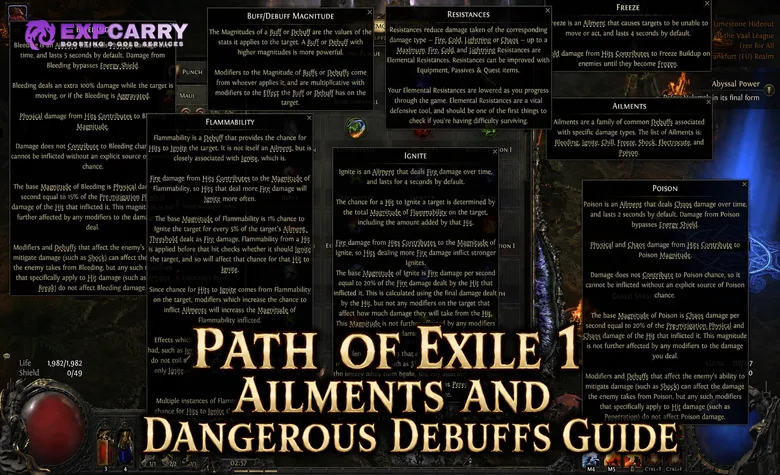
Ailments are some of the most dangerous status effects in Path of Exile 1 because they attack different parts of a character at the same time. Ignite, Bleeding, and Poison drain Life through damage over time. Chill and Freeze restrict movement and actions. Shock increases incoming damage. Scorch, Brittle, and Sap change resistances, critical strike calculations, and outgoing damage. Treating all of them as the same problem leads to incomplete defenses.
This evergreen guide separates damaging ailments, non-damaging elemental ailments, alternative elemental ailments, and dangerous effects that are not ailments. Corrupted Blood receives its own section because it is a stacking physical damage over time debuff, not an ailment and not Bleeding. The mechanics were checked against the current Path of Exile 1 version 3.29 patch notes and the earlier official updates that established the present rules.
What Counts as an Ailment in Path of Exile 1
An ailment is a defined status effect that can be inflicted on a target. PoE 1 divides the important ailments in this guide into damaging ailments and non-damaging elemental ailments. The three damaging ailments are Ignite, Bleeding, and Poison. The standard non-damaging elemental ailments are Chill, Freeze, and Shock. Scorch, Brittle, and Sap are alternative non-damaging elemental ailments.
The word elemental is important. A modifier that grants immunity to Elemental Ailments protects against Ignite, Chill, Freeze, Shock, Scorch, Brittle, and Sap. It does not protect against Bleeding or Poison. A modifier that protects from Damaging Ailments covers Ignite, Bleeding, and Poison, but not Corrupted Blood. Exact wording always takes priority over an assumed category.
| Effect | Category | Damage type or result | Key defensive check |
|---|---|---|---|
| Ignite | Damaging elemental ailment | Fire Damage over Time | Ignite avoidance, immunity, removal, duration, and Fire Resistance |
| Chill | Non-damaging elemental ailment | Reduces Action Speed | Reduced Chill effect, avoidance, immunity, or unaffected |
| Freeze | Non-damaging elemental ailment | Stops actions by reducing Action Speed to zero | Cannot be Frozen, avoidance, immunity, duration, or unaffected |
| Shock | Non-damaging elemental ailment | Increases damage taken | Reduced Shock effect, avoidance, immunity, or unaffected |
| Scorch | Alternative elemental ailment | Lowers all Elemental Resistances | Elemental ailment avoidance, immunity, or unaffected |
| Brittle | Alternative elemental ailment | Adds base Critical Strike Chance against the affected target | Elemental ailment avoidance, immunity, or unaffected |
| Sap | Alternative elemental ailment | Makes the affected target deal less damage | Elemental ailment avoidance, immunity, or unaffected |
| Bleeding | Damaging non-elemental ailment | Physical Damage over Time with extra danger while moving | Bleed avoidance, immunity, removal, and physical DoT mitigation |
| Poison | Damaging non-elemental ailment | Stacking Chaos Damage over Time | Poison avoidance, immunity, removal, Chaos Resistance, and recovery |
| Corrupted Blood | Debuff, not an ailment | Stacking Physical Damage over Time | Protection that explicitly names Corrupted Blood |
How Ailment Chance, Magnitude, and Duration Work
Applying an ailment and determining its result are separate steps. A hit may have a chance to Ignite, Freeze, Shock, Scorch, Brittle, Sap, Bleed, or Poison. If the ailment is inflicted, its damage, magnitude, or duration is then determined by the relevant hit, skill rules, ailment threshold, and modifiers. Chill from a hit is a special case because eligible Cold Damage can inflict it without a separate chance roll. Some skills, critical strikes, ground effects, and fixed-value sources use additional rules.
For hit-based non-damaging ailments, the target's ailment threshold determines how much effect or duration the hit can produce. Larger relevant elemental hits generally create stronger Chill, Shock, Scorch, Brittle, or Sap, while Freeze uses the hit to determine duration rather than a variable magnitude. A hit-based Freeze is discarded if its calculated duration is below 0.3 seconds. Bosses are therefore much harder to affect strongly than ordinary monsters. A build may show 100% chance to Shock but still create only a weak Shock if the Lightning hit is small. Chance to inflict does not guarantee maximum effect.
Duration answers a different question: how long the ailment remains. Increased effect does not automatically extend duration, and reduced duration does not reduce the magnitude of an ailment while it is active. Freeze is the important exception to the usual magnitude discussion: hit-based Freeze has a duration calculation rather than a variable magnitude. Ground effects can continuously reapply an ailment, so shortening duration may provide little protection while the character remains on the ground.
- Chance: Determines whether an eligible hit applies the ailment.
- Magnitude: Determines the strength of Chill, Shock, Scorch, Brittle, or Sap.
- Damage: Determines the damage per second of Ignite, Bleeding, or Poison after relevant modifiers.
- Duration: Determines how long the effect remains unless removed, refreshed, or replaced; for hit-based Freeze, duration is also the key threshold for whether the Freeze applies at all.
- Ailment threshold: Controls how difficult it is for a hit to create a meaningful non-damaging ailment on that target.
Ignite: Fire Damage over Time
Ignite is a damaging elemental ailment that deals Fire Damage over Time. Fire Damage from a hit can contribute to Ignite unless a skill or modifier allows other damage types to Ignite. Critical strikes with damage that is capable of Igniting have 100% chance to Ignite unless another rule prevents the ailment, while non-critical hits normally need chance to Ignite or another guaranteed source.
Multiple Ignites can exist on one target, but only the strongest normally deals damage at a time. Applying a weaker Ignite does not add its damage to the active one. Special modifiers can change how many Ignites deal damage, so an Ignite build must read its unique items and passive effects rather than assuming normal stacking.
For defense, Fire Resistance reduces Ignite damage taken because Ignite deals Fire Damage. Reduced Ignite duration shortens the effect, while faster expiration and removal can end it sooner. Ignite immunity or avoidance prevents the ailment from becoming an active threat. Recovery must be strong enough to survive the damage that remains after mitigation.
Important distinction: Ignite is a type of burning, but not all burning is Ignite. Burning Ground, Righteous Fire, Searing Bond, and other Fire Damage over Time effects are not automatically Ignites. A character that cannot be Ignited can still take damage from Burning Ground unless another modifier covers that ground effect or Fire Damage over Time generally.
Explore services related to this guide, selected from our Path of Exile catalog.
View All Path of Exile Services

Chill and Freeze: Two Different Cold Ailments
Chill and Freeze are separate non-damaging elemental ailments associated with Cold Damage. Chill reduces Action Speed, which slows movement, attacks, casts, traps, mines, and other animations controlled by Action Speed. The ordinary maximum Chill effect is 30%, although specific mechanics can alter maximum effect or apply a fixed value.
Freeze is not simply a stronger icon for Chill. Freeze reduces Action Speed to zero and prevents normal actions for its duration. A source that says Cannot be Frozen does not automatically prevent Chill. Likewise, reduced Chill effect does not by itself provide complete Freeze protection.
Hit-based Chill and Freeze use the target's ailment threshold differently. Chill uses the hit to determine its magnitude, while Freeze uses the hit to determine its duration and is discarded if that duration is below 0.3 seconds. Fixed Chilled Ground and other skill-specific sources may apply a stated value without using the ordinary hit calculation. This is why a small Cold hit can fail to Freeze a boss even when the character has chance to Freeze.
| Cold threat | What it does | What does not fully solve it | Reliable answers |
|---|---|---|---|
| Chill | Reduces Action Speed by a variable or fixed magnitude | Cannot be Frozen alone | Reduced Chill effect, Chill avoidance, immunity, or unaffected by Chill |
| Freeze | Reduces Action Speed to zero for its duration | Reduced Chill effect alone | Cannot be Frozen, Freeze avoidance, immunity, shorter duration, or unaffected by Freeze |
| Chilled Ground | Applies Chill while the character remains in its area | Reduced duration when the ground immediately reapplies the ailment | Reduced effect, immunity, unaffected, or leaving the area |
During the campaign, Freeze protection is often more urgent than perfect Chill mitigation because losing every action can cause an immediate death. A coherent PoE 1 league starter setup should still plan both effects before entering maps with stronger elemental ailments.
Shock: Increased Damage Taken
Shock is a non-damaging Lightning ailment that increases all damage taken by the affected target. It does not deal Lightning Damage over Time. The normal maximum effect is 50% increased damage taken, but specific skills and modifiers can raise the maximum or apply a fixed Shock value.
A hit with a high chance to Shock may still create a low-magnitude Shock against a boss if its Lightning Damage is small relative to the boss's ailment threshold. Conversely, a skill that applies a fixed or minimum Shock can provide a predictable effect. For players, even a moderate Shock makes every physical, elemental, and chaos hit or damage over time effect more dangerous.
Shock immunity and avoidance prevent the ailment from applying. Reduced Shock effect lowers its magnitude but does not itself prevent Shock from being inflicted; at 100% reduced effect, the Shock can still be present while having no harmful effect. Reduced duration shortens hit-based Shock, while Shocked Ground can reapply it. Lightning Resistance does not reduce the increased-damage-taken multiplier from an existing Shock; it only mitigates Lightning Damage according to the normal resistance calculation.
Scorch, Brittle, and Sap: Alternative Elemental Ailments
Scorch, Brittle, and Sap are alternative non-damaging elemental ailments. They are associated with Fire, Cold, and Lightning Damage respectively, but they are not Ignite, Chill, Freeze, or Shock. Sources such as Secrets of Suffering prevent the standard elemental ailments from being inflicted by the character and cause critical strikes to inflict the corresponding alternative ailments when the hit deals the relevant elemental damage.
| Alternative ailment | Associated damage | Maximum ordinary effect | What the effect means |
|---|---|---|---|
| Scorch | Fire | 30% lower Elemental Resistances | Lowers Fire, Cold, and Lightning Resistance; it is separate from Exposure and curses |
| Brittle | Cold | +6% base Critical Strike Chance against the target | Adds to the base critical chance used before increased Critical Strike Chance modifiers |
| Sap | Lightning | 20% less Damage dealt | Reduces damage dealt by the affected target rather than increasing damage taken |
Brittle is the value most often copied incorrectly from old guides. Its maximum was reduced from +15% to +6%, with a default value of +2%, in the official Path of Exile 1 version 3.19 patch notes. A current build calculation must not use the old +15% cap.
Scorch is not elemental penetration. It changes the target's resistance and can coexist with Exposure and resistance-reducing curses when their rules permit. Sap is not Fortification and does not reduce damage taken by the sapped target. It makes that target deal less damage. These wording differences determine which modifiers and immunities interact with each effect.
Elemental ailment immunity and chance to avoid Elemental Ailments cover Scorch, Brittle, and Sap even when a tooltip focuses on the more familiar standard ailments. Protection that names only Ignite, Chill, Freeze, or Shock covers only the named ailments.
Bleeding and Aggravated Bleeding
Bleeding is a damaging ailment that deals Physical Damage over Time. It is normally inflicted by eligible Physical Attack hits. By default, only the strongest Bleeding instance on a target deals damage. Crimson Dance changes this rule by allowing multiple Bleeds to deal damage while removing the ordinary extra damage for movement and applying its own damage penalty.
Ordinary Bleeding deals its base damage while the target is stationary and a much higher amount while the target is moving. Aggravation is a property of an individual Bleed debuff that makes its movement-style extra damage apply while the target is stationary. The strongest normal Bleed component and the strongest aggravated extra component can come from different Bleed instances. Aggravation has no effect with Crimson Dance because Crimson Dance removes the movement-based extra damage.
Armour mitigates Physical Damage from hits and, by default, does not mitigate the Physical Damage over Time from Bleeding or Corrupted Blood. Generic Physical Damage Reduction that is not derived from Armour can apply to Physical Damage over Time, and modifiers to reduced Physical Damage over Time taken can also help. Bleeding immunity, avoidance, removal, and recovery remain important. A modifier that says moving while Bleeding does not cause extra damage removes the movement penalty but does not remove the Bleed itself.
- Ordinary Bleeding is one of the three Damaging Ailments.
- Bleeding usually does not stack for damage; the strongest active instance deals damage.
- Movement greatly increases ordinary Bleeding damage.
- Aggravated Bleeding applies its movement-style extra damage while the target is stationary; it does not create a second movement bonus while the target is moving.
- Bleeding immunity does not protect against Corrupted Blood unless the modifier explicitly names both.
Poison: Stacking Chaos Damage over Time
Poison is a damaging ailment that deals Chaos Damage over Time. Under the standard rule, the Physical and Chaos portions of an eligible hit contribute to Poison. Modifiers and specific skills can allow other damage types to Poison or change how the ailment is calculated.
Unlike ordinary Ignite and Bleeding, separate Poison instances can deal damage at the same time. Fast-hitting builds can maintain many stacks, with each stack keeping its own damage and duration. There is no ordinary global one-stack damage rule for Poison. Removing existing Poisons does not prevent a rapid attacker from applying new stacks immediately.
Chaos Resistance mitigates Poison damage, but Poison immunity or avoidance is the cleaner solution when the content applies stacks faster than recovery can handle them. Reduced Poison duration lowers the life of each stack, while recovery and Chaos Damage over Time mitigation help survive unavoidable applications.
Important distinction: Poison immunity does not protect against every Chaos Damage over Time effect. Caustic Ground, Desecrated Ground, skill debuffs, and other chaos degeneration can remain dangerous because they are not necessarily Poison.
Corrupted Blood Is a Debuff, Not an Ailment
Corrupted Blood is a stacking Physical Damage over Time debuff. It is not an ailment. It is not Bleeding. It is not included in Elemental Ailments or Damaging Ailments. A character that is immune to all damaging ailments can still take Corrupted Blood damage unless another modifier explicitly protects against it.
The official Path of Exile 1 version 3.14 patch notes established the current separation: Corrupted Blood is treated as completely separate from Bleeding, and up to ten of its strongest instances normally deal damage at the same time. Bleeding-only modifiers that once affected it no longer apply unless their wording was updated to name both effects.
| Question | Bleeding | Corrupted Blood |
|---|---|---|
| Is it an ailment? | Yes, a damaging ailment | No, it is a debuff |
| Damage type | Physical Damage over Time | Physical Damage over Time |
| Default stacking behavior | Only the strongest Bleed deals damage unless a special mechanic changes the rule | Up to ten of the strongest instances normally deal damage at once |
| Movement interaction | Ordinary Bleeding deals extra damage while moving | No Bleeding movement multiplier |
| Does Bleeding immunity cover it? | Covers Bleeding | Only if the modifier also names Corrupted Blood |
| Does damaging ailment immunity cover it? | Yes | No |
Reliable answers include a jewel modifier stating that Corrupted Blood cannot be inflicted on you, a flask modifier that explicitly covers both Bleeding and Corrupted Blood during its effect, or another current item, passive, or skill that names Corrupted Blood. Always read the whole modifier. The word Bleeding by itself is insufficient.
Avoidance, Immunity, Unaffected, Effect, and Removal
PoE 1 uses several defensive terms that sound interchangeable but are mechanically different. Combining them correctly is more important than collecting random percentages across gear.
| Defense type | What it does | Common failure |
|---|---|---|
| Chance to avoid | Prevents the ailment from being inflicted when the avoidance roll succeeds | Anything below 100% remains probabilistic |
| Cannot be inflicted or immunity | Both prevent new applications of the named ailment while active; gaining immunity also removes existing instances, while a Cannot be X modifier does not necessarily remove an ailment that was already present | Exact wording still matters: immunity to one named ailment does not automatically cover related ailments, Corrupted Blood, or ground damage |
| Unaffected | The ailment can remain on the character, but its harmful effect does not apply | The ailment can still be present for mechanics that check whether the character is Ignited, Shocked, Bleeding, and so on |
| Reduced effect | Lowers the harmful effect of a non-damaging ailment; at 100% reduced effect, the ailment can still be present but its effect is nullified | It is not immunity or avoidance, because the ailment can still be inflicted |
| Reduced duration | Shortens how long the ailment remains | Ground or repeated hits can immediately reapply it |
| Removal | Ends an ailment or debuff that is already present | Does not prevent the next application unless immunity is also granted |
| Damage mitigation | Reduces the Fire, Physical, or Chaos damage dealt by a damaging effect | Does not prevent non-damaging effects such as Freeze or Shock |
One hundred percent chance to avoid Elemental Ailments is functionally dependable against the seven elemental ailments, but it does not cover Bleeding, Poison, or Corrupted Blood. Purity of Elements grants immunity to Elemental Ailments, while other builds may assemble avoidance from boots, shields, passives, jewels, and specialized items. One hundred percent reduced effect is a different defense: the ailment may still be present, but its harmful effect is reduced to zero rather than the application being prevented.
Flasks, Pantheon, Gear, and Passive Defenses
Flasks are useful for temporary coverage but should not be the only answer to an effect that must be prevented during every boss phase. Utility Flask ailment suffixes can grant immunity to a named effect during the Flask Effect while shortening the flask's duration. Life, Mana, and Hybrid Flask ailment suffixes are reactive: they grant immunity for a separate duration when used while the named effect is present. Because these reactive modifiers only grant their ailment immunity when the flask is used under the stated condition, charge availability and timing still matter.
Pantheon powers can solve or reduce specific threats such as Freeze, Chill, Shock, Ignite, Burning Ground, Bleeding, or Poison after the relevant upgrades are captured. Pantheon is most efficient when it closes one remaining gap instead of duplicating immunity already supplied by an aura or gear.
Gear and passives provide the permanent layer. Common directions include chance to avoid Elemental Ailments, ailment immunity from an aura or Ascendancy, Cannot be Frozen, reduced effect of Chill or Shock, Cannot be Ignited, Poisoned, or Bled, and a jewel that prevents Corrupted Blood. Current corruption outcomes can also provide Cannot be Ignited, Poisoned, or Bled on belts, but each line protects only the named ailment.
A full defensive plan should be evaluated with the build's reservations, attributes, resistances, flask uptime, and target content. A PoE 1 build-specific configuration is more reliable than copying an immunity package from a character that uses different gear slots and Pantheon powers.
Ground Effects and Debuffs That Are Not Ailments
Many dangerous icons and ground zones are debuffs without being ailments. Elemental ailment immunity does not automatically protect against them. Some ground effects inflict an ailment, while others deal damage or apply a separate debuff directly.
| Effect | Classification | Why ailment immunity may fail |
|---|---|---|
| Burning Ground | Ground-based Fire Damage over Time | It is burning but not Ignite |
| Desecrated or Caustic Ground | Ground-based Chaos Damage over Time | It is not Poison |
| Exposure | Resistance-reducing debuff | It is not Scorch, even though both can lower resistance |
| Withered | Stacking debuff that increases Chaos Damage taken | It is not Poison or an elemental ailment |
| Hinder | Movement Speed debuff | It is not Chill |
| Maim | Movement Speed debuff | It is not Bleeding |
| Curses | Debuffs from Hexes or Marks | Hexes and Marks need curse-specific defenses; Hexproof applies to Hexes but does not mitigate Marks, so use curse effect reduction, immunity, or Mark-specific defenses as appropriate |
| Corrupted Blood | Stacking Physical Damage over Time debuff | It is neither Bleeding nor an ailment |
Chilled Ground is different because it applies the Chill ailment. Brittle Ground applies Brittle, and other ailment ground effects can apply their named ailment. The ground object and the ailment it applies are related, but leaving the area, avoiding the ailment, and being unaffected by the ground are separate defensive approaches.
Campaign and Early Mapping Priorities
The campaign introduces ailments gradually, but the resistance penalties after major story milestones make Ignite, Shock, and elemental hits more dangerous. Freeze can prevent movement at the exact moment a boss attack must be avoided. Bleeding becomes dangerous when the player keeps running without noticing the icon, and Poison can overwhelm weak Chaos Resistance through repeated stacks.
- Acts 1 to 4: Obtain dependable Freeze protection and a way to stop Bleeding. Maintain updated Life Flasks and elemental resistances.
- Acts 5 to 10: Add Shock and Ignite mitigation, improve Chaos Resistance, and identify whether Poison is a recurring problem.
- Before maps: Decide whether Elemental Ailments will be solved by immunity, 100% avoidance, or a combination of permanent and temporary defenses.
- Early maps: Add explicit Corrupted Blood protection. Do not assume a Bleeding-only line covers it.
- Red maps: Test the setup without kill-based flask charges and against map modifiers that increase ailment effect, duration, or chance.
An ailment plan is complete only when the player can name the answer to all nine ailments in this guide and Corrupted Blood. The answer can be shared, such as Elemental Ailment immunity covering seven effects, but it must be active in the content where it is needed.
Endgame Defense Checklist by Threat
| Threat | Minimum functional answer | Preferred dependable answer |
|---|---|---|
| Ignite | Removal plus Fire Resistance and recovery | Elemental ailment immunity or 100% avoidance |
| Chill | Strong reduced Chill effect | Immunity, avoidance, or unaffected by Chill |
| Freeze | Cannot be Frozen | Elemental ailment immunity or 100% avoidance |
| Shock | Strong reduced Shock effect | Elemental ailment immunity or 100% avoidance |
| Scorch, Brittle, and Sap | Awareness of content that can inflict them | Elemental ailment immunity or 100% avoidance |
| Bleeding | Reliable removal and awareness while moving | Cannot be Bled or 100% Bleeding avoidance |
| Poison | Chaos Resistance, removal, and recovery | Cannot be Poisoned or 100% Poison avoidance |
| Corrupted Blood | Flask effect explicitly covering Corrupted Blood | Corrupted Blood cannot be inflicted on you |
Permanent immunity is not required for every character, but the fallback must work without monsters to refill flasks. If a jewel, belt corruption, or other item closes the final gap, compare it with the rest of the PoE 1 gear progression so that the upgrade does not break resistances, attributes, or another defensive layer.
Common Ailment and Debuff Mistakes
| Mistake | Why it is wrong | Correct interpretation |
|---|---|---|
| Calling Corrupted Blood an ailment | Damaging ailment modifiers do not cover it | It is a separate stacking Physical Damage over Time debuff |
| Assuming Bleeding immunity prevents Corrupted Blood | The effects were separated and must be named independently | Use a modifier that explicitly includes Corrupted Blood |
| Using the old +15% Brittle cap | The maximum was reduced in version 3.19 | Current maximum Brittle is +6% base Critical Strike Chance |
| Treating Ignite immunity as all burning immunity | Burning Ground and other Fire DoT effects are not necessarily Ignite | Check whether the source is Ignite, burning ground, or another Fire DoT |
| Treating Poison immunity as all chaos DoT immunity | Caustic and Desecrated Ground are not Poison | Use Chaos Resistance and ground or generic DoT mitigation where required |
| Assuming Cannot be Frozen also prevents Chill | Freeze and Chill are separate ailments | Add reduced Chill effect, immunity, avoidance, or unaffected by Chill |
| Assuming 100% chance to Shock means 50% Shock | Chance and magnitude are separate calculations | Check the displayed effect or calculate it against the target threshold |
| Relying on reduced duration against ailment ground | The ground can reapply the ailment continuously | Use reduced effect, avoidance, immunity, unaffected, or leave the area |
Final Ailment Audit
- Ignite is covered without assuming immunity to Burning Ground.
- Chill and Freeze have been checked separately.
- Shock cannot multiply incoming damage during critical encounters.
- Elemental ailment protection includes Scorch, Brittle, and Sap.
- Bleeding protection accounts for movement and Aggravated Bleeding.
- Poison protection remains effective against repeated stacks.
- Corrupted Blood has an explicit answer that names Corrupted Blood.
- Chaos Resistance is not being mistaken for Poison immunity.
- Armour itself is not being counted as Bleeding or Corrupted Blood mitigation; separate generic Physical Damage Reduction is treated independently.
- Flask coverage has been tested during bosses without kill-based refills.
- Ground effects, Exposure, Withered, Hinder, Maim, and curses are not being mistaken for ailments.
- Old Brittle values and pre-3.14 Corrupted Blood interactions are not used.
Conclusion
Path of Exile 1 ailments are easiest to manage when they are grouped by their actual mechanics. Ignite, Bleeding, and Poison are damaging ailments, but they deal Fire, Physical, and Chaos Damage over Time and stack differently. Chill, Freeze, and Shock are standard non-damaging elemental ailments. Scorch, Brittle, and Sap are alternative elemental ailments with different offensive and defensive consequences.
Corrupted Blood belongs outside those groups. It is a stacking Physical Damage over Time debuff, not an ailment and not Bleeding, and up to ten of its strongest instances normally deal damage together. It requires protection that explicitly names Corrupted Blood. Build defenses around exact wording, separate chance from magnitude and duration, remember that Freeze is governed by hit-based duration rather than variable magnitude, and test temporary coverage without easy flask refills. That approach creates a reliable ailment plan for the campaign, mapping, and endgame bosses without relying on outdated mechanics.