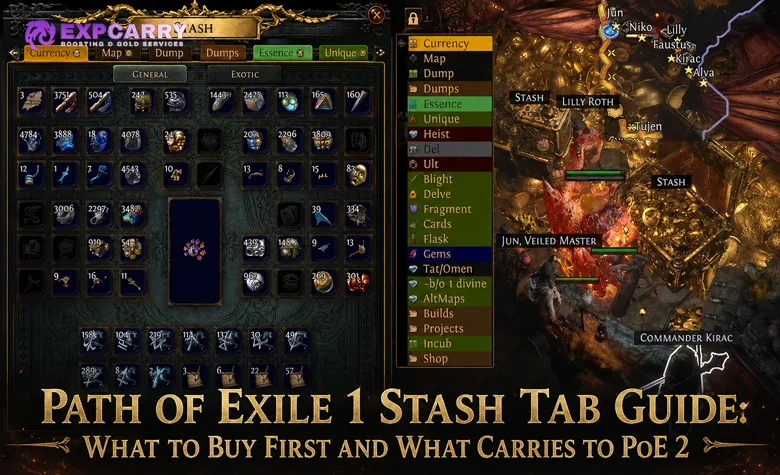
Path of Exile 1 stash tabs are one of the few purchases that can permanently improve every league, but buying them in the wrong order is an easy way to waste Points. The best first purchase for almost every player is the Currency Stash Tab. After that, the correct order depends on whether you play Trade or SSF: Trade players get unusually high value from a Fragment Tab and one Merchant's Tab, while SSF players can ignore Merchant entirely and move toward Fragment and Map storage. A Premium Quad Tab is excellent later, but it is usually a luxury before the core specialised tabs are covered.
The buying order has also changed after recent PoE 1 updates. Merchant's Tabs support asynchronous trading in Path of Exile 1, while the 3.28 Atlas rework made regular Map items generic by tier instead of tying them to one named Map area. That system remains in place in 3.29 Curse of the Allflame, so the old pressure to buy a Map Stash Tab immediately is still lower than it was before 3.28. Version 3.29 also increased the capacity of most Currency, Fragment, Divination Card and other stackable items in their respective specialised tabs to 10,000. Most importantly, many stash-tab purchases are shared with Path of Exile 2 where the corresponding tab is supported. The purchase carries across; the items inside your PoE 1 stash do not.
PoE 1 Stash Tabs: What to Buy First
For a new account, think in terms of problems solved per Point rather than raw storage size. Currency removes the largest stacking problem, Fragment handles a huge range of endgame pieces and Scarabs, Merchant unlocks modern asynchronous selling in Trade, Map handles long-term map volume, Premium adds flexible normal storage and public listings, and Quad becomes valuable when fast dumping matters more than another specialised tab.
| Stash tab | Standard price | New-player priority | Best for | PoE 2 value |
|---|---|---|---|---|
| Currency Stash Tab | 75 Points | 1 | All players | Supported, with game-specific currency slots |
| Fragment Stash Tab | 75 Points | 2 | Maps, Scarabs, bosses, SSF | Supported in PoE 2 since 0.5.0 |
| Merchant's Tab | 40 Points | 2-3 in Trade | Asynchronous item sales | Supported in both games |
| Map Stash Tab | 150 Points | 3-5 | Heavy mapping and long-term map storage | Supported in both games |
| Premium Stash Tab | 40 Points | 3-5 | Flexible storage and public manual listings | Supported in both games |
| Upgrade to Premium | 15 Points | High under tight budgets | Turning an existing regular tab into a public Premium tab | Premium functionality is cross-game where supported |
| Premium Quad Stash Tab | 150 Points | Later | Dumping large amounts of general loot | Supported in both games |
These are standard prices, not a claim that a stash-tab sale is active when you read this. GGG runs recurring stash-tab sales, so the correct shopping habit is to decide your priority first and then check the displayed store price. Do not buy a lower-priority tab simply because it happens to fit the last 30 or 40 Points in the account.
Best PoE 1 Stash Tabs for 100, 200 and 300 Points
Your budget should set a ceiling, not force you to spend every Point. The recommendations below use standard store prices and separate Trade from SSF because Merchant has no value as an SSF selling tool, while Map storage becomes more attractive for long-term self-found progression.
Best Stash Tabs for a 100 Point Budget
One hundred Points is enough to fix the biggest stash problem, but not enough to buy every modern Trade convenience at full price. The safest universal purchase is the Currency Stash Tab for 75 Points. A Trade player can then upgrade one existing regular tab to Premium for 15 Points, spending 90 total and keeping 10 Points.
100 Points for Trade League.
Buy Currency Stash Tab first, then use a 15-Point Premium upgrade on one of your existing regular tabs if you need a public sale tab. That gives you organised currency storage plus a normal Premium tab that can be renamed, coloured, made public, and used for traditional trade listings.
Do not replace Currency with a Merchant's Tab just because Merchant costs less. Merchant solves selling; Currency solves constant inventory pressure from the first acts through endgame. At 100 Points, buying Currency first creates more daily value for a completely new player.
100 Points for SSF.
Buy Currency for 75 and keep the remaining 25 Points. Merchant's Tabs are not usable in SSF leagues, so they provide no reason to spend the balance. Wait until you have played enough maps to learn whether Fragment, Map, Essence, Gem, or another specialised tab is actually creating the next problem.
This is a case where not spending all the budget is the correct recommendation. Points do not expire because your stash has 25 left over.
Best Stash Tabs for a 200 Point Budget
Two hundred Points is the first budget where a Trade player can build a strong modern core without waiting for a sale. Currency, Fragment, and Merchant cost 190 Points at standard prices and cover three different problems rather than buying three versions of generic storage.
200 Points for Trade League.
The recommended full-price order is Currency 75 + Fragment 75 + Merchant 40 = 190 Points. Currency organises the game's most common stackables. Fragment absorbs Scarabs and many endgame access items. Merchant provides asynchronous sales for eligible items, including sales that can complete while you are offline.
This setup deliberately skips Map at first. Since PoE 1 version 3.28, regular Map items have been generic by tier rather than being separate Mesa, Strand, Jungle Valley, and other Map items in your inventory. The system remains in place in 3.29. The Map Tab is still excellent, but the storage crisis it solved in older Atlas versions is less severe for a fresh account.
200 Points for SSF.
Buy Currency and Fragment for 150 Points, then keep the remaining 50 until a real bottleneck appears. An Essence Tab can become a sensible next purchase for a player heavily farming Essence, while a Gem or Flask Tab can help a long-term SSF collector. None of them is automatically better than waiting for a future Map or Quad purchase.
If your character is still building out the Atlas, a focused PoE Atlas progression route is relevant to missing Atlas objectives rather than stash capacity. The tab decision should still be based on what your account repeatedly needs to store.
Best Stash Tabs for a 300 Point Budget
Three hundred Points is enough to create a complete practical SSF mapping setup or a very strong Trade setup, but the two carts should not be identical. The mistake is assuming that a larger budget means every Point must be spent immediately.
| Budget | Recommended purchase order | Standard total | Points left | Best for |
|---|---|---|---|---|
| 100 Trade | Currency + Premium Upgrade | 90 | 10 | Basic storage plus manual selling |
| 100 SSF | Currency | 75 | 25 | Universal first purchase |
| 200 Trade | Currency + Fragment + Merchant | 190 | 10 | Modern Trade core |
| 200 SSF | Currency + Fragment | 150 | 50 | Core crafting and endgame storage |
| 300 Trade | Currency + Fragment + Merchant, then wait for Map/Quad need or a sale | 190 | 110 | Best disciplined cross-game value |
| 300 SSF / mapper | Currency + Fragment + Map | 300 | 0 | Long-term mapping without Trade |
For Trade, the 190-Point core is still the strongest base. At standard prices, the next Map or Quad purchase costs 150, so forcing the remaining 110 into several small specialised tabs can make the account worse rather than better. Keep the Points until you can identify the next permanent friction or until a stash-tab sale changes the arithmetic.
When a 300 Point Trade Player Should Buy Map Instead.
If you already own a Premium or Merchant selling solution and you are spending most sessions in maps, you can change the budget. Currency 75 plus Fragment 75 plus Map 150 uses all 300 Points and creates an excellent PoE 1 mapping stash. You give up the new Merchant purchase, so this variant makes the most sense when Trade selling is already covered.
When to Turn the Remaining Points Into Smaller Tabs.
Only do this after your loot tells you what is overflowing. An Essence farmer can justify Essence. A player saving hundreds of gems can justify Gem. A collector may value Unique Collection. A new player who has not reached the mechanic yet is buying a hypothetical problem.
Currency Stash Tab Is Still the Best First Purchase
Currency wins because it is relevant before maps, after maps, in Trade, in SSF, and in both Path of Exile games where supported. It removes piles of individual stacks from generic tabs and gives the account a permanent home for crafting and trade currency. PoE 1 version 3.29 also increased the maximum capacity of most Currency and other supported stackable items in their respective specialised stash tabs from 5,000 to 10,000, further improving their long-term storage value.
The PoE 2 Early Access FAQ explains the cross-game rule directly: stash-tab purchases from Path of Exile 1 are available in Path of Exile 2 where relevant, and applicable tabs are adapted to the second game's item system. A Currency Tab does not copy PoE 1 Orbs into PoE 2. It gives the account the corresponding Currency Tab functionality there, with the slots appropriate to PoE 2.
For the underlying currencies rather than storage, the PoE 1 Currency Guide explains which core Orbs are worth using, saving, or trading. The tab makes currency easier to manage; it does not change the economic value of spending an Orb.
Explore services related to this guide, selected from our Path of Exile catalog.
View All Path of Exile Services
Fragment Stash Tab Is the New Strong Second Purchase
Fragment has become easier to recommend ahead of Map for a modern PoE 1 player. The PoE 1 tab centralises a large amount of endgame clutter, including Scarab-heavy mapping and boss-access materials. Unlike a pure collector tab, these items are repeatedly consumed during normal Atlas farming, which makes the organisation valuable every session. The 3.29 increase to the capacity of most stackable Fragment items in their appropriate specialised storage also makes the tab more comfortable for long-term farming.
The cross-game value also improved. Path of Exile 2 update 0.5.0 added Fragment Stash Tab support and made existing PoE 1 Fragment purchases available there. In PoE 2 the same account feature is adapted to that game's fragments and endgame items rather than mirroring the exact PoE 1 layout.
Why Fragment Can Beat Map for a New Player
PoE 1's Atlas changed fundamentally in 3.28. The official 3.28 patch notes removed the old relationship between each regular Map item and a named Map area. A generic Tier 10 Map can now be used on an eligible Tier 10 Atlas location selected by the player. This system remains part of the Atlas in 3.29.
Fragments did not receive the same simplification. Scarabs and different access items still represent many distinct resources with different purposes, so Fragment storage remains a high-frequency organisation problem. That is the main reason an old "Currency then Map, always" recommendation needs updating.
Merchant's Tab vs Premium Stash Tab
Merchant and Premium are not upgraded versions of the same tool. A Premium Stash Tab is normal storage with extra organisation and public listing functions. A Merchant's Tab is a separate selling inventory designed for asynchronous trade. Buying one does not make the other obsolete.
| Feature | Premium Stash Tab | Merchant's Tab |
|---|---|---|
| Standard price | 40 Points, or 15 to upgrade an existing regular tab | 40 Points |
| Normal stash storage | Yes | No, it is managed as a merchant shop inventory |
| Rename and colour | Yes | Not its main purpose |
| Public/manual trade listing | Yes | Built for direct asynchronous sales |
| Can sell while offline | Traditional listings still require the normal trade flow | Yes, eligible listed items can be purchased while seller is offline |
| PoE 1 access | Stash | Faustus after reaching the required progression |
| SSF usefulness | General storage still useful | Not available for use in SSF leagues |
| Quad conversion | Premium Quad is a separate purchase | Premium Quad cannot be converted into Merchant |
The official PoE 1 3.27 patch notes added asynchronous trade to PoE 1. After reaching Act 6, Faustus can act as steward for Merchant's Tabs, allowing eligible items to be listed for direct purchase even when the seller is offline. Merchant's Tabs previously bought in PoE 2 also became available in PoE 1 when that system launched.
Buy Merchant If You Actually Trade
One Merchant's Tab is enough for many new players. Do not immediately buy a six-tab Merchant bundle because experienced traders have several. The limiting factor for a beginner is more often identifying valuable items and pricing them correctly than finding hundreds of simultaneous sale slots.
The PoE 1 Trading Guide covers the modern split between the Currency Exchange, Merchant sales, official Trade search, and manual player-to-player trading. Merchant is for items that are not available on the Currency Exchange, not as a replacement for every other market system.
Use the 15-Point Premium Upgrade Under Tight Budgets
If you only have 100 Points, upgrading an existing regular stash tab to Premium is the cheap way to gain a public normal tab without buying a separate 40-Point Premium tab. That is why Currency plus Premium Upgrade is stronger than two generic storage purchases for a new Trade account.
Do not convert old Premium tabs into Merchant functionality without understanding the consequence. Only eligible Premium tabs bought or upgraded before the Path of Exile 2 0.3.0 release can be converted through the account conversion system, and Premium Quad Tabs cannot be converted to Merchant. Converted tabs stop functioning as Premium tabs, while items already stored in them remain in a remove-only version of the original Premium tab. Read the live account conversion description before changing any eligible tab.
Is the Map Stash Tab Still Worth 150 Points?
Yes, but it is no longer an automatic second purchase. The Map Tab is still one of the best long-term quality-of-life tabs for a player who lives in the Atlas, especially when map volume becomes large. What changed is the urgency, not the usefulness.
Before 3.28, named regular Map items created many more separate stacks and made the dedicated Map Tab feel almost mandatory once mapping began. With generic tiered Map items, which remain the current system in 3.29, a regular tab or Quad can tolerate early map storage much longer. That gives a beginner time to buy Fragment or Merchant first.
Buy Map Early If You Are an SSF Mapper.
SSF cannot replace storage friction by selling excess resources or buying only the maps it needs. A Currency + Fragment + Map setup for exactly 300 standard-price Points is therefore one of the cleanest SSF purchases. It covers the resources most likely to accumulate across a long Atlas progression.
Delay Map If You Are Still Learning Endgame
If you have reached maps only recently and hold a modest number of generic Map items, the 150 Points may solve a problem you do not have yet. Use a regular tab with a Map affinity, learn how much you actually keep, and upgrade when the volume becomes annoying.
The PoE 1 Atlas Passive Tree Guide explains the generic-map Atlas and progression priorities. If the account is still earning Atlas points rather than bulk-farming, that stage can help determine whether Map storage is already worth its price.
Premium Quad Stash Tab: Great Dump Tab, Bad First Tab
A Premium Quad Stash Tab has four times the area of a normal Premium tab and can be made public, making it extremely useful as a dump tab for fast mapping. The problem for a new account is opportunity cost: at 150 Points it costs the same as a Map Tab and twice the price of Currency or Fragment.
Quad becomes attractive after specialised items already have homes. When Currency, Fragment, Maps, Essences, and other affinity items leave the dump tab automatically, the Quad can hold rares, bases, Uniques, jewels, crafting projects, and items that require manual decisions. Without those specialised destinations, a new Quad can become a larger unsorted mess rather than a solution.
Quad vs Four Premium Tabs.
One Quad has roughly four regular-tab areas in one view, which is convenient for fast dumping. Separate Premium tabs are easier to divide into categories and can be named individually. A player who wants one giant intake buffer usually prefers Quad; a player who wants several distinct sale or project tabs may prefer multiple Premium tabs.
Do not buy a Quad because a streamer uses several. High-volume farming produces a different inventory problem from a first character finishing the campaign.
What Stash Tabs Carry From PoE 1 to PoE 2?
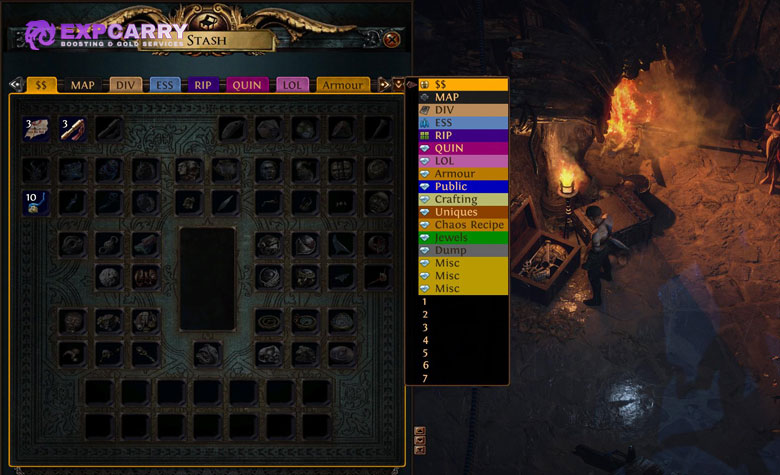
The key word in GGG's policy is purchase. The account entitlement to a supported stash tab can be shared between Path of Exile 1 and Path of Exile 2. Your league stash contents, currency, maps, items, Atlas progress, and character inventory do not become shared between the games.
GGG's official Path of Exile 2 FAQ states that PoE 1 stash purchases are available in PoE 2 where relevant and that game-specific tabs may not be usable when the related content does not exist. The layout can also be adapted: the Currency Tab is the clearest example because the two games do not have identical currency systems.
- Currency: supported in both games, with slots adapted to each game's currencies.
- Fragment: supported in PoE 1 and PoE 2; PoE 2 support was added in update 0.5.0.
- Map: supported in both games with game-specific endgame storage behaviour.
- Premium and Premium Quad: general account storage supported across both games where platform ownership allows.
- Merchant: available in both games as an asynchronous trade tool rather than ordinary stash storage.
- Mechanic-specific tabs: availability depends on whether the relevant content exists and is supported in the other game.
This cross-game value is a strong reason to prioritise Currency, Fragment, Merchant, Premium, Map, and Quad before buying an obscure PoE 1 mechanic tab. They solve broad account problems and currently have relevant use on both sides.
Cross-Game Is Not the Same as Cross-Platform.
PC, Xbox, and PlayStation ownership rules can complicate the picture. GGG's FAQ notes that stash tabs can become remove-only when you log in on a platform where you do not own the relevant microtransaction. Do not assume "works in both PoE games" means one purchase automatically bypasses every platform-store restriction.
League Resets Do Not Delete Purchased Tabs.
When a fresh league starts, the purchased tab type remains part of the account. What resets is the new league's contents and progression. A fresh league Currency Tab starts empty because your old league currency did not migrate into the new economy; the purchase itself was not lost.
How to Avoid Wasting Points on Stash Tabs
After the core purchases, the right decision is usually to wait until a repeated storage problem appears. Free affinities, different priorities in Trade and SSF, and recurring stash sales all let you delay niche purchases without losing progression.
Stash Tabs New Players Can Safely Delay
No specialised tab is universally useless. The question is whether it solves a frequent problem before Currency, Fragment, Trade, Map, or general storage. For most beginners, the tabs below are purchases to make after actual play proves the need.
- Unique Collection Tab: excellent for collectors and long-term SSF, but it is not a bulk dump tab and should not replace the core utility tabs.
- Gem Stash Tab: convenient for quality gems, alternate gems, and SSF libraries, but a new Trade character does not need to keep every gem that drops.
- Flask Stash Tab: useful for crafting projects and SSF collections, but most beginners should keep only a small set of relevant bases.
- Essence Stash Tab: very good when you actively farm Essence; lower priority when Essences are only an occasional side reward.
- Divination Stash Tab: useful for players who deliberately collect many card types, but not a stronger first purchase than Currency or Fragment.
- Breach, Delirium, Blight, Delve and other mechanic tabs: buy them when that mechanic becomes a repeated farm or collection goal, not because the tab exists in the store. Breach Stash Tab support was enabled in PoE 1 in version 3.29, but that does not make it a universal early purchase.
The recurring beginner mistake is to buy a tab for a mechanic encountered once while leaving daily currency, Scarabs, sales, or maps disorganised. Specialisation should follow your Atlas strategy rather than predict it.
Use Stash Affinities Before Buying More Storage
Stash affinities let even free regular tabs act as temporary destinations for supported item categories. When an affinity is set, Ctrl-clicking an eligible item can send it to the designated tab regardless of which stash tab is currently open. This is one of the best ways to test whether a specialised tab is worth buying.
For example, set Map affinity on a regular tab before buying Map. If the tab fills constantly and you spend too much time managing map stacks, the dedicated Map Tab has demonstrated its value. If it stays mostly empty after several days of mapping, 150 Points can wait.
Affinities Do Not Create Specialised Capacity.
A normal tab with Currency affinity is still a normal tab. It does not gain the specialised stack sizes, slot layout, sub-tabs, or capacity of a Currency Stash Tab. Affinity removes sorting clicks; the paid specialised tab removes both sorting and much of the storage pressure.
Folders also cost no Points and can reduce visual clutter. Group sale tabs, crafting projects, old gear, and specialised tabs before buying another general tab simply because the tab bar feels messy.
Trade League vs SSF Stash Tab Priorities
Trade and SSF value the same space differently. Trade can liquidate surplus items instead of storing them forever, while SSF often keeps crafting bases, fragments, gems, flasks, Essences, Uniques, and future-project items because they cannot be repurchased on demand.
Trade League Order.
A practical order is Currency, Fragment, one Merchant, then Map or Quad based on actual volume. A Premium upgrade is especially good under a 100-Point cap or when you still use traditional public listings. After that, buy mechanic tabs only for content you farm repeatedly.
If your goal is open-ended farming rather than a specific tab problem, the verified PoE hourly farming option can be used for an agreed mapping or progression objective. The loot still follows the same storage logic, so extra playtime is not a substitute for a sensible tab layout.
SSF Order.
A practical SSF order is Currency, Fragment, Map, then the specialised tab that matches the resources you are accumulating most heavily. Merchant drops out of the list completely because Merchant's Tabs are not available in SSF leagues. Unique, Gem, Flask, Essence, and mechanic tabs all gain value relative to Trade because keeping future options is more important.
SSF is also where Quad becomes attractive later. A long-running character can accumulate crafting bases and projects that do not fit a dedicated category, and one large dump/project tab can be easier to manage than many small generic tabs.
Should You Wait for a Stash Tab Sale?
If you are not actively blocked, yes. GGG runs recurring stash-tab sales and has included broad cross-game tabs such as Merchant, Premium, Extra, Premium Quad, Currency, Map, and other supported types in 2026 sales. The sale price shown in the store should always override an old discount table from a guide.
Do not delay Currency for weeks if four free tabs are already making the game miserable just to save a small number of Points. But for a 150-Point Map or Quad purchase, waiting for the next sale is much easier to justify because the absolute saving is larger and those tabs are rarely required to continue playing.
Build a Priority List Before the Sale Starts.
Write down your next two purchases before opening the sale page. This prevents a common mistake: buying three cheap niche tabs because each looks discounted and then discovering you still cannot afford the Fragment, Map, or Quad tab that would have solved the real problem.
If Trade liquidity rather than storage is the immediate limitation, the verified PoE Chaos Orb option is directly related to buying early upgrades in eligible leagues. Stash Points and in-game currency are separate decisions; spending more on one does not fix a poor plan for the other.
Common Stash Tab Buying Mistakes
The worst purchases are not bad tabs; they are good tabs bought before the account needs them. A simple priority system prevents most regret.
- Buying Map second because an old guide said so: the 3.28 generic Map system remains in 3.29 and reduced early map-storage pressure.
- Skipping Currency to buy more generic tabs: four more messy tabs do not organise the resource you touch every session.
- Buying several Merchant tabs immediately: one is enough to learn asynchronous selling and pricing.
- Treating Merchant as normal storage: it is a trading inventory managed through the merchant system, not a replacement for a Premium or Quad stash.
- Buying Merchant for SSF: Merchant's Tabs are not available for use in SSF leagues.
- Buying Quad before specialised tabs: a larger dump pile is not the same as organised Currency and Fragments.
- Buying a mechanic tab before farming the mechanic: use affinities and regular storage until the category becomes persistent friction.
- Assuming PoE 1 items transfer to PoE 2: compatible tab ownership can carry; stash contents do not.
- Ignoring platform ownership: cross-game support does not erase platform-specific microtransaction restrictions.
- Spending every remaining Point: keeping 25, 50, or 110 Points for the next sale or real bottleneck is often better than buying filler.
A stash is a workflow tool. The best purchase is the one that removes repeated sorting, trade, or storage friction from the content you actually play.
PoE 1 Stash Tab FAQ
These answers cover the questions that repeatedly appear when new players receive 100-300 Points or move between Path of Exile 1 and Path of Exile 2.
What stash tab should I buy first in Path of Exile 1?
Buy the Currency Stash Tab first. It has value throughout the campaign and endgame, works for Trade and SSF, and has relevant support in PoE 2.
What should I buy with 100 Points?
For Trade, Currency for 75 plus a 15-Point upgrade of one regular tab to Premium is the strongest full-price starter. For SSF, buy Currency and keep the remaining Points.
What should I buy with 200 Points?
For Trade, Currency + Fragment + Merchant costs 190 Points at standard prices. For SSF, Currency + Fragment costs 150 and leaves 50 for a future need.
What should I buy with 300 Points?
For an SSF mapper, Currency + Fragment + Map uses exactly 300 standard-price Points. For Trade, Currency + Fragment + Merchant is the stronger core; keep the remaining 110 until a Map, Quad, or sale creates a better purchase.
Is the Map Stash Tab still worth it?
Yes for regular mappers, but it is less urgent because the generic Map system introduced in 3.28 remains in 3.29: normal Map items are organised by tier instead of being tied to every named Atlas area.
Is Fragment or Map better after Currency?
For many current PoE 1 players, Fragment is the better second specialised purchase because Scarabs and endgame fragments remain highly varied while regular Map storage was simplified in 3.28. Heavy SSF mappers may still prefer Map early.
Should I buy a Premium Tab or Merchant's Tab?
Merchant is better for asynchronous item sales in Trade. Premium is normal stash storage that can be public and supports the traditional trade flow. Under a tight budget, upgrading an existing regular tab to Premium for 15 Points is especially efficient.
Can Merchant's Tabs sell currency?
No. Merchant's Tabs can only be used for items that are not available on the Currency Exchange. Use the Currency Exchange for supported currency and bulk-trade items.
Can I use a Merchant's Tab in SSF?
No. Merchant's Tabs are not available for use in SSF leagues.
Is a Premium Quad Stash Tab worth buying?
Yes once you produce enough uncategorised loot to need a large dump tab. It is usually not worth buying before Currency and other core specialised storage on a new account.
Do my PoE 1 stash tabs carry to PoE 2?
Supported stash-tab purchases are available across the games where relevant. Currency, Premium, Quad, Map, Merchant, and Fragment have cross-game use, but the exact layout can be adapted to each game's items.
Do the items inside my PoE 1 stash carry to PoE 2?
No. Cross-game stash-tab ownership does not merge the two games' economies, characters, or stash contents.
Does a stash tab disappear at league reset?
No. The purchased account feature remains. A new league creates a new empty league stash rather than deleting the tab purchase.
Should I wait for a stash-tab sale?
Wait for expensive later purchases such as Map or Quad when you are not blocked. If the basic free stash is already seriously hurting play, Currency is valuable enough to buy without waiting.
Which tabs should beginners avoid buying first?
Unique Collection, Gem, Flask, Divination, Essence, Breach, and other mechanic-specific tabs should normally wait until their category is actually filling your stash. None should come before Currency on a fresh account.
Conclusion
The safest Path of Exile 1 stash-tab order is no longer the old universal Currency-then-Map checklist. Currency remains the best first purchase, but Fragment now deserves serious priority because it handles high-volume endgame resources and has PoE 2 support. Trade players should add one Merchant's Tab for asynchronous sales, while SSF players should skip Merchant and move toward Map. Premium is a flexible storage and traditional trading tool, and the cheap Premium upgrade is especially good inside a 100-Point budget.
For 100 Points, solve Currency first. For 200, Trade can build the Currency + Fragment + Merchant core for 190. For 300, SSF can buy Currency + Fragment + Map exactly, while Trade should resist spending the remaining Points just to empty the wallet. The 3.28 generic Map system remains current in 3.29, while 3.29 further improved specialised stash capacity and enabled the Breach Stash Tab in PoE 1. Use affinities to test what is actually overflowing, wait for a sale when an expensive Map or Quad purchase is not urgent, and remember the cross-game rule: compatible stash-tab ownership can follow your account into PoE 2, but your PoE 1 items and league wealth stay where they were earned.