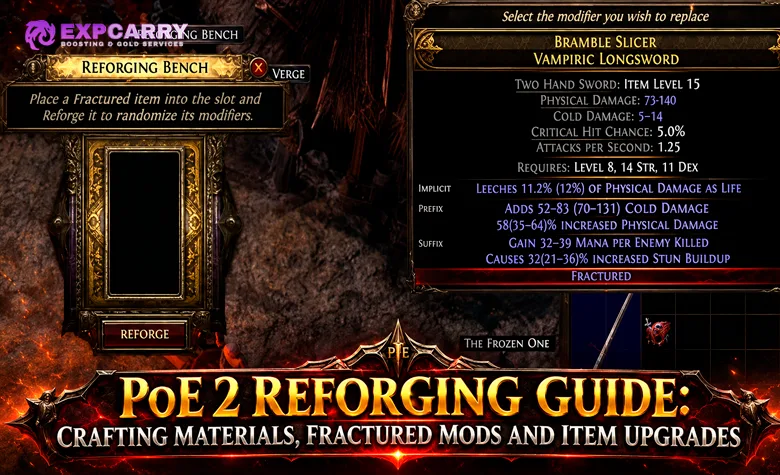
Reforging is a new item-crafting mechanic coming to Path of Exile 2 with the Conquerors of Wraeclast Challenge League on December 11, 2026 (PST). It allows players to select unwanted equipment modifiers and replace them with new fractured modifiers while keeping the useful parts of an item. The main material demonstrated at ExileCon 2026 is Crimson Iron, obtained through the league's castle treasury rewards. More specialized blood vials offer access to particular modifier effects, including build-specific interactions shown for the Shadow. The catch is that replacement modifiers become permanently locked against later ordinary crafting, and the demonstrated system does not allow repeated Reforging attempts on the same item. As of November 13, version 1.0 has not launched, so exact material costs, item restrictions, modifier pools, and crafting probabilities are not yet confirmed by live gameplay.
Short answer: Farm Conquerors castle treasuries for Crimson Iron, select the unwanted affixes on a promising item, and use the new Reforging operation to replace them with random fractured modifiers. Use blood vials when targeting their special modifier options, and commit only when you can afford an irreversible result.
How the New Reforging System Works in PoE 2
The main advantage of Reforging is control over which existing modifiers you replace. Traditional currency crafting often involves accepting a random addition or risking the removal of a valuable affix. With the new league mechanic, you identify the specific modifiers that are holding an otherwise useful item back and mark them for replacement. The remaining desirable modifiers are the reason the item is worth Reforging in the first place.
There is still a substantial random element. Crimson Iron does not guarantee that the replacement will be the exact damage, resistance, attribute, or defensive modifier your build needs. It replaces the selected affix with a new random modifier, and that result becomes fractured. The fracture protects the new modifier from later ordinary changes but also prevents you from simply rerolling it when you dislike the outcome.
GGG introduced this feature as part of the Path of Exile 2 full-release announcement. The official league description connects its crafting materials to castle treasuries, making Reforging a reward for participating in Conquerors rather than an ordinary crafting currency that players are already using in Early Access.
| Feature | Demonstrated behavior | What it means for crafting |
|---|---|---|
| Crimson Iron | Selects unwanted explicit modifiers for replacement. | You choose which existing lines to sacrifice, but not their random replacements. |
| Multiple materials | The ExileCon demonstration showed additional materials allowing multiple modifiers to be selected. | Several undesirable affixes can be targeted in one operation. |
| Fractured results | New modifiers become fractured and remain locked during later ordinary crafting. | A poor replacement can become a permanent weakness of the item. |
| Repeated Reforging | The demonstrated rules do not permit endlessly reforging the same item. | Plan the complete operation before committing materials. |
| Blood-infused materials | Provide access to particular modifier effects associated with different blood types. | Offer a more targeted alternative to completely random replacements. |
| Material sources | Castle treasuries for Crimson Iron; precise sources of individual blood materials remain unconfirmed. | Progressing the league is part of obtaining the new crafting options. |
These are the rules shown or announced before release. They are not a complete specification of every compatible item and currency interaction. In particular, GGG has not yet provided a final public list of which item rarities, special item types, existing fractured items, or corrupted items can use the new operation. Check the released item's tooltip and the crafting interface before attempting an expensive project.
New Reforging vs. the Existing Reforging Bench
One important distinction is that Path of Exile 2 already has a Reforging Bench in Early Access. Its existing recipes generally combine three eligible items or materials to create a new result. Those recipes include upgrading certain currency tiers and processing eligible equipment. The new Conquerors mechanic is different: it targets individual modifiers on an existing item using new crafting materials.
The terminology is similar because the ExileCon demonstration also used a Reforging Bench interface. However, players should not assume that the old three-item recipes provide Crimson Iron effects, or that placing three Rare items into the current bench will allow individual affix selection. The new mechanic changes the result and the consequences of the craft, not merely the number of input items.
How the Existing Bench Differs
The pre-1.0 Reforging Bench supports recipes such as combining three suitable items into a new item or combining eligible currency materials into another tier. The equipment result is a newly generated item, rather than the targeted preservation of several selected modifiers on one existing piece. That makes ordinary bench recipes more suitable for recycling unwanted items than repairing an expensive Rare with one bad affix.
Early Access players unlock the bench through Act 3 progression, but the full release expands and changes the campaign. The announcement has not established every new access requirement for the Conquerors-specific operation, so do not assume the existing Act 3 unlock alone guarantees immediate access to Crimson Iron crafting in version 1.0.
The broader PoE 2 Crafting Guide covers regular currency, Essences, Alloys and the older equipment-upgrade systems. This article focuses on the new modifier-selection mechanic and its fractured results rather than repeating every established crafting recipe.
Reforging vs. Fracturing Orb
A Fracturing Orb and Crimson Iron solve different problems. A Fracturing Orb is used to lock an existing modifier through its own random selection rules. The new Reforging mechanic lets you choose an unwanted modifier to remove, creates a replacement, and fractures that new result. In the first case, the fracture protects a modifier already on the item; in the second, it locks whatever new modifier the Reforging operation generates.
This distinction matters most on equipment with several valuable affixes. If the goal is to preserve an exceptional existing modifier, the Fracturing Orb's mechanics are relevant. If the goal is to eliminate one bad line without replacing all the good ones, Crimson Iron is the newly announced option. Neither system should be treated as a guaranteed method of producing one exact desired affix.
Where to Get Crimson Iron in Conquerors of Wraeclast
Crimson Iron is the main Reforging material demonstrated at ExileCon 2026. It is associated with castle treasury rewards unlocked through Conquerors military operations and successful sieges. The developer presentation showed league bosses providing access to castle treasuries containing gold, equipment and the new crafting resources.
The broader Conquerors progression begins during the campaign, when players meet Varek, recruit mercenaries, gather supplies and participate in military battles. The army becomes more capable as the league progresses, eventually gaining access to larger sieges and stronghold development. This creates a natural route toward more valuable treasury rewards without establishing a fixed Crimson Iron drop location or guaranteed amount.
Castle Treasuries and Crafting Material Drops
During the ExileCon demonstration, defeating a league battle boss produced a key granting access to a treasury. These rooms contain the usual rewards of a successful military operation as well as materials related to Reforging. The castle treasury system therefore gives players a reason to complete military encounters even when they are not currently interested in upgrading the army itself.
GGG has not published reliable drop probabilities for Crimson Iron, a complete list of eligible encounters, or a guaranteed material count per chest. It would also be inaccurate to promise that every campaign fight provides the same crafting rewards as later endgame sieges. Use the official ExileCon 2026 expansion overview for the announced league structure, then verify actual material sources in the version 1.0 client.
Which Conquerors Activities Should You Farm First?
Start with military encounters your character and army can clear consistently. A difficult siege may offer attractive rewards, but the cost of rebuilding troops, collecting supplies, and repeating failed attempts can make it inefficient. The better farming target is one that gives reliable access to treasuries without forcing you to spend most of the session recovering from a failed battle.
As the league develops, stronger troops and improved stronghold infrastructure may make previously difficult encounters more manageable. At that point, reassess the available castle rewards rather than continuing to farm only the earliest missions. Players still preparing a character for Atlas progression can use PoE 2 farming and progression assistance for supported activities, but no pre-launch service can establish a guaranteed Crimson Iron yield from an unreleased league.
The important difference between a profitable farm and an impressive encounter is repeatability. Record how much time and army investment each completed treasury requires once the league is live. Until those figures exist, no fixed Crimson Iron-per-hour recommendation can be considered verified.
Explore services related to this guide, selected from our Path of Exile 2 catalog.
View All Path of Exile 2 Services


How to Reforge an Item with Crimson Iron
The ExileCon demonstration established the main sequence: acquire the material, select the unwanted modifiers on an existing item, and use the Reforging interface to replace those modifiers. Because the replacements are fractured, the item should already be valuable enough to justify keeping after a reasonable result. A weak base with several unusable modifiers is usually a poor place to invest a material that cannot be recovered after an unsuccessful outcome.
The following workflow describes the demonstrated mechanic and the checks players should perform before confirming it. Exact interface button names, compatibility warnings and material costs must be verified in the released version.
- Choose a worthwhile item: Start with a weapon, armour piece or accessory whose base and existing useful modifiers justify further investment.
- Inspect its affixes: Identify the exact explicit modifiers you want to keep and the unwanted lines you are willing to replace.
- Check eligibility: Confirm that the item is accepted by the new Reforging operation and that the desired modifier selections are available.
- Prepare Crimson Iron: Have the material required for the intended replacement; the demonstration showed that additional materials can support selecting multiple affixes.
- Select unwanted modifiers: Mark the specific lines you want the operation to replace rather than choosing the item's strongest existing modifiers.
- Review the operation: Check the selected affixes, material consumption and any displayed restrictions before confirming.
- Complete the Reforging: The selected affixes are replaced by random modifiers that become fractured.
- Evaluate the result: Read the entire item again and decide whether any further ordinary crafting is legal, worthwhile and compatible with the locked modifiers.
The key choice happens before the confirmation step. You control which old modifier is sacrificed, but the normal Crimson Iron operation does not give you full control over its replacement. Adding more materials to replace more affixes therefore increases the number of permanent outcomes you must accept. That can be worthwhile when several lines are genuinely bad, but it also exposes the item to more unfavorable results.
Which Modifiers Should You Replace?
Look for an affix that contributes little to the build and is preventing an otherwise strong item from being useful. Examples include a damage modifier that does not scale your main skill, an attribute bonus you no longer need, or an irrelevant defensive stat on an item with several good lines. The best candidate is usually equipment that already performs most of its intended job and needs one meaningful improvement.
Do not select an affix solely because its number looks small. A modest amount of an attribute may be the difference between meeting a Skill Gem requirement and disabling part of the build. Likewise, resistance on one item may allow another slot to carry more offensive modifiers. Evaluate the whole character before deciding that a line has no value.
For attack weapons, preserve modifiers that genuinely improve the weapon's relevant damage and attack behavior. For caster equipment, check skill levels and applicable spell modifiers rather than valuing local weapon damage by default. For armour, consider the item's base defenses, Life or Energy Shield, resistance coverage and the requirements of the rest of the equipment set.
Should You Replace One Modifier or Several?
The demonstration showed that using additional Reforging materials can let players select more than one unwanted modifier. That offers a way to repair an item containing multiple weak lines in a single operation, but it is not automatically the best use of Crimson Iron. Every random replacement becomes another locked result, and the system is not designed for repeatedly rerolling the same item until those new lines become perfect.
Replacing one affix makes the outcome easier to judge. Replacing several is more suitable when the item is unusually valuable as a base or when the remaining strong modifiers justify a larger gamble. If an item has only one good line and several poor ones, consider using ordinary crafting on a fresh base instead of spending scarce Conquerors materials trying to rescue it.
Fractured Modifiers: What Becomes Permanent?
The defining risk of Reforging is that its newly generated modifiers become fractured. A fractured modifier is locked against ordinary attempts to change or remove it. This can be extremely valuable when the new affix is strong, because it becomes a stable part of the item. The problem is that the same protection applies when the new affix is disappointing.
GGG's ExileCon keynote demonstration showed the Reforging process and explained the consequences of locking new modifiers. The presentation does not establish that every other possible crafting operation remains available afterward. Treat the fracture as a restriction and verify the exact interaction before applying another expensive currency item.
Can You Reroll a Fractured Reforging Result?
Not through the demonstrated Reforging system. The ExileCon explanation and subsequent reporting describe the new modifier as locked, with repeated Reforging of the same item restricted. You therefore cannot plan a crafting strategy around using Crimson Iron over and over until a specific top-tier modifier appears. The ability to choose the old affix is the controlled part of the process; the final replacement remains a risk.
This matters for high-value items. A failed result may leave the original useful modifiers intact while adding a fractured line that contributes very little to the character. The item may still be wearable or saleable, but its future crafting options are now more restricted. A player buying a previously Reforged item should inspect its fractured lines rather than assuming they can be repaired later.
What Happens When You Use Other Currency on a Fractured Item?
The announced rule is that Reforged modifiers remain locked during subsequent ordinary crafting. This does not mean all other modifiers on the item automatically become immutable, nor does it mean every currency item is guaranteed to remain usable. The result depends on the operation and any item-specific restrictions, and those complete interactions have not been documented for version 1.0.
In particular, do not assume that Essences, Alloys, Annulment Orbs, Omens, Desecration, or other specialized systems can bypass a fractured result. The current crafting system already has separate limitations on crafted and Desecrated modifiers, and the new Reforging feature may interact with those rules in ways not demonstrated at ExileCon. Finish essential, well-understood upgrades before committing an item to an uncertain irreversible operation.
A Good Fracture vs. a Bad Fracture
A good fractured result solves a meaningful problem without compromising the item's other strengths. For example, an armour piece that already has useful defensive modifiers and receives another relevant defensive affix may become a strong long-term item. A bad fractured result occupies part of the item's value with a modifier the build does not use, while leaving fewer safe options for improving it afterward.
Neither outcome should be judged by the fractured label alone. A fractured modifier is not automatically valuable because it is difficult to change. Its actual usefulness still depends on the base, the modifier tier, the build's requirements and the other affixes already present.
Blood-Infused Reforging and Special Modifier Effects
Blood-infused materials, shown as blood vials, provide a more specialized branch of the Reforging system. The ExileCon presentation associated them with the Blood Lord storyline and demonstrated access to particular new modifier effects rather than relying only on the broad random outcomes of Crimson Iron. Different blood types have different modifier pools, making the material choice an important part of the crafting plan.
This does not establish that every desired affix can be selected freely. The available effect depends on the blood material and its supported modifier pool. GGG has not published a complete final table covering every blood type, compatible equipment slot, or the probability of each possible result. The system should therefore be described as more targeted than ordinary Crimson Iron, not as a universal guaranteed-mod crafting bench.
Where Do Blood-Infused Materials Come From?
The materials are tied to later Conquerors progression and its Sanguar-themed endgame storyline, The Blood Lord's Promise. The developers demonstrated them as part of the league's advanced crafting rewards, beyond the initial castle treasury introduction. However, the exact bosses, drop rates, quest requirements and trade restrictions for each blood material have not been established before release.
Players should first progress through the league's battles and associated story rather than farming a rumored boss for an item whose source is not yet confirmed. The official ExileCon announcement confirms the December 11 full release and the new league. Detailed material acquisition beyond the showcase needs version 1.0 confirmation.
Blood Reforging Effects Shown for the Shadow
The developer presentation included examples of new effects associated with the Shadow. One demonstrated a dark wave triggered by hitting enemies with Chaos skills, while another involved applying Corrupted Blood with Strike skills used from Stealth. These examples show why blood-based Reforging could be valuable: it may add new mechanical interactions rather than only increasing a familiar stat by a small amount.
Those effects were shown before launch, and their final wording, scaling, supported item slots and application requirements may change. They should not yet be treated as completed build recipes. A player planning around a particular blood effect must first confirm that the chosen character can activate the mechanic consistently and that the equipment is eligible for the corresponding material.
Crimson Iron vs. Blood Materials: Which Should You Use?
Crimson Iron is the general modifier-replacement material. It is more relevant when several different random results would improve an item and the main goal is removing an unwanted affix. Blood-infused materials are more relevant when a particular pool of special modifiers directly supports a build. The correct choice depends on the item and the available outcomes, not simply which material is rarer.
| Question | Crimson Iron | Blood-infused materials |
|---|---|---|
| Main purpose | Replace selected unwanted affixes with random fractured ones. | Access particular special modifiers associated with the blood type. |
| Control over result | Control over the replaced line, not the exact resulting affix. | More targeted through the selected material's modifier pool. |
| Announced source | Conquerors castle treasury rewards. | Later blood-related Conquerors content; precise drops are unconfirmed. |
| Best potential use | Improve a strong item containing one or more bad modifiers. | Pursue an interaction that a build can use directly. |
| Main risk | A random replacement becomes locked. | Limited material pools, compatibility rules and final outcomes remain incompletely documented. |
Practical Reforging Examples: When the Risk Makes Sense
The most useful way to evaluate Reforging is to look at the item before the craft and decide which results would genuinely improve the character. The following are illustrative planning examples, not screenshots of actual version 1.0 outcomes or promises that a particular affix will roll. Their purpose is to show how to identify a good candidate and when to preserve the material instead.
Example 1: A Strong Weapon with One Unwanted Affix
Imagine an attack weapon with a suitable high-level base, several strong damage modifiers, and one line that does not contribute to the main skill. Replacing the entire item would be expensive because the existing offensive modifiers are already valuable. This is the type of candidate that makes the new Reforging mechanic interesting: you can select the irrelevant line rather than risking every useful affix through a broad reroll.
The risk is still meaningful. Crimson Iron might replace the weak modifier with another stat that does not help the build, and the new result would be fractured. Before spending the material, compare the weapon with available trade alternatives and decide whether a disappointing replacement would leave it worth using. If the weapon requires one exact rare affix to function, a fully random Crimson Iron outcome may be a poor choice.
Example 2: Armour with Good Defenses but a Dead Modifier
Consider a piece of armour that already provides an appropriate defensive base, useful Life or Energy Shield, and resistance coverage. One unrelated modifier may be preventing it from becoming a stronger long-term option. Reforging that line could improve the item without discarding the existing defensive package, which is the main advantage over starting the entire craft again.
However, defensive items must be evaluated as part of the whole gear set. Removing a resistance or attribute that looks unimportant in isolation may force an expensive replacement elsewhere. Check the character after unequipping the item, account for lost requirements, and only target a modifier that is genuinely expendable. If the current armour already solves every important defensive problem, there may be little reason to risk it.
Example 3: A Build-Defining Blood Modifier
A Shadow using a Stealth-based Strike setup may be interested in the demonstrated blood modifier that interacts with Corrupted Blood. In this case, the goal is not simply to improve a random number on a Rare item. The goal is to obtain an effect that supports the build's existing combat mechanics, making a relevant blood-infused material potentially more valuable than general Crimson Iron.
That project should begin with confirming the final skill behavior and material eligibility. If the build cannot use the effect reliably, the modifier may provide less value than an ordinary damage or defensive upgrade. Do not invest in a rare blood material based solely on a pre-release demonstration without checking its final tooltip and the item slot it supports.
Example 4: An Item That Should Not Be Reforged
An ordinary Rare with a weak base and several poor modifiers is usually not a strong Reforging candidate. Even if you can select the worst lines, the random replacements may not solve its fundamental problems. The same applies to a temporary campaign item that will be replaced as soon as the character reaches the next equipment tier. Using a scarce league material on that piece can consume more value than simply finding or crafting another base.
A good Reforging target should already have a reason to exist in the finished build. If that reason disappears when you inspect the base, item level or remaining modifiers, save the material. The PoE 2 Fast Gearing Guide covers safer ways to upgrade equipment without spending scarce Reforging materials.
How to Value Crimson Iron and Reforging Materials
Crimson Iron has two possible forms of value: the improvement it may create on your own equipment and the trade value players assign to the material. In a trade league, those are competing uses of the same resource. An item is not automatically worth crafting simply because the material dropped for free; consuming it still has an opportunity cost equal to what it could have provided through trade or a different project.
There is no reliable live market price for Conquerors-specific Reforging materials on November 13, because the league has not launched. Early prices after release may fluctuate sharply as players discover the most valuable modifier outcomes and material sources. Do not use fabricated Divine Orb or Exalted Orb values to rank the new materials, and do not assume their price will follow an older league's crafting economy.
When Is Reforging Better Than Buying a Finished Item?
Start by pricing the item you want to own at the end, not merely the base you currently have. If a completed weapon with the required stats is reasonably available, compare that cost with the value of the base, the Reforging material, and the risk of receiving an undesirable locked affix. Buying the completed item removes much of the outcome risk, while Reforging offers a chance to retain valuable existing modifiers on equipment that would otherwise be difficult to replace.
Crimson Iron becomes more attractive when the starting item is already unusual or expensive and several replacement outcomes would be acceptable. It becomes less attractive when only one exact result creates meaningful value. If the craft fails, the item may still have usable stats, but the fractured replacement can limit its future potential. Always compare the failure case, not only the perfect result.
Players evaluating conventional finishing costs can compare the value of Exalted Orbs for additional ordinary modifiers with a Reforging project. These are different crafting operations, and buying or obtaining an Exalted Orb does not substitute for Crimson Iron. The correct choice depends on whether the item needs an additional affix or the replacement of an existing one.
Should You Save Crimson Iron Early in the League?
Saving the first materials is sensible when your gear is changing rapidly. A weapon used for a few campaign levels does not need the same investment as an endgame base with several excellent modifiers. The more limited your current resources, the more important it becomes to reserve irreversible crafts for items that will survive several future upgrades.
For a trade-league character, compare the market value of the material with the price of a finished replacement item. For Solo Self-Found, the comparison is between using it now and preserving it for a rarer, stronger base later. Neither mode has a universal rule that every Crimson Iron must be saved indefinitely; the correct decision depends on whether the craft solves a real progression problem that cannot be handled more cheaply.
How Fractured Results Affect an Item's Trade Value
A valuable fractured affix can make an item attractive to other players, but an irrelevant locked modifier may reduce demand because it cannot be easily repaired. This is especially important for equipment intended for resale. A buyer may value the current stats while also discounting the item for its restricted future crafting options.
When comparing two otherwise similar pieces of gear, inspect which modifiers are fractured and whether they are useful for the intended build. Do not automatically pay more for an item because it has a special crafting history. The PoE 2 Currency Guide explains the established role of ordinary crafting currency and trade value; the new Reforging market will require separate price discovery after launch.
Best Crafting Order Before Using Reforging
The biggest mistake is treating Reforging as an ordinary correction that can be undone later. The demonstrated system makes the selected replacement modifiers permanent, so preparation matters more than the speed of clicking the crafting interface. A sensible sequence is to finish the inexpensive and predictable parts of an item first, verify its role in the build, and reserve Reforging for a meaningful decision rather than using it as the first step on every Rare drop.
- Choose the right base: Confirm weapon type, defensive profile, implicit modifiers, item level and character requirements.
- Evaluate the useful affixes: Identify which existing modifiers justify keeping the item instead of starting over.
- Check conventional crafting options: Determine whether an Essence, Alloy, Orb or trade replacement would solve the problem at lower risk.
- Confirm existing crafted restrictions: Inspect crafted, fractured, Desecrated and other special modifier states rather than assuming the new operation ignores them.
- Select the Reforging material: Use ordinary Crimson Iron for a random replacement or an eligible blood material for the relevant specialized effect.
- Preview the committed operation: Read any material requirements, marked modifiers and resulting restrictions displayed in the released interface.
- Reforge only when the failure is acceptable: A bad result can remain locked, even when the rest of the item survives.
- Finish only with legal follow-up crafts: Verify which other operations remain supported instead of assuming every familiar currency still applies.
This order does not promise that every conventional crafting step can be performed before or after Reforging. The final 1.0 rules will determine the legal interactions. The point is to identify all important decisions before consuming a material that creates locked results. For players building a complete character around expensive equipment, a character build and gear setup should establish the required damage and defensive stats before any specific Reforging project is treated as essential.
Reforging in SSF and Early Atlas Progression
Solo Self-Found changes the value of Crimson Iron because unused materials cannot simply be converted into a trade purchase. A strong dropped base with one unwanted modifier may be difficult to replace, making Reforging an attractive way to improve the item. However, the cost of a failed attempt is also substantial when the next Crimson Iron or suitable base is not readily available.
For SSF players, prioritize gear that supports several acceptable replacement outcomes. A defensive item that could benefit from multiple resistance, attribute or defense modifiers is a more flexible candidate than an item that requires one exact rare affix. The same applies to weapons: replacing an irrelevant modifier has more potential when several damage-related outcomes would be useful. Save rare blood materials for builds that can actually exploit their special effects.
During early mapping, basic character progression should still take priority. A reliable main skill, appropriate defenses, resistances and recovery often produce a larger improvement than gambling on a premium craft. Reforging becomes more interesting after the character can repeatedly access suitable league encounters and has equipment worth retaining. The PoE 2 SSF Progression Guide covers the broader equipment and farming decisions; this page deals with the new league's specific modifier-replacement mechanic.
Common PoE 2 Reforging Mistakes
Most Reforging mistakes come from overestimating how much control the material provides or failing to recognize that a disappointing result can become permanent. The announced mechanic is powerful because it protects valuable existing affixes while targeting specific unwanted ones, but it is not a guaranteed route to perfect equipment.
- Assuming Crimson Iron guarantees the desired affix: It lets you choose the existing modifier to replace, not the random result.
- Trying to reforge the same item repeatedly: The demonstrated system restricts repeated Reforging, and new fractured modifiers remain locked.
- Replacing too many lines without a plan: Additional materials can target more modifiers, but every new result creates another permanent outcome.
- Confusing the new operation with old bench recipes: Three-item Reforging and modifier-targeted Crimson Iron crafting are different mechanics.
- Using materials on weak bases: A new modifier cannot fix every problem caused by unsuitable base stats or insufficient item level.
- Ignoring attribute and resistance dependencies: A line that appears unnecessary may be supporting the requirements of another gear slot or Skill Gem.
- Assuming blood materials guarantee any modifier you name: Different blood types have limited pools, and the full final choices are not yet documented.
- Copying old crafting sequences blindly: Existing Essence, Alloy, fractured and crafted-modifier restrictions must be checked against the new 1.0 interactions.
- Spending without checking trade value: The material may be worth more than the expected improvement, especially during the first days of the league.
PoE 2 Reforging FAQ
These answers cover additional questions about the new crafting materials and the restrictions that matter before committing a valuable item.
Can Reforging replace an exact modifier instead of rerolling the entire item?
Yes. Crimson Iron lets you select unwanted explicit modifiers for replacement, preserving the concept of the useful existing affixes. The replacement itself is random and becomes fractured.
Can you use Crimson Iron on Unique or corrupted items?
The final public eligibility rules for Unique, corrupted and other special item types have not been fully established. Do not assume those items are supported until the released material tooltip and interface confirm it.
Can you change a modifier after Reforging fractures it?
The announced rule is that newly Reforged modifiers remain locked during ordinary later crafting. Do not plan around rerolling or removing the fractured result through another standard currency item.
Does blood-infused Reforging guarantee the exact modifier you want?
Blood materials provide more targeted special modifier options, with different pools associated with different blood types. They do not establish universal access to every affix, and the complete final selection and outcome rules remain to be verified.
Conclusion
Use Reforging to improve an item that is already worth keeping, not to rescue every disappointing Rare. Crimson Iron gives you control over which old modifiers disappear, while blood-infused materials offer access to more specialized effects. The replacement becomes fractured, so check the base, existing affixes, resource cost and acceptable outcomes before committing to the craft.