
Starting Path of Exile 2 can feel difficult because the game introduces classes, skill gems, support gems, a large passive tree, crafting currencies, weapon requirements, and boss mechanics within the opening hours. The solution is not to understand every system immediately. A first character only needs a clear damage skill, compatible equipment, one defensive plan, and a sensible route through the campaign.
This PoE 2 beginner's guide reflects the live Early Access game in patch 0.5.4b. It covers the eight currently playable classes, explains how active and support skills work, and provides a practical progression plan from character creation through Act 4, the three Interludes, and the first steps into endgame. The goal is to help a new player build a functional character without copying decisions they do not understand.
Choose a PoE 2 Class by Playstyle, Not a Tier List
A class determines the character's starting position on the passive tree and which Ascendancy Classes can be selected later. It also provides a recommended early weapon and skill package. A class does not permanently restrict the character to one weapon type or one category of skills. Unusual combinations are possible when their equipment, Attribute, and skill requirements are met, but a first character is easier to develop when it follows the class's natural starting direction.
Balance patches can change which individual build performs best, so a current popularity ranking is a poor foundation for a first character. Choose the combat rhythm you want to repeat for an entire campaign. A player who enjoys deliberate melee attacks will learn more comfortably on Warrior than on a fast projectile class, while someone who prefers to attack from range will usually understand Ranger or Mercenary more quickly.
The difficulty labels below are editorial guidance based on how clearly each class presents its early combat loop. They are not rankings of maximum power or endgame potential.
| Class | Natural starting style | Recommended for | Beginner complexity |
|---|---|---|---|
| Warrior | Maces, Slams, Stun, Armour, Shields, Warcries | Players who prefer heavy melee attacks and durable positioning | Moderate |
| Ranger | Bows, projectiles, speed, Evasion, Poison | Players who want mobile ranged combat and clear visual feedback | Moderate |
| Sorceress | Elemental spells, Mana, Energy Shield, ailments | Players who enjoy Fire, Cold, Lightning, and ranged spellcasting | Moderate |
| Monk | Quarterstaves, Combo, elemental attacks, Evasion and Energy Shield | Players comfortable with fast melee combinations and active positioning | High |
| Mercenary | Crossbows, ammunition skills, grenades, Armour and Evasion | Players who want deliberate ranged attacks and tactical skill combinations | Moderate |
| Witch | Minions, Curses, Chaos, Fire, spellcasting | Players who prefer summons, damage over time, or occult spells | Moderate |
| Huntress | Spears, Bucklers, Parry, mobile melee and projectiles | Players who enjoy changing distance and reacting to enemy attacks | High |
| Druid | Shapeshifting, Primal skills, Rage, elemental nature magic | Players who want to combine animal attacks with spellcasting | Moderate |
Warrior, Ranger, Sorceress, and Witch have readable first builds
Warrior, Ranger, Sorceress, and Witch each introduce a recognizable archetype. Warrior teaches attack timing, Stun, Armour, and close-range positioning. Ranger teaches projectiles, movement, and Evasion. Sorceress teaches elemental spells, Mana management, and Energy Shield. Witch teaches minions, Curses, and occult damage. These classes are useful first choices because their recommended skills make the intended combat loop visible early.
None of them removes the need for defense. A Ranger still needs enough Life and resistances to survive the hits that pass through Evasion. A Warrior must move away from dangerous boss attacks instead of assuming Armour solves everything. A Witch cannot rely on minions to intercept every projectile, and a Sorceress must protect Energy Shield recovery windows.
Monk, Mercenary, Huntress, and Druid reward more interaction
Monk, Mercenary, Huntress, and Druid are also valid first characters, but their natural skill packages ask the player to manage more interactions. Monk often combines a setup attack with a Combo payoff. Mercenary alternates ammunition or combines grenades with Crossbow attacks. Huntress changes distance, throws Spears, uses Buckler mechanics, and reacts through movement or Parry. Druid moves between human skills, Primal abilities, Rage, and shapeshifted forms.
Choose one of these classes if its core action sounds enjoyable, not because it is described as stronger. Ascendancy details can wait until the character's basic skills and defenses are working reliably.
How Skills and Support Gems Work in PoE 2
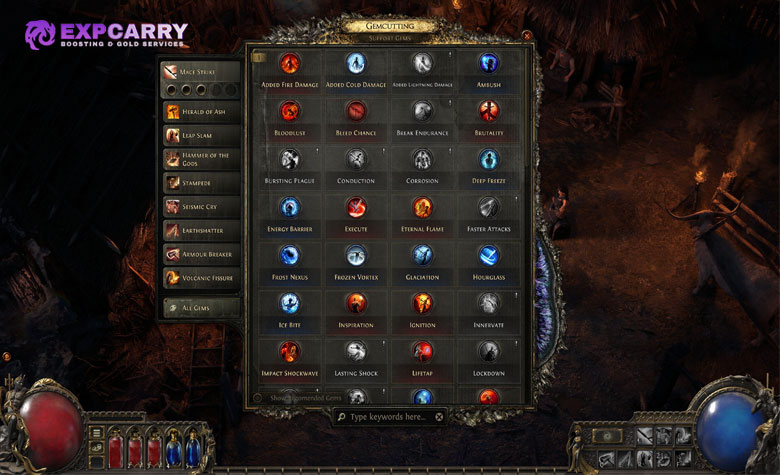
Skills are organized in a dedicated skill panel rather than being socketed directly into equipment. Active Skill Gems provide attacks, spells, minions, Warcries, movement abilities, and other actions. Support Gems are socketed into an active skill to change how that specific skill behaves. Persistent skills provide ongoing effects and normally require Spirit while active.
Uncut Gems let the player select from skills available at that gem level. An Uncut Skill Gem can create a new active skill or upgrade an existing compatible gem. Uncut Support Gems create supports, while Uncut Reservation Gems are used for persistent effects. The gemcutting menu recommends options based on class and equipment, but those recommendations are guidance rather than permanent restrictions.
Active Skill Gems must match the build and equipment
Every active skill lists tags, requirements, and any weapon restrictions. A Bow attack needs a Bow, many Quarterstaff attacks need a Quarterstaff, and Crossbow ammunition requires a Crossbow. Spells usually depend more on gem level and spell modifiers than on weapon attack damage, while weapon attacks are strongly affected by the damage and speed of the equipped weapon.
Do not unlock every attractive skill as soon as an Uncut Skill Gem drops. First keep the main damage skill current, then add a complementary skill that solves a real problem. That second skill might improve single-target damage, create an ailment, break Armour, generate Combo, control enemies, or provide a safe ranged option.
Support Gems change one specific skill
A Support Gem only works when the supported skill satisfies its conditions. Read both the benefit and the cost. A support may add projectiles, increase area, improve an ailment, change damage conversion, or create a trigger, but it may also increase resource cost, reduce direct damage, add a cooldown, or require a particular skill tag.
The official 0.3.0 support system overhaul removed the old character-wide restriction on duplicate Support Gems, so the same support type can be used on more than one skill when appropriate. Supports also have tiers, and stronger Lineage Supports belong to endgame progression rather than the opening campaign. For a first character, two supports that clearly improve the main skill are better than several supports whose conditions are rarely active.
Persistent skills reserve Spirit
Persistent skills include effects that remain active instead of being cast repeatedly. They commonly reserve Spirit, a separate resource that must be available before the effect can be enabled. After creating a persistent gem, place it in the skill panel, add only compatible supports, and confirm that the skill is activated for the intended weapon set.
Do not reserve all available Spirit without checking the result. Minions and persistent buffs can compete for the same resource. If a required companion disappears or a buff refuses to activate, inspect total Spirit, support costs, and weapon-set activation before changing the entire build.
Build a Simple First Skill Setup
A new character does not need a full bar of damage skills. Too many attacks divide gem upgrades, support choices, Mana, and attention. The flexible system used by Path of Exile 2 works best when every selected skill has a clear job. Start with a small setup and expand it only when the campaign presents a mechanic the existing setup cannot handle.
| Skill role | Purpose | Beginner rule |
|---|---|---|
| Main clearing skill | Defeats ordinary groups efficiently | Keep its gem level, weapon, and supports current |
| Single-target or payoff skill | Damages bosses or consumes a setup condition | Use it when its required condition is active |
| Setup or control skill | Applies Freeze, Shock, Armour Break, Poison, Combo, Pin, or another useful state | Choose a setup that directly benefits the payoff skill |
| Defensive or mobility skill | Creates space, blocks damage, recovers defenses, or changes position | Keep it accessible and use it before the character is surrounded |
| Persistent skill | Provides a buff, minion, reservation effect, or ongoing utility | Confirm it is active and supported without exceeding Spirit |
The most reliable beginner setup has one main damage engine and one combination. A Cold caster might build Freeze before using a skill that benefits from Frozen enemies. A Warrior might build Stun or break Armour before a heavy payoff. A Monk might generate Combo before using a finisher. The exact skills can change, but the logic remains the same: one action creates a useful state and another exploits it.
Test new skills in a familiar area before changing multiple gems at once. If damage becomes worse, restore the previous setup and change one component. This makes it possible to identify whether the problem came from the skill, its weapon requirement, an incompatible support, resource cost, or missing Attributes. A current PoE 2 starter build guide can provide complete routes when a player wants a tested skill and Ascendancy combination.
Explore services related to this guide, selected from our Path of Exile 2 catalog.
View All Path of Exile 2 Services


Spend Passive Points Around One Damage Plan
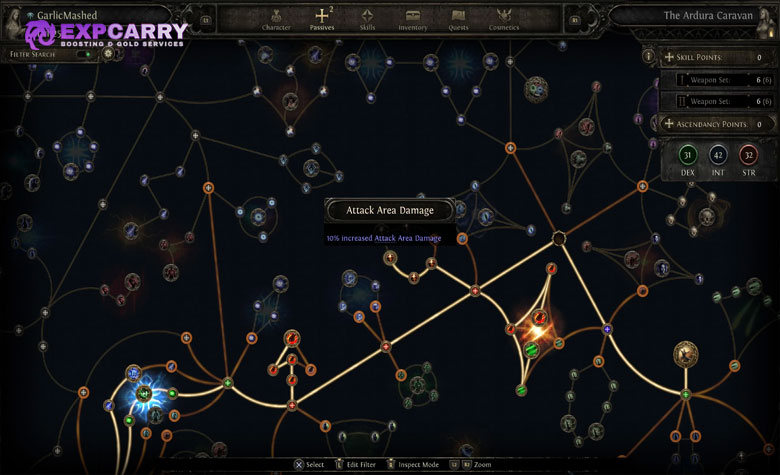
All classes use the same large passive tree but begin in different locations. The opening points around each class support its expected Attributes, weapons, damage types, and defenses. Because later specialization still depends on the selected base class, the PoE 2 Classes and Ascendancies overview can help confirm the long-term direction before a first build travels toward distant passive clusters.
Check the tags on the main skill before allocating damage passives. Projectile damage does not automatically improve every ranged-looking effect, Attack damage does not improve ordinary spells, and weapon-specific nodes require the correct weapon. Damage type, skill type, weapon, ailment, and minion tags provide a better route than guessing from the animation.
Balance offense, defense, and Attributes
Early damage points make combat faster, but a tree containing only damage becomes fragile. Combine relevant offensive clusters with Life, Energy Shield, Armour, Evasion, Block, recovery, or another defense that matches the class and equipment. One coherent defensive plan is more useful than small investments in every available defense.
Attribute nodes solve Strength, Dexterity, and Intelligence requirements, but they should usually be selected for a known need. Check upcoming equipment and gem requirements before taking several Attribute nodes. If a skill upgrade suddenly becomes unusable, it may be better to delay that gem level or adjust equipment than to redirect the entire passive tree.
Use weapon-set passives only when they solve a real problem
Weapon-set passive points allow selected passives to change when the character switches weapon sets. This supports combinations such as a ranged setup and a close-range payoff, or separate elemental tools. It is a powerful system, but a beginner can leave these points assigned identically until the build has a deliberate reason to switch.
Passive choices can be refunded with gold, so an imperfect early point does not permanently destroy a character. Respec costs still matter, especially when many points are changed at once. Correct a small mistake early rather than waiting until an entire branch must be rebuilt.
Upgrade Gear for Function, Not Rarity
An item's color does not determine whether it is useful. A Rare item with unrelated modifiers can be worse than a Magic item with the exact resistance, movement speed, or weapon damage the character needs. Players comparing realistic upgrade priorities can use the PoE 2 budget endgame builds overview as a reference, but Unique items are not automatic upgrades for every build.
Attack builds should keep their weapon current
For most weapon attacks, the equipped weapon is one of the largest damage sources. Compare physical or elemental damage, attack speed, critical properties when relevant, and useful modifiers for the skill. A weapon with a higher level requirement is not automatically stronger if its actual damage is lower.
Upgrade the weapon when ordinary enemies begin taking too long to defeat. Use appropriate low-level crafting currency on a promising base rather than saving every item for an undefined future. Do not invest valuable currency into a weak base that will be replaced after a few areas.
Spell and minion builds need relevant levels and modifiers
Spell builds normally care about gem level, spell damage, elemental or Chaos damage, Cast Speed, and modifiers that match the spell's tags. Minion builds need modifiers that explicitly affect minions or companions. Weapon attack damage does not normally improve an ordinary spell or minion simply because the weapon is equipped.
Keep important skill gems upgraded only while the character can satisfy their Attribute and resource requirements. A higher gem level is not helpful if the skill becomes too expensive to use consistently.
Defensive equipment must cover predictable weaknesses
Prioritize Life or Energy Shield, elemental resistances, and the main defense type used by the build. Movement Speed on Boots is especially valuable because it improves exploration, repositioning, and boss survival. Keep Life and Mana Flasks close to the character's level, and replace outdated versions when stronger bases appear.
Elemental resistances should move toward the normal 75% maximum as the campaign advances. A temporary damage upgrade is rarely worth creating a major resistance gap before a boss. Chaos resistance is also useful, but early characters may need to improve it gradually rather than solving it immediately.
First Progression Steps Through the PoE 2 Campaign
The current Early Access campaign contains Acts 1 through 4 followed by three temporary Interludes that lead to approximately level 65, where endgame begins. Cruel Difficulty was removed in update 0.3.0. Act 4 is non-linear, so players comparing routes and permanent objectives can consult the broader Path of Exile 2 guides coverage while completing its major destinations in different orders.
First hour: learn movement and establish one attack
Equip the weapon recommended for the opening skill, place the main skill on a comfortable input, and learn its range and resource cost. Practice dodge roll against clearly telegraphed attacks. Holding the dodge input after the roll activates Sprint, which is useful for travelling outside combat, but taking a hit while Sprinting knocks the character down.
Activate waypoints and checkpoints while exploring. Checkpoints can warp to other checkpoints in the same area and to the area's waypoint, which reduces unnecessary backtracking. Pick up currency, Uncut Gems, suitable equipment bases, rings, amulets, belts, and items with useful resistances. Do not return to town for every low-value item.
Acts 1 and 2: create a complete basic combat loop
During the early acts, add the first useful supports to the main skill and unlock a second skill that complements it. Begin building one defensive layer on equipment and the passive tree. Upgrade Flasks, keep the main weapon current for attack builds, and check resistances before important bosses.
Complete optional objectives that advertise permanent character rewards such as passive points, Spirit, Attributes, or other lasting bonuses. Optional bosses also provide practice against movement and damage patterns that return later. If a boss repeatedly defeats the character, gain a level in a recent area, upgrade one or two weak equipment slots, and inspect the cause of each death before trying again.
Acts 3 and 4: specialize instead of adding unrelated mechanics
By the middle campaign, the character should have a recognizable main damage engine, a developing defensive plan, and an intended Ascendancy. Continue upgrading the same core interaction instead of adding skills that require different damage types or weapons. Complete an appropriate Ascendancy Trial when the character can handle it reliably, then choose nodes that strengthen the existing build.
Act 4 allows major destinations to be visited in different orders. If one route feels unusually difficult, work on another destination, gain experience, and return with better equipment. Non-linear progression is an opportunity to adjust difficulty rather than a requirement to defeat the first selected boss immediately.
Interludes: prepare the character for endgame
The three Interludes bridge the completed acts and the endgame level range. Use them to finish permanent-reward objectives, stabilize elemental resistances, upgrade Flasks, improve the main weapon or caster item, and confirm that both clearing and single-target damage are reliable. This is the correct time to replace temporary campaign equipment that has survived only because its old modifiers were convenient.
Before endgame, the build should defeat ordinary packs without exhausting resources and survive mistakes without immediately collapsing. It should also have a repeatable answer for Rare monsters and bosses. If only clearing or only single-target damage works, correct that weakness before adding another damage multiplier.
How to Survive PoE 2 Bosses as a Beginner
Bosses are designed around readable attacks, positioning, and damage windows. Do not spend the entire fight attacking. Learn which animations create safe openings and which attacks require immediate movement. Red-flash boss skills cannot be avoided through Evasion, so even an Evasion character must react to them directly.
Dodge roll is not a substitute for positioning. Stand where the next escape route is visible, avoid being trapped against arena edges, and move out of persistent ground effects before using a long attack or spell. Sprint is mainly a travel tool and can be dangerous during combat because receiving a hit causes a knockdown.
When a boss attempt fails, identify whether the cause was low damage, insufficient recovery, a resistance problem, or an unlearned mechanic. These require different solutions. Farming levels will not fix an incompatible Support Gem, and adding damage will not solve repeated deaths to an avoidable attack.
Common PoE 2 Beginner Mistakes
| Mistake | Why it causes problems | Better decision |
|---|---|---|
| Choosing a class only from a tier list | The recommended build may use a combat style the player dislikes | Choose a class by preferred range, speed, and mechanical complexity |
| Unlocking too many damage skills | Gem upgrades, supports, resources, and attention become divided | Use one main skill and one complementary payoff or setup |
| Ignoring Support Gem conditions | The support may not function or may add an unwanted cost | Read compatibility, skill tags, benefits, and penalties |
| Taking only damage passives | The character cannot survive long enough to deal damage | Add defenses and recovery that match the equipped gear |
| Keeping an outdated attack weapon | Weapon-based skills lose damage even if the passive tree is correct | Compare actual weapon damage and upgrade during the campaign |
| Equipping every Unique item | Special effects may provide no benefit and remove needed resistances | Use an item only when its modifiers support the build |
| Ignoring permanent side rewards | The character reaches later acts without passive points or other bonuses | Complete objectives that list lasting character rewards |
| Changing several systems at once | It becomes impossible to identify why performance changed | Change one skill, support, item, or passive branch at a time |
Your First Steps Into PoE 2 Endgame
Endgame begins around level 65 after the Interludes. The first objective is consistency, not maximum reward. Enter early areas with stable elemental resistances, a current main skill, a reliable single-target combination, usable Flasks, and enough defense to recover from one mistake. Avoid stacking difficult modifiers until the character's weaknesses are understood.
Continue replacing the weakest item rather than attempting to rebuild every slot. For an attack build, the weapon may remain the highest-priority upgrade. For a spell build, relevant gem levels and caster modifiers may matter more. Defensive upgrades should correct resistances, Life, Energy Shield, Armour, Evasion, or recovery according to the build's actual plan.
Learn one endgame mechanic at a time. Read area modifiers before entering, keep spare resistance and Attribute items in the stash, and do not spend valuable currency simply because it has dropped. Endgame crafting and trading are easier once the player knows which upgrade the build requires.
A Clear Build Plan Makes PoE 2 Easier to Learn
A successful first character does not need perfect gear or a complicated passive tree. It needs a class that matches the player's preferred combat style, one supported damage engine, a complementary skill, current equipment, and enough defense to learn boss mechanics. Every later system becomes easier to evaluate once that foundation works.
Choose a class by playstyle, keep the main skill and its weapon or caster modifiers current, read every Support Gem condition, and spend passive points around one coherent plan. During Acts 1 through 4 and the Interludes, prioritize permanent rewards, resistances, Flasks, and reliable boss damage. When endgame begins, improve the weakest part of the build instead of replacing everything at once.
Path of Exile 2 rewards experimentation, but useful experimentation changes one variable and observes the result. Build from a stable core, correct problems while they are small, and make each new skill, passive, and equipment choice support the same character plan.