
Waking the Dreamer is a complete endgame progression chain rather than a loop of isolated purple circles. Start by clearing Breaches near the Monastery of the Keepers, fill their progress bars to create Stabilised Breaches, gather Hiveblood, Wombgifts and Breach Splinters, then use the Genesis Tree to turn those resources into targeted rewards and a Breachstone. A Breachstone reveals a Domain containing Breach Hives, Sky Hives and a Fortress. Defeating It That Was Tul and It That Was Esh produces the Breachlord Sac that opens the Twisted Domain and the fight against Xesht, We That Are One.
How to Start Waking the Dreamer
The Breach storyline begins at the Monastery of the Keepers, a permanent endgame hub south of the Ziggurat Refuge. Travel to the Monastery, speak with Ailith and enable quest tracking if the next objective is not visible. Maps around the hub form a Breach Stronghold: they contain guaranteed Breach content and award points for the Breach Atlas Passive Tree when completed.
The first practical objective is to stabilise five Breaches. Enter the surrounding maps, touch the Breach hand to open the encounter and kill continuously while the expanding rift releases Hiveborn enemies. Once all five qualifying encounters have reached the stabilised state, return to Ailith. She supplies the quest Breachstone used for the deterministic first Domain. The official Return of the Ancients Breach notes define the rebuilt system, including the Monastery, Stabilised Breaches, Genesis Tree and multi-map Domains.
| Progression stage | Required action | Main result |
|---|---|---|
| Breach Stronghold | Clear maps around the Monastery | Breach Atlas Points and mechanic resources |
| Unstable Breaches | Fill the encounter bar five times | Quest Breachstone from Ailith |
| Genesis Tree | Grow Wombgifts with Hiveblood | Jewellery, Catalysts, currency or a repeat Breachstone |
| Breach Domain | Reveal and clear its connected maps | Access to Tul and Esh |
| Domain Fortress | Defeat It That Was Tul and It That Was Esh | Breachlord Sac |
| Twisted Domain | Give the Sac to the Dreamer | Xesht encounter and Breach Atlas Points |
How to Stabilise Breaches and Maximise Their Drops
An ordinary map encounter begins as an Unstable Breach. The progress indicator measures whether the invasion will stabilise, while kills extend the available time. Follow the expanding edge instead of standing where the hand opened, kill dense packs before chasing isolated monsters and cross over Clasped Hands when the route permits. Hands release extra loot, but abandoning a large pack to open one can cost more progress than it earns.
Reaching 100 percent changes the objective. Return toward the centre and defeat the stronger waves produced by the Stabilised Breach. Vruun, Marshal of Xesht can appear in this final phase. His Head unlocks the Grasping Orchid after it is returned to Ailith, so confirm that the quest item has been collected before leaving the map. Vruun can also provide valuable Lineage Support drops, with specialised Atlas passives improving his appearance rate and rewards.
Clear speed is the primary requirement because every second spent backtracking reduces the number of monsters that can be released. Open layouts, movement speed, wide damage coverage and enough damage to remove rares without stopping are more useful than extreme single-target investment during ordinary Breaches. Pack size, item quantity and Breach-specific map modifiers improve the reward ceiling, but they should be added only when the build can still complete the bar.
- Hiveblood: the fuel paid when growing rewards on the Genesis Tree.
- Wombgifts: category-specific seeds that determine which branch creates the reward.
- Breach Splinters: the repeat-access resource that eventually becomes a special Wombgift.
- Breach Rings: jewellery bases with an additional 20 percent maximum Quality.
- Vruun's Head: the unlock item for the Grasping Orchid.
Breach Tablets can add Breach content or modify its rewards through the map device. Useful modifiers raise Wombgift quantity or level, increase the chance to encounter Vruun, add rare monsters or extend the stabilised phase. Do not stack difficulty merely because a Tablet has more modifiers: failed stabilisation means fewer resources and no chance to finish the central challenge.
Genesis Tree Crafting, Wombgifts and Hiveblood
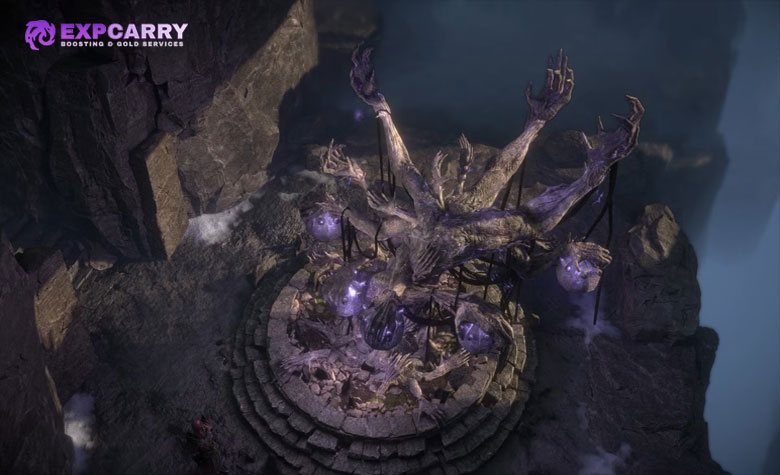
The Genesis Tree stands inside the Monastery and converts Breach farming into targeted crafting. A craft requires a Wombgift of the appropriate family and enough Hiveblood to grow it. Placing and completing Wombgifts unlocks passive points within that branch. Allocate those points before growing the next reward because the selected nodes determine bases, modifier pools, guarantees, exclusions and special outcomes.
| Genesis branch | Required Wombgift | Possible reward focus |
|---|---|---|
| Currency | Lavish Wombgift | Currency and Catalysts |
| Amulets | Ornate Wombgift | Exclusive amulet bases and controlled affixes |
| Rings | Signet Wombgift | Breach Rings and caster-oriented modifiers |
| Belts | Banded Wombgift | Exclusive bases and minion-oriented modifiers |
Each of the four principal branches has its own progression and can support up to 15 allocated Genesis points. Points are not a single shared pool, so advancing the Currency branch does not complete the Ring branch. Ctrl-clicking a Wombgift places it into the correct section, and the Tree interface can access the stash for faster bulk crafting.
The Ring branch can unlock Breach Rings and exclusive caster affixes, including spell damage, spell critical bonuses and rare skill-level modifiers. The Belt branch can produce modifiers for minion life, speed, area and skill levels. The Amulet branch can target special bases, including options with permanent skills that do not reserve Spirit and socketed Corona Amulets. The Currency branch is the source of Catalysts, including types that improve tagged modifiers on jewellery and types designed for Jewels. Applying a new Catalyst quality type replaces the old type, so choose the tag matching the finished item's most valuable modifiers.
Do not spend the best high-level Wombgifts with an unfinished tree. First use cheaper gifts to open useful nodes, then configure the branch around the intended result and only then grow valuable seeds. Hiveblood is consumed by every attempt and cannot be replaced by ordinary crafting currency, making poor allocation more expensive than the Wombgift itself. For a wider view of how Breach fits into current progression, the PoE 2 Return of the Ancients guide connects the Genesis Tree with the other rebuilt endgame systems.
Explore services related to this guide, selected from our Path of Exile 2 catalog.
View All Path of Exile 2 Services

How to Create a Breachstone and Reveal a Domain
The first storyline Domain uses the quest Breachstone received from Ailith after five stabilisations. For repeat access, collect 300 Breach Splinters. A full stack no longer converts directly into a finished Breachstone: it becomes a Revelatory Wombgift. Place that Wombgift in the Genesis Tree and pay its Hiveblood growth cost to produce the Breachstone.
Breach Domains are fixed points of interest on the Atlas. Select a discovered Domain and use the Breachstone to reveal its internal maps. The item does not immediately send the character to Xesht. It opens a connected mini-Atlas that must be progressed map by map, with the quest route teaching all three encounter types before the Fortress bosses become available. The official Waking the Dreamer overview presents this invasion, crafting and Domain progression as one connected endgame system.
Prepare several suitable Waystones before revealing the Domain. Each internal node is a real map attempt, and dangerous Waystone modifiers remain relevant during its special objective. Prioritise survivability and successful completion on the quest route; the Domain is already denser and more demanding than an ordinary Atlas map.
Breach Hives, Sky Hives and the Domain Fortress
A Breach Hive reverses the flow of a normal encounter. Move through the surrounding walls to burn the Hiveborn defences, then return to the centre and help Ailith close the breach. Destroying more walls increases the number of enemies released during the central battle, which raises both difficulty and rewards. Do not activate every wall automatically if the build cannot survive the resulting waves.
Sky Hives use a defensive multi-wave format. Stay close enough to protect Ailith, remove dangerous rares before they accumulate and use the temporary abilities she creates in the arena. Those abilities can be improved through the Breach Atlas tree. Losing control of the centre is more dangerous than missing a distant monster, so prioritise enemies threatening the defence objective.
The Fortress is the Domain's boss route. Fight through the Hiveborn and defeat It That Was Esh and It That Was Tul. The pair combines lightning and cold pressure with a much higher single-target requirement than earlier Domain maps. Cap elemental resistances, keep reliable recovery available and avoid Waystone combinations that amplify both bosses' strongest damage types. Their defeat supplies the Breachlord Sac, the key required for the Xesht stage.
- Use the Breachstone to reveal the Domain.
- Complete the Hive Colony objective by burning the outer defences.
- Finish the defensive Hive encounter with Ailith.
- Advance into the Fortress route.
- Defeat It That Was Esh and It That Was Tul.
- Return to Ailith and take the Breachlord Sac.
How to Unlock and Defeat Xesht
Take the Breachlord Sac back to the Monastery, speak with the Mysterious Acolyte and present the key to the Dreamer. Speak with the Dreamer again to enter the Twisted Domain, fight through the Hiveborn alongside Ailith and confront Xesht, We That Are One. This quest version completes Waking the Dreamer and provides the first deterministic opportunity to learn the encounter.
Xesht combines the identities of the Breachlords and applies several elemental and physical threats in a constrained arena. Keep moving around the boss rather than retreating blindly to the edge, preserve a movement skill for large telegraphs and avoid standing between overlapping effects. Recovery must work during long periods without weak monsters to kill, while damage should be sustainable enough to prevent the arena from becoming saturated.
For repeat kills, use another Breachlord Sac at the Dreamer's chamber. The repeat fight is a farming encounter with limited recovery from mistakes, so price the key against the expected drop pool before opening it. Players who have completed the route but cannot safely finish the pinnacle encounter can use the exact PoE 2 Xesht kill boost instead of risking repeated keys.
Defeating Xesht awards points for the Breach Atlas tree. Additional clears at increased difficulty unlock more points, and difficulty-gated rewards require the higher settings. Do not increase the Twisted Domain difficulty until the current version is consistent: extra reward access has no value if the boss cannot be completed.
Breach Rewards and Atlas Progression
Breach rewards come from four different layers, and treating them as one pool makes farming decisions inaccurate. Ordinary encounters supply Hiveblood, Wombgifts, Splinters, Breach Rings and general drops. Stabilised encounters add concentrated waves and the chance to fight Vruun. Domains provide Hive and Fortress rewards, while the Genesis Tree converts gathered resources into targeted items. Xesht supplies pinnacle-exclusive uniques and higher-difficulty rewards.
| Reward source | Important rewards | Best use |
|---|---|---|
| Ordinary and Stabilised Breaches | Hiveblood, Wombgifts, Splinters, Rings, Vruun drops | Funding Tree crafts and repeat access |
| Genesis Tree | Catalysts, currency, exclusive jewellery bases and modifiers | Targeted crafting |
| Domain maps | Dense Hiveborn loot and Breachlord Sac progression | Advancing toward Xesht |
| Xesht | Exclusive uniques, Breach Atlas Points and difficulty rewards | Pinnacle farming and mechanic specialisation |
Xesht's established unique pool includes Hand of Wisdom and Action, The Pandemonius, Xoph's Blood, Choir of the Storm and Beyond Reach. Skin of the Loyal becomes available at higher difficulties, while Controlled Metamorphosis requires the highest difficulty. Exact market value changes with builds and league supply, so evaluate the current value of the Breachlord Sac and the desirable rolls before committing to repeated fights.
The Breach Atlas tree improves ordinary encounters, Wombgift targeting, Vruun frequency, Hive waves, Ailith's Domain abilities and the Twisted Domain. Strong farming paths usually solve consistency first: longer encounters, more monsters and preferred Wombgift categories. Boss difficulty and aggressive reward nodes belong later, after the build can stabilise Breaches and finish Domains without losing attempts.
Vruun's Head also unlocks the Grasping Orchid at the Genesis Tree. The Orchid consumes 60 Breach Rings to create a Grasping Mail capable of carrying ring-derived modifiers and receiving Catalyst quality. Save rings with no individual value if this conversion is planned; selling or hiding every weak Breach Ring removes the input needed for one of the system's rarest crafts.
Common Breach Progression Problems
- The Breach does not stabilise: improve clear speed, follow the expanding edge and stop detouring for isolated hands.
- Ailith does not give the quest Breachstone: verify that five encounters reached the stabilised phase, not merely that five Breaches were opened.
- A full Splinter stack did not create a Breachstone: grow the resulting Revelatory Wombgift with Hiveblood at the Genesis Tree.
- The Domain does not lead directly to Xesht: finish its Hive maps and defeat Tul and Esh for the Breachlord Sac.
- The Grasping Orchid is locked: kill Vruun during a Stabilised Breach and return his Head to Ailith.
- Genesis rewards are unfocused: allocate the matching branch before planting valuable Wombgifts.
- Breach Atlas Points are missing: clear the Stronghold maps and defeat Xesht at the next required difficulty.
The most damaging mistake is following the pre-rework access route. Current repeat progression uses Splinters to create a Revelatory Wombgift, the Genesis Tree to grow a Breachstone, a Domain to obtain the Breachlord Sac and the Dreamer's chamber to open Xesht. Skipping one conversion makes the following item appear unusable even though the quest state is working correctly.
Conclusion
Breach progression works as a resource cycle with a boss route attached to it. Fast map clears stabilise encounters and finance the Genesis Tree; a correctly configured Tree converts that effort into valuable crafts and repeat Breachstones; Domains transform those stones into Breachlord Sacs; Xesht clears return Atlas power that improves the entire cycle. Build the loop in that order. Spending premium Wombgifts before unlocking their branch, overloading Hives before the character can defend Ailith or raising Xesht difficulty too early breaks the cycle at its most expensive point. Consistent stabilisation and targeted Tree allocation produce more long-term value than forcing the final boss before the Breach engine is ready.