
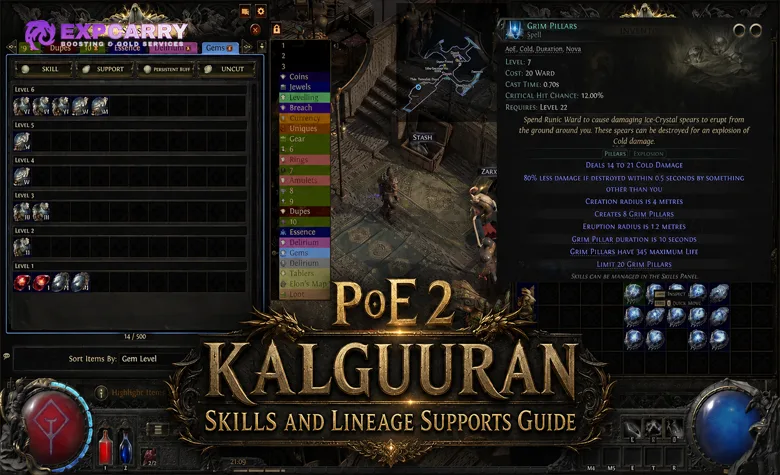
Kalguuran Skills and Kalguuran Supports form Path of Exile 2's Runic Ward gem system, while Lineage Supports are a separate family of rare support gems obtained through endgame drops and specific encounters. The distinction matters. A Remnant recipe can create one of the 23 Kalguuran Skills or seven Kalguuran Supports, but it does not let you engrave an arbitrary Lineage Support. The first family is designed around Runic Ward and broad class access; the second behaves more like a collection of unique build components with narrow compatibility rules.
This evergreen guide explains where every category comes from, how Runic Ward costs compete with survival, which classes can use the gems, and where their mechanics solve a real build problem. It describes functions instead of assigning a permanent tier list because balance values, trade prices, and preferred combinations can change. Always read the current gem tooltip before committing expensive gear or an endgame farming route.
PoE 2 Kalguuran Gems Quick Answer
Complete Farrow's campaign progression, learn Remnant recipes, and use suitable inscriptions at Remnants to craft Kalguuran Skills or Kalguuran Supports. Put Runic Ward on armour through Verisium Runeforging before testing a Ward spender. Kalguuran gems have no colour and ignore attribute and weapon requirements, so any class can equip them. Their individual tags, target rules, reservations, trigger conditions, and resource demands still determine whether they function in a particular build.
| Gem family | Primary source | Core rule | First compatibility check |
|---|---|---|---|
| Kalguuran Skills | Crafted through Runic Recipes at Remnants | Colourless, class-agnostic skills built around Runic Ward, remnants, runes, or Kalguuran interactions | Can the build generate and recover enough Runic Ward for the intended use pattern? |
| Kalguuran Supports | Crafted through Runic Recipes at Remnants | Modify eligible skills and usually add a Ward cost, trigger cost, or Ward-based effect | Do the supported skill's tags and use method satisfy the complete support restriction? |
| Lineage Supports | Global endgame drops or designated encounters and bosses | Rare supports with unusual power and restrictions; they cannot be engraved from an Uncut Support Gem | Does the gem support this exact skill, and can the character meet its level, support, reservation, or cost requirements? |
The official Return of the Ancients overview establishes the universal class access of Kalguuran Skills and their relationship with Runic Ward. That promise removes class, colour, attribute, and weapon gates from the gem itself. It does not remove the mechanical restrictions written on a skill or support.
Three Different Gem Categories
The most common research error is to treat every gem added beside Return of the Ancients as a Kalguuran gem. The update introduced 23 Kalguuran Skills, seven craftable Kalguuran Supports, and 23 additional Lineage Supports. These are three lists, not different names for one drop pool.
Kalguuran Skills are active or persistent abilities
A Kalguuran Skill can be a direct action, a persistent buff, an empower effect, a temporary defence, or a resource engine. Many spend Runic Ward, but not all follow the same cost model. Animus Exchange restores Ward by sacrificing Life, Remnants of Kalguur can generate Ward remnants, and persistent skills may reserve Spirit while adding an ongoing Ward interaction. The exact tooltip is more reliable than the shortcut that every Kalguuran ability simply pays a normal Ward cost.
Kalguuran Supports modify an existing skill
The seven craftable supports connect ordinary attacks, slams, persistent buffs, damaging skills, and Ignite setups to Runic Ward. Socketing one does not guarantee that it works. Some require a self-used attack, a self-triggered attack, a Heavy Stun, Fully Broken Armour, a Persistent Buff, or a skill that Hits. Several explicitly reject Channelling, Sustained, no-cost, or otherwise incompatible abilities.
Lineage Supports are rare endgame components
Lineage Supports existed before the Kalguuran system and continue to use their own acquisition rules. Some belong to the global endgame pool; others are tied to particular bosses, vaults, or mechanics. A character normally cannot use a second copy of the same named Lineage Support across another skill. Each also has a support category, so it can conflict with another support from that category inside one skill setup.
The official Third Edict feature page describes Lineage Supports as the support-gem counterpart to unique items and confirms the split between global drops and boss-specific rewards. That model remains the correct starting point even as later expansions add more gems and sources.
How to Get Kalguuran Skills and Supports
Kalguuran gems are products of the Remnant system. A Remnant presents engraved slots and available Runic Recipes. Insert the required runeshapes, inspect the resulting encounter and reward, then defeat the empowered waves to claim the crafted item. More runeshapes can make a recipe possible, but they also add waves and runic monster modifiers. Recipe execution is therefore both a crafting decision and a combat check.
- Meet Farrow during the campaign and complete his quests as they become available.
- Interact with Remnants, examine their slots, and learn the recipes the system reveals.
- Choose a recipe for the named Kalguuran Skill or Support rather than assuming an ordinary Uncut Gem can create it.
- Read every runeshape modifier before starting because the encounter inherits extra danger from the selected pattern.
- Defeat the spawned waves and claim the crafted gem only after the Remnant encounter is complete.
The current foundational rules and the complete launch lists appear in GGG's Content Update 0.5.0 notes. Those notes also confirm that endgame Expedition Remnants use the new Remnant system and that ocean exploration expands access to advanced Kalguuran content. Fixed claims about a best map, recipe frequency, or guaranteed profit should be ignored unless the current client explicitly supports them.
Campaign recipes and endgame access
The campaign introduces Runeforging early and adds more crafting features through Farrow's later quests. Endgame Expedition integrates the same Remnant framework, while the Ruins of Kingsmarch, ocean exploration, islands, dungeons, and Kalguuran bosses extend the progression. If the immediate target is simply one craftable gem, work backward from its known recipe rather than running every branch of the wider Expedition storyline without a target.
Remnant access, Verisium collection, map progression, and boss routes can overlap when planned together. Players who want assistance with a defined farming objective can compare the available PoE 2 hourly farming options, but the requested scope should name the required Remnant, recipe, or endgame objective instead of promising an unverified random drop.
Explore services related to this guide, selected from our Path of Exile 2 catalog.
View All Path of Exile 2 Services


How Runic Ward Costs Work
Runic Ward is both a survival layer and a skill resource. When damage would take the character to death, Ward begins protecting the character at one Life and absorbs further damage until it is exhausted. It regenerates independently from Life. Spending Ward offensively or on utility therefore reduces the emergency buffer that could prevent a lethal hit.
Runic Ward is added to armour with Verisium Runeforging. Armour below item level 55 gains it without sacrificing its normal base protection, while higher-level armour trades part of its regular base Armour, Evasion, or Energy Shield for Ward. Modifiers that refer collectively to Armour, Evasion, and Energy Shield do not automatically scale Runic Ward. Treat it as its own resource and verify every applicable modifier by wording.
| Ward pattern | Examples | Build implication |
|---|---|---|
| Fixed or skill-scaled payment | Several active Kalguuran abilities | Measure repeated use against Ward recovery and the desired emergency reserve. |
| Percentage of maximum Ward | Runic Infusion and related Ward-based supports | Increasing maximum Ward can raise both the available pool and the amount paid per supported use. |
| All current Ward | Refutation, Hollow Shell, and Wardbound Minions | Use as a deliberate conversion or emergency action, not an automatic button in every pack. |
| Ongoing drain or recovery lock | Leylines and Runic Reprieve | Leaving the effect active at the wrong time can prevent the pool from rebuilding before danger. |
| Conditional trigger payment | Concussive Runes and Runeforged Blades | The effect may fail to trigger when the required event occurs without enough Ward available. |
| Added cost derived from another cost | Runic Extraction, Scouring Flame, and Olroth's Conviction | A high Life or Mana cost can quietly create a substantial extra Ward burden. |
| Ward generation | Animus Exchange and Remnants of Kalguur | These can support a spender engine, but their Life, Spirit, pickup, or timing requirements still need testing. |
Set a Ward floor before adding damage
Decide how much Ward should remain available during ordinary mapping and boss mechanics. Test the build in three states: full Ward before combat, sustained use during a long target, and recovery after the pool is depleted. A setup that produces excellent tooltip damage only while consuming the entire safety layer may be unsuitable for a fragile character.
Ward Cost Efficiency, maximum Ward, Ward regeneration, remnant generation, pickup consistency, cast or attack rate, and the number of triggered events all affect sustainability. Calculate the complete action loop rather than the cost of one use. A fast skill can turn an individually small payment into an unsustainable drain, while an occasional payoff ability can support a much larger cost.
All 23 Kalguuran Skills
The following table groups the complete craftable skill list by function. Descriptions intentionally avoid level-specific numerical values so the guide remains useful after ordinary balance changes. The live tooltip determines the final cost, damage, duration, and radius for the character's gem level and quality.
| Skill | Core function | Practical build use |
|---|---|---|
| Animus Exchange | Sacrifices Life to recover Runic Ward and can Overflow the Ward pool | Resource engine for builds that can safely restore the sacrificed Life and want a prepared Ward reserve |
| Animus Splinters | Creates a brief copy that uses a socketed eligible skill once | Delayed extra use of a compatible high-impact action; rejects Channelled, Remote, Cooldown, Conditional, and minion-summoning skills |
| Bitter Dead | Turns corpses into seeking cold cores that chill, explode, and leave damaging runes | Corpse-consuming cold clear and area control where corpses remain reliably available |
| Conductive Runes | Places attack-based hazardous runes that arm and trigger on enemies | Electrocution buildup, zoning, and weapon-independent attack scaling for deliberate placement builds |
| Detonate Living | Explodes a living enemy below its culling threshold and identifies eligible targets | Pack cleanup and chain-style finishing after the main skill pushes enemies into the valid state |
| Eternal March | Instantly revives minions, prioritizing stronger minions first | Recovery tool for minion builds facing concentrated boss damage or repeated minion deaths |
| Explosive Transmutation | Persistent buff that makes collected remnants trigger effects based on remnant type | Remnant builds that already create and collect enough pickups to justify Spirit and socket investment |
| Fragments of the Past | Creates a Verisium volcano with an initial hit and triggered Ice Fragments | Area pressure and fragment synergy for cold or trigger-oriented setups |
| Frostflame Nova | Attaches to Ignited enemies, preserves the active Ignite, and rapidly builds Freeze while preventing a replacement Ignite | Ignite-to-Frostfire control for builds that value one strong Ignite and a reliable Freeze window |
| Grim Pillars | Creates ice-crystal spears around the player that can be destroyed for cold explosions | Defensive spacing, cold area damage, and crystal-destruction combinations |
| Hollow Shell | Consumes current Ward in a pulse and grants nearby allies Guard based on the amount spent | Party or minion protection when converting personal Ward into timed group durability is intentional |
| Leylines | Reveals zones that increase spell damage while standing on them, but drains Ward and stops Ward recovery there | Stationary spell encounters where the player can manage positioning and leave before the resource collapses |
| Powered by Verisium | Creates Verisium Infusions that can substitute for Elemental Infusions | Infusion-dependent rotations seeking a flexible setup or payoff resource |
| Rain of Blades | Converts Ward into a buff that calls blades onto enemies hit by projectile attacks | Projectile attack builds with frequent hits and enough Ward recovery to sustain the added layer |
| Refutation | Spends all Ward for a short all-direction block and Parry window against blockable hits | Manual defensive answer to a dangerous hit sequence; Heavy Stun can end the effect |
| Remnants of Kalguur | Persistent buff that can create Ward remnants from kills and stuns | Mapping or stun-focused Ward engines that can collect pickups consistently |
| Repulsion | Applies Fragility so hits can trigger a physical explosion with knockback and stun buildup | Hit-heavy physical clear and crowd control, especially where displacement is beneficial |
| Runic Reprieve | Channels a protective bubble that blocks hits while damage from blocked hits is removed from Ward | Planned protection during dangerous patterns; Ward cannot recover during the effect and a minimum pool is required |
| Skyfall | Builds Glory by spending Ward, then calls down a damaging mass and temporary minions | Ward-spending builds that want a high-impact Glory payoff instead of constant automatic output |
| Triskelion Cascade | Empowers the next Cascadable spell to affect the player and surrounding areas | Spell builds that can exploit repeated area placement and deliberately time the next cast |
| Verisium Manifestations | Persistent attack interaction that spends Ward to create short-lived attackers | Frequent attack builds seeking extra manifestations without relying on persistent targetable minions |
| Voltaic Barrier | Places pylons that form an electrified wall and energize player projectiles passing through it | Projectile positioning, chaining lightning, electrocution, and controlled boss arenas |
| Wardbound Minions | Spends all Ward to summon temporary cold-casting minions, with output scaling from the Ward committed | Burst minion window for builds willing to convert the complete current Ward pool |
Seven Kalguuran Supports
Kalguuran Supports are best evaluated as cost-and-condition packages. The desirable payoff is only half the gem. The other half is the event that activates it, the skills it refuses to support, and the amount of Ward removed when the event occurs.
| Support | Eligible use | Ward and build consideration |
|---|---|---|
| Concussive Runes | Attacks that can produce the required Heavy Stun event | Triggers a Runic Shockwave at a Ward cost; without enough Ward, the expected payoff does not occur |
| Fist of Kalguur | Self-used, non-Channelled Slam skills | Spends a substantial Ward amount to boost the Slam with added physical power and a runic aftershock |
| Healing Runes | Persistent Buff skills | Adds Spirit reservation and periodically spends Ward to heal injured nearby allies |
| Runeforged Blades | Self-used attacks that can consume Fully Broken Armour and do not already consume it | Uses Ward to fire a projectile nova after consuming the armour state; the projectiles cannot hit the source target |
| Runic Extraction | Skills that can deal damage | Kills may produce a Verisium Infusion Remnant, while the supported skill gains extra Ward cost derived from its Life and Mana cost |
| Runic Infusion | Attacks used or triggered by the player, excluding Channelled, Sustained, and no-cost skills | Adds a maximum-Ward-based payment and physical damage based on the resulting Ward cost |
| Scouring Flame | Skills that Hit | Strengthens the Ignite package and adds Ward cost derived from the skill's Life and Mana cost |
Support a skill only after checking the full sentence
Matching one tag is insufficient. Runic Infusion may show an Attack requirement, but it also cares who uses or triggers the attack and rejects several use types. Runeforged Blades depends on Fully Broken Armour and conflicts with skills that already consume that condition. Healing Runes attaches to a Persistent Buff rather than directly to a healing spell. Build planners should reproduce the complete support line, not only the most attractive damage clause.
How to Get Lineage Supports
Lineage Supports cannot be selected from the ordinary Gemcutting menu with an Uncut Support Gem. They enter the economy as random global endgame drops or as rewards tied to named encounters and bosses. The correct farming process begins with the exact gem, not with the word Lineage: identify its current drop restriction, unlock the associated content, then decide whether direct farming or trade is more efficient for the character.
| Source model | How to approach it | Evergreen warning |
|---|---|---|
| Global endgame pool | Run suitable level 65 or higher content and treat the gem as a rare unrestricted endgame drop | Do not claim a specific ordinary map guarantees it or publish an unsupported drop rate |
| Named boss | Unlock the boss's quest route, then use its repeatable access path for additional attempts | Quest and repeatable boss versions can differ in difficulty and access items |
| Mechanic reward or vault | Progress the linked endgame system until the relevant chest, vault, or reward room is available | Confirm that the support comes from the reward container rather than every monster in the mechanic |
| Trade | Search the exact gem name and compare its cost with the time and access cost of farming the source | Price is league-, platform-, and time-dependent, so no permanent buy-versus-farm answer exists |
Return of the Ancients Lineage source map
Return of the Ancients added the following 23 Lineage Supports. The table separates confirmed sources from unresolved drop assignments. An unresolved entry means the gem exists and its function is known, but a specific boss should not be advertised as guaranteed until the live data or a later official note identifies it.
| Lineage Support | Current source status | Build hook |
|---|---|---|
| Arbiter's Reach | Specific source not confirmed | Adds periodic Guard for allies in Presence to an eligible Persistent Buff |
| Breachlord's Amalgam | Breach endgame family; specific boss not confirmed | Adds a cooldown to eligible self-used Cold or Lightning projectile skills, then makes projectiles return and pierce on the way back |
| Catha's Brilliance | The Bodach | Makes eligible Companions Blind and Ignite nearby enemies, with the Ignite based on minion Life |
| Eonyr's Thunder | Global endgame pool | Trades Shock for Electrocution buildup and an explosion when Electrocuted enemies are killed |
| Esh's Prowess | It That Was Esh and It That Was Tul | Improves an eligible Lightning skill's level and changes how its Lightning damage range rolls |
| Helbrym's Hide | Global endgame pool | Rewards committed Shapeshifting with a temporary Guard-and-Rage interaction |
| Her Declaration | The Arbiter of Divinity | Lets an eligible Persistent Buff Intimidate enemies when they enter Presence |
| Olroth's Conviction | The Aberration | Lets an eligible empower skill cover more uses by adding a Ward cost derived from its Life and Mana cost |
| Olroth's Hubris | Specific source not confirmed | Adds Physical and Cold damage to an eligible attack through an extra maximum-Ward-based cost and enables Physical contribution to Freeze buildup |
| Medved's Felling | Specific source not confirmed | Turns Rage into speed and Rage generation for self-used melee attacks while adding Life loss |
| Morrigan's Insight | The Bodach | Creates a Freeze-consumer payoff and Nature's Exchange for a hit skill that cannot consume Freeze already |
| Prototype Seventeen | The Arbiter of Divinity | Converts Rage into Critical Hit chance for an eligible non-Channelled self-used hit, then removes Rage on a Critical Hit |
| Seraph's Heart | Specific source not confirmed | Adds a chance for enemy Hits to calculate against exceptionally high Resistances while an eligible Persistent Buff is active |
| Styrn's Ferocity | Styrn, Fallen Knight of Aldur | Lets Shield hits Crush targets so subsequent Physical hits can Break Armour |
| Styrn's Mountain | Styrn, Fallen Knight of Aldur | Rewards blocking while raising a Shield with a later melee damage window |
| Tangmazu's Thurible | The Raven Trickster | Makes eligible Companions Gigantic and connects their Evasion and Deflection to the player's values |
| Trickster's Shard | The Raven Trickster | Builds Fractured Mimics from eligible self-cast non-instant spells for a delayed copied cast |
| Tul's Avalanche | It That Was Esh and It That Was Tul | Builds Seals through Block so an eligible Cascadable spell Echoes when the Seals are broken |
| Uhtred's Constellation | Uhtred, the Stardrinker | Adds uses to an eligible non-instant cooldown skill and rewards rotating different cooldown abilities |
| Uhtred's Rite | Uhtred, the Stardrinker | Connects cooldown skills to Life Flask damage and Mana Flask cost-efficiency windows |
| Vorana's Siege | Medved, the Fallen Seer | Expands an eligible area hit and improves its performance against Isolated targets |
| Vruun's Inevitability | Breach endgame family; specific boss not confirmed | Builds Combo through other melee Strikes, then spends it for area on the supported melee attack |
| Vruun's Aftermath | Breach endgame family; specific boss not confirmed | Lets Warcries destroy Ice Crystals and Ice Fragments, then rewards a sufficiently large detonation with more empowered attacks |
Do not infer a source from a character's name alone. Vorana's Siege, for example, is currently assigned to Medved, the Fallen Seer, while some supports named after a specific figure still lack a confirmed individual drop listing. Search the exact gem before opening a repeatable encounter, and treat any database label such as likely as a research lead rather than publication-ready evidence.
Boss access is often the real bottleneck, not the fight itself. The PoE 2 pinnacle boss access guide can be used to check current quest and repeatable key routes before spending mapping resources. If assistance is needed for a named eligible encounter, start from the broader PoE 2 services hub and verify that the exact boss and delivery method are listed.
Class Compatibility and Universal Use
Any class can equip a Kalguuran Skill because these gems have no colour and ignore attribute and weapon requirements. That makes a cross-class idea possible, not automatically functional. A Sorceress can equip an attack-oriented rune skill, a Warrior can equip a spell-oriented Ward tool, and a Witch can equip a defensive Kalguuran ability. Their passive tree, damage scaling, Spirit budget, action speed, ailment support, and Ward equipment still decide whether the result is good.
| Compatibility layer | Question to ask | Example of a hidden gate |
|---|---|---|
| Class and attributes | Can this character equip the Kalguuran gem? | For Kalguuran gems, class, colour, attribute, and weapon requirements are ignored |
| Skill tags and wording | Does the effect apply to this exact skill type? | A support may require an Attack, Slam, Hit, Persistent Buff, or Cascadable spell |
| Use method | Is the skill self-used, triggered, Channelled, Sustained, or minion-used? | A support can accept self-triggered attacks but reject Channelling or minion actions |
| Condition | Can the build reliably create the required state? | Heavy Stun, Fully Broken Armour, Ignite, corpses, remnants, Block, or Glory may be mandatory |
| Resource | Can Ward, Spirit, Life, and Mana support the full loop? | A persistent setup may reserve Spirit while repeated actions drain Ward |
| Scaling | Do passives and gear improve the actual damage or utility? | Universal equip access does not make spell nodes scale an attack or minion nodes scale player hits |
| Lineage restriction | Does the support satisfy its own requirements and category rules? | Lineage Supports can carry level, support-stat, reservation, tag, category, and one-copy restrictions |
Lineage Supports are class-neutral, not requirement-free
No Lineage Support belongs exclusively to a named class, but many require specific skill tags or a small support-stat contribution. Persistent Lineage options can add Spirit reservation. Others add a cooldown, transform a cost, require self-casting, consume Rage or Combo, or work only with Companions. Check the support panel after socketing because an inactive icon often exposes a missing condition that a broad build label did not reveal.
Real Build Use Cases
A useful Kalguuran or Lineage gem should solve a defined problem: resource generation, a single-target payoff, clear coverage, crowd control, minion recovery, party defence, or a missing mechanical bridge. Starting from the gem name and forcing an entire character around it without checking the problem often produces a fragile showcase rather than a repeatable build.
| Build goal | Promising Kalguuran direction | Lineage direction to investigate | Main failure test |
|---|---|---|---|
| Physical Slam burst | Fist of Kalguur on an eligible self-used Slam | Supports that reward Rage, Armour Break, or a deliberate payoff condition | Can Ward recover before the next planned empowered Slam? |
| Fast physical attacks | Runic Infusion or conditional Runeforged Blades | Olroth's Hubris or attack-specific Lineage effects when compatible | Does attack speed deplete Ward faster than the character rebuilds it? |
| Ignite and Freeze control | Frostflame Nova and Scouring Flame | Elemental or ailment Lineage supports that preserve the intended Ignite ownership | Does another hit replace, block, or weaken the Ignite the rotation expects? |
| Cascadable spells | Triskelion Cascade, with Leylines only when stationary play is safe | Tul's Avalanche for a Block-and-Seal route where all restrictions are met | Can the character remain positioned long enough to gain the real payoff? |
| Projectile attacks | Rain of Blades or Voltaic Barrier | Projectile Lineage options that match element, cooldown, and self-use wording | Do projectiles cross the intended wall or hit frequently enough to justify setup time? |
| Cold corpses and crystals | Bitter Dead, Grim Pillars, or Fragments of the Past | Vruun's Aftermath when a Warcry can exploit the required crystals and fragments | Are corpses, destructible objects, and the trigger action available during boss phases? |
| Persistent minions | Eternal March, Remnants of Kalguur, or Hollow Shell | Catha's Brilliance for eligible Companions or another minion-specific Lineage support | Can the Spirit budget, Ward recovery, and minion type satisfy every component? |
| Temporary minion burst | Wardbound Minions, Skyfall, or Verisium Manifestations | A Lineage support that modifies the controlling or payoff skill rather than an incompatible temporary minion | Does spending all Ward leave the player exposed during the burst window? |
| Party defence | Hollow Shell, Healing Runes, or Runic Reprieve | Arbiter's Reach or another eligible Persistent Buff support | Are allies actually in Presence or effect range when the protection occurs? |
| Emergency personal defence | Refutation with a deliberately preserved Ward pool | Defensive Lineage support that fits the current Spirit and skill layout | Does the effect cover the incoming hit type, and can Heavy Stun remove it? |
A practical example: Ward-funded attack engine
Start with an eligible self-used or self-triggered attack and test Runic Infusion. Record maximum Ward, Ward consumed per action, attacks per second, time to empty, and time to refill after stopping. Add Remnants of Kalguur only if the build creates and collects enough Ward remnants during the content being tested. A mapping setup may sustain through kills but fail on a boss with no adds; the boss test must therefore be separate.
A practical example: Frostflame control loop
Use a reliable Ignite source, then apply Frostflame Nova to preserve that active Ignite while rapidly building Freeze. Because the affected enemy cannot receive another Ignite until the current one ends, the build should prioritize the intended Ignite rather than many competing low-value applications. Test ailment thresholds on rare and boss targets, not only normal packs.
A practical example: minion recovery package
Eternal March is valuable when minions genuinely die during important moments and immediate revival restores more output than another offensive socket. Hollow Shell can convert Ward into Guard for nearby allies, including supported battlefield partners, while Healing Runes can attach periodic recovery to a valid Persistent Buff. These tools compete for Ward, Spirit, sockets, and attention, so stacking all of them is not automatically safer.
If a character needs a full skill, support, passive, and equipment rebuild rather than one gem swap, the PoE 2 starter build service is the relevant comparison point. Define the desired class, main skill, Ward target, and content goal first so compatibility can be verified instead of selecting a build only because it contains a rare gem.
How to Evaluate a Gem Before Committing
Use a repeatable inspection order. It prevents most expensive mistakes and remains valid when balance values move. The goal is to prove that the gem works in the live character, not merely that a planner allows it to be placed in a socket.
- Identify the category: Kalguuran Skill, Kalguuran Support, or Lineage Support.
- Confirm the current source and reject any page that labels the source as speculative.
- Read every gem tag and the full supports or cannot-support line.
- Check level, support-stat, Spirit, Life, Mana, Ward, cooldown, and reservation requirements.
- Identify the activation condition and prove the build can create it against a boss.
- Calculate resource use per second or per rotation rather than per tooltip action.
- Check support categories for conflicts inside the chosen skill.
- Test mapping, single-target uptime, recovery after depletion, and survival after a failed rotation.
- Compare the result with the support or skill socket that was removed.
| Test | Pass condition | Reason to reject or redesign |
|---|---|---|
| Socket test | The skill panel shows the support as active and all resource requirements are met | Inactive support, unmet reservation, or a category conflict |
| Condition test | The trigger or payoff occurs reliably on the intended target type | Works only on weak packs or depends on unavailable corpses, adds, or stuns |
| Sustain test | The rotation keeps enough Ward for its planned offensive and defensive roles | The pool empties before the payoff or cannot recover between dangerous windows |
| Damage and utility test | The complete encounter improves after accounting for setup time and the removed socket | Tooltip gain disappears when positioning, downtime, or opportunity cost is included |
| Survival test | The character remains stable after spending Ward and can survive a missed timing window | Ordinary enemy hits become lethal whenever the gem is used as intended |
Common Mistakes
Most failures come from mixing the three gem systems or treating Runic Ward as free damage. Correcting the model usually costs less than replacing the whole character.
- Trying to engrave a Lineage Support from an Uncut Support Gem.
- Calling all 23 new 0.5.0 Lineage Supports Kalguuran Supports.
- Assuming universal class access removes skill tags and support restrictions.
- Increasing maximum Ward without noticing that a percentage-based cost also increases.
- Testing a kill- or remnant-driven Ward engine only in dense maps and assuming it will sustain on a solitary boss.
- Spending all Ward on offence while counting the same pool as protection from a lethal hit.
- Ignoring the base Armour, Evasion, or Energy Shield traded away when high-level armour is Runeforged.
- Using a Lineage source marked likely or unknown as though it were confirmed.
- Publishing a permanent best-gem ranking without defining the skill, content, cost, and opportunity cost.
- Buying a rare Lineage Support before confirming its category conflict and exact supported-skill wording.
Final Verdict
Kalguuran gems make Runic Ward a build resource rather than only an emergency defence. Their universal equip rules let every class explore attacks, spells, minions, persistent effects, and defensive conversions, but a successful setup still needs the correct tags, conditions, scaling, and resource engine. Craft the 23 Kalguuran Skills and seven Kalguuran Supports through Remnants; obtain Lineage Supports from their global or encounter-specific endgame sources; never treat the two acquisition systems as interchangeable.
The safest build order is source, compatibility, condition, cost, sustain, then payoff. Preserve enough Ward for the character's defensive plan, measure repeated rather than isolated use, and verify the current tooltip before trading for a rare component. A gem is worth using when it solves a real encounter problem without breaking the build's resource loop or survival floor.