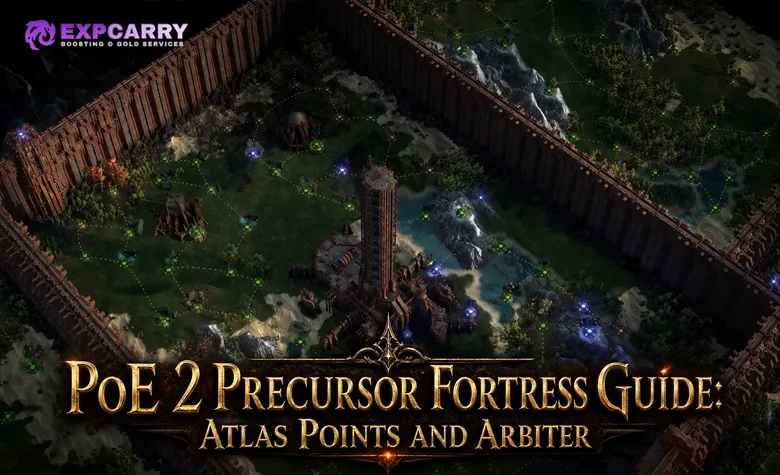
The Precursor Fortress does not appear through random exploration. Complete your first Precursor Tower on the endgame Atlas and the enormous structure rises near the centre of the Atlas. Its internal maps then become the main source of regular Atlas Passive Points. The efficient route is to enter through the Ancient Gateway, activate the eastern and western sides, recover the quest Crisis Fragments from the Enigma Chambers, defeat the Arbiter of Ash, collect the Origin Spark and Origin Cradle from the two Halls, create the Origin Core and carry it to the top of the Origin Tower. This opens the Arbiter of Divinity encounter. In the current 0.5.5 system, completing the quest encounter is only the first step: a subsequent victory using a non-quest Origin Core automatically completes the entire Fortress for the map owner, replacing the old five-kill progression method.
Short answer: Complete a Precursor Tower to reveal the Fortress, follow its Gateway and boss questline, then defeat the Arbiter of Divinity with an Origin Core. After the first quest clear, defeat the harder non-quest Arbiter once to automatically complete the entire Precursor Fortress and receive its remaining Atlas progression.
How to Find and Enter the Precursor Fortress
Progress outward from the Ziggurat Refuge until you reach any Precursor Tower, insert a suitable Waystone and complete its objective. Finishing that first Tower triggers the Fortress reveal; searching farther into the fog before completing a Tower will not make it spawn. The structure is visually distinct from ordinary map clusters and occupies a fixed central position once revealed.
The Fortress is a self-contained progression board rather than one large dungeon. Select the Ancient Gateway on its edge, provide the Waystone tier displayed by the map interface and clear the area. Internal connections become usable only when the relevant Gateway, boss or device has been completed, so a visible node is not necessarily an accessible node. The official Return of the Ancients 0.5.0 patch notes confirm that the first Tower raises the Fortress and that its maps replace the previous method of earning normal Atlas Points.
| Fortress stage | Main objective | Progress gained |
|---|---|---|
| Ancient Gateway | Enter the structure and establish the first route | Initial internal maps and Atlas Points |
| Eastern and Western Gateways | Defeat their bosses and activate the local mechanisms | Access to the side sections |
| Eastern and Western Enigma Chambers | Take both quest Crisis Fragments | Quest access to the Arbiter of Ash |
| Burning Monolith | Use the fragments and defeat the Arbiter of Ash | Route toward the Origin Tower |
| Patriarch and Matriarch Halls | Obtain the Origin Spark and Origin Cradle | Components required to create the Origin Core |
| Origin Tower | Insert the Origin Core and defeat the Arbiter of Divinity | Final storyline unlock and access to the repeatable encounter |
Open Both Gateway Wings Before Chasing the Bosses
Both Gateway wings are required for the quest route. Clearing only the shortest visible path toward the centre is not enough, because the Enigma Chambers provide the missing fragments needed to open the Burning Monolith.

After the Ancient Gateway, clear toward both the Eastern Gateway and Western Gateway. Each Gateway contains a boss and controls access to a different portion of the Fortress. Activate the mechanism after the fight; killing the boss and leaving without interacting with the room can make the route appear unfinished. Treat every interactable device as part of the objective, not optional scenery.
Do not rush directly toward the Burning Monolith. Its central position makes it look like the first destination, but the quest encounter remains locked until both missing Crisis Fragments have been recovered. Work one wing at a time, clear the connected maps required for access and check the Atlas node for its completion state before moving across the Fortress. Ordinary maps also provide Atlas Points along the way, although the non-quest Arbiter shortcut introduced in 0.5.5 can later complete the remaining Fortress automatically.
Fortress maps can carry Ancient Modifiers in addition to the modifiers on the inserted Waystone. Read both sets before opening a difficult node. Dangerous combinations such as reduced recovery with heavy degeneration, extra projectiles on a projectile-dense boss or severe resistance pressure can turn a routine step into a lost Waystone. If progression is the priority, use a manageable Waystone instead of maximizing quantity on a mandatory boss map. A broader PoE 2 Atlas, Fortress and Waystone guide can help align the Fortress route with ordinary endgame sustain. If your character repeatedly fails basic encounters, improving its build setup is more useful than forcing another dangerous modifier combination.
Enigma Chambers and the Arbiter of Ash
The two Enigma Chambers provide the quest versions of the Crisis Fragments used at the Burning Monolith. One additional quest fragment is already installed there, so you only need to recover the two missing pieces. The Western Enigma Chamber leads to Count Geonor and provides the Ancient Crisis Fragment, while the Eastern Enigma Chamber leads to Doryani and provides the Weathered Crisis Fragment. Defeat both encounters and make sure each quest fragment is collected before leaving. These items are for the Arbiter of Ash; they are not the components that activate the Arbiter of Divinity.
- Complete the Western Enigma Chamber and secure the quest Ancient Crisis Fragment.
- Complete the Eastern Enigma Chamber and secure the quest Weathered Crisis Fragment.
- Return to the Burning Monolith and place both missing fragments in the activation device alongside the fragment already installed.
- Defeat the quest Arbiter of Ash, then use the opened route deeper into the Fortress.
The quest version is deterministic and exists to advance Origins of Divinity. Prepare fire mitigation, reliable movement and enough single-target damage to avoid a prolonged arena. As of patch 0.5.5, the Arbiter of Ash has Fire Resistance and Cold Vulnerability rather than resistance to every element. If the Monolith still shows as locked, inspect the two Enigma Chamber nodes and your quest inventory rather than repeatedly running unrelated Atlas maps.
The official 0.5.1 notes documented fixes to Fortress quest states and the Precursor Reactor. A later 0.5.5c update also made presence at the deaths of Count Geonor and Doryani necessary to receive their quest fragments. Being in a party while another player defeats the boss elsewhere is not a substitute for being present at the encounter. The same requirement applies to the Origin components from the two Hall bosses.
Explore services related to this guide, selected from our Path of Exile 2 catalog.
View All Path of Exile 2 Services


Create the Origin Core and Reach the Arbiter of Divinity
Defeating the Arbiter of Ash opens the path toward the Origin Tower, but it does not immediately unlock the new pinnacle fight. Two separate Citadel routes supply the necessary components. Clear the Patriarch Halls and defeat Phyx, Sentinel of the Spark, for the Origin Spark. Clear the Matriarch Halls and defeat Phya, Sentinel of the Cradle, for the Origin Cradle.
Bring both components to the Precursor Reactor in the Origin Engine at the base of the Origin Tower. Insert the Origin Spark and Origin Cradle to produce the Origin Core. Ascend the Origin Tower, place the Core in its final mechanism and enter the Arbiter of Divinity encounter. The order matters because the Reactor combines the two Hall rewards; neither component can activate the pinnacle arena by itself.
- Origin Spark: drops from Phyx in the Patriarch Halls.
- Origin Cradle: drops from Phya in the Matriarch Halls.
- Origin Core: created from both components at the Precursor Reactor.
- Arbiter of Divinity: unlocked by inserting the completed Core at the top of the Origin Tower.
Be present when Phyx and Phya die if you need their quest components. Patch 0.5.5c explicitly requires this, and overlooking it can leave the Legacy of the Precursors quest incomplete even after a party has defeated both bosses. Check that the Spark and Cradle are actually in your quest inventory before returning to the Reactor.
Before activating the final fight, verify elemental defences, recovery under pressure and sustained boss damage. The Arbiter of Divinity now has Lightning Resistance and Fire Vulnerability under the 0.5.5 balance rules, which is useful to remember when choosing damage sources. The first, quest-based clear advances the storyline but no longer automatically completes a Fortress section. Players who need help preparing a character or replacing failed farming time can use a PoE 2 hourly boost and farming service, but the Fortress quest sequence itself still follows the same component chain.
How Fortress Atlas Points Work
Every internal map contributes one or more normal Atlas Passive Points, while major nodes such as Gateways, Towers, Enigma Chambers and Halls award larger bundles. Clearing only the shortest boss path leaves points behind until the remaining Fortress is completed. You can obtain those points through ordinary Fortress mapping or through the updated non-quest Arbiter completion method.

Precursor Towers positioned around the Fortress deserve special attention while progressing manually. Each completed Fortress Tower awards four Atlas Points, making these nodes useful sources of early passive power. Before the 0.5.5 rework, players needed to clear Towers separately because the old section-by-section boss shortcut did not complete them. The current official rule instead states that a successful non-quest Arbiter of Divinity kill completes the entire Precursor Fortress for the map owner. Do not follow old instructions requiring five separate boss completions and manual cleanup afterward.
The main Atlas tree is designed to become fully allocated after complete Fortress progression, so conventional respecialisation is unnecessary. Choice nodes can still be switched between their available options. Patch 0.5.1 expanded the upper section with 24 additional passives and increased the point rewards from several Fortress map types. Older guides and challenge descriptions therefore show different totals, including 311 and 335. Rather than treating one historical number as a guaranteed current maximum, use the live Atlas tree and its remaining unallocated nodes to track completion.
The important distinction is between earning points gradually and unlocking the remaining Fortress in one step. Manual mapping is useful while your character is not ready for the harder repeatable Arbiter. Once you can defeat that non-quest encounter, its completion reward removes the need to clear every remaining ordinary Fortress map solely for Atlas Points.
Repeat Kills, Automatic Sections and Missing Points
After the quest clear, the Arbiter of Divinity becomes a repeatable progression option. Origin components can be found again, and trade-league players can obtain tradable fragments through the Currency Exchange. However, patch 0.5.5 fundamentally changed the reward. A victory with a non-quest Origin Core now automatically completes the entire Precursor Fortress for the map owner. The quest version no longer awards the automatic completion of even one Fortress section.
This replaces the former five-kill method and the need to select individual sections through the Ancient Mechanism after each victory. You need to finish the quest encounter first, obtain or assemble a non-quest Origin Core and defeat the harder repeatable Arbiter once. The reward is automatic for the owner of the map, not a guaranteed full-Fortress completion for every party member who joins the encounter. The change is explicitly stated in the official 0.5.5 patch notes.
The repeat fight is an alternative to clearing the remaining Fortress maps manually, not a source of duplicate Atlas Points. Previously completed maps stay completed, while the non-quest victory resolves the remaining Fortress progression. For players planning to trade for missing Origin components, the availability of Divine Orbs or other trade currency may affect whether buying an access item is preferable to finding another Hall. The quest and boss rules themselves do not change based on how you obtained a tradable component.
If Atlas Points are missing, check the problem in this order:
- Inspect incomplete internal maps, Gateways, Enigma Chambers, Halls and Towers if you are still progressing through the Fortress manually.
- Confirm that the first Arbiter of Divinity kill completed the quest and that you are not confusing it with the repeatable non-quest version.
- Check whether the successful non-quest encounter was opened with a non-quest Origin Core and whether you were the map owner.
- Verify that you were present when the Enigma Chamber and Hall bosses died and that their required components were actually collected.
- Check the live Atlas tree for any remaining unallocated points, and distinguish the main Atlas tree from separate mechanic-specific trees.
A failed ordinary map does not permanently block the storyline. Replace the Waystone, reduce avoidable map difficulty and attempt the node again. For repeat pinnacle runs, distinguish the cost of another Origin Core from the cost of ordinary internal mapping: buying components may save time, and one successful non-quest Arbiter victory can now replace a large amount of remaining Fortress clearing. If your character cannot handle the harder encounter yet, continue collecting manageable Atlas Points manually while improving its defences and boss damage.
Conclusion
The fastest reliable Fortress clear is a completion route, not simply a straight line to the pinnacle arena. Open both Gateways, collect the two missing Crisis Fragments, resolve the Burning Monolith, then keep the Spark-and-Cradle chain separate from the earlier Arbiter of Ash objective. The first Arbiter of Divinity kill completes the quest; one later victory with a non-quest Origin Core completes the remaining Fortress for the map owner. That updated sequence prevents wasted boss attempts and lets you secure the Atlas power needed for the rest of PoE 2's endgame.