
The Path of Exile 2 endgame begins when the campaign and Interludes are complete and the Atlas becomes your main progression screen. Your immediate goals are to establish a supply of usable Waystones, complete nearby maps, reach and finish your first Tower, and begin the Origins of Divinity storyline. Completing that first Tower causes the Fortress to rise, and maps inside the Fortress award the Atlas Passive Points that drive long-term progression.
The Atlas is no longer a featureless field where every direction is equally useful. It contains fixed points of interest, mechanic-specific regions, quest objectives, Towers, Gateways, Citadels, and the Fortress. The fastest way forward is to follow visible objectives while keeping enough safe Waystones to continue mapping. This guide explains that route from the first Map Device activation to Fortress progression and Pinnacle Boss access.
PoE 2 Endgame Progression at a Glance
| Stage | Main objective | What it unlocks |
|---|---|---|
| First maps | Complete manageable Atlas locations and build Waystone sustain | Routes toward Towers, Masters, and fixed points of interest |
| First Tower | Reach and complete a Tower | Causes the Fortress to rise on the Atlas |
| Origins of Divinity | Enter the Fortress and advance its objectives | Atlas Passive Points and access to deeper Fortress sections |
| Gateway and Citadel progression | Clear key maps and obtain the required access items | Routes toward Fortress bosses and Arbiter of Divinity |
| Mechanic storylines | Follow fixed regions and their quests | Quest Pinnacle Bosses, mechanic trees, and repeatable endgame paths |
How the Current PoE 2 Endgame Is Structured
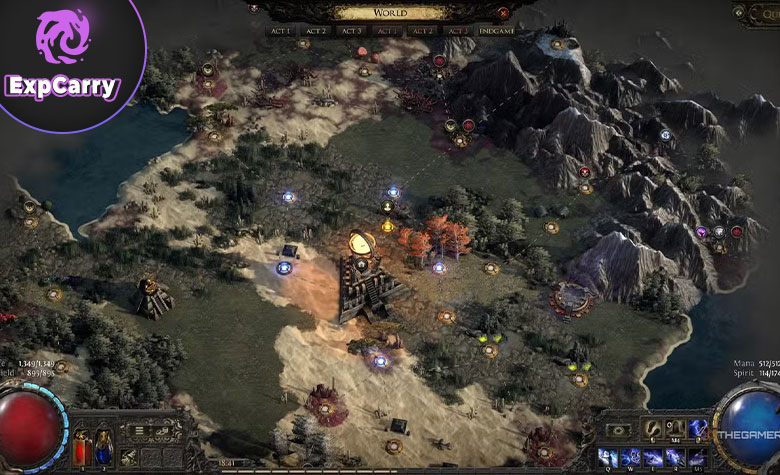
The Atlas connects several progression systems, but they do not all serve the same purpose. Normal Atlas travel opens routes and helps you build a Waystone supply. Completing the first Tower causes the Fortress to appear. The Fortress contains the primary Atlas Passive Point progression, while fixed points of interest and mechanic regions lead into separate endgame questlines and their respective Pinnacle Bosses.
Grinding Gear Games also split Pinnacle encounters into two forms. Quest versions are deterministic and belong to progression, while repeatable non-quest versions are harder and intended for continued farming. This distinction matters: a new endgame character should follow quest objectives and secure Atlas power before investing heavily in repeatable boss attempts. The complete structural changes are documented in the official endgame patch notes.
Preparing for Your First Waystones
Finishing the campaign does not automatically mean the character is ready for every Atlas modifier. Before activating the first Waystone, check whether the build can clear ordinary packs without spending all flask charges, defeat a Rare Monster with a repeatable single-target rotation, and survive one positioning mistake. Fix obvious resistance, recovery, and damage gaps before adding map difficulty.
- Carry a stable clearing setup and a separate plan for bosses or durable Rare Monsters.
- Replace campaign gear with severely outdated defensive bases.
- Keep enough Gold and basic currency for small gear or Waystone corrections.
- Prepare several Waystones instead of investing everything into a single map.
- Leave the most dangerous modifiers for a stronger character.
Your first objective is consistency, not maximum reward. A modest Waystone that you complete keeps Atlas progression moving. Previously attempted maps have penalized item rewards and 50% reduced Experience, so a reliable first completion is more valuable than forcing modifiers your build cannot handle. This penalty is confirmed in the latest official endgame update.
Explore services related to this guide, selected from our Path of Exile 2 catalog.
View All Path of Exile 2 Services


How Waystones Work
Waystones activate maps through the Map Device and determine the base difficulty of the area. They must be identified before they can be used. Once identified, read every modifier and decide whether the combination is safe for your build. A modifier that looks harmless in isolation may become dangerous when combined with stronger monsters, limited recovery, or a boss that already pressures the build's weakest defense.
| Waystone check | Practical decision |
|---|---|
| Waystone is unidentified | Identify it before attempting to place it in the Map Device. |
| Modifiers counter the build | Use another Waystone or modify the item instead of risking progression. |
| Several exits are available | Choose the route that leads toward a Tower, quest marker, or useful region. |
| Waystone supply is low | Prioritize completion and Waystone Drop Chance over unnecessary difficulty. |
| Build is clearing comfortably | Add difficulty gradually for better Pack Size, Rarity, or other reward bonuses. |
Waystone modifiers can improve Monster Effectiveness, Pack Size, Item Rarity, Monster Rarity, or Waystone Drop Chance. Prefixes generally affect what monsters output toward the player, while suffixes generally affect the player or monster defenses. Treat that as a reading aid, not a substitute for checking the full modifier text.
How to Maintain Waystone Sustain
Do not spend your entire pool on the hardest Waystones available. Keep a reserve that your character can clear reliably, connect multiple Atlas routes, and avoid ending a session with only one dangerous map remaining. When sustain is unstable, favor completions and Waystone Drop Chance. Increase reward pressure after you have enough backup Waystones to absorb a failed map.
Choosing an Efficient Route Across the Atlas
Fixed points of interest make route planning more deliberate. Before opening a map, look beyond the next node and identify where that branch leads. A slightly longer path toward a Tower, Master mission, mechanic region, or main quest objective is usually more valuable than a short branch with no progression target.
- Keep more than one route open. A second branch lets you continue progressing without immediately repeating a penalized map.
- Reach the first Tower early. Completing it is the trigger that causes the Fortress to appear.
- Follow Origins of Divinity. This storyline is the required source of general Atlas Passive Points.
- Use visible mechanic regions intentionally. Enter one when you want its questline and specialized progression.
- Do not chase every icon immediately. Secure your core Atlas progression before spreading resources across several advanced systems.
The Atlas includes search, expanded zoom, and direct town travel. Use those tools to find objectives and reduce unnecessary navigation. The map should function as a route planner, not just a record of completed locations.
How to Unlock and Progress Through the Fortress
The Fortress is the center of the Origins of Divinity progression. It appears after you complete your first Tower. Entering and clearing Fortress maps awards one or more Atlas Passive Points, replacing the older method of gaining general Atlas Points. This means that ordinary Atlas exploration alone is not enough: if you want to develop the Atlas Passive Tree, you must advance the Fortress storyline.
The Fortress is divided into sections with its own routes and objectives. Gateway Maps provide access to different sections, while Enigma Chambers and Citadels form part of the path toward major encounters. Two Citadel bosses drop keys needed for the Pinnacle Boss Arbiter of Divinity. The Burning Monolith and Arbiter of Ash are also located within the Fortress structure.
| Fortress feature | Role in progression |
|---|---|
| Fortress maps | Award Atlas Passive Points and advance Origins of Divinity. |
| Ancient Modifiers | Add or change map content and can significantly alter difficulty. |
| Gateway Maps | Open routes into different Fortress sections. |
| Enigma Chambers | Contain quest versions of Crisis Fragments used in Fortress progression. |
| Citadels | Contain bosses that provide keys for Arbiter of Divinity. |
| Arbiter of Divinity | Serves as the central Pinnacle encounter for the Fortress storyline. |
Fortress maps can carry Ancient Modifiers that add encounters or change existing content. Read these before committing an important Waystone. Progression maps are valuable, and failing one because of a modifier your build cannot handle creates avoidable reward and Experience penalties on another attempt.
A later alternative is available once you can defeat Arbiter of Divinity repeatedly. Five Arbiter of Divinity kills can automatically complete different Fortress sections in sequence, allowing the associated Atlas Tree progression to be earned through repeated boss clears.
Atlas Passive Points and the Atlas Tree
General Atlas Passive Points come from maps inside the Fortress. Completing all Fortress maps provides enough points to allocate the expanded Atlas Passive Tree fully. Because the tree can eventually be completed, progression is less about permanently choosing one narrow route and more about deciding which bonuses matter first.
Early allocations should support the content you can complete consistently. If Waystones are scarce, strengthen progression and sustain before focusing on high-risk rewards. If the build already clears safely, begin investing in the mechanics and reward types you intend to run. Multi-choice nodes can be switched between their available options, so use them to adjust the Atlas to your immediate objective.
Masters of the Atlas
Masters of the Atlas is a separate, Ascendancy-style endgame progression system. Doryani, Hilda, and Jado each offer a different set of bonuses. Each Master has 12 nodes, but only four can be selected at the same time. Selections can be changed, and you can switch between the three Masters before entering a map.
Doryani's Science is unlocked by clearing a Corruption Nexus. Hilda's Hunting begins at Hilda's Campsite southwest of the starting Atlas location, while Jado's Spycraft is unlocked by completing an Anomaly Map near the starting region. Complete Master missions to unlock additional rows of nodes. Choose the Master whose current bonuses support the content you are about to run rather than treating one selection as permanent.
Mechanic Regions and Pinnacle Boss Progression
Major endgame mechanics have visible regions and questlines that introduce their systems, develop their specialized trees, and lead to a quest version of the associated Pinnacle Boss. The official endgame overview explains how these storylines are distributed across the Atlas.
Follow one or two mechanic paths that match your build and goals instead of trying to progress every system at once. Quest Pinnacle versions provide deterministic progression. Repeatable non-quest versions are harder and make more sense after the build has reliable defenses, boss damage, and the resources needed for repeated attempts.
Recommended Priorities for Your First Atlas Session
- Identify all available Waystones and separate safe options from dangerous ones.
- Complete nearby maps while preserving at least a small Waystone reserve.
- Open multiple branches so a penalized map does not force an immediate repeat attempt.
- Move toward the first reachable Tower and complete it.
- Locate the newly risen Fortress and begin Origins of Divinity.
- Spend early Atlas Passive Points on immediate progression needs.
- Unlock a useful Master path when its starting objective becomes available.
- Choose a mechanic region after your basic Waystone progression is stable.
Common Endgame Progression Mistakes
- Trying to use unidentified Waystones or ignoring modifiers that disable the build's recovery or damage plan.
- Adding maximum difficulty before establishing a reserve of usable Waystones.
- Exploring without moving toward a Tower, Fortress objective, or fixed point of interest.
- Expecting ordinary maps outside the Fortress to provide general Atlas Passive Points.
- Spreading resources across every mechanic storyline before one progression path is stable.
- Treating quest Pinnacle Bosses and repeatable farm versions as the same difficulty.
- Ignoring Master missions even when their bonuses directly support the current objective.
- Entering valuable Fortress maps without checking Ancient Modifiers.
Conclusion
PoE 2 endgame progression follows a clear core route: stabilize your Waystones, complete the first Tower, enter the Fortress, and advance Origins of Divinity for Atlas Passive Points. From there, Gateway Maps, Enigma Chambers, Citadels, Masters, and mechanic regions provide distinct paths toward stronger Atlas bonuses and Pinnacle encounters.
Do not try to complete every system immediately. Protect Waystone sustain, follow visible objectives, and add difficulty only when the build can finish maps consistently. A deliberate route through the Atlas reaches the Fortress and its major bosses faster than unfocused exploration with higher but unreliable map rewards.