
A rare item in Path of Exile 2 is not valuable because it has six modifiers. Its price comes from a combination of modifiers that one build wants on the correct base. A five-mod item with high Life, two useful resistances, and Movement Speed can sell faster than a full item whose six lines serve different builds.
Price an item by identifying its buyer, isolating the two or three modifiers that define its purpose, and comparing listings with similar rolls. Then account for the base, item level, remaining affix space, quality, sockets, and corruption. This method avoids both vendoring valuable gear and listing ordinary rares at prices they will never reach.
How Trading Works in PoE 2
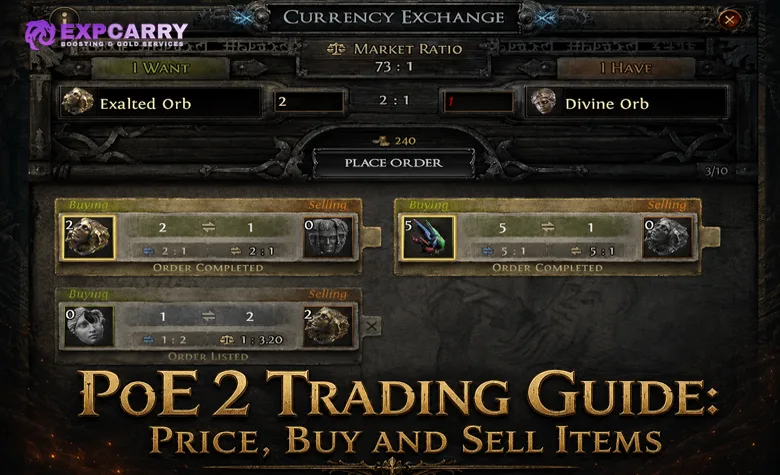
Equipment can be found through the official PoE 2 Trade site or the in-game Trade Market. Ordinary player-to-player listings may require contacting the seller and completing the exchange in a trade window. Items listed in a Merchant's Tab support asynchronous purchases, so an eligible item can sell without the owner being present.
The buyer pays the Gold cost of a Merchant's Tab purchase; listing and selling do not cost the seller Gold. Merchant's Tabs cannot list items handled by the Currency Exchange, and they are unavailable in SSF. Stackable currencies and other supported commodities belong on the Currency Exchange, while equipment, jewels, and other non-exchange items belong in the equipment market.
| Market | Best use | Important limitation |
|---|---|---|
| Trade site or Trade Market | Rare equipment, Uniques, jewels, bases, and exact modifier searches | A conventional listing may still require the seller to respond |
| Merchant's Tab | Asynchronous sale of individually priced non-exchange items | The buyer pays Gold and price changes have a cooldown |
| Currency Exchange | Supported stackable currency and commodities | It is not the market for ordinary rare equipment |
Do not mix prices from different leagues or rule sets. A Standard listing does not establish the value of the same item in a current challenge league, and an SSF character cannot use player trade at all.
Price Rare Items by Modifier Combinations
Begin with one question: what job does this item perform for a real build? A modifier has market value only when it improves that job and appears with other compatible lines. Maximum Life and resistances reinforce each other on defensive gear. Added physical damage, increased physical damage, and Attack Speed form a coherent weapon package. Spell Damage paired with an irrelevant attack modifier does not become expensive merely because both rolls are high.
- Identify the base and buyer. Decide whether the item is a leveling upgrade, defensive endgame piece, attack weapon, caster weapon, minion item, attribute solution, or crafting base.
- Select the core combination. Choose the two or three modifiers without which the item loses its purpose.
- Separate supporting lines. Treat extra resistances, attributes, rarity, recovery, or utility as price adjustments rather than the starting search.
- Check roll strength. Buyers search minimum values. Several relevant low rolls may be worth less than two excellent rolls with room to improve the item.
- Inspect future potential. An open affix, useful socket state, suitable item level, or uncorrupted status can make a crafting candidate more desirable.
The fastest in-game starting point is the quick market search. Shift-Alt-clicking an item populates its market filters, and individual modifiers on a Rare can be enabled or disabled to reveal which lines change the comparable price. This feature is a shortcut, not an automatic valuation: the seller must still remove irrelevant filters and compare a meaningful group of listings.
If an item is difficult to replace because several strong lines work together, its price may rise sharply rather than increase by the value of each modifier separately. Conversely, a full set of unrelated affixes has little synergy. Count useful combinations, not visible lines.
Valuable Combinations by Item Type
| Item type | Core combinations to compare | Common pricing trap |
|---|---|---|
| Attack weapon | Correct weapon base, compatible added damage, increased damage, Attack Speed, and Critical Hit modifiers when the build scales them | Adding every damage number together even though the buyer needs one damage type or a specific weapon speed |
| Caster weapon or focus | Relevant Skill Level, Spell Damage, Cast Speed, Critical Hit modifiers, Spirit, or build-specific utility | Pricing an irrelevant Skill Level modifier as though every caster can use it |
| Body armour, helmet, gloves | Life or Energy Shield, the correct local defences, resistances, attributes, Spirit, and build-specific utility | Ignoring a weak base defence or incompatible armour type |
| Boots | Movement Speed with Life or Energy Shield and useful resistances | Overvaluing defensive rolls on slow boots that most buyers will replace |
| Ring or belt | Life, resistances, required attributes, damage or recovery appropriate to one build, plus a useful implicit | Assuming mixed offensive modifiers serve the same character |
| Amulet | Relevant Skill Level, attributes, Spirit, defences, critical or damage modifiers that support the same archetype | Comparing different Skill Level families as equal |
| Jewel | Several modifiers that apply to the same skill, damage type, minion setup, or defensive plan | Counting conditional modifiers that the intended build cannot activate together |
These are search frameworks, not a permanent list of best modifiers. Demand changes with popular builds, balance changes, and league supply. The reliable signal is the current market depth for a coherent package. If many builds need the same defensive combination but only a few comparable items exist, the rare deserves closer checking.
Weapons require the strictest base comparison because local damage and speed determine practical output. For armour, compare the defence type the target build actually scales. On jewellery, implicits and attribute requirements can decide whether an otherwise strong item fits without forcing changes elsewhere.
Explore services related to this guide, selected from our Path of Exile 2 catalog.
View All Path of Exile 2 Services


A Reliable PoE 2 Price Check
Start broad enough to find a market, then narrow the search in stages. Searching all six exact modifiers and exact values usually produces no useful comparison. Searching only the base produces too much noise. The goal is to locate the price band created by the item's core package.
- Use the correct league, item category, rarity, and base type. Match item level when it affects available modifier tiers or crafting value.
- Enter the two strongest compatible modifiers with realistic minimum values slightly below the item's rolls.
- Add the third defining modifier. Observe whether the number of results collapses and whether prices rise consistently.
- Toggle secondary modifiers one at a time. A line that does not move comparable prices may improve usability without adding much sale value.
- Match corruption, sockets, quality, and special states before choosing the final price. These properties can change both usability and crafting options.
- Compare several believable listings, not only the cheapest result. Look at recently listed alternatives and the depth of stock near each price.
A lone listing far below every comparable item may be outdated, already sold, incorrectly priced, or intended to influence sellers. A lone expensive listing proves only that someone asked that amount. Use a cluster of comparable offers as the range, then place the item according to its rolls and how quickly you want it to sell.
For Uniques, search the exact item and compare roll ranges, sockets, quality, corruption, and any variant-specific properties. For crafting bases, strip the search back to the exact base, item level, special state, and remaining potential. The value of a base comes from what it can become, not from random modifiers that will be replaced.
When the market is denominated in a currency you do not normally hold, compare its current exchange value before accepting an apparent bargain. Players who specifically need additional crafting stock can review the current PoE 2 Exalted Orb option, but the item's actual upgrade value should still determine whether the purchase makes sense.
How to Buy Items Without Wasting Currency
Define the upgrade before opening the market. List the mandatory modifiers, minimum acceptable rolls, maximum budget, and one or two flexible lines. This prevents a cheap but unsuitable item from consuming currency and forcing new resistance, attribute, or Spirit problems elsewhere.
- Search mandatory modifiers first and sort by price only after the filter describes a usable item.
- Compare the candidate with equipped gear as a complete swap, including lost attributes, resistances, sockets, Spirit, and requirements.
- Loosen one secondary filter at a time when results are scarce; do not remove the modifier that makes the upgrade work.
- Check whether an open affix or better base makes a slightly more expensive item cheaper to finish.
- Keep enough Gold for an asynchronous purchase and enough currency for any required finishing step.
Before confirming, read the item itself rather than trusting the search card, whisper text, or seller description. Verify the base, every important roll, socket state, quality, corruption, price, and quantity. In a direct trade, recheck the item after it enters the trade window and cancel if anything differs.
Do not evaluate an upgrade only by the number shown on one tooltip. A weapon can raise sheet damage while breaking resource sustain or attack timing; armour can add defences while leaving a resistance gap. The correct purchase solves the build's limiting problem with the fewest secondary repairs.
How to Sell and Reprice Items
List non-exchange equipment in a Merchant's Tab when you want asynchronous availability. Each item needs an individual price, and the interface remembers the last price entered. The buyer pays the Gold cost, while the seller collects received currency from the Earnings Tab through Ange. The official Asynchronous Trade FAQ explains tab eligibility, Gold costs, repricing restrictions, and the separation between Merchant's Tabs and the Currency Exchange.
Choose a price according to your goal. List near the lower edge of the comparable range for a quick sale, in the middle for a balanced result, or near the top only when the item has clearly stronger rolls or better finishing potential. Do not imitate an isolated listing that has no supporting market.
| Market response | Likely meaning | Action |
|---|---|---|
| Immediate heavy interest | The item may be underpriced or contains a valuable combination you missed | Repeat the modifier search before listing another comparable item at the same price |
| A few normal enquiries or a prompt async sale | The price is probably within the active market range | Complete the sale and use the result as a reference for similar items |
| No interest despite active demand | The price may be high, the rolls weak, or the combination too narrow | Recheck comparables and lower the price after the repricing cooldown allows it |
| No meaningful comparables | The item may be exceptional, niche, or simply built from incompatible filters | Broaden the search and price conservatively rather than inventing a premium |
Currency and other supported commodities should be sold through the Currency Exchange instead of occupying equipment listings. Use current ratios and available market depth; do not assume yesterday's Divine-to-Exalted relationship still applies. If a planned purchase specifically requires a larger high-value budget, the PoE 2 Divine Orb option is relevant only after the exact item and price have been verified.
Trading Mistakes That Cost the Most
- Pricing by affix count: six unrelated modifiers do not form a six-mod premium item.
- Copying the cheapest listing: the first result can be stale, mispriced, unavailable, or a poor match.
- Using exact filters too early: an empty result does not prove the item is priceless.
- Ignoring the base: similar affixes on a slower weapon or weaker armour base are not equivalent.
- Forgetting total swap cost: a bargain is not cheap if other slots must be replaced to recover resistances or attributes.
- Accepting substituted items: always inspect the final item and quantity in the trade window.
- Sharing account access: legitimate trading never requires a password, authentication code, or account handover.
Quick market search makes comparison faster, but it also imports every visible modifier and can create misleading matches. The official trade-search feature notes confirm that Rare modifiers can be toggled individually. Use that control to discover which combination creates demand instead of treating the generated search as a price certificate.
Conclusion
The practical trading loop is simple: identify the build that wants the item, search its core modifier package, confirm the base and item state, and use several comparable listings to establish a range. Buy only when the complete gear swap improves the character, and reprice sales from actual market response rather than attachment to the item.
For the next rare you find, disable every modifier except its two strongest compatible lines, add the third line separately, and watch how the result pool changes. That one comparison reveals more about value than counting all six affixes ever will.