
Reliable mapping in Path of Exile 2 depends on three decisions made before entering a Map: choose a Waystone tier the build can finish consistently, craft enough reward modifiers to replace the Waystone being consumed, and reject combinations that disable the build's damage, recovery, or defence. Pushing the highest available tier is useful only when the character can clear its rare monsters and final boss without turning every run into a likely loss.
Keep separate supplies for progression and recovery. Use the strongest safe Waystones on valuable Atlas nodes and bosses, preserve several lower-tier stones for rebuilding the pool, and upgrade surplus tiers through the Reforging Bench. The current endgame requires Waystones to be identified before the Map Device will accept them, so every modifier can and should be checked before a run. Grinding Gear Games documents that requirement and the present Atlas structure in the official Path of Exile 2 endgame patch notes.
How Waystone Tiers and Atlas Progression Work
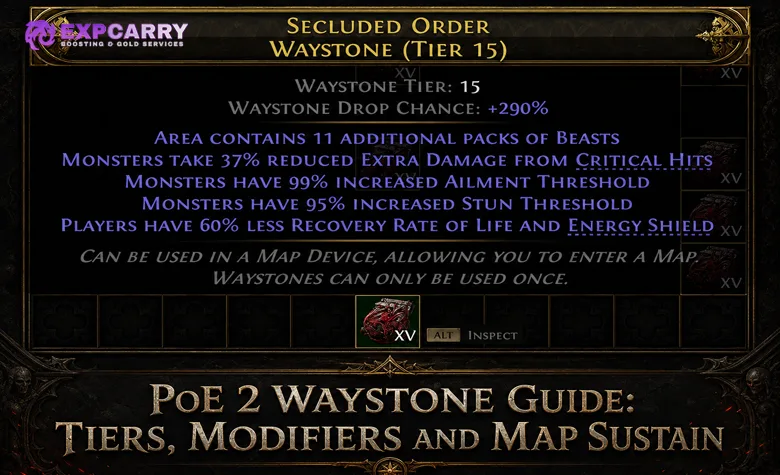
Waystones open Maps on the endgame Atlas. Their tier determines the base area level: Tier 1 opens a level 65 area, with each tier adding one level until Tier 15 opens a level 79 area. Higher area levels produce stronger monsters and access to higher-level item bases, modifiers, encounters, and Atlas progression requirements.
| Waystone range | Area level | Recommended use |
|---|---|---|
| Tier 1-5 | 65-69 | Establish defences, build an initial reserve, and learn common map modifiers |
| Tier 6-10 | 70-74 | Advance Atlas objectives while testing whether damage and recovery still scale |
| Tier 11-14 | 75-78 | Prepare for endgame bosses, valuable mechanics, and stronger item bases |
| Tier 15 | 79 | Run completed builds against the normal top tier and premium Atlas objectives |
| Tier 16 | 80 | Use only after a successful Tier 15 corruption and a full modifier check |
Tier 16 is not part of the ordinary drop and Reforging Bench ladder. A Vaal Orb used on a Tier 15 Waystone can produce an outcome that raises it to Tier 16 while randomising its modifiers. Corruption can also leave the item unchanged or produce another result, and the finished Waystone cannot be modified normally. Treat the attempt as an optional endgame risk rather than a sustain method.
Atlas nodes and quest objectives may require a minimum Waystone tier. Do not spend the last stone of that tier on a low-value route when a required objective is already visible. Use lower Waystones for connecting Maps that accept them, then save the progression tier for bosses, Gateways, Nexuses, or other locations that move the Atlas forward.
How to Get and Upgrade Higher-Tier Waystones
Waystones come from mapping, final bosses, rare monsters, endgame encounters, and Doryani's rotating inventory. Drops inside a Map are influenced by the Waystone's own modifiers and relevant Atlas effects. Higher difficulty alone is not enough: the useful value is the displayed Waystone Drop Chance combined with monster density and a completion rate the build can sustain.
The Reforging Bench converts three Waystones of the same tier into one Waystone one tier higher. This works from Tier 1 through Tier 14, allowing three Tier 14 stones to become one Tier 15. It does not turn three Tier 15 stones into Tier 16. Because each upgrade consumes three runs to create one, use it mainly for surplus low tiers, stalled quest progression, or stones with poor modifiers that are cheaper to combine than repair.
| Method | Best use | Main limitation |
|---|---|---|
| Natural Waystone drops | Maintain the tier currently being cleared | Returns fall when maps are undercrafted or frequently failed |
| Final and Powerful Map Bosses | Seek current-tier volume and higher-tier progression opportunities | The character must finish the boss reliably |
| Doryani's inventory | Recover from an empty pool or buy ingredients for reforging | Stock is limited and tied to progression |
| Three-to-one Reforging Bench recipe | Convert excess Tier 1-14 Waystones into the next tier | Consumes three possible runs and stops at Tier 15 |
| Corrupting a Tier 15 Waystone | Create a possible Tier 16 endgame run | Unpredictable result and irreversible modifiers |
Do not combine every lower-tier Waystone immediately. A reserve of runnable stones is more valuable than one high-tier stone the build cannot complete. Keep enough lower tiers to recover after failed runs, test equipment changes, and travel across ordinary Atlas nodes without risking premium inventory.
Boss Maps deserve the best safe Waystones because bosses are central to tier progression and Atlas rewards. The boss-focused drop framework was established in the official 0.2.0 endgame changes, while later patches adjusted individual rewards and Atlas bonuses. Adding several damage modifiers to a boss the build already struggles to kill can erase that advantage, so increase the reward side only while the final encounter remains dependable.
How to Craft Waystones Without Creating Dead Maps
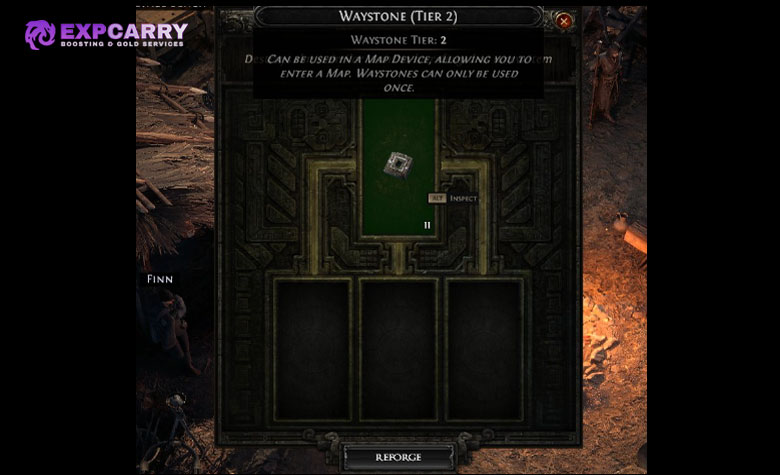
A normal Waystone has no explicit modifiers and offers the safest run but weak sustain. An Orb of Transmutation turns it Magic, and an Orb of Augmentation can add a second modifier when a slot is available. A Regal Orb upgrades a Magic Waystone to Rare, while an Orb of Alchemy can turn a Normal Waystone directly into a Rare one. Additional modifiers increase difficulty but can also improve Pack Size, monster rarity, Item Rarity, or Waystone Drop Chance.
Since update 0.5.0, the reward bonuses attached to Waystone modifiers are multiplicative with relevant external sources such as the Atlas Passive Tree. This makes well-rolled maps important for sustain, but it does not make every Rare Waystone worth running. One modifier that removes the build's recovery can be more dangerous than several ordinary monster bonuses combined.
| Waystone state | When to use it | Decision rule |
|---|---|---|
| Normal | Emergency recovery or testing a newly changed build | Use sparingly because the reward and sustain bonuses are low |
| Magic | Early progression and fragile characters | Accept two manageable modifiers with useful Waystone Drop Chance |
| Rare | Stable builds and valuable Atlas locations | Run only when the complete modifier combination remains safe |
| Corrupted | Endgame risk, special progression, or a final attempt to change an unusable stone | Read the finished item because ordinary crafting can no longer repair it |
Craft in stages rather than spending currency blindly. Add the first modifier, read it, add the second, and decide whether the result deserves a Rare upgrade. When a valuable high-tier Waystone rolls a build-breaking modifier, compare the cost of changing it with the price of replacing the stone. Do not invest repeatedly just because the item started at a high tier.
Waystones must be identified before use under the current rules. Older advice recommending unidentified maps for an extra drop bonus no longer produces a runnable strategy. Identify first, check every line, and then choose the Atlas node that best matches the final risk and reward.
Liquid Emotions can no longer be instilled onto Waystones. That option was removed in the official 0.4.0 patch, so older sustain guides that include Waystone instilling should not be used as a current crafting plan.
Explore services related to this guide, selected from our Path of Exile 2 catalog.
View All Path of Exile 2 Services


Dangerous Waystone Modifiers and Combinations
A modifier is dangerous when it attacks the build's weakest system. There is no universal list of safe mods because a high-Armour melee character, an Evasion projectile build, a critical caster, and a minion build fail for different reasons. Sort modifiers by whether they reduce your output, disable recovery, overwhelm a defence, or make enemies act too quickly for the build's normal control.
| Modifier category | Builds most affected | Why the combination becomes dangerous |
|---|---|---|
| Reduced recovery or resource pressure | Builds dependent on regeneration, leech, flask recovery, or expensive skills | Long rare and boss fights can exhaust the resource needed to attack or survive |
| Resistance penetration or extra elemental damage | Characters with weak maximum hit protection or uncapped resistances | Ordinary monster attacks can bypass the defensive assumptions used by the build |
| Increased monster damage and critical pressure | Low-Life, low-Energy Shield, or avoidance-heavy characters | Separate offensive modifiers can combine into sudden lethal hits |
| More monster Life or reduced critical damage taken | Low-damage and critical-strike builds | Slower kills create more incoming attacks and extend boss resource checks |
| Armour break or defence-specific counters | Characters relying heavily on the affected defensive layer | The map directly weakens the protection expected against repeated hits |
| Monster speed, extra projectiles, and area pressure | Slow builds and characters with limited movement or crowd control | Overlapping attacks reduce safe positioning and recovery windows |
| Ailment and ground-effect pressure | Characters without reliable ailment removal or recovery while moving | Persistent damage continues after the initial hit and restricts usable space |
Read combinations, not isolated lines. Increased monster damage may be acceptable alone, and extra projectiles may be acceptable alone, but together they can multiply the number and strength of hits reaching the character. The same principle applies to more monster Life combined with reduced effectiveness of the build's main damage mechanic: the map may be technically possible but too slow to justify the Waystone.
Create a personal reject list for the build. Include modifiers that disable sustain, invalidate the main damage type, remove an essential defensive interaction, or have already caused repeated failures. This is more reliable than copying a generic list written for another class. If ordinary high-tier Maps remain unsafe even after careful rolling, a coherent PoE 2 Starter Build can address the underlying damage, defence, and recovery setup instead of trying to solve the problem with easier modifiers forever.
How to Maintain Waystone Sustain

Waystone sustain means replacing the stones consumed over a meaningful group of maps, not forcing every individual run to drop one. Random short droughts happen, so the solution is a reserve, controlled crafting, and a route that concentrates valuable Waystones on locations with the best chance of returning progression.
- Build a reserve before pushing the next tier instead of running the only Waystone that can advance the quest.
- Take early Atlas bonuses that improve Waystone drops or boss returns before specialising fully into optional reward mechanics.
- Roll enough modifiers to produce meaningful Waystone Drop Chance without accepting a combination likely to fail.
- Use current-tier stones on boss nodes, Powerful Map Bosses, and required objectives rather than ordinary travel when lower tiers are accepted.
- Clear the final boss and enough of the map to benefit from rare monsters and density instead of leaving after a league encounter.
- Reforge surplus Tier 1-14 stones selectively and keep a separate recovery stack.
- Buy usable Waystones from Doryani when the Gold cost is lower than losing progression momentum.
Early Atlas points should stabilise access before increasing specialised difficulty. The current Atlas contains many choices, but a reward mechanic cannot pay out if the player has no Waystones left to reach it. Once the stash holds several runnable stones at the current tier, move points gradually toward the content the build clears efficiently.
Map completion rate is part of sustain. A Rare Waystone showing a large drop bonus has zero practical return if its modifiers prevent the boss kill or cause the run to fail. Compare expected successful clears rather than item text alone: two manageable Magic Waystones can protect progression better than one heavily modified Rare stone followed by an empty stash.
Separate farming from progression when the pool becomes unstable. Drop one or two tiers, use safe modifiers, rebuild inventory, and return only when several attempts are available. A temporary step backward is cheaper than combining the last lower stones into one difficult map and losing it.
For broader decisions about whether gear, Atlas routing, or Waystone selection is causing the stall, use the PoE 2 campaign-to-endgame gearing guide. The relevant upgrade is the one that improves successful map completion, not merely the largest tooltip increase.
A Practical Waystone Routine
Sort Waystones by tier and then by risk. Keep safe progression stones, high-reward stones, build-breaking stones, and low-tier recovery inventory separate. This prevents an expensive Atlas node from being opened with the wrong item and makes shortages visible before the final runnable Waystone is consumed.
| Situation | Waystone choice | Action |
|---|---|---|
| Entering a new tier | Magic or controlled Rare with no build-breaking modifiers | Prioritise a reliable clear and learn the new damage level |
| Running a valuable boss node | Best safe Waystone with strong sustain bonuses | Invest only while the boss remains consistently killable |
| Pool falling below several runs | Lower-tier safe stones | Stop pushing and rebuild the reserve |
| Many surplus low tiers | Matching groups of three | Reforge part of the surplus without deleting the recovery stack |
| Unusable Tier 15 | Only a stone the build cannot run normally | Sell, store, or corrupt it after accepting that the result is irreversible |
Before opening a Map, verify the tier requirement, every explicit modifier, the displayed Waystone Drop Chance, the Atlas node's boss and mechanics, and the character's current equipment. After the run, record whether the failure came from damage, defence, sustain, layout, or a specific modifier. Adjust one variable before spending the next valuable stone.
Conclusion
A healthy Waystone pool is built by controlling risk across many Maps. Maintain separate progression and recovery supplies, use the Reforging Bench without consuming every fallback stone, and reserve the strongest safe rolls for bosses and required Atlas objectives. Increase difficulty only when the additional modifiers improve long-term returns without reducing the completion rate that produces those returns.
The next step is to sort the current stash into safe, risky, and upgrade material, then run a small group of manageable Waystones and measure whether the pool grows. If it shrinks, lower the tier or modifier load and repair the Atlas or character bottleneck before risking the remaining progression stones.