Path of Exile 3.30 is shaping up to be more than the next league added to an already crowded endgame. Grinding Gear Games has described the update as an "extreme shakeup" aimed at a problem that has become central to the current endgame discussion: the Atlas can offer a huge amount of content while efficient players still gravitate toward a narrow set of reward sources. The result is an endgame that looks enormous on paper but can feel predictable once the strongest farms are solved.
The confirmed direction is broader than a simple Atlas reshuffle. In a developer interview discussed by PC Gamer, game designer Christopher "Octavian" Laferriere said 3.30 will put heavy emphasis on refreshing the endgame, revisiting as many existing league mechanics as possible, creating more interactions between them, and reconsidering which rewards should remain tied to particular activities. The goal is not simply to increase the amount of loot. It is to make killing monsters and discovering random drops feel exciting again.
That distinction matters. As of August 26, 2026, there is no complete Path of Exile 3.30 patch note set, no final 3.30 Atlas tree, and no confirmed list of mechanics being removed, merged, buffed, or rebuilt. An exact release date has also not been announced. The August 5 interview coverage said the update was roughly four months away, which points toward late 2026, but that is a development window rather than a locked launch date.
PoE 3.30 Is Targeting the Endgame, Not Just Another League
The clearest signal from GGG is the scale of the problem it wants to solve. Path of Exile has spent more than a decade stacking one league mechanic on top of another. Breach, Legion, Abyss, Bestiary, Delirium, Ritual, Expedition, Heist and many other systems all have their own reward identities, scarabs, Atlas passives, encounters and economy niches. That history is one of PoE's strengths, but it also creates a strange kind of fatigue: there are many things to run, yet veteran players can still decide that only a small fraction are worth serious investment.
Patch 3.29, Curse of the Allflame, already shows GGG revisiting older systems rather than leaving them frozen. The official Curse of the Allflame announcement confirmed that the expansion would launch on July 24 PDT, and the full 3.29 patch notes include dedicated Abyss and Legion revamps as well as Endgame Changes and Atlas Passive Tree Changes. The difference with 3.30 is scale. GGG has said it wants to reach as many existing league mechanics as possible rather than selecting only one or two systems for a normal update.
For players, that means the most important 3.30 question is not "Which map becomes Tier 16?" It is "How many viable reasons will I have to build a strong character?" A healthy endgame needs farms that ask different things from a build. One strategy can reward speed, another single-target damage, another survivability, another mechanical knowledge, and another heavy investment. If 3.30 succeeds, choosing an Atlas strategy should feel more like choosing a playstyle than copying a single spreadsheet with the highest expected return.
The PoE Atlas Rework Is About Choice More Than Geography
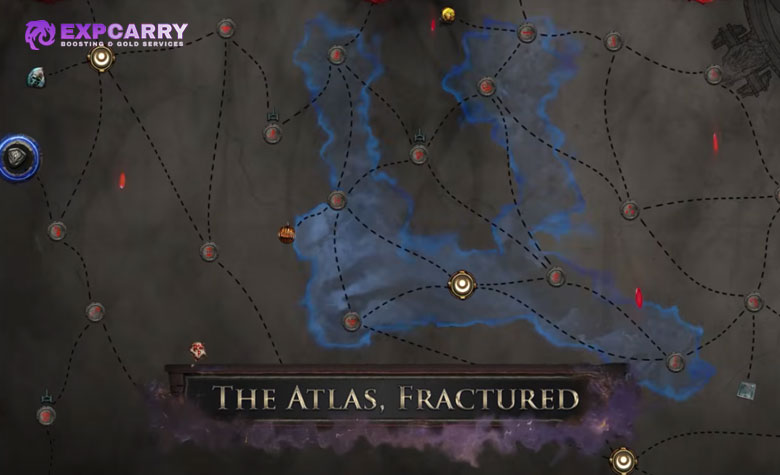
The phrase "poe atlas rework" is already attached to 3.30 searches, but it needs careful handling. GGG has not confirmed that 3.30 will replace the Atlas layout, rebuild every Atlas passive cluster, or discard the current map progression system. The official Atlas Skill Tree remains the live reference for the current system. What has been confirmed is an endgame shakeup large enough to change how many of the mechanics inside that Atlas relate to one another.
That may sound like a semantic difference, but it changes how players should prepare. The current Atlas is not valuable only because of its map nodes. It is also the routing layer for multiple reward systems. Scarabs, passives, map modifiers, bosses, special encounters and league mechanics all feed into one another. When GGG says it wants more interactions between older systems, the confirmed target is the endgame ecosystem around the Atlas, not necessarily a replacement of the Atlas map itself.
The community has been asking for exactly this kind of depth. Recent 3.29 feedback repeatedly focuses on weak high-investment farming and on activities that do not scale rewards enough to justify heavily developed characters. A large 3.29 feedback megathread specifically groups complaints about endgame loot, high-investment strategies, Abyss, Legion, Breach and Voyages. That is community evidence, not a GGG design document, but it helps explain why the phrase "endgame shakeup" received so much attention.
There is also recent precedent for GGG changing the long-term status of systems instead of automatically preserving an entire league. Before 3.29, the studio confirmed that the Mirage league mechanic itself would not go core, while core Atlas content introduced during Mirage, including Astrolabes, would remain, along with Exceptional Support Gems. The official Mirage end-of-league notice is a useful reminder that a future rework can preserve selected systems without preserving every part of the league that introduced them.
PoE 3.30 Loot Changes Aim to Make Drops Feel Exciting Again
The loot problem is the most concrete part of the 3.30 discussion. Current complaints are not simply that players want more items on the screen. The deeper issue is where valuable rewards come from and how strongly difficulty and investment affect them. In 3.29, players have repeatedly contrasted fixed or chest-based rewards with loot produced by killing monsters. When the predictable reward container is the real prize, monsters on the way there can start to feel secondary.
GGG's stated direction is to reconsider which items should be exclusive to specific mechanics and which rewards could appear more broadly. That is potentially a major economy change. Path of Exile has spent years teaching players that some bases, currencies, fragments and high-value items belong to specific content. Exclusivity gives a mechanic identity, but too much exclusivity can also make ordinary ground loot easier to ignore because players already know that certain desirable items cannot come from a random monster.
The developers have also talked about making drops more spontaneous and less deterministic, with Path of Exile 2 cited as a reference point for how exciting random loot can feel. This does not mean PoE 1 is becoming PoE 2, and it does not confirm a direct copy of PoE 2's rarity, currency or item-generation systems. It means the team is examining how random monster drops can become more meaningful instead of concentrating too much value in rewards whose source is known before an encounter begins.
That makes one prediction tempting but unsafe: "all mechanic-exclusive items are going core." GGG has not said that. The confirmed idea is a reevaluation of which items need to remain tied to a specific mechanic. Some items may stay exclusive because they define an activity; others could gain different sources or be repositioned. Until the 3.30 reveal and patch notes exist, pricing an investment around one specific item losing exclusivity is speculation.
Explore services related to this guide, selected from our Path of Exile catalog.
View All Path of Exile Services


Old League Mechanics Are Being Pulled Back Into the Same Ecosystem
The second major pillar of Path of Exile 3.30 endgame changes is interaction. Many legacy systems currently behave like separate rooms built inside the same house. You specialize in one mechanic, stack the scarabs and passives that make it work, and largely ignore everything outside that plan. Efficient farming naturally rewards specialization, but extreme isolation can also create stale routes because most of the important decisions happen before the map rather than during it.
GGG wants more cases where league mechanics can interact with one another. The exact implementation has not been published, so it is too early to claim specific scarab combinations, Atlas nodes or cross-mechanic reward formulas. The important confirmed point is the direction: 3.30 is intended to make older systems interact more often. Anyone presenting a complete 3.30 scarab list or a finished Atlas passive tree today is filling gaps that GGG has not yet filled publicly.
Curse of the Allflame is useful context because 3.29 already combines a new league with substantial changes to older systems. Players who want to understand the current baseline can use our Curse of the Allflame mechanic guide for Charts, Voyages and Allflame progression. The 3.30 discussion begins where that guide ends: with the question of how the wider endgame will change once more older mechanics receive new interactions and reward roles.
This also explains why GGG warned that smaller additions may receive less attention. New Transfigured Skill Gems are one example the developers mentioned as content that might be limited because the endgame work is so broad. That tradeoff shows how much development focus is being placed on structural endgame changes rather than only adding the usual number of smaller features.
Confirmed 3.30 Changes Stop Well Short of Full Patch Notes
There is enough information to describe the design direction, but not enough to write preview patch notes. Keeping those two things separate is essential because 3.30 discussion is already mixing direct developer comments with assumptions about the Atlas, the economy and individual league mechanics.
| Topic | Status | Player takeaway |
|---|---|---|
| Major endgame shakeup | Confirmed direction | GGG is treating 3.30 as broad structural endgame work, not only a normal seasonal balance pass. |
| Existing league mechanics refreshed | Confirmed direction | The team wants to reach as many older mechanics as possible and give them something new or different. |
| More interaction between mechanics | Confirmed direction | GGG wants older league systems to interact with one another more often, although the exact implementations are not public yet. |
| Loot source reevaluation | Confirmed direction | GGG is reviewing which rewards need to stay mechanic-exclusive and how random monster drops can feel more meaningful. |
| Completely new Atlas layout | Not confirmed | Do not assume the current Atlas geography, Voidstone structure or map progression is being deleted. |
| Full Atlas passive tree replacement | Not confirmed | The current Atlas Skill Tree remains the live reference until GGG publishes 3.30-specific changes. |
| Exact launch date | Not confirmed | The August interview indicated roughly four months, not a locked release date. |
| Specific item nerfs or new drop locations | Not confirmed | Avoid buying or selling solely because of rumors about one high-value item. |
The table is deliberately conservative. Additional comments and community summaries are circulating around the developer interview, but until GGG publishes official reveal material and patch notes, the safest approach is to base decisions on confirmed direction rather than rumored implementation. That is especially important for Standard players holding rare legacy gear and for trade-league players tempted to speculate on items that might gain or lose exclusive drop sources.
Prepare Currency and Characters Without Betting on Rumors
The worst preparation strategy is panic trading around an unfinished patch. If you are actively enjoying 3.29, your currency still has its highest practical value when it improves the character or farm you are using now. A Divine Orb sitting in the stash because "3.30 might change everything" does not improve your current progression. At the same time, sinking your entire bank into a highly specialized speculative asset is unnecessary when GGG has openly signaled that reward sources are being reevaluated.
A sensible approach is to separate currency by purpose. Keep enough liquid currency for normal trading and crafting. Finish upgrades that materially improve clear speed, defenses or boss access in 3.29. Be more cautious with luxury purchases whose price depends heavily on one specific farming mechanic remaining dominant. If you play Standard, preserve irreplaceable or historically unusual items rather than trying to predict how every future drop-source change will affect them.
For trade-league players, there is another reason not to hoard blindly: a fresh challenge league normally starts with a new economy. Your current league wealth does not simply become a 3.30 league-start bankroll. What you can carry forward is knowledge - which builds level smoothly, how quickly you can reach maps, which defenses you tend to neglect, and which Atlas systems you actually enjoy enough to farm for days.
If your current bottleneck is still Atlas completion, it makes more sense to solve that problem while the live rules are known. A focused PoE Atlas boost can be relevant for players who want missing Atlas passive points completed without turning the rest of 3.29 into preparation for an unannounced patch. The same logic applies if you are doing the work yourself: finish concrete goals now and treat speculative 3.30 investments as optional, not mandatory.
There is no reason to delete, dismantle or deliberately weaken a strong character because of 3.30. The patch is expected to change endgame incentives, but GGG has not announced a universal character reset, a passive-tree wipe, or a list of builds that will stop functioning. Character balance details should be judged when GGG publishes actual 3.30 balance information and patch notes.
Instead, use the remaining 3.29 time to identify what makes your build strong. Does it survive because of layered defenses or because current content dies before it can hit you? Does it clear well in open maps but fall apart in cramped mechanics? Does it need a highly specific scarab strategy to justify its investment? These questions matter more than chasing a hypothetical "3.30 build" before the balance pass is public.
Players returning specifically because of the 3.30 news should also avoid studying old Atlas guides as if nothing changed in 2026. Our PoE 1 returning player guide covers the redesigned Atlas, current Voidstones, 3.29 socket changes and other systems that define the live game. Relearning the 3.29 baseline now will make the actual 3.30 differences much easier to understand once the reveal arrives.
If the character itself is the weak point, a custom PoE build setup is more relevant than buying around rumors. A coherent mapper with reliable defenses will teach you far more about the current endgame than a pile of speculative uniques in the stash. Players planning an entirely new archetype can also use a PoE leveling service to establish another character, but there is no 3.30-specific build package worth treating as future-proof before balance details exist.
The Real 3.30 Test Is Whether Power Has Somewhere to Go
The strongest version of Path of Exile's endgame is not the one with the most icons on the Atlas. It is the one that gives players reasons to keep improving a character after ordinary mapping is already comfortable. That is why the discussion around high-investment and aspirational farming matters. A build worth hundreds of Divine Orbs should have access to harder, more rewarding content that meaningfully tests that investment instead of simply completing the same encounter faster.
The important uncertainty is how GGG will balance spontaneity against reward scaling. Making drops less deterministic could make monster loot more exciting, but it will only solve the current complaint if difficult, heavily invested content also has a meaningful reward ceiling. The developer interview establishes the direction, not the final balance. A promise to make random drops more exciting is not the same thing as a guarantee that every farming strategy will become profitable.
The reveal will therefore need to answer practical questions. How does difficulty scale rewards? Which old mechanics have new interactions? Where do high-value items come from? Can several different builds reach profitable high-investment farms, or does one strategy dominate again? How much of the current Atlas progression remains? Those answers will determine whether 3.30 becomes a genuine endgame reset in player behavior or simply a large balance pass with a new optimal route discovered soon after launch.
Conclusion
Path of Exile 3.30 is important because GGG is openly targeting the structure of the endgame rather than one isolated league mechanic. The confirmed plan is to revisit as many older league systems as possible, create more interaction between them, rethink which valuable items need to remain tied to specific mechanics, and make random drops feel more exciting. That is a broader ambition than simply moving maps around the Atlas.
The key caution is equally important: a complete replacement of the Atlas has not been confirmed, the final loot rules are not public, and there is no locked 3.30 release date as of August 26, 2026. Treat the current information as a design direction, not patch notes. Keep playing the character you enjoy, spend currency on real 3.29 progress instead of rumor-driven speculation, and preserve flexibility if you hold expensive items whose value depends on one exclusive reward source.
Once GGG publishes the 3.30 reveal and patch notes, the useful questions will become much more concrete: which Atlas strategies survive, which mechanics gain new interactions, which valuable drops move, and which builds can actually exploit the new high-investment endgame. Until then, the best preparation is not a warehouse of guesses. It is a finished character, a liquid stash, and a clear understanding of how the current Atlas produces its rewards.