
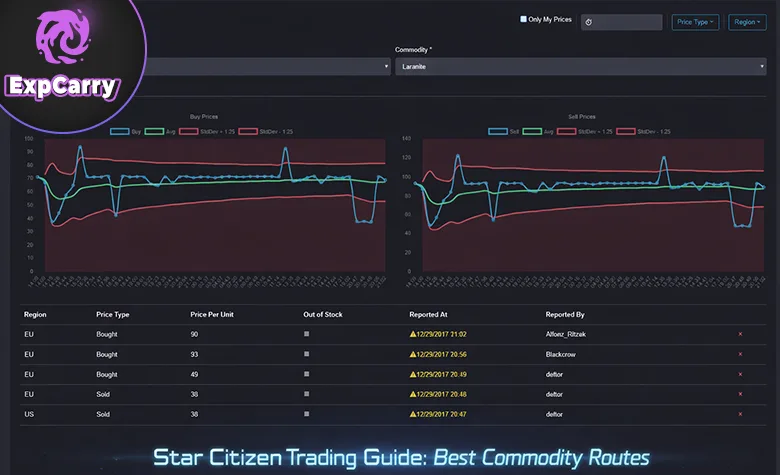
Trading in Star Citizen is one of the most flexible ways to earn aUEC, but there is no single permanent best trade route in 2026. Commodity prices, stock, demand, ship capacity, loading time, server conditions, player traffic, and piracy risk can all change whether a route is profitable from one session to the next.
The modern cargo career has two main lanes: hauling contracts, where you transport cargo for organizations such as Covalex Shipping, Red Wind Linehaul, and Ling Family Hauling, and commodity trading, where you invest your own aUEC into goods and sell them somewhere with stronger demand. Both use similar cargo skills, but the risk model is very different.
This Star Citizen trading guide combines both paths into one progression. You will learn which hauling contracts to start with, how reputation affects better freight work, which commodity route families are worth testing, how to measure real profit per hour, how ship size changes route selection, and when Stanton or Nyx makes more sense for your cargo operation.
Quick answer: Beginners should start with small hauling contracts, build reputation with one hauling company, learn one Stanton planet-and-hub network, and only then add self-funded commodity trading. Prioritize repeatable mid-risk routes over one theoretical high-profit run, and never put your entire aUEC balance into a single cargo load.
Last verified: September 2026. Exact commodity prices, stock, demand, and payouts remain dynamic, so this guide focuses on route selection and progression rather than pretending one static route is permanently best.
How Star Citizen Trading Works
Hauling and commodity trading look similar because both involve loading cargo, travelling to another location, and unloading it. The main difference is who owns the cargo and who carries the financial risk.
| Trading Type | How It Works | Main Risk | Progression |
|---|---|---|---|
| Hauling Contracts | Accept a contract and transport assigned cargo between specified locations | Contract failure, time, cargo handling, route problems | Builds reputation with the organization providing the contract |
| Commodity Trading | Buy commodities with your own aUEC and sell them where demand is higher | Your own capital, stock, demand, cargo loss, piracy | Profit depends on market knowledge and repeatable routes |
Hauling is generally the better learning path because you do not need to finance an entire cargo hold yourself. Commodity trading has a higher capital risk, but it gives you more freedom to choose cargo, destinations, and route timing.
If you are still learning freight elevators, hangars, inventory, landing, ship retrieval, or basic navigation, complete those fundamentals first with our Star Citizen Beginner Guide.
Best Hauling Contracts for Beginners
New cargo players should begin with smaller direct or planetary hauling contracts. These missions teach the full freight workflow without forcing you to manage a huge ship, multiple destinations, dozens of containers, or a large personal investment.
Your first goal is to become comfortable with:
- accepting and reading hauling contracts;
- identifying pickup and delivery locations;
- using freight elevators;
- loading containers efficiently;
- planning cargo placement inside the ship;
- landing legally at the destination;
- unloading and submitting the completed contract;
- recovering when a route or terminal does not behave as expected.
Do not select a contract only because its payout number is larger. A complicated multi-stop contract that takes twice as long and creates more opportunities for failure can produce worse real income than several clean smaller contracts.
Build Reputation With One Hauling Company First
The most efficient early strategy is usually to concentrate on one hauling organization instead of spreading your contracts evenly across every available company. Covalex Shipping is a practical default because it has a clear hauling progression and a large contract network.
Current Covalex hauling progression uses the following career ranks:
| Rank | What It Means for Progression |
|---|---|
| Trainee | Entry point for basic hauling work |
| Rookie | Broader beginner contract selection |
| Junior | Further access to larger and more complex hauling work |
| Member | Established hauling progression with broader contract availability |
| Experienced | Important scaling point for larger medium hauls and larger container formats |
| Senior | Higher-level freight contracts |
| Master | Top Covalex hauling progression and access to the highest contract tiers |
You do not have to use Covalex forever. Red Wind Linehaul, Ling Family Hauling, and other organizations can also support a freight career. The important principle is to build enough standing with one organization for progression to become meaningful before constantly switching employers.
For a broader explanation of faction standing, reputation scopes, and mission unlocks, use our Star Citizen Reputation Guide.
Best Star Citizen Trade Routes by Trading Style
Because live prices and stock change, the best Star Citizen trade routes should be treated as route families, not permanent buy-and-sell instructions.
The stable principle is simple: buy commodities where supply is available, sell where demand is stronger, and measure the complete cycle rather than looking only at the price difference per SCU.
| Route Style | Best For | Commodity Examples | Main Advantage |
|---|---|---|---|
| Safe starter surface-to-hub loop | Beginners and smaller cargo ships | Lower-value agricultural, processed, industrial, or bulk goods | Lower capital exposure and easier route learning |
| Mid-tier industrial loop | Medium cargo ships | Titanium, Tungsten, Beryl, Copper and similar industrial cargo | Better balance between margin, availability, and repeatability |
| High-value low-stock loop | Experienced traders with more capital | Gold, Agricium, Laranite, Taranite and other higher-value goods | Higher potential return when stock and demand cooperate |
| Contract-first freight loop | Players building hauling reputation | Contract cargo | No commodity purchase risk and direct reputation progression |
| Intersystem / frontier hauling | Experienced players | Contract or commercial cargo between systems | Longer routes and more varied logistics |
Explore services related to this guide, selected from our Star Citizen catalog.
View All Star Citizen Services


Best Stanton Cargo Routes to Learn First
Stanton remains the most practical system for learning cargo trading because it gives you multiple major landing zones, orbital infrastructure, outposts, industrial locations, and alternative destinations if one route becomes inefficient.
Instead of memorizing one fixed route, learn a complete planet-and-hub network.
Hurston Trade Network
Hurston is useful for learning routes between surface locations, Lorville, and the wider orbital network. The value is not one particular commodity. The value is knowing the local terminals, travel times, landing process, and alternative destinations well enough to switch cargo without rebuilding your entire route.
microTech Trade Network
microTech gives traders another practical surface-to-major-hub environment centered around New Babbage and nearby orbital infrastructure. It works well for players who want to become comfortable with one region before expanding into system-wide hauling.
ArcCorp Trade Network
ArcCorp and its surrounding moon network support another useful route family into Area18 and nearby cargo infrastructure. Again, the correct commodity depends on current stock and demand, so the location network is more important than one static commodity recommendation.
A good trader should know at least two alternative commodities and one alternative sell destination before loading a high-value cargo hold.
Profit Per Hour Matters More Than Profit Per Run
Theoretical margin per SCU is not enough to identify the best trade route. What matters is how much profit the entire loop produces over time.
| Metric | What to Check | Why It Matters |
|---|---|---|
| Margin per SCU | Difference between effective buy and sell value | Shows theoretical cargo margin |
| Available stock | How quickly you can fill the required cargo volume | Prevents long waits for inventory |
| Sell demand | Whether the destination can absorb your cargo | Prevents getting stuck with unsold goods |
| Cycle time | Loading, travel, landing, selling, and return time | Determines actual profit per hour |
| Risk | Piracy, technical instability, landing complexity, route exposure | Determines whether the theoretical margin is worth the loss potential |
A lower-margin route that can be completed reliably every 15 or 20 minutes can outperform a premium route that requires long stock waits, difficult loading, long travel, or repeated attempts to sell the cargo.
Quick Trade Route Scoring Method
Use the same process whenever you test a new route:
- Record the commodity, buy location, sell location, and ship.
- Record how much cargo you could actually purchase.
- Track the full cycle from departure to completed sale.
- Check whether you could sell the entire load without waiting.
- Record fuel, repair, and other operating costs.
- Rate the route risk as low, medium, or high.
- Compare the result with your safer alternative.
| Route Rating | Meaning | Action |
|---|---|---|
| Strong | Good margin, fast cycle, reliable stock and demand | Repeat while conditions remain stable |
| Average | Profitable but dependent on stock, timing, or player traffic | Use moderate cargo exposure |
| Weak | Low stock, slow sales, poor margin, or excessive travel | Change commodity or route |
| High Risk | Large capital exposure with unstable conditions | Reduce cargo value or avoid the route |
Community trading tools are useful for finding candidates, but always confirm important prices, stock, and destination demand in the current game before investing a large amount of aUEC.
Best Trade Strategy by Ship Size
The correct trade route changes with cargo capacity. A route that is excellent for a small ship can be inefficient for a large hauler if supply is too low to fill it or the destination cannot absorb enough cargo.
| Ship Size | Best Strategy | Avoid |
|---|---|---|
| Small Cargo Ships | Short routes, useful margins, fast loading and landing | Low-margin bulk cargo that wastes limited SCU |
| Medium Cargo Ships | Repeatable industrial routes with enough stock | Waiting too long for one premium commodity |
| Large Cargo Ships | Reliable supply, strong sell demand, efficient cargo handling | Routes where you repeatedly leave partially loaded |
| Heavy Haulers | Volume-oriented routes, stable terminals, careful route planning | High-value direct runs without fallback destinations or risk planning |
As cargo capacity increases, volume and throughput become more important than margin per SCU. A large hauler needs reliable supply and demand more than it needs the highest theoretical commodity price difference.
Nyx and Levski Cargo Hauling
Nyx adds a different type of cargo gameplay because intersystem travel introduces longer routes, additional logistics, and more exposure than a short Stanton loop.
Levski is the major operating hub for Nyx, while the surrounding asteroid regions and gateway connections create opportunities for freight, resource transport, and system-to-system logistics.
Nyx hauling makes the most sense after you already understand loading, route planning, ship recovery, and capital management in Stanton.
Nyx Hauling Checklist
- Repair and refuel before beginning the intersystem route.
- Carry enough aUEC for recovery and unexpected operating costs.
- Do not invest your entire trading bankroll into one frontier load.
- Know your destination and fallback location before leaving.
- Use a ship with sufficient range and practical cargo access.
- Check mission requirements before transporting contract cargo.
- Expect longer cycle times than short Stanton trade loops.
For Levski, gateways, Keeger Belt, Glaciem Ring, and other Nyx locations, use our Star Citizen Nyx System Guide.
Dogleg Routing for High-Risk Cargo Runs
On routes where player interception is a realistic concern, a direct source-to-destination path can become predictable. A dogleg route introduces an intermediate navigation point so your final approach is not simply the most obvious line between the two locations.
This does not make valuable cargo safe. It only reduces predictability. The stronger protection is still conservative capital exposure, awareness of player activity, fast loading and landing, and the ability to abandon a route when conditions are poor.
Best Full Trading Progression
The most reliable progression from beginner hauling to larger commodity trading is:
- Start with small hauling contracts.
- Build reputation with one hauling company.
- Learn one Stanton planet-and-hub network.
- Develop a reserve instead of spending every payout.
- Add low-risk self-funded commodity runs.
- Move into repeatable mid-tier industrial trading.
- Upgrade cargo capacity only when your current ship becomes the bottleneck.
- Test premium low-stock commodities only when you can absorb a failed run.
- Move into Nyx or longer intersystem hauling after the basic cargo workflow is routine.
This sequence separates learning from financial exposure. Commodity trading becomes much easier once cargo loading, terminals, landing, navigation, and recovery are already routine.
Common Cargo Trading Problems
| Problem | Why It Hurts Profit | Practical Response |
|---|---|---|
| Low commodity stock | Your ship cannot be filled efficiently | Switch commodity, source location, or use a smaller ship |
| Low sell demand | You cannot liquidate the full cargo quickly | Use a fallback destination or reduce load size |
| Ship not available at terminal | Trading workflow stops | Confirm legal landing and correct ship/location state |
| Slow cargo handling | Cycle time destroys theoretical margin | Choose simpler routes and cargo layouts |
| Piracy or player pressure | Large capital exposure can be lost | Reduce cargo value, alter route, use escort when justified |
| Server or terminal instability | Loading or selling may fail | Stop increasing exposure and change activity or server |
Biggest Trading Mistakes That Kill Profit
Chasing the highest theoretical margin
The commodity with the largest price difference is not automatically the most profitable cargo. Low stock, restricted demand, long travel, difficult cargo handling, and heavy competition can erase the advantage.
Splitting reputation too early
Constantly switching hauling organizations slows your climb toward higher contract tiers. Establish one progression path first, then diversify later.
Using a ship that is too large for the route
A large cargo hold only improves profit when you can fill and sell it efficiently. Half-empty heavy haulers create more handling and travel cost without receiving the intended volume advantage.
Investing the entire bankroll
Always maintain enough aUEC to recover from cargo loss, repair the ship, refuel, purchase equipment, and continue playing. One failed run should not reset your entire trading career.
Operating without fallback destinations
Before buying expensive cargo, know where else you can sell or what alternative commodity you can run if the planned market is no longer attractive.
How to Make More aUEC With Trading
Improving trade income is less about discovering a secret commodity and more about making each cycle more efficient.
- Track cycle time: compare completed profit per hour, not screenshots of profit per load.
- Know multiple commodities: avoid dependence on one stock pool.
- Prepare fallback destinations: do not let one low-demand terminal trap your capital.
- Protect operating capital: keep a reserve outside the current cargo load.
- Match the ship to the route: cargo capacity only helps when supply and demand support it.
- Stop bad sessions early: repeated terminal failures or unstable servers can make other gameplay more productive.
If your only goal is accumulating enough credits for a specific ship, component setup, or trading bankroll, compare the manual route with the current Star Citizen aUEC option before spending many sessions rebuilding capital.
Star Citizen Trade Routes FAQ
What is the best trade route in Star Citizen?
There is no permanent best trade route. The correct route depends on current commodity stock, buy and sell values, demand, ship capacity, cycle time, server conditions, and risk. Repeatable mid-risk routes are often more useful than one high-margin low-stock route.
What is the best cargo route for beginners?
Start with smaller Stanton hauling contracts or short surface-to-hub commodity routes. These allow you to learn freight elevators, cargo loading, terminals, navigation, and landing without risking a large amount of capital.
What is the difference between hauling and commodity trading?
Hauling contracts pay you to transport cargo provided for a mission and usually build reputation with the contracting organization. Commodity trading requires you to purchase the goods yourself and profit from the difference between the buy and sell market.
Which hauling company should I level first?
Covalex is a strong default because it offers a clear hauling progression from Trainee through Master. The more important rule is to build meaningful reputation with one organization before spreading your effort across several companies.
Which commodities are best for trading?
Industrial goods are often easier to trade repeatedly, while high-value commodities such as Gold, Agricium, Laranite, and Taranite can offer better upside when stock and demand are available. Always verify current market conditions before buying.
Is Stanton good for cargo trading?
Yes. Stanton is an excellent system for learning trade because it offers multiple major hubs, surface locations, stations, and fallback destinations within one established network.
Is Nyx good for hauling?
Nyx is useful for frontier and intersystem logistics, but its longer routes and additional operational risk make it better suited to players who already understand the core cargo workflow.
How much aUEC should I risk on one cargo run?
Do not invest an amount that would prevent you from continuing to play if the cargo is lost. Keep enough reserve for fuel, repairs, claims, equipment, and another income-producing activity.
Do I need a large cargo ship to make money?
No. Small and medium ships can be more efficient on limited-stock or short-cycle routes. Large ships become more valuable when you have enough reliable supply, demand, and cargo-handling efficiency to use their capacity.
Final Recommendation
The best Star Citizen trade route in 2026 is not the route with the highest theoretical margin. It is the route you can fill, fly, sell, and repeat reliably with your current ship, bankroll, and risk tolerance.
Start with hauling contracts, build reputation with one company, learn a Stanton trading network, and maintain an operating reserve. Add self-funded commodity trading only after the cargo workflow is familiar. Mid-tier industrial routes should form the core of most repeatable trading plans, while premium low-stock goods and intersystem Nyx hauling are better treated as advanced opportunities.
Once you measure profit by complete cycle time rather than profit per SCU alone, cargo trading becomes much easier to scale without turning one failed run into a complete financial reset.