
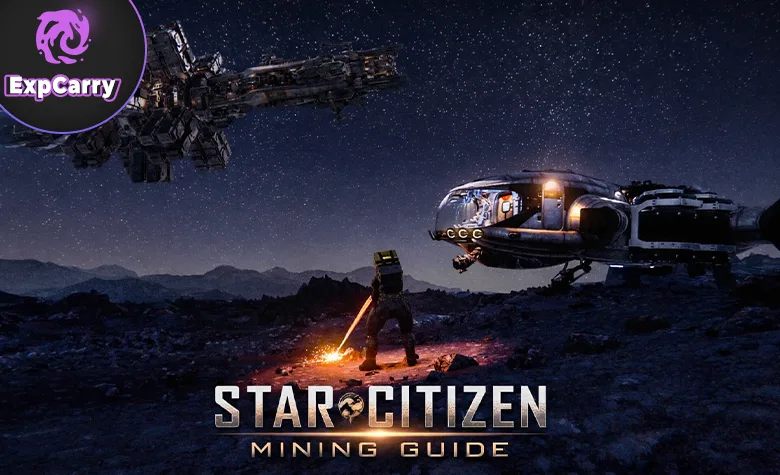
Star Citizen mining is an industrial career built around finding deposits, fracturing them safely, extracting useful minerals and deciding whether to sell, refine or use the materials for crafting. In Alpha 4.10.2 LIVE, players can mine with handheld equipment, the Argo ATLS GEO, Greycat ROC vehicles and dedicated ships such as the Drake Golem, MISC Prospector and Argo MOLE. Material quality, detachable ore pods, mining modules and refinery logistics now make equipment and resource selection especially important.
Short answer: start with hand mining or a ROC for low-cost resource gathering, use the Golem for straightforward ship mining, the Prospector for flexible solo operations and the MOLE for coordinated crews. Scan composition, resistance, instability and quality before fracturing, then match your equipment and processing route to the target material.
Alpha 4.7 connected mining more closely to crafting by introducing material quality and overhauling resource distribution. Alpha 4.10 expanded equipment progression with craftable ore pods and mining modules associated with Recco Battaglia. The current public build is Alpha 4.10.2 LIVE, released on October 9, 2026, with Long Term Persistence preserved. Exact mineral prices, distribution and component statistics can change between patches.
Star Citizen Mining at a Glance
Mining equipment is divided by deposit scale, collection method and carrying capacity. Handheld tools work on small crystals, ground vehicles have their own resource pool, and ship mining provides access to larger ore deposits and refinery processing.
| Mining type | Recommended equipment | Best for | Refining required? |
|---|---|---|---|
| Hand mining | Pyro RYT Multi-Tool with OreBit Mining Attachment | Caves, small deposits and low-cost mineral collection | Usually no |
| Power-suit mining | Argo ATLS GEO | Mobile small-scale surface mining | Depends on the material |
| Vehicle mining | Greycat ROC or ROC-DS | Ground-vehicle minerals such as Beradom, Glacosite and Feynmaline | Generally no |
| Starter ship mining | Drake Golem | Learning ship scanning, fracturing and extraction | Optional, often beneficial |
| Solo ship mining | MISC Prospector | Customizable solo mineral extraction | Optional, often beneficial |
| Multi-crew mining | Argo MOLE | Large deposits and coordinated operations | Optional, often beneficial |
Alpha 4.1 separated traditional FPS mineables, including Aphorite, Dolivine and Hadanite, from the regular ROC resource pool. Some early patch notes contain inconsistent spellings for these materials; this guide uses the names found in current game-data catalogs. Ship-mined ore can be sold raw where supported or processed through refinery work orders, while smaller gemstones normally follow a different sale workflow.
How Mining Works in Star Citizen
The basic process has three stages: scanning, fracturing and extraction. Refining, hauling and selling are subsequent economic steps rather than part of fracturing itself.
- Scanning: find deposits and evaluate composition, size, difficulty and quality.
- Fracturing: control mining energy until the rock splits into collectible fragments.
- Extraction: collect useful minerals using the appropriate tool or extraction beam.
A profitable run depends on the entire process, including where the recovered material goes after mining.
1. Scan the Deposit
Use the scanner available on your ship, vehicle or handheld equipment to find mineable objects. Approach the deposit carefully and inspect its properties before activating the mining laser.
- Composition: the resources inside the rock and their approximate concentrations.
- Mass: the size of the deposit and an important factor in fracture difficulty.
- Resistance: how strongly the deposit opposes mining-laser energy.
- Instability: how difficult the charge is to control.
- Material quality: the quality rating relevant to supported crafting recipes.
- Inert content: unwanted material that can consume valuable storage capacity.
Reject deposits whose useful content does not justify the required time or difficulty. A clean, moderately valuable rock can outperform a large deposit containing only a trace of premium minerals.
For resource-specific profitability, see the Star Citizen Best Ore Guide. This overview concentrates on mining mechanics and equipment rather than duplicating a changing price ranking.
2. Fracture the Rock
Enter Fracture Mode and direct the mining laser onto the deposit. Increase the charge into the optimal green window and maintain it until the rock fractures.
Insufficient energy prevents progress, while excessive energy can push the charge into the overcharge zone and cause dangerous fragmentation. Reduce or increase laser power gradually rather than holding maximum output throughout the process.
Highly resistant deposits may require more effective equipment, resistance-reducing modifiers or multiple lasers. Unstable rocks may benefit from improved charge control and a wider optimal window. If your equipment cannot fracture a deposit safely, leave it and search for another target.
3. Extract Valuable Material
After fracturing, inspect the resulting pieces. Break down oversized fragments again and switch to Extraction Mode when material becomes collectible.
Evaluate individual fragment composition before extraction. Valuable resources can remain mixed with unwanted material, so avoid filling limited containers unnecessarily.
For commodity profit, prioritize concentration and net sale value. For crafting, retain the required mineral at the quality specified by your blueprint. Once containers are full, return to the appropriate refinery, buyer or storage facility.
Material Quality and Why It Matters
Alpha 4.7 introduced quality values for mined resources. CIG confirmed that quality is preserved during refining: refining Iron Ore into Iron does not automatically erase the material's quality rating.
Blueprints use material quality to influence the characteristics of crafted items. Some have minimum input-quality requirements, and certain recipes can produce negative stat modifiers from sufficiently low-quality materials.
- Commodity value: the price obtainable through available buyers and trade terminals.
- Crafting value: the usefulness of the correct material and quality level for a known blueprint.
A high-quality mineral is not automatically more profitable than a lower-quality premium ore. Consider the recipe, material quantity, minimum quality, available storage and the intended finished item before deciding what to retain.
Alpha 4.10.2 preserved Long Term Persistence, but preservation of LTP does not guarantee that every inventory item or physical cargo state will survive a technical problem. RSI separately documents missing inventory items after some updates. Do not describe isolated quality-loss reports as a confirmed universal quality reset.
Explore services related to this guide, selected from our Star Citizen catalog.
View All Star Citizen Services

Hand Mining in Star Citizen
Hand mining is the lowest-cost introduction to mineral extraction. Equip a Pyro RYT Multi-Tool with an OreBit Mining Attachment and bring suitable inventory capacity.
Small FPS deposits can appear in caves, on surfaces and in selected industrial or mission locations. Their resource pool differs from normal ROC and ship mining.
- Equip the Multi-Tool and mining attachment.
- Locate a small mineral deposit.
- Inspect its composition and difficulty.
- Apply power and control the charge.
- Fracture the rock without overcharging it.
- Collect the resulting mineral pieces.
- Transfer them to suitable storage or an accepting buyer.
Common FPS resources include Aphorite, Dolivine and Hadanite. More specialized deposits can require different locations and additional preparation.
Janalite Mining
Janalite is a rare FPS-scale mineral with demanding fracture characteristics. It should be treated as a specialist target, not a guaranteed beginner farming route.
Current resource databases identify possible deposits in Stanton locations including Calliope, Clio, Euterpe, Lyria, Wala and microTech, as well as selected Pyro regions. CIG also expanded Janalite surface availability during the Alpha 4.7 distribution update.
These are possible search regions, not guaranteed spawn points. Carry sufficient storage, select environmental protection for the destination and account for the mineral's resistance and narrow charge window before attempting extraction.
ATLS GEO Mining
The Argo ATLS GEO is a mining-focused power suit that fills the operational gap between a handheld tool and a larger mining vehicle.
It features a Lawson mining laser, Surveyor-Go radar and removable resource container, along with equipment storage for short expeditions. Its mobility can be useful on uneven terrain or around deposits that are inconvenient to approach in a larger vehicle.
The GEO does not replace a Prospector or MOLE for large ship-mining deposits and refinery-oriented hauling. Choose it for compatible small-scale deposits where mobility and specialized equipment offer a practical advantage.
ROC Mining
The Greycat ROC and ROC-DS are designed for surface deposits that use the ground-vehicle mining resource pool. Alpha 4.1 separated this pool from ordinary FPS mineables.
- Beradom: easier beginner ground-vehicle mineral.
- Glacosite: intermediate beginner mineral.
- Feynmaline: more difficult beginner mineral.
- Specialist minerals: additional deposits with different difficulty or acquisition requirements.
Aphorite, Dolivine and Hadanite belong to the standard FPS category and should not be presented as normal ROC targets under this updated classification.
Alpha 4.1 also introduced four dedicated Size 0 ROC mining heads. Their advantages differ in laser power, resistance reduction, instability and optimal-window behavior.
A typical ROC operation requires:
- a ROC or ROC-DS;
- a compatible transport ship with sufficient loading space;
- a surface location with ground-vehicle deposits;
- environmental protection for the operator;
- adequate mineral storage;
- a verified unloading or sale destination.
ROC materials generally do not require a traditional ship-ore refinery work order. The main challenge is transporting the vehicle, locating worthwhile deposits and returning safely with the collected resources.
Best Mining Ships in Star Citizen
The three primary currently usable dedicated mining ships are the Drake Golem, MISC Prospector and Argo MOLE. They differ in crew needs, active mineral capacity, laser mounts and operational flexibility.
| Mining ship | Crew | Standard active capacity | Best for | Main limitation |
|---|---|---|---|---|
| Drake Golem | 1 | 32 SCU, two 16-SCU containers | Starter ship mining | Simple starter configuration and limited operational scale |
| MISC Prospector | 1 | 32 SCU, four 8-SCU containers | Flexible solo mining | One Size 1 mining arm |
| Argo MOLE | Up to 4 | 96 SCU, eight 12-SCU containers | Coordinated multi-crew mining | Requires operators to use all three mining turrets efficiently |
These figures describe standard active mineral storage, not ordinary cargo-grid capacity or every achievable configuration with upgraded pods. Compatibility and capacity must be verified for specific replacement containers.
Drake Golem — Best Starter Mining Ship
The Drake Golem is a single-seat starter mining ship carrying two removable 16-SCU mineral containers, giving it 32 SCU of standard mining capacity. Its default equipment includes the Size 1 Pitman laser.
The Pitman emphasizes beginner-friendly fracture control. The Golem is therefore a practical way to learn scanning, laser management, extraction and refinery deliveries without managing multiple crew positions.
Choose the Golem if:
- you want to learn dedicated ship mining;
- you usually operate alone;
- you prefer straightforward equipment and container handling;
- you need an entry point into refinery-based mining.
Alpha 4.10 equipment change: current 4.10 mining-equipment data lists the Golem's Size 1 mining head as swappable with compatible Size 1 lasers. Older information describing the Pitman as permanently fixed may be outdated. Confirm the actual mount and replacement options in the current Vehicle Loadout Manager before purchasing an upgrade.
MISC Prospector — Best Flexible Solo Mining Ship
The MISC Prospector is a flexible choice for solo miners who want to adapt their equipment to different deposits. It has one replaceable Size 1 mining head and four standard 8-SCU mineral containers, totaling 32 SCU.
The frequently quoted 48-SCU setup relies on larger compatible replacement pods; it is not the Prospector's default storage capacity.
Its main advantage is the ability to customize laser and module characteristics, including:
- effective mining power;
- resistance handling;
- optimal-charge window size;
- charge stability;
- extraction efficiency;
- performance against specific deposit types.
More power does not always produce better results. An aggressive configuration may be difficult to control on unstable rocks. Choose the Prospector if mining is a regular activity and you want to adjust your loadout as your target materials change.
Argo MOLE — Best Multi-Crew Mining Ship
The Argo MOLE is a multi-crew mining ship with three independently operated Size 2 mining turrets. Its standard active mineral capacity is 96 SCU across eight 12-SCU containers.
Multiple operators can combine mining power against difficult deposits or divide work between suitable fragments. Additional logistics can support extended operations, but storage arrangements should not be confused with the standard active capacity.
The MOLE works best when one player handles flight and positioning while others operate the mining turrets. Solo operation is possible but inefficient because the pilot must move between stations. Evaluate returns per crew member, not simply the value of a full hold.
What About the RSI Arrastra?
The RSI Arrastra is planned as an advanced industrial mining ship with large-scale extraction and onboard processing capabilities.
It should not be described as an operational LIVE mining option until its release is confirmed. For practical current mining routes, rely on ships available in the live client rather than proposed concept functionality.
Mining Ore Pods and Recco Battaglia Upgrades
Alpha 4.10 expanded mining equipment progression through Recco Battaglia in Levski, Nyx. Her mission and reputation system offers crafting blueprints for mining-related modules and mineral containers.
Current 4.10 game-data catalogs identify five added ore-pod blueprints:
- Drake Ore Pod
- Argo Ore Pod
- MISC Ore Pod
- MISC Enhanced Ore Pod
- GOLEM MC-4 Ore Pod
Pods differ in fitment and capacity. A blueprint provides a recipe for the Fabricator, not a finished installed container. The standard MISC Ore Pod has an 8-SCU capacity; the MISC Enhanced Ore Pod holds 15 SCU according to current game-data records.
The Enhanced blueprint is a reward from Recco's Idea for Isaac story mission, unlocked after completing the preceding story requirements and reaching Trusted Associate at 6,000 reputation. Its listed crafting recipe requires 0.75 SCU of Iron at quality Q800 or higher.
The same story milestone awards the GOLEM MC-4 Ore Pod blueprint. Earlier Recco missions award mining-module recipes. Possessing any of these blueprints does not automatically install an upgrade or guarantee compatibility with every mining ship.
Check the current pod mount, material cost, crafting quality requirement and installed capacity before planning a larger mining load. For the complete reputation and reward route, see the Star Citizen Recco Battaglia Guide.
Best Mining Laser Heads
Mining lasers differ in effective power, resistance handling, instability modifiers, operating range and optimal-charge behavior. The best laser depends on its mount size and the deposits you intend to work.
| Mining laser | General role | Recommended for |
|---|---|---|
| Arbor | General-purpose entry-level mining head | Beginners and manageable deposits |
| Hofstede | Balanced alternative with different handling modifiers | General mining and loadout comparisons |
| Helix | Resistance reduction with a narrow optimal window | Prepared miners working difficult deposits |
| Impact | Improved charge control with resistance trade-offs | Miners prioritizing stability and a wider window |
| Klein | Alternative general mining configuration | Comparing compatible heads against target rocks |
| Lancet | Control-oriented specialist configuration | Situations benefiting from its current modifiers |
| Pitman | Starter-oriented mining head | Drake Golem default equipment |
These are practical descriptions, not a permanent numerical ranking. In current equipment data, the Helix family trades a smaller optimal window for resistance reduction, while the Impact family offers a wider window and lower instability with other trade-offs.
Use the SC DataHub Mining Equipment database for component statistics, ensuring that the displayed data matches the build you are playing.
Best Prospector Mining Loadout
A good Prospector configuration must balance sufficient fracture power, manageable charge control and efficient extraction. There is no single best setup for every ore and rock mass.
- Begin with a balanced Size 1 mining head. Learn its fracture behavior on manageable deposits.
- Check resistance. If charge barely increases, consider effective power or resistance reduction.
- Check stability. If charge rises unpredictably, prioritize stability and optimal-window control.
- Match modules to the problem. Do not add performance modifiers without evaluating their drawbacks.
- Review storage upgrades. Larger compatible pods help only when your route can fill and deliver them efficiently.
- Compare complete runs. Include scanning, mining, travel, refining, hauling and selling time.
When collecting materials for crafting, the required quality and available recipe can matter more than completing the initial fracture as quickly as possible.
Mining Modules Explained
Mining modules change the behavior of compatible lasers. Passive modules provide modifiers while fitted; active modules provide temporary effects that may consume charges.
| Module | Effect or role | Use it when |
|---|---|---|
| Focus | Improves optimal-window control with power trade-offs | The deposit is difficult to control |
| Rieger | Increases mining laser power with variant-dependent drawbacks | More effective power is needed |
| Forel | Modifies charging and extraction characteristics | You need a different mining balance |
| Vaux | Adjusts charge and extraction behavior | Control or efficiency requires adjustment |
| Torrent | Changes mining-charge performance | You are optimizing a compatible setup |
| Surge | Active temporary charge manipulation | A difficult fracture needs a short-term adjustment |
| Torpid | Active specialist modifier | The rock needs a temporary handling change |
Variants such as Rieger, Rieger-C2 and Rieger-C3 can differ. Check their exact in-game statistics, mount compatibility and active charges instead of assuming all versions have the same behavior.
New Mining Modules Introduced in Alpha 4.10
Alpha 4.10 added five mining-module blueprints: Clearcut, Stampede, Deluge, Overrun and Torrent III. They do not all have the same type, effects or acquisition requirements.
- Clearcut: active module that increases the optimal-charge window; current item records list six charges and a 30-second duration.
- Stampede: active module with temporary mining modifiers.
- Deluge: passive mining module associated with Recco progression.
- Overrun: passive mining module associated with Recco progression.
- Torrent III: an additional Torrent-family module variant.
Recco's introductory mission Welcome to the System awards the Clearcut blueprint; current crafting records list Iron and Copper as its materials. Emergency: Blinding Hope in Trouble awards the Deluge and Overrun blueprints after the appropriate reputation and story requirements have been met.
Use the Recco Battaglia Guide for unlocking these recipes, and a current equipment database for exact performance modifiers.
Mining Gadgets Explained
A mining gadget changes the properties of an individual rock rather than permanently altering your mining laser. Different models adjust resistance, instability, the optimal window or valuable-material clustering.
- Identify a deposit worth modifying.
- Leave the ship or operating position only when conditions are safe.
- Attach the gadget to the deposit.
- Calibrate its settings to locate the required resonant frequency.
- Activate the gadget.
- Return to mining controls and fracture the rock.
- Recover the gadget when possible and safe.
Choose gadgets based on the actual mining difficulty, not simply their advertised power.
| Gadget | Main benefit | Trade-off |
|---|---|---|
| Sabir | Reduces resistance and widens the optimal window | Increases instability |
| BoreMax | Reduces instability and improves valuable-material clustering | Increases resistance |
| OptiMax | Reduces resistance and improves clustering | Reduces optimal-window size |
| Okunis | Improves optimal-window size and charging behavior | Reduces material-clustering efficiency |
| Stalwart | Reduces instability and improves charge and clustering characteristics | Reduces optimal-window size |
| WaveShift | Substantially widens the optimal window | Slows optimal-window charging |
Do not stack multiple gadgets on the same rock. Manufacturer warnings identify a risk of catastrophic explosion when more than one gadget is applied to a single deposit. Include placement time and recovery risk when judging whether the gadget is worthwhile.
Current Mining Gadget Warning
Alpha 4.10.2 LIVE has a documented issue preventing certain mining gadgets from being placed while the player is in EVA. RSI explicitly states that there is no workaround.
This primarily affects asteroid-mining strategies requiring players to leave the ship in space to attach a gadget. It does not establish that all surface gadget placement is broken.
Do not build an asteroid-mining loadout that depends on EVA gadget placement until the issue is resolved. Check the official Alpha 4.10.2 Known Issues page for changes.
What Ore Should You Mine?
The best mineral depends on whether your goal is aUEC, crafting, contracts or organizational supply. Composition, difficulty, quality and route time are often more important than a single theoretical sale price.
| Goal | What to prioritize |
|---|---|
| Learning mining | Easy deposits with manageable resistance and instability |
| Fast aUEC | Valuable concentrations and short sale routes |
| Crafting | Required mineral with sufficient material quality |
| Group mining | Large deposits justifying multiple lasers and crew time |
| Low-risk route | Repeatable Stanton operations near refinery services |
| Frontier mining | Pyro or Nyx resources that justify additional travel and security risks |
Common ship-mined resources include Aluminum, Copper, Corundum, Iron, Titanium, Tungsten, Agricium, Bexalite, Borase, Gold, Hephaestanite, Laranite, Taranite and Quantainium.
Other notable resources include Riccite, Stileron, Ouratite, Savrilium, Lindinium, Torite and Aslarite. Their availability, quality and value depend on the specific resource and region.
Do not assume Quantainium is always the most profitable resource per hour. A clean Gold or Bexalite deposit may be more efficient than a difficult low-percentage premium rock. For detailed ore comparisons, see the Star Citizen Best Ore Guide. For specific physical materials, see the Star Citizen Mining Resources catalog.
Quantainium Mining
Quantainium is a valuable, highly unstable ship-mined resource used in quantum-fuel production. Its mining difficulty and cargo-handling requirements make preparation particularly important.
- Select a region with a practical return and refinery route.
- Plan the destination before extracting material.
- Find a deposit with useful Quantainium concentration.
- Check rock resistance, instability and available mining power.
- Fracture the rock without uncontrolled overcharge.
- Extract valuable fragments selectively.
- Return and unload promptly, following current on-screen warnings.
Quantainium has historically involved volatility and transport timers, but the exact handling behavior can change. Follow the warnings in the current game client rather than assuming an old fixed timer still applies.
Regular profitable deposits may offer better long-term income than spending every session searching exclusively for Quantainium.
Best Mining Locations in Star Citizen
There is no permanently best mining location. Alpha 4.7 substantially revised resource distribution, and quality makes targeted material searching more important.
| System | Advantages | Disadvantages |
|---|---|---|
| Stanton | Established refinery stations and repeatable mining routes | Known routes can attract traffic and threats |
| Pyro | Different resources and frontier opportunities | Higher security risk and more demanding logistics |
| Nyx | Regional industrial materials and Recco Battaglia progression | Longer logistics chains and greater preparation requirements |
Stanton Mining Locations
Stanton is usually the most convenient starting system because refinery stations and mineral regions can support relatively short, repeatable operations.
The Aaron Halo remains an important asteroid-mining region. Lyria, Daymar, Aberdeen and moons around microTech provide additional surface-mining opportunities, depending on your target resource.
Asteroid mining avoids terrain and atmospheric constraints but still involves navigation, collision and piracy risks. Surface mining supports ground equipment but adds gravity, environmental hazards and exposed landing positions.
Pyro Mining
Pyro provides different mineral distributions but generally creates higher operational risk than routine Stanton mining.
- Confirm the desired material's likely location.
- Identify refinery, unloading and final sale options.
- Account for fuel and travel distance.
- Evaluate cargo-loss and security exposure.
- Consider support or escorts for valuable group operations.
- Prepare an alternative return destination.
Higher danger does not guarantee higher profit. The material advantage must justify the additional costs.
Nyx Mining
Nyx combines mineral collection with industrial missions and frontier logistics. Levski is especially important for Recco Battaglia's reputation and mining-blueprint progression.
Use Nyx when a required resource or mission reward justifies the additional travel. Confirm material availability, cargo capacity, processing services and the security of your chosen route before committing to an extended operation.
Refining Mined Ore
Refining converts supported raw ore into processed materials that can be transported, sold or used in crafting. It is a major economic option for traditional ship-mining operations.
At a refinery, submit eligible material and choose a processing method. Methods differ in time, cost and yield, while station-specific modifiers can further affect the result.
| Priority | Refining approach |
|---|---|
| Fast turnaround | Use a faster process, accepting potential cost or yield trade-offs |
| Maximum yield | Favor a high-yield method when waiting is acceptable |
| Balanced routine | Compare the current refinery's fee, processing time and expected output |
| Crafting materials | Retain the required material quality while avoiding unnecessary loss |
Available methods include Dinyx Solventation, Ferron Exchange, Gaskin Process, Cormack Method and XCR-related processing. CIG confirmed that material quality carries through refining, so high-quality ore can remain useful for crafting.
Completed work orders must be collected with a suitable cargo-capable ship. Check the destination buyer before hauling the refined material. For methods, locations and station bonuses, use the Star Citizen Refinery Guide.
How to Sell Mined Materials
Sale procedures depend on resource type and processing state. FPS crystals, ROC minerals, raw ship ore and refined commodities do not always use the same terminals or inventory workflow.
- Hand-mined minerals: use a buyer that accepts the specific physical resource.
- ROC minerals: transfer or transport the collected ground-vehicle material to a compatible selling location.
- Raw ship ore: sell directly where supported or submit it for refining.
- Refined commodities: collect the completed work order into cargo and deliver it to an accepting buyer.
- Crafting materials: retain or distribute the exact material and quality required by the blueprint.
For commodity profit, include fuel, equipment, active-module charges, refinery fees, cargo transport and the probability of loss. Crafting materials should instead be valued against a specific recipe or confirmed demand, not speculative future use.
Best Beginner Mining Progression
New players can learn mining in stages rather than immediately purchasing the most expensive ship. Each step introduces different equipment, operating costs and logistics.
| Stage | Recommended equipment | Main skill learned |
|---|---|---|
| 1 | Multi-Tool and OreBit | Basic scanning, fracturing and collecting |
| 2 | ATLS GEO | Mobile small-scale mining and storage handling |
| 3 | Greycat ROC | Vehicle transport and surface logistics |
| 4 | Drake Golem | Ship-mining workflow and refinery deliveries |
| 5 | MISC Prospector | Laser and module customization |
| 6 | Argo MOLE | Multi-operator mining and coordinated fracturing |
This is a suggested learning sequence, not a required purchase order. Players who already own a Prospector or have access to a crewed MOLE can begin directly with that equipment.
Recommended Mining Loadouts by Goal
Choose mining equipment according to the target deposits, expected capacity and available operators rather than assuming one loadout can perform every task equally well.
Beginner Ship Mining
Keep the equipment straightforward and select a short return route.
- Drake Golem or MISC Prospector;
- starter or balanced compatible mining head;
- simple module setup;
- manageable Stanton deposits;
- known refinery and unloading route;
- no dependence on EVA gadget placement for asteroids.
Use easier rocks to develop reliable charge control before pursuing highly resistant premium minerals.
Solo Profit Mining
The Prospector offers flexible equipment selection and efficient solo runs when mining locations and materials are chosen carefully.
- Prospector with a suitable Size 1 laser;
- modules matched to resistance and stability;
- compatible mineral pods;
- current resource-value information;
- reliable refinery access;
- cargo transport for processed output.
Prioritize complete profitable trips rather than finding the rarest mineral at any cost.
Group Mining
The MOLE supports coordinated work on large deposits, especially when operators can use several mining lasers effectively.
- Argo MOLE with an appropriate crew;
- pilot coordinating travel and positioning;
- dedicated mining-turret operators;
- laser configurations matched to deposit resistance;
- clear communication during charging;
- ore-pod and refinery logistics;
- security support where appropriate.
Measure practical returns per player and per hour, not only the theoretical value of a full ship.
Common Star Citizen Mining Mistakes
Most avoidable losses come from poor deposit selection, unsuitable equipment or missing logistics plans rather than insufficient laser power alone.
Mining Every Rock You Find
Reject deposits with poor composition, difficult fractures or limited practical value. Scanning is part of profitable mining.
Buying the Strongest Laser Immediately
More effective power can help with resistant deposits but may make unstable rocks harder to control. Match equipment to the problem.
Ignoring Material Quality
Quality matters for crafting. Preserve a resource when it meets a known recipe requirement, not simply because its quality number is high.
Using the Wrong Mining Gadget
Each gadget changes different rock properties. Check its modifiers and drawbacks before placement.
Putting Multiple Gadgets on One Deposit
Manufacturer warnings identify a catastrophic explosion risk when several gadgets are attached to one rock.
Relying on EVA Gadgets in Alpha 4.10.2
RSI documents gadget-placement failures in EVA with no workaround. Do not make asteroid operations dependent on this mechanic.
Assuming the Prospector Has 48 SCU by Default
The standard Prospector uses four 8-SCU pods for 32 SCU. Larger configurations require compatible replacements.
Using Old ROC Resource Lists
The ground-vehicle mineral pool changed in Alpha 4.1. Traditional FPS gems should not be assumed to be normal ROC targets.
Taking the MOLE Out Solo
A solo pilot cannot operate all three mining turrets while flying. Crew availability determines the ship's actual efficiency.
Mining Before Planning the Refinery Route
Know where raw materials will be processed, collected and sold before filling the mineral containers.
Using Old Location Spreadsheets as Absolute Truth
Distribution, prices and quality change between versions. Use current scans and build-matched resource data.
Star Citizen Mining FAQ
These answers summarize the most important equipment and workflow questions for Alpha 4.10.2.
How do you mine in Star Citizen? Scan a suitable deposit, inspect its properties, control mining energy until it fractures, extract valuable fragments and then sell, refine or store the material.
What is the best solo mining ship? The Prospector is the most adaptable solo option thanks to its interchangeable Size 1 mining laser and module choices. The Golem offers a simpler starting point.
Does the Prospector carry 48 SCU? Not by default. Standard active capacity is 32 SCU, with larger configurations dependent on compatible replacement pods.
Can you use mining gadgets on asteroids in Alpha 4.10.2? Certain gadgets cannot currently be placed while in EVA, and RSI lists no workaround. Surface placement should be evaluated separately.
Final Star Citizen Mining Checklist
Before departing, confirm the equipment, target mineral and destination so that extraction does not create avoidable storage or transport problems.
- Choose hand, power-suit, vehicle or ship mining.
- Identify your target material or economic goal.
- Bring equipment suited to the deposit size.
- Scan before attempting to fracture.
- Check composition, mass, resistance, instability and quality.
- Select suitable laser heads, modules or gadgets.
- Check the current EVA gadget-placement restriction.
- Keep charge inside the optimal window.
- Extract valuable fragments selectively.
- Verify ore-pod compatibility and installed capacity.
- Plan refinery, cargo transport and buyer access.
- Preserve materials meeting confirmed crafting requirements.
For current profitability and resource locations, see the Star Citizen Best Ore Guide. For processing methods and work orders, use the Star Citizen Refinery Guide. Specific materials are available through the Star Citizen Mining Resources catalog and the wider Star Citizen services section.
Conclusion
Mining in Star Citizen Alpha 4.10.2 rewards informed deposit selection, controlled fracturing and reliable logistics. Beginners can start with inexpensive tools or ground vehicles, solo industrial miners can use the Golem or Prospector, and organized crews can take advantage of the MOLE. Evaluate mineral quality alongside commodity value, use compatible upgrades and current LIVE information, and plan the complete route from discovery to processing or sale.