Rogues turn uninterrupted melee uptime into damage through energy management, combo point planning, fast off-hand attacks, and carefully timed finishers. Phase 3 gives the class access to Black Temple, Mount Hyjal, Tier 6 armor, and its legendary weapon set. Blizzard has scheduled the Anniversary release of these raids for August 27, 2026, as detailed in the official Black Temple Phase 3 announcement. Combat remains the strongest raid specialization, but optimized Assassination and Subtlety builds can complete PvE content when a player values their different mechanics more than maximum damage. This guide covers the raid role, talents, rotation, caps, weapons, and Phase 3 gearing plan for all three choices.
Rogue PvE Specializations Compared
Every Rogue specialization is a melee damage dealer with access to Kick, Sap, Gouge, Kidney Shot, Cloak of Shadows, Evasion, Sprint, and Vanish. The meaningful difference is how each build generates energy and combo points. Combat has the best sustained output and cleave, Assassination builds quickly with Mutilate, and Subtlety trades damage for Hemorrhage efficiency and additional mobility. Raid leaders should also decide before combat which Rogue maintains Improved Expose Armor because that assignment changes both talents and finishing move usage.
| Specialization | Recommended Framework | Preferred Weapons | Best Use | Main Limitation |
|---|---|---|---|---|
| Combat | 20/41/0 Combat Swords | Slow main-hand sword and fast off-hand sword | Progression raids, sustained damage, and two-target cleave | Strongly dependent on weapons and melee uptime |
| Assassination | 41/20/0 Mutilate | Daggers in both hands | Dagger-focused single-target gameplay | Must attack from behind and loses major Combat talents |
| Subtlety | 11/28/22 Hybrid or 20/0/41 Full Subtlety | Slow main hand and fast off hand | Niche Hemorrhage gameplay and frequent repositioning | Lower sustained damage and more demanding gearing |
Combat is the safest recommendation for a first raid character because it converts group buffs and weapon upgrades into the most reliable performance. Assassination and Subtlety are legitimate alternatives for players whose raids accept a lower damage ceiling. Players arranging repeated Phase 3 clears may include TBC raid completion support when mapping out a practical schedule for weekly upgrades.
Combat Rogue PvE Guide
Combat is the benchmark Rogue specialization for TBC raids. Its advantage comes from Combat Potency energy returns, Sword Specialization extra attacks, Weapon Expertise, Blade Flurry, and Adrenaline Rush. The build performs well on long single-target encounters and becomes exceptional whenever Blade Flurry can connect with a second enemy. It still requires disciplined maintenance of Slice and Dice and, when assigned, five-combo-point Expose Armor.
Combat Talents and Raid Role
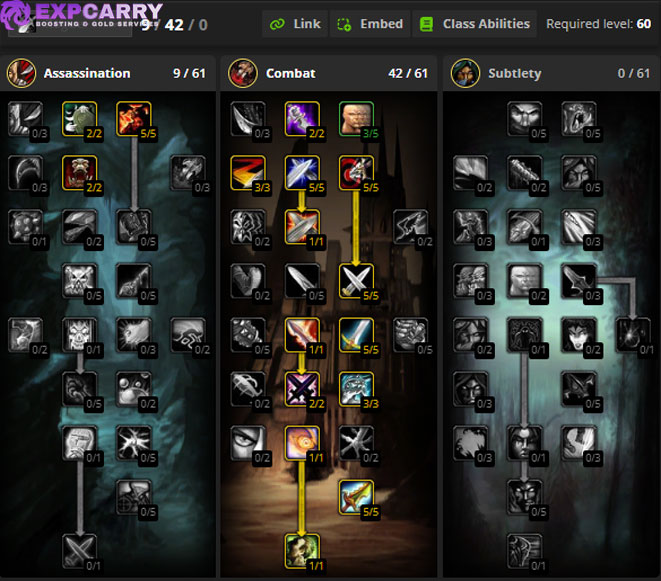
The standard sword build is 20/41/0. The Assassination points secure Malice, Ruthlessness, Murder or Improved Eviscerate, Relentless Strikes, Lethality, and Improved Expose Armor when required. Combat supplies Improved Sinister Strike, Improved Slice and Dice, Precision, Dual Wield Specialization, Blade Flurry, Sword Specialization, Weapon Expertise, Aggression, Adrenaline Rush, Combat Potency, and Surprise Attacks. The exact filler points can change with encounter needs, but removing the core energy, weapon, and maintenance talents weakens the purpose of the build.
Improved Expose Armor is a raid contribution, not merely a personal debuff. Its five-point version reduces more armor than five stacks of Sunder Armor, and the two effects do not stack. One Rogue should receive the assignment while the raid avoids spending global cooldowns on a weaker armor effect. When another Rogue handles Expose Armor, the freed points can improve personal finishers. The current TBC Rogue talent guide shows the sword framework as well as supported fist, mace, and dagger alternatives.
Combat Rotation and Cooldowns
Begin a long boss fight with Sinister Strike and an early Slice and Dice so auto attacks start benefiting from increased speed. Continue building with Sinister Strike, apply five-point Expose Armor if assigned, and then protect both timers. Later Slice and Dice refreshes should use enough combo points to cover the next cycle. Pooling energy before a finisher gives the Rogue room to rebuild if Ruthlessness or Combat Potency produces an unexpected result.
Rupture and Eviscerate are spare finishers. Rupture is useful when every tick will land and the target still has meaningful armor. Eviscerate is preferable when the enemy will die early, when armor reduction is extensive, or while Blade Flurry is copying direct attacks to another target. Envenom is not a standard raid finisher because it consumes Deadly Poison stacks. Shiv is reserved for saving a poison stack that would otherwise expire, not for routine combo point generation.
Stack Blade Flurry and Adrenaline Rush during uninterrupted contact, ideally with trinkets, Bloodlust or Heroism, and a second target in range. Avoid wasting energy at the cap during Adrenaline Rush. Blade Flurry duplicates direct attacks but does not reproduce Rupture ticks, which is why Eviscerate gains priority during cleave. Vanish provides a full threat reset, Cloak of Shadows can prevent mechanics from forcing downtime, and Sprint should be used before movement rather than after several seconds have already been lost.
Combat Stats and Caps
Combat gearing begins with dependable special attacks and then evaluates hit, expertise, and damage stats as parts of a complete set. Use these level 70 values against a level 73 raid boss:
- Special attacks stop missing at 9 percent total hit. Five points in Precision provide 5 percent, leaving 4 percent or roughly 63 hit rating before Heroic Presence and Improved Faerie Fire.
- Dual wield white attacks have a 28 percent miss ceiling before modifiers. Hit remains productive after the special cap, but reaching the complete white cap is not a mandatory objective.
- A boss can dodge attacks from behind at a base rate of 6.5 percent. Removing that chance takes 26 expertise before talents and racial weapon bonuses.
- Weapon Expertise contributes 10 expertise. A non-Human Combat Rogue can benefit from up to approximately 63 expertise rating, while a Human using swords or maces reaches the same limit near 43 rating.
- After useful hit and expertise values, compare Haste, Agility, critical strike, attack power, and Armor Penetration by their effect on the entire equipment set.
Caps mark the point where a stat stops solving a particular combat-table problem. They are not instructions to replace a clearly stronger item. Group composition, race, weapon type, and current talents must be included before deciding how much rating to obtain from gear.
Combat Phase 3 Gear and BiS
Combat Swords wants a slow weapon with high average damage in the main hand and a 1.4 or 1.5 speed sword in the off hand. Sinister Strike uses the main-hand weapon, while a rapid off hand creates more Combat Potency and Sword Specialization opportunities. A strong mace or fist weapon can justify the 16/45/0 hybrid, but the off hand should remain a fast sword when the build keeps Sword Specialization. Combat Daggers is playable with Backstab, although it produces fewer combo points for maintaining both Slice and Dice and Expose Armor.
Phase 3 introduces Slayer's Armor. Both set bonuses are strong enough that gearing should be planned around maintaining the two-piece and four-piece thresholds instead of judging every slot independently. The Twin Blades of Azzinoth are the ultimate Combat sword pair, but their low drop availability makes alternative weapons essential. The Phase 3 Rogue BiS guide provides slot rankings from Black Temple, Mount Hyjal, and earlier raids.
Assassination Rogue PvE Guide
Assassination offers a complete PvE style for players who want Mutilate and two daggers. Mutilate delivers two combo points per successful use and rewards attacks from behind a poisoned target. The specialization can maintain the same raid effects as Combat, but it gives up Combat Potency, Blade Flurry, Adrenaline Rush, Weapon Expertise, and the powerful sword interaction. The result is functional single-target damage with a lower maximum than Combat.
Assassination Talents and Raid Role
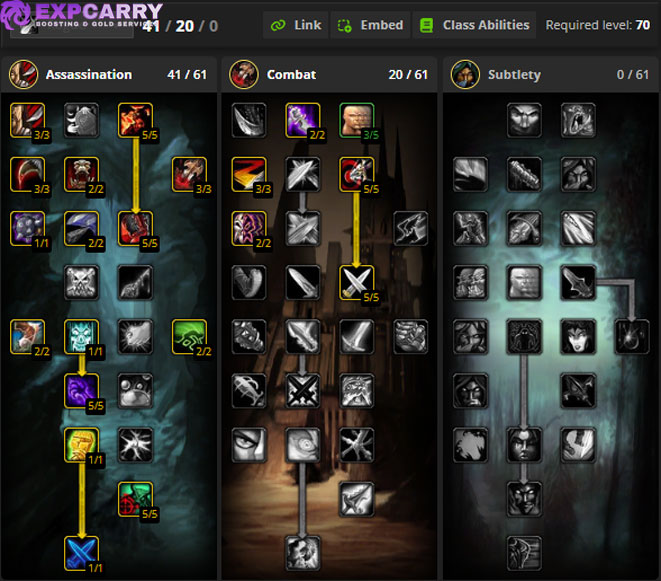
The raid framework is 41/20/0. Important Assassination talents include Malice, Ruthlessness, Puncturing Wounds, Relentless Strikes, Lethality, Vile Poisons, Cold Blood, Seal Fate, Find Weakness, and Mutilate. Improved Expose Armor is included when this Rogue owns the armor assignment. Murder is valuable only against supported creature types, so its points can move when the current raid contains unsuitable enemies. The Combat investment reaches Precision, Improved Slice and Dice, and Dual Wield Specialization.
Seal Fate gives critical combo builders a chance to add another combo point, while Find Weakness increases ability damage after a finisher. These mechanics reward energy pooling before the Rogue spends combo points. Mutilate itself is efficient, but acquiring it requires a deep investment in a tree whose surrounding talents do not match Combat's sustained energy and weapon scaling. Present the build as an optimized dagger choice rather than an equal replacement for Combat Swords.
Assassination Rotation and Cooldowns
Approach from behind, establish poison, and use Mutilate to generate combo points. Apply Slice and Dice early, then build to five points for Expose Armor when assigned. Refresh maintenance effects close to expiration rather than erasing long remaining durations. Pool energy before Rupture or Eviscerate so the following Find Weakness window contains immediate Mutilates instead of several seconds of waiting.
Choose Rupture when the boss will live through its duration and physical mitigation remains relevant. Choose Eviscerate for short targets, favorable armor conditions, or a guaranteed Cold Blood critical strike that will not delay maintenance. Mutilate cannot be used from the front, so route movement around the rear of the boss before the next energy cycle. If positioning is briefly impossible, conserve energy and resume correctly instead of disrupting the entire sequence with inefficient attacks.
Assassination has no Blade Flurry or Adrenaline Rush. Its burst comes from Cold Blood, trinkets, racial abilities, Haste Potion, and Thistle Tea. Combine them with stable target access, but do not consume so much energy that Slice and Dice or Expose Armor falls. Kick important casts even when doing so delays Mutilate, and use Cloak of Shadows to maintain position through removable magical effects.
Assassination Stats and Caps
Mutilate uses several of the same ratings as Combat, but the missing Weapon Expertise talent changes the amount of expertise that can remain useful:
- The special hit requirement is 9 percent. Precision supplies 5 percent, so approximately 63 hit rating is needed before raid hit effects.
- Hit beyond that point continues to support white attacks and poison applications. The modified value should be compared with Agility, Haste, and other offensive stats rather than pushed automatically to the 28 percent white ceiling.
- Without Weapon Expertise, a non-Human can use expertise until 26 points or about 103 expertise rating against a boss.
- A Human receives 5 expertise only when the racial bonus matches the equipped weapon. Daggers do not receive the Human sword or mace bonus, so the normal Mutilate setup keeps the full rating ceiling.
- Agility supplies attack power and critical strike chance. Critical strike also supports Seal Fate, while Haste increases auto attacks and poison frequency.
- Armor Penetration strengthens physical attacks and Eviscerate but does not increase poison or Rupture damage.
Do not sacrifice a large amount of total damage merely to display a capped expertise value. The real goal is to reduce lost Mutilates and finishers while preserving a strong balance of weapon damage and secondary stats.
Assassination Phase 3 Gear and BiS
Mutilate requires a dagger in each hand. Place the higher-damage, slower dagger in the main hand for stronger ability hits. The off hand should combine competitive damage and useful stats with enough speed to maintain poisons consistently. Weapon DPS remains important in both slots, so speed alone should never justify a major item-quality downgrade. Keep alternative hit pieces because changing either dagger can alter the best gem and armor configuration.
Slayer's Armor remains the central Tier 6 target for Assassination. It is usually better to preserve valuable set thresholds than to replace one piece without evaluating the finished setup. The dedicated Assassination Phase 3 BiS guide provides dagger-oriented gear and alternatives. A regular Black Temple raid option can help maintain access to the daggers and Tier 6 pieces on that list.
Explore services related to this guide, selected from our WoW TBC Anniversary catalog.
View All WoW TBC Anniversary Services


Subtlety Rogue PvE Guide
Subtlety is a real but niche PvE option built around Hemorrhage. It will normally finish below a similarly geared Combat Rogue and can also trail an optimized Mutilate build, yet it remains capable of clearing dungeons and raids with a group that accepts the damage tradeoff. Players can choose a hybrid that retains Blade Flurry and key Combat bonuses or a full build that reaches Shadowstep and the deepest Subtlety damage talents.
Subtlety Talents and Raid Role
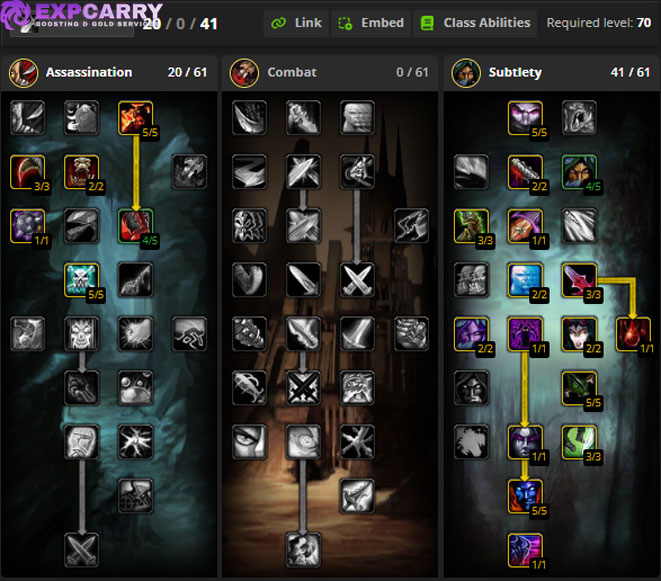
The 11/28/22 hybrid draws from all three trees. Assassination provides Malice, Ruthlessness, and Relentless Strikes. Combat adds Precision, Improved Slice and Dice, Dual Wield Specialization, Blade Flurry, Sword Specialization, and Weapon Expertise. Subtlety reaches Serrated Blades and Hemorrhage. This version gives up Shadowstep and Sinister Calling, but its Combat investment makes it the more practical sustained-damage choice.
The full alternative uses 20/0/41. It reaches Premeditation, Hemorrhage, Deadliness, Sinister Calling, and Shadowstep while retaining useful Assassination talents. The build gains 15 percent Agility from Sinister Calling and excellent repositioning, but it loses Precision, Dual Wield Specialization, Blade Flurry, and Improved Slice and Dice. Improved Expose Armor is normally handled by a Combat or Assassination Rogue; a lone full Subtlety player can move points into it if the raid requires the debuff.
Hemorrhage is an inexpensive combo builder that also places charges increasing physical damage from subsequent attacks. A physical-heavy group can consume those charges quickly, but the debuff does not erase Subtlety's personal damage disadvantage. The Subtlety PvE talent resource contains both the hybrid and full frameworks.
Subtlety Rotation and Cooldowns
Use Hemorrhage to build combo points and refresh its charges when they are consumed. Establish Slice and Dice with three to five points, then maintain Rupture on targets that will survive for the complete bleed. Eviscerate spends surplus points only after those effects are safe. Shiv should rescue Deadly Poison immediately before expiration, not replace Hemorrhage as the regular builder.
The hybrid activates Blade Flurry for two-target damage and combines it with a prepared burst window. It has no Adrenaline Rush, so Thistle Tea and Haste Potion require deliberate timing. Full Subtlety can begin with Premeditation, Shadowstep, and Garrote when that opener fits the pull, then transition into Hemorrhage. Shadowstep is most valuable for recovering melee uptime, but the destination must be safe before it is pressed.
Subtlety has limited area damage. The hybrid can cleave one nearby enemy through Blade Flurry, while the full build relies on switching targets and using single-target finishers. On short dungeon packs, prioritize Slice and Dice and immediate Eviscerate damage instead of applying a Rupture that cannot finish ticking. Preserve Kick, Sap, Blind, and Kidney Shot for the group's control plan rather than judging the specialization only by the damage meter.
Subtlety Stats and Caps
The two Subtlety frameworks have different hit requirements because only the hybrid reaches Precision:
- The 11/28/22 hybrid needs 4 percent hit from gear before external effects to complete the 9 percent special attack requirement. That amount is approximately 63 hit rating.
- The 20/0/41 version must assemble the full 9 percent special hit from equipment and raid support because it has no Precision.
- Additional hit continues to improve normal swings and poison reliability, but neither build must force the character to the full dual wield white cap.
- The hybrid can take Weapon Expertise, leaving 16 expertise or about 63 rating available before a racial weapon bonus.
- Full 20/0/41 Subtlety has no Weapon Expertise and can use up to 26 expertise or approximately 103 rating against a raid boss.
- A Human hybrid using swords reduces its remaining target to 11 expertise or about 43 rating. The racial bonus does not improve daggers or fist weapons.
- Agility becomes particularly effective for full Subtlety through Sinister Calling. Haste, critical strike, attack power, and Armor Penetration remain important complete-set comparisons.
Serrated Blades provides passive Armor Penetration and improves Rupture, but that advantage does not make Armor Penetration the only stat worth collecting. Weapon quality, caps, Agility, and uptime still determine the finished result.
Subtlety Phase 3 Gear and BiS
A Hemorrhage setup uses a slow, high-damage main hand and a quick off hand. The hybrid should match its weapons to the selected Combat specialization, while full Subtlety has more freedom to use the strongest available slow weapon. A fast off hand improves poison consistency and makes Shiv cheaper. Daggers are necessary only for dagger-specific openers, so a Hemorrhage player should not accept a weak main-hand dagger merely to appear more Rogue-like.
Phase 3 Subtlety also targets Slayer's Armor and evaluates off-set items around the Tier 6 bonuses. Full Subtlety needs more hit from equipment than the hybrid, which means the same item list cannot be copied blindly between the two builds. The Subtlety Phase 3 BiS guide separates the recommended configurations and their alternatives.
Rogue Poisons, Consumables, Gems and Enchants
Preparation is shared by all three specializations. The correct poison arrangement depends on party buffs, while consumables and enchants should be selected after the gear set reveals its remaining hit and expertise needs. Lists in this section serve as a raid checklist rather than a requirement to spend every available consumable on farm content.
Weapon Poisons
When a Shaman provides Windfury Totem, leave the main hand free of poison because Windfury needs the temporary weapon slot. Apply Deadly Poison VII to the off hand for sustained encounters. Without Windfury, use Instant Poison VII on the main hand and Deadly Poison on the off hand. Encounter utility can require a different poison, so bring spare off-hand weapons instead of replacing the raid damage setup permanently.
Raid Consumables
The main Rogue consumables for Phase 3 are:
- Flask of Relentless Assault for a persistent general attack power bonus.
- Elixir of Demonslaying for eligible demon encounters when its specialized attack power is more valuable than a flask.
- Haste Potion for a planned high-uptime damage window.
- Thistle Tea for immediate energy when it can produce extra abilities without causing maintenance effects to expire.
- Ravager Dog for attack power or Warp Burger for Agility.
- Drums of Battle when the Rogue has Leatherworking and the group assigns a drum rotation.
Carry enough poison charges and reagents for the entire raid. Protection potions, Free Action Potion, bandages, and encounter-specific resistance consumables can be more valuable than another damage potion when they prevent a death or preserve melee uptime.
Gems and Enchants
Socketing starts with the meta requirement and the ratings missing from the completed equipment set. Match socket colors only when the bonus or meta activation justifies the stat trade. Phase 3 epic gems improve the available totals, but they do not change the need to recalculate caps after every substantial weapon or armor upgrade.
- Glyph of Ferocity is the standard offensive head enchant.
- Greater Inscription of Vengeance is the Aldor shoulder option, while Greater Inscription of the Blade is the Scryers alternative.
- Nethercobra Leg Armor supplies the primary offensive leg enhancement.
- Enchant Weapon Mongoose is the dependable enchant for both permanent weapons.
- Enchant Boots Cat's Swiftness provides movement speed when no equivalent non-stacking effect is active.
Movement speed is a damage stat whenever it shortens time away from the boss. Cat's Swiftness does not stack with another movement-speed effect, so a Rogue already receiving one from the selected build or meta gem can use an alternative boot enchant.
Final Verdict
Combat Swords is the strongest general Rogue PvE choice for Phase 3 because it combines sustained energy generation, efficient weapon scaling, powerful cooldowns, and reliable cleave. Assassination provides a complete Mutilate style for dedicated dagger players but gives up the strongest parts of Combat. Subtlety remains a valid niche path through either an 11/28/22 hybrid or a full 20/0/41 build, with Hemorrhage and mobility purchased at the cost of raid damage. Whichever specialization you play, secure Slice and Dice, complete assigned raid utility, calculate caps from the actual character setup, and plan upgrades as a complete equipment set.