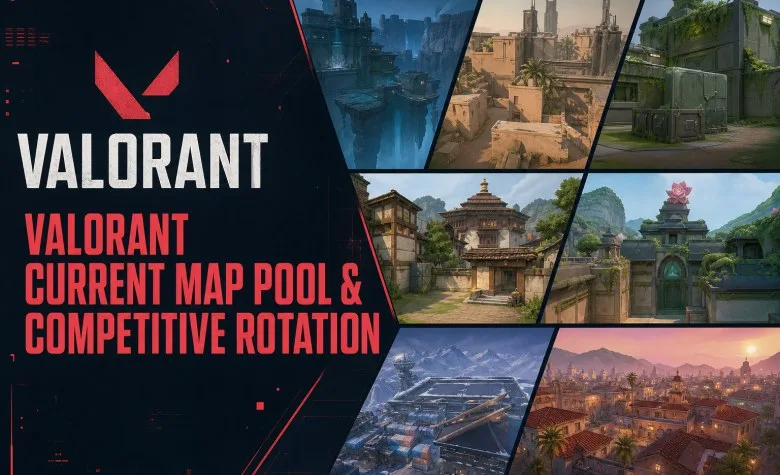
The current VALORANT Competitive map pool contains Abyss, Bind, Corrode, Haven, Lotus, Summit and Sunset. The latest rotation happened with Patch 13.08 on October 13, 2026: Bind and Corrode entered the pool, while Ascent and Split rotated out. Patch 13.09 did not change the map rotation.
VALORANT uses a limited active pool so Competitive players do not need to prepare every standard map at the same time. Maps outside the rotation are not deleted from the game; they can remain available in other modes and may return in a future rotation.
| Current map | Status | Sites | Main characteristic |
|---|---|---|---|
| Abyss | Active | 2 | Long sightlines, dangerous death drops and large rotations |
| Bind | Entered in Patch 13.08 | 2 | No traditional Mid and two one-way teleporters |
| Corrode | Entered in Patch 13.08 | 2 | Traditional three-lane structure with layered defensive positions |
| Haven | Active | 3 | Three sites create unusual rotation and map-control decisions |
| Lotus | Active | 3 | Three sites, rotating doors and fast route changes |
| Summit | Active | 2 | Large droppable walls can change parts of the battlefield for a round |
| Sunset | Active | 2 | Traditional three-lane layout with strong Mid importance |
What Is the Current Valorant Map Pool?
As of Patch 13.09, the seven maps you need to prepare for the current Competitive rotation are:
- Abyss
- Bind
- Corrode
- Haven
- Lotus
- Summit
- Sunset
This is the active V26 Act 6 rotation. The pool was established in Patch 13.08 and remained unchanged in Patch 13.09.
If your goal is Ranked improvement, these seven maps deserve most of your preparation time. Learning detailed utility and setups for maps currently outside Competitive provides less immediate value unless you also play modes where the broader map list is available.
What Changed in the Latest Map Rotation?
Patch 13.08 made four important rotation changes:
| Change | Map |
|---|---|
| Entered | Bind |
| Entered | Corrode |
| Rotated out | Ascent |
| Rotated out | Split |
Corrode also received map adjustments in the same patch, including changes intended to improve defender movement toward the backs of both sites and changes around Mid. Players returning to the map should therefore avoid relying entirely on older setups.
Bind returned without becoming a fundamentally different map. Its defining structure remains unusual for VALORANT: two sites, no conventional central Mid route and teleporters that can rapidly move players between sections of the map.
Which Valorant Maps Are Currently Out of Competitive?
Six standard Spike maps are currently outside the Competitive rotation:
- Ascent
- Breeze
- Fracture
- Icebox
- Pearl
- Split
Being out of rotation does not mean that a map has been removed permanently. Riot regularly rotates maps back into the active pool. Bind and Corrode are direct examples: both returned with Patch 13.08.
This is why deleting all knowledge of an inactive map is a mistake. You do not need to practice it every day, but maintaining basic callout and layout familiarity makes future rotations much easier.
Explore services related to this guide, selected from our Valorant catalog.
View All Valorant Services


Does Unrated Use the Same Map Pool as Competitive?
No. The competitive rotation specifically limits queues such as Competitive, Premier and Deathmatch. Casual queues are not restricted in exactly the same way by the active Competitive pool.
This distinction matters because seeing Ascent, Split or another inactive Competitive map in a different mode does not mean it has returned to Ranked.
For current Ranked preparation, always separate two questions:
- Is the map playable somewhere in VALORANT?
- Is the map in the current Competitive rotation?
Those are not the same thing.
Abyss
Abyss is a two-site map built around large open areas, long angles and environmental death drops. Falling from parts of the map can kill a player, which creates unusual opportunities for displacement abilities and positioning mistakes.
For Competitive preparation, focus on:
- Mid control and safe crossing routes;
- long-range fights and Operator positions;
- avoiding unnecessary exposure near death drops;
- retake routes, which can require significant travel;
- utility that clears deep or elevated positions.
We cover this map separately in our VALORANT Abyss Map Guide.
Bind
Bind has two sites but no traditional Mid connecting them. Instead, the map uses one-way teleporters that allow rapid movement between different areas.
This makes information especially valuable. A defender who hears or sees attackers at one location cannot always assume they will remain on that side of the map.
Priorities to practice:
- teleporter rotations;
- Hookah and B Long control;
- A Short and Showers pressure;
- fast reactions to attacker rotations;
- post-plant positions that account for teleporter routes.
Corrode
Corrode is a traditional three-lane map set around a fortified French environment and layered defensive positions. It returned to the active pool with Patch 13.08 and received layout adjustments at the same time.
The most important lesson for returning players is simple: do not assume every old angle and rotation timing remains optimal.
Practice:
- current Mid control;
- defender rotation paths;
- clearing layered positions instead of checking only the first angle;
- utility combinations for site entry;
- retake routes after the Patch 13.08 adjustments.
Haven
Haven remains one of VALORANT's most distinctive maps because it has three Spike sites: A, B and C.
Three sites stretch the defense across more territory. Attackers can exploit this with defaults, pressure and late rotations, while defenders must decide when information is strong enough to justify leaving a site.
Focus on:
- A Long and A Short control;
- Garage and C pressure;
- Mid-to-B timings;
- defensive information gathering;
- avoiding over-rotations after early attacker utility.
Lotus
Lotus also uses three Spike sites, but its rotating stone doors create additional route changes and sound information.
Because players can move between several lanes quickly, Lotus rewards teams that understand when to keep map control instead of grouping five players in one location too early.
Practice:
- A Rubble and A Main control;
- door timing and sound cues;
- C pressure and fast rotations;
- three-site defensive positioning;
- late-round rotations after forcing defender utility.
Summit
Summit entered VALORANT with Patch 13.00 in June 2026. Its defining mechanic is a set of large droppable walls that can change parts of the battlefield for an entire round.
This means map knowledge is not limited to static callouts. Players also need to understand how available routes change once a wall has been dropped.
Focus on:
- wall states before committing to a route;
- Mid control;
- alternative rotations when a route changes;
- vertical angles and elevation;
- utility that remains useful under different wall configurations.
Sunset
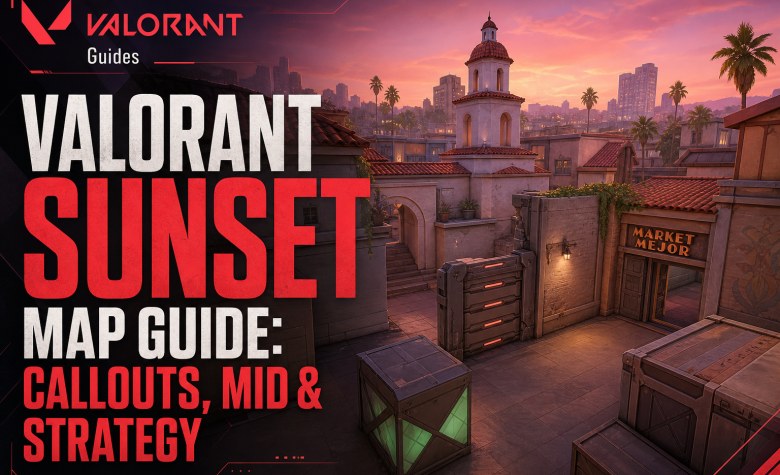
Sunset follows a more traditional three-lane design, but Mid has major strategic value. Teams that lose Mid control can give opponents flexible access toward both sites.
Practice:
- Mid control without overcommitting resources;
- B Main and Market pressure;
- A Main entry structure;
- fast rotations through central territory;
- post-plant crossfires.
Which Current Valorant Maps Have Three Sites?
Two maps in the current rotation have three Spike sites:
- Haven — A, B and C
- Lotus — A, B and C
Abyss, Bind, Corrode, Summit and Sunset use two sites.
This matters for Agent selection and defensive structure. Three-site maps generally force defenders to distribute resources more widely and make information gathering especially important.
Which Map Should You Learn First?
If you are new to the current rotation, do not try to memorize seven full playbooks simultaneously.
A more efficient order is:
- Learn basic callouts for all seven maps.
- Learn two safe defensive setups for your main Agent on each map.
- Learn one default attack route for each site.
- Learn common plant locations and post-plants.
- Only then add advanced lineups and situational utility.
This creates usable Competitive knowledge much faster than spending hours memorizing ten lineups for one map while still getting lost on the other six.
How to Prepare for a New Valorant Map Rotation
When Riot announces the next rotation, do not immediately rebuild your entire Agent pool. Start with the maps entering Competitive.
Use this checklist:
- Learn the current layout. Maps can receive changes before returning.
- Update your callouts. Old names used by your group may differ from current common calls.
- Check your Agent pool. Identify one primary and one backup pick.
- Rebuild utility. Old smokes, recon lineups and Sentinel setups can stop working after geometry changes.
- Play lower-pressure matches first. Re-establish timing before taking the map into important Competitive games.
When Is the Next Valorant Map Rotation?
Riot has not officially announced the exact maps entering and leaving the next rotation yet.
Historically, map-pool changes often arrive around the start of an Act, but that pattern should not be treated as confirmation of specific future maps.
Until Riot publishes the next rotation, lists claiming that a particular map is “confirmed to return” should be treated as speculation unless they cite an official announcement.
Should You Dodge Maps You Are Bad At?
Dodging is a poor long-term solution to a weak map. Queue dodges can carry penalties, and avoiding a map prevents you from correcting the exact problems that make it uncomfortable.
A better approach is to identify whether the weakness comes from:
- poor callout knowledge;
- the wrong Agent for your experience;
- weak attacking routes;
- bad defensive rotations;
- unfamiliar post-plants;
- poor utility usage.
The new VALORANT Map Rating system is particularly useful here because it separates map performance and helps reveal differences between attack, defense and individual impact.
Common Valorant Map Pool Misconceptions
| Claim | Correct? | Explanation |
|---|---|---|
| Every VALORANT map is in Competitive | No | The active Competitive rotation currently contains seven maps |
| A map outside Ranked has been removed from VALORANT | No | Inactive maps can remain available elsewhere and may return later |
| Patch 13.09 changed the map pool | No | The latest rotation change was Patch 13.08 |
| Ascent and Split are currently in Competitive | No | Both rotated out in Patch 13.08 |
| Bind and Corrode are currently active | Yes | Both entered with Patch 13.08 |
| The next maps are already confirmed | No | Riot has not officially announced the next in/out pair yet |
Valorant Map Pool FAQ
How many maps are in the current Valorant Competitive pool?
Seven: Abyss, Bind, Corrode, Haven, Lotus, Summit and Sunset.
What maps were added in the latest rotation?
Bind and Corrode entered the Competitive pool with Patch 13.08.
What maps were removed in the latest rotation?
Ascent and Split rotated out with Patch 13.08.
Is Abyss currently in Competitive?
Yes. Abyss is part of the current Competitive rotation.
Is Bind back in the Valorant map pool?
Yes. Bind returned to the active pool with Patch 13.08 on October 13, 2026.
Is Corrode currently in Competitive?
Yes. Corrode returned alongside Bind in Patch 13.08 and also received map adjustments.
Did Patch 13.09 change the map rotation?
No. Patch 13.09 introduced Hush and other gameplay updates but did not rotate Competitive maps.
Current Valorant Map Pool: What to Prioritize
If you play Competitive, prioritize the seven active maps rather than treating all VALORANT maps equally. Start with callouts, site structure, your main Agent's basic utility and common attack and defense routes. Advanced lineups come later.
The current pool is Abyss, Bind, Corrode, Haven, Lotus, Summit and Sunset. Keep this page as the evergreen reference: when Riot changes the rotation, the correct strategy is to update this URL rather than create a new “current map pool” article every Act.
If your main goal is overall Competitive progression, you can also explore our VALORANT progression services.