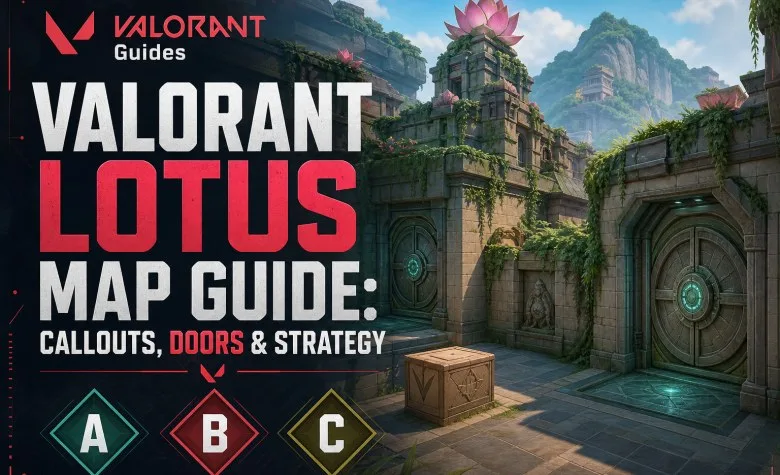
Lotus is a three-site VALORANT map built around fast rotations, rotating stone doors and aggressive early map control. Like Haven, it has A, B and C Spike Sites, but Lotus plays very differently because attackers can manipulate two rotating doors and break a permanent wall to create new routes during a round.
Lotus is currently part of the Competitive map pool. Its overall geometry is stable, so the most important skills to learn are how the doors work, how to control A Main and C Mound, when to attack B and how to avoid over-rotating on defense.
| Lotus overview | Current information |
|---|---|
| Sites | A, B and C |
| Official callouts | 28 |
| Main mechanics | Two rotating doors |
| Destructible object | 400 HP wall between A Main and A Link |
| Other mechanics | Rope ascender and silent drop at A |
| Location | City of Flowers, Western Ghats, India — Omega Earth |
| Introduced | Patch 6.00 |
| Current status | Competitive rotation |
Is Lotus in the Current Valorant Map Pool?
Yes. Lotus is currently in Competitive together with Abyss, Bind, Corrode, Haven, Summit and Sunset.
It has been in the active rotation since Patch 12.05.
See our current VALORANT map pool guide for the complete live rotation.
Why Is Lotus Different?
Lotus combines three Spike Sites with several map mechanics:
- two rotating stone doors;
- a destructible wall;
- a rope ascender;
- a silent drop;
- fast routes between all three sites.
The map does not have a traditional central Mid like Ascent or Sunset. Instead, attackers fight for several connected lanes and use the doors to open access between them.
All Official Lotus Callouts
| Area | Official callouts |
|---|---|
| A | A Top, A Drop, A Site, A Hut, A Tree, A Door, A Main, A Rubble, A Root, A Lobby, A Link, A Stairs |
| B | B Pillars, B Main, B Site, B Upper |
| C | C Lobby, C Door, C Waterfall, C Link, C Mound, C Main, C Bend, C Site, C Hall, C Gravel |
| Spawns | Attacker Side Spawn, Defender Side Spawn |
Lotus currently has 28 official in-game callouts.
Explore services related to this guide, selected from our Valorant catalog.
View All Valorant Services


How Do Lotus Rotating Doors Work?
Lotus has two rotating doors:
- A Door: between A Main and A Tree;
- C Door: between C Mound and B Main.
A player can activate a door from either side using its switch.
Once activated, the stone structure rotates 180 degrees. The current rotation takes approximately 10 seconds to complete.
During that movement, players can pass through the temporary opening.
Are Lotus Doors Loud?
Yes. Activating a rotating door creates a distinctive audio cue.
This gives both teams information, so opening a door is never completely free.
Attackers can use the sound to:
- signal a real split;
- threaten a rotation;
- fake pressure;
- force defenders to check another route.
Can Abilities Pass Through Lotus Doors?
Some utility can interact with the temporary opening while the door rotates.
The longer 10-second rotation window gives players time to fight or use utility through the opening before the door completes its movement.
However, ability interactions vary by Agent, so do not build an entire strategy around an outdated lineup without testing it in a Custom Game.
How Does the Lotus Destructible Wall Work?
A destructible wall stands between A Main and A Link.
The wall has 400 HP.
While intact:
- players cannot move through it;
- bullets cannot penetrate it.
After enough damage destroys the wall, the passage remains open for the rest of the round.
This creates an important decision: breaking the wall gives your team another route, but it also permanently gives that route to the opponent.
What Are the Wall's Damage Indicators?
The destructible wall visually changes as it loses HP:
- blue when healthy;
- yellow after taking significant damage;
- red when close to destruction.
You can therefore estimate whether the wall is close to breaking without knowing its exact remaining HP.
Lotus Rope and Silent Drop
A Site contains two additional movement mechanics.
A rope ascender connects A Site to A Top.
Players can then drop from A Top toward A Drop. When the movement is performed correctly without running too far off the ledge, the fall can be silent.
This gives both attackers and defenders additional vertical repositioning options around A.
Where Are the Ultimate Orbs on Lotus?
Lotus has two Ultimate Orbs:
- A Main;
- C Mound.
An older B orb was removed when Riot reworked Lotus, so guides that still describe three orbs are outdated.
Major Lotus Layout Changes You Should Know
Lotus received a significant redesign in Patch 8.00.
Important changes included:
- A Hut was closed and received a new back cubby;
- B Site received more playable space and boxes;
- C Site plant zone and C Bend stairs were adjusted;
- C Main and C Bend received additional space and cover;
- rotating door timing increased from 8 to 10 seconds;
- the B Ultimate Orb was removed.
If you are watching a very old Lotus guide, check whether it predates these changes.
How to Attack Lotus
Lotus rewards attackers who take early space before deciding which site to finish on.
The three-site layout makes defensive rotations difficult, but only if attackers deny information.
A basic default can spread pressure across:
- A Root / A Main;
- B Main;
- C Mound / C Main.
Once defenders reveal utility or numbers, attackers can commit or rotate.
How to Attack A Site
A is often the most complex site because it contains multiple stages of control:
- A Root;
- A Rubble;
- A Main;
- A Door / Tree;
- A Link;
- A Site;
- A Top / Drop.
Take A Rubble and Main First
Do not rush through A Main without clearing the early defensive space.
Use flashes, recon or damaging utility to remove defenders from close angles around Rubble and Main.
Use A Door to Split the Site
Once A Main is controlled, the rotating door can create pressure toward A Tree.
This forces defenders to respect both the direct site route and the Tree-side route.
Decide Whether to Break the Wall
Breaking the A Main–A Link wall can create another route into or out of the site.
Do it when the extra access has strategic value, not automatically at the beginning of every round.
How to Attack B Site
B is the smallest and most central site.
This makes it possible to hit quickly, but defenders can also rotate there very quickly from A and C.
A good B execute should:
- clear B Main;
- isolate B Upper and deeper angles;
- control B Pillars;
- plant quickly;
- prepare for fast retakes from multiple directions.
B becomes especially dangerous when your team also controls one of the rotating-door routes.
How to Attack C Site
C attacks normally begin around C Mound and C Main.
The C rotating door can connect pressure toward B Main, giving attackers the option to:
- continue toward C;
- pivot toward B;
- create a split;
- fake the door and keep defenders uncertain.
Clear C Bend and Site Carefully
C Bend, Hall and deeper site cover give defenders several fallback positions.
Do not spend all of your utility at the first choke and then enter the site without tools left to clear the second defensive layer.
How to Defend Lotus
Three sites with only five defenders means information is critical.
Fight for Early Space Without Throwing Your Life Away
Useful early areas include:
- A Rubble;
- A Main;
- C Mound;
- C Main.
Defenders often contest these areas because losing them gives attackers much more freedom around the rotating doors.
Use Utility to Cover Empty Space
Sentinel utility is especially valuable on Lotus because it lets defenders monitor one lane while physically supporting another site.
Do Not Over-Rotate Because of a Door
A door activation gives information, but it does not prove the final destination.
Attackers can deliberately trigger doors to force rotations.
Retake When Necessary
With three sites, some defensive setups naturally leave one site lighter than the others.
If five attackers hit a site with full utility, staying alive for a coordinated retake can be stronger than trying to stop the entire execute alone.
Best Agents for Lotus
Lotus rewards Agents who provide persistent information, fast rotations and utility that clears layered positions.
| Role | Strong current picks | Why they work |
|---|---|---|
| Duelist | Waylay, Neon, Phoenix | Fast space creation across a large three-site map |
| Controller | Clove | Flexible Ranked smokes and strong rotation support |
| Initiator | Fade | Excellent clearing and information around Main lanes and sites |
| Sentinel | Cypher, Vyse, Killjoy | Passive information and strong control across three sites |
Current Ranked data places Cypher, Waylay, Clove and Vyse among Lotus's strongest performers, with Phoenix, Killjoy, Fade and Neon also producing competitive results.
For overall Agent strength, see our VALORANT Agent Tier List.
Why Cypher Is Strong on Lotus
Three sites create more routes than five defenders can manually watch.
Cypher's information lets the team:
- track late lurks;
- leave a site with passive coverage;
- rotate earlier with confidence;
- identify whether a door play is real or a fake.
Why Vyse Works on Lotus
Vyse can punish attackers moving through narrow site entrances and Main lanes.
Her defensive utility is particularly valuable when the team needs to delay one route while rotating from another site.
Clove on Lotus
Clove is currently one of the strongest Ranked Controller choices on Lotus.
Their flexible smoke placement supports quick rotations and allows the team to isolate important angles on all three sites.
Fade on Lotus
Fade can clear close corners with Prowlers and reveal defenders across layered sites with Haunt.
This is particularly useful around A Main, C Main and the deeper defensive positions that are difficult to clear one angle at a time.
Best Duelists on Lotus
Waylay
Waylay's mobility can convert early information into fast site pressure and helps exploit the gaps created by three-site rotations.
Neon
Neon's speed is naturally valuable on a large map where attackers may need to rotate from A pressure toward C or vice versa.
Phoenix
Phoenix remains a reliable Ranked option for players who need self-contained flashes, sustain and straightforward entry power.
Example Lotus Team Composition
A practical Ranked composition is:
Neon / Clove / Fade / Cypher / Vyse
This composition provides:
- fast entry and rotations;
- reliable smokes;
- strong information and clearing utility;
- two layers of passive map control;
- excellent protection against lurks and fast site hits.
You do not need to copy the composition exactly. Player comfort is more important than forcing a theoretically optimal Agent.
Best Weapons on Lotus
Lotus mixes medium-range Main fights with tight site interiors.
Phantom is excellent around sites, rotating doors and smokes.
Vandal remains the most flexible rifle when fights stretch into longer A Main or C Main angles.
Judge can punish players around tight door and site positions, but becomes much weaker when attackers clear corners properly.
Operator can control longer Main lanes but requires a safe fallback route because attackers can pressure from multiple directions.
See our VALORANT Weapons Guide for current prices and damage.
Lotus Attack Mistakes
| Mistake | Better approach |
|---|---|
| Committing five players immediately | Take early space and identify the weak site first |
| Opening doors without a plan | Use door sound and access for a specific split or fake |
| Breaking the A wall automatically | Only open the route when it benefits your round plan |
| Slow B execute | Expect rapid rotations and establish post-plant positions quickly |
| Using all utility at C Mound | Save tools to clear C Bend and deeper site positions |
Lotus Defense Mistakes
| Mistake | Better approach |
|---|---|
| Over-rotating on a door sound | Wait for additional confirmation |
| Giving A Rubble and C Mound for free | Contest information or utility early |
| Trying to manually watch every lane | Use Sentinel utility |
| Dying alone on a weak site | Preserve your life and coordinate a retake |
| Ignoring the broken A wall | Remember the route remains permanently open for that round |
Lotus FAQ
How many sites does Lotus have?
Three: A, B and C.
How many official callouts are on Lotus?
28.
How many rotating doors does Lotus have?
Two: one around A Main/A Tree and one between C Mound and B Main.
How long does a Lotus door take to rotate?
Approximately 10 seconds for a full rotation.
Does Lotus have a breakable wall?
Yes. The wall between A Main and A Link has 400 HP.
Does the breakable wall respawn?
It returns at the start of the next round. Once destroyed during a round, the passage remains open until that round ends.
Does Lotus have three Ultimate Orbs?
No. Lotus currently has two, at A Main and C Mound.
Is Lotus currently in Competitive?
Yes.
What are the best Agents for Lotus?
Strong current Ranked options include Cypher, Waylay, Clove, Vyse, Phoenix, Killjoy, Fade and Neon.
Final Lotus Strategy
The core rule of Lotus is: take early space, manipulate the doors and make the opponent defend three sites without giving them reliable information.
On attack, avoid revealing your final site too early. On defense, preserve information, use passive utility to cover empty lanes and do not rotate your entire team simply because a rotating door was activated.