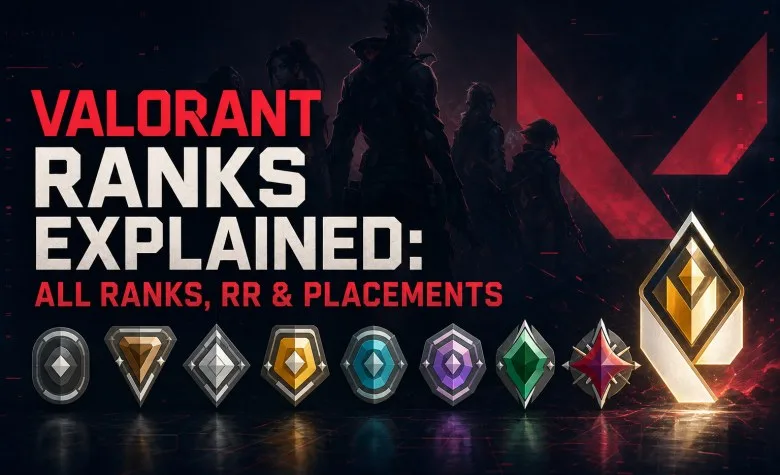
VALORANT Competitive uses nine ranks from Iron to Radiant. Most ranks contain three tiers, while Radiant stands alone at the top of the ladder.
Your visible rank is moved primarily through Rank Rating (RR), while a separate hidden matchmaking rating — MMR — helps determine who you play against and how quickly the game tries to move your visible rank toward your actual skill level.
| Rank | Tiers | Progression |
|---|---|---|
| Iron | 1, 2, 3 | 100 RR per tier |
| Bronze | 1, 2, 3 | 100 RR per tier |
| Silver | 1, 2, 3 | 100 RR per tier |
| Gold | 1, 2, 3 | 100 RR per tier |
| Platinum | 1, 2, 3 | 100 RR per tier |
| Diamond | 1, 2, 3 | 100 RR per tier |
| Ascendant | 1, 2, 3 | 100 RR per tier |
| Immortal | 1, 2, 3 | Regional RR thresholds |
| Radiant | No subdivisions | Regional threshold + top 500 |
All Valorant Ranks in Order
From lowest to highest, the current VALORANT Competitive ranks are:
- Iron 1–3
- Bronze 1–3
- Silver 1–3
- Gold 1–3
- Platinum 1–3
- Diamond 1–3
- Ascendant 1–3
- Immortal 1–3
- Radiant
Tier 1 is the lowest subdivision of a rank and Tier 3 is the highest. For example, Gold 3 is above Gold 2 and immediately below Platinum 1.
How Do You Unlock Ranked in Valorant?
Modern accounts must reach Account Level 20 before Competitive becomes available.
Reaching level 20 does not automatically give you a rank. You still need to complete placement matches.
See our Valorant Ranked unlock guide for the full Account Level and Competitive requirement breakdown.
How Many Placement Matches Are There?
VALORANT now uses a year-long Season containing six Acts.
| Act | Placements for returning ranked players |
|---|---|
| Act 1 — Season start | 5 |
| Act 2 | 1 |
| Act 3 | 1 |
| Act 4 — Mid-Season reset | 5 |
| Act 5 | 1 |
| Act 6 | 1 |
A new player completing their first Competitive placement also needs the full placement process.
Explore services related to this guide, selected from our Valorant catalog.
View All Valorant Services


What Is the Highest Placement Rank?
The current maximum rank you can receive directly from placements is Ascendant 3.
Patch 11.00 raised the cap from Ascendant 1 to Ascendant 3.
You cannot place directly into Immortal or Radiant. Those ranks must be reached through Competitive progression after placement.
What Is RR in Valorant?
Rank Rating (RR) is the visible number that tracks progress toward your next rank.
For Iron through Ascendant, you normally need 100 RR to move into the next tier.
After placements, Riot currently starts players at 50 RR in their assigned rank.
What Determines How Much RR You Gain?
Riot identifies four main factors:
- Match outcome — winning or losing matters most.
- Round differential — a dominant 13-2 win generally matters more than a close 13-11 win.
- Individual performance — exceptional performance can slightly improve gains or soften losses.
- Rank convergence — the system compares your visible rank with your hidden MMR.
Individual performance is not simply K/D. Riot considers broader performance including damage and assists.
Why Do I Gain Less RR Than I Lose?
This usually means your visible rank is above where your hidden MMR currently places you.
If:
- MMR is above rank: wins tend to give more RR and losses cost less;
- MMR matches rank: gains and losses become more balanced;
- MMR is below rank: wins give less and losses cost more.
For a deeper explanation, see our Valorant MMR vs RR guide.
Can You Gain RR From a Loss?
No. You cannot finish a normal loss with positive RR.
However, strong individual performance can improve your hidden MMR and reduce how much RR you lose.
Can You Double Rank Up?
Yes.
If your hidden MMR is significantly higher than your visible rank, Riot's convergence system can skip a tier during promotion.
For example, a player can move from Gold 1 directly to Gold 3 instead of stopping at Gold 2.
This is designed to move obviously misplaced players toward their correct rank faster.
How Does Promotion Work?
For Iron through Ascendant:
- reach 100 RR;
- win enough RR to cross the promotion threshold;
- move into the next tier;
- begin the new tier with promotion RR rather than returning to zero.
Once you reach Ascendant 3 and earn enough RR to promote again, you enter Immortal 1.
How Does Demotion Work?
You normally do not demote immediately when you first reach 0 RR.
You must lose while already at 0 RR before a normal tier demotion occurs.
Tier 1 ranks receive additional protection through Rank Shields.
What Are Rank Shields?
Rank Shields protect players who are at Tier 1 of a rank, such as Gold 1 or Diamond 1.
When you reach 0 RR in Tier 1:
- you have two Rank Shields;
- the first loss consumes one shield;
- the second loss consumes the second shield;
- the third loss at 0 RR causes the demotion.
For example:
Gold 1 → two shielded losses at 0 RR → third loss → Silver 3.
Rank Shields do not protect normal tier drops such as Gold 3 to Gold 2 or Gold 2 to Gold 1.
Do Rank Shields Recharge?
Not just because you win a match.
If you use a shield at Gold 1, then win and return above 0 RR, the used shield is not automatically restored.
Rank Shields refresh when you enter Tier 1 again through promotion or demotion.
What Happens After Ascendant 3?
Immortal and Radiant use a different RR system.
Once you reach Immortal 1:
- RR is no longer capped at 100;
- RR continues accumulating;
- Immortal 2 and 3 require regional RR thresholds;
- Radiant requires both enough RR and a top-500 leaderboard position.
Current Immortal and Radiant RR Requirements
| Region | Immortal 2 | Immortal 3 | Radiant |
|---|---|---|---|
| EU | 100 RR | 200 RR | 500 RR + Top 500 |
| NA | 90 RR | 200 RR | 450 RR + Top 500 |
| APC | 80 RR | 200 RR | 400 RR + Top 500 |
| BR | 100 RR | 230 RR | 340 RR + Top 500 |
| LATAM / KR | 90 RR | 150 RR | 200 RR + Top 500 |
These thresholds can be adjusted by Riot and should be checked whenever Riot announces high-rank Competitive changes.
How Do You Reach Radiant?
You must satisfy both conditions:
- reach your region's minimum Radiant RR threshold;
- be inside the top 500 players in that region.
Having enough RR without being top 500 is not enough.
Likewise, being temporarily inside the top 500 while below the regional RR minimum does not grant Radiant.
Can You Lose Radiant?
Yes.
You can fall out of Radiant if:
- your RR drops below the regional Radiant requirement;
- your leaderboard position falls below the current Radiant cutoff.
Does Valorant Have Rank Decay?
No traditional rank decay exists.
Your visible rank does not automatically decrease simply because you stop playing.
Immortal and Radiant players can lose leaderboard position while inactive because other players continue earning RR, but this is not the same as automatic rank decay.
How Often Does Valorant Rank Reset?
Under the current six-Act Season structure, the major placement reset happens twice per year:
- Act 1 — start of the Season;
- Act 4 — Mid-Season.
These resets require five placement matches.
Acts 2, 3, 5 and 6 use a shorter one-match placement for players who have already been ranked.
Does MMR Reset With Your Rank?
Not completely.
Riot keeps hidden skill information so that experienced players are not treated like completely new accounts after every reset.
The current system can make a slight MMR adjustment around placements, but your historical skill data still heavily influences matchmaking.
What Is Act Rank?
Your current Rank and your Act Rank are not the same thing.
Current Rank is where you are right now.
Act Rank represents your proven performance across an entire Act and is based on your highest ranked win.
The Act Rank screen uses a triangle containing individual ranked-win triangles.
How Does the Act Rank Border Work?
The border around your Act Rank progresses as you earn Competitive wins.
Border upgrades occur at:
- 9 wins;
- 25 wins;
- 50 wins;
- 75 wins;
- 100 wins.
How Do Ranked Rewards Work?
You need at least 9 Competitive wins in an Act to qualify for the Act Rank badge and ranked reward eligibility.
Riot also awards ranked Gun Buddies based on the highest qualifying Act Rank during the relevant Mid-Season or Season reward period.
Which Ranks Can Play Together?
For duos and trios, Riot currently uses these restrictions:
| Lowest rank | Highest rank allowed |
|---|---|
| Iron / Bronze | Silver |
| Silver | Gold |
| Gold | Platinum |
| Platinum and above | One rank higher at the same tier number |
For example, Platinum 2 can queue with Diamond 2, but not Diamond 3.
Can Four Players Queue Ranked?
No.
Competitive allows:
- solo;
- duo;
- trio;
- five-stack.
A party of four cannot enter Competitive matchmaking.
Immortal 1 and above can only queue solo, duo or as a full five-stack.
Can Five Different Ranks Play Together?
Yes. Five-stacks ignore normal rank disparity restrictions.
However, RR penalties apply when the rank spread exceeds normal limits or when high-ranked players are included.
- outside normal Iron–Ascendant ranges: 25% RR reduction;
- one or more Immortal players: 25% RR reduction;
- one or more Radiant players: 75% reduction;
- Radiant mixed with lower-ranked players can reduce potential RR by 90%.
Does K/D Determine Your Rank?
No.
Winning remains the biggest factor in RR movement.
Individual performance can affect RR, particularly below Immortal, but Riot does not use kills alone.
Damage, assists and performance relative to your normal level can also contribute.
Why Am I Hardstuck?
A common reason is that your visible rank and hidden MMR have converged.
When the system believes your rank accurately represents your current skill, RR gains and losses become relatively balanced and climbing requires consistent wins.
If you want the improvement side rather than the rank-system mechanics, see our guide to ranking up faster in Valorant.
Valorant Ranks FAQ
What is the lowest Valorant rank?
Iron 1.
What is the highest Valorant rank?
Radiant.
How many Valorant ranks are there?
Nine main ranks: Iron, Bronze, Silver, Gold, Platinum, Diamond, Ascendant, Immortal and Radiant.
How many total rank tiers are there?
Iron through Immortal each contain three tiers, while Radiant has no subdivisions.
How much RR do you need to rank up?
Iron through Ascendant normally require 100 RR per tier. Immortal and Radiant use regional thresholds instead.
What is the highest placement rank?
Ascendant 3 under the current system.
Does your rank decay?
No. There is no normal rank decay.
Can you skip a rank?
The convergence system can grant a double promotion when your hidden MMR is substantially higher than your visible rank.
Can you gain RR after losing?
No, but strong performance can improve hidden MMR and reduce the amount of RR lost.
Can you lose Radiant without playing?
You can fall down the leaderboard as other players gain RR, even though VALORANT does not apply traditional rank decay.
Valorant Ranked System in One Minute
- There are nine ranks from Iron to Radiant.
- Iron through Immortal have three tiers.
- 100 RR promotes you through normal tiers.
- Hidden MMR influences your RR gains and losses.
- Act 1 and Act 4 use five placement matches.
- Acts 2, 3, 5 and 6 normally use one placement for returning ranked players.
- Ascendant 3 is the highest direct placement.
- Rank Shields protect Tier 1 players at 0 RR.
- Immortal uses regional RR thresholds.
- Radiant requires both the regional RR threshold and a top-500 position.
- VALORANT does not use normal rank decay.