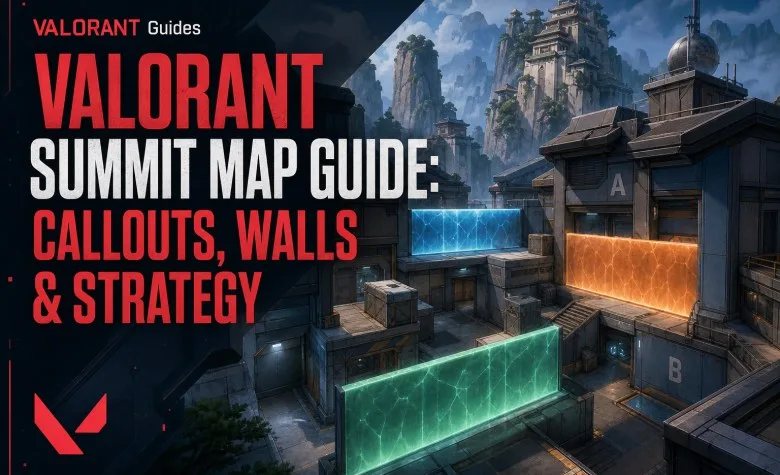
Summit is a two-site, three-lane VALORANT map built around Mid control, vertical fights and three massive droppable walls that can permanently change the layout of a round.
Unlike doors that can be reopened, Summit's walls stay down after they are activated. A well-timed wall can cut a rotation, isolate a site defender, block a retake route or trap players on the wrong side of the map.
| Summit overview | Current information |
|---|---|
| Sites | A and B |
| Layout | Three lanes with central Mid |
| Main mechanic | Three droppable walls |
| Other mechanics | Rope ascender and silent drop on B |
| Location | Zhangjiajie, Hunan, China — Alpha Earth |
| Introduced | Patch 13.00 |
| Current status | Competitive rotation |
Is Summit in the Current Valorant Map Pool?
Yes. Summit is currently part of the Competitive rotation together with Abyss, Bind, Corrode, Haven, Lotus and Sunset.
It entered the pool when Patch 13.00 launched and has remained in rotation since release.
See our current VALORANT map pool guide for the complete live rotation.
Summit Map Layout Explained
Summit uses a traditional three-lane structure:
- A lane: A Lobby → A Main → A Garden / A Site;
- Mid: Mid Bottom / Mid Tiles → Mid Fountain → Mid Top / Mid Window;
- B lane: B Lobby → B Main → B Site / B Tower.
A Link and B Link connect the center of the map toward the sites, while Summit's wall system can permanently change which routes remain available.
This makes the map unusually dynamic. Two rounds can begin with the same default but become completely different once one or more walls fall.
All Official Summit Callouts
| Area | Official callouts |
|---|---|
| A | A Art, A Cave, A Garden, A Hall, A Link, A Lobby, A Main, A Site |
| Mid | Mid Bend, Mid Bottom, Mid Fountain, Mid Tiles, Mid Top, Mid Window |
| B | B Drop, B Gym, B Link, B Lobby, B Main, B Site, B Tower, B Trophy |
| Spawns | Attacker Side Spawn, Defender Side Spawn |
Explore services related to this guide, selected from our Valorant catalog.
View All Valorant Services


How Do Summit's Droppable Walls Work?
Summit has three permanent round-changing walls:
- one between A Art and A Garden;
- one between Mid Window and Mid Bottom;
- one between B Tower and B Site.
Each wall is connected to a destructible switch with 125 HP.
When the switch is destroyed:
- the wall begins descending;
- anything directly underneath is in danger;
- the falling wall can destroy utility;
- a player caught underneath can be killed;
- the wall remains closed for the rest of the round.
That last point is the most important. You are not just opening or closing a temporary door. You are changing the map until the next round.
Can Abilities Activate Summit Walls?
Yes. Because the switches take damage, damaging utility can interact with them.
This creates advanced plays where a team can trigger a wall without standing directly in front of the switch.
However, do not waste expensive utility simply to activate a wall unless closing that route has clear tactical value.
Can You See or Throw Utility Over a Dropped Wall?
The walls are not completely sealed at the top.
A small opening remains that can allow limited vision and some utility interaction.
That means a dropped wall blocks movement but does not always eliminate every possible information or ability play across the route.
Summit's B Tower, Rope and Silent Drop
B Site has additional vertical mechanics.
A rope ascender connects B Gym to B Tower, giving players access to the elevated position.
Players can also move from B Tower toward B Drop using the map's silent-drop geometry when the movement is performed correctly.
Because of this, B should never be cleared as if it were a flat site. Always account for high and low positions.
Why Mid Control Matters on Summit
Mid gives attackers flexibility and defenders information.
If attackers gain enough Mid control, they can threaten:
- A through A Link;
- B through B Link;
- late rotations;
- split executes;
- wall plays that cut defensive routes.
Defenders do not need to fight Mid to the death, but giving it away without information makes both sites harder to read.
How to Attack Summit
The best attacking rounds normally combine space control with wall timing.
Do not treat the walls as random map objects. Decide before the execute what closing a specific wall achieves.
Use Walls to Cut Rotations
If you commit to a site, destroying a wall switch can prevent a defender from rotating through the most direct route.
This is especially powerful when your team already controls the opposite side of the wall.
However, closing a wall at the wrong time can also trap your own lurker or remove your safest escape route.
Pressure More Than One Lane
Five-player Main rushes can work, but Summit rewards teams that create uncertainty.
A stronger default can use:
- one or two players controlling A Main;
- one or two players contesting Mid;
- one player maintaining B pressure or watching aggression.
When defenders reveal their setup, the attacking team can choose which lane to reinforce.
How to Attack A Site
A attacks revolve around A Main, Garden, Cave, Hall, Art and A Link.
Before committing:
- clear close A Main positions;
- use recon or flash utility on Garden and deeper angles;
- check Cave instead of assuming the corner is empty;
- coordinate A Link timing if Mid is controlled;
- decide whether dropping the A wall helps your post-plant.
A wall timing can be particularly strong if defenders are forced to rotate from the wrong side after the Spike is planted.
How to Attack B Site
B is more vertical than A.
Important positions include:
- B Main;
- B Tower;
- B Drop;
- B Gym;
- B Trophy;
- B Link.
Clearing Tower is essential because an elevated defender can punish a planter or the second player entering the site.
Recon, drone-style utility or flashes are valuable because they reduce the number of heights the entry player has to check manually.
How to Defend Summit
Defense becomes easier when your team understands when to preserve a wall and when to drop it.
Do Not Automatically Drop Every Wall Early
A closed wall is permanent for the round.
If you trigger it immediately without a reason, you may remove a useful rotation path before attackers have committed.
Use walls when they:
- deny an active push;
- cut a known attacker from teammates;
- protect a site anchor;
- delay a retake route that attackers would otherwise use;
- force attackers into a predictable lane.
Preserve Information
A defender can give up some space without giving up the entire site.
Use Sentinels, recon utility and safe jiggle information to understand which lane attackers are preparing before committing your rotations.
Best Agents for Summit
| Role | Strong picks | Why they work |
|---|---|---|
| Duelist | Yoru, Jett, Phoenix, Neon | Fast space creation, repositioning and pressure around multiple lanes |
| Controller | Clove, Omen | Flexible smokes for Mid, Tower and site entries |
| Initiator | Fade, Sova, Gekko | Information and clearing utility for vertical positions |
| Sentinel | Vyse, Sage, Cypher | Strong current Ranked results, lane control and site anchoring |
For overall Agent strength across the current patch, see our VALORANT Agent Tier List.
Best Sentinels on Summit
Vyse
Vyse is currently one of the strongest Ranked performers on Summit. Her kit can punish predictable Main pushes and protect space while teammates rotate.
Sage
Sage performs well because Barrier Orb can create another structural obstacle on a map already defined by blocked routes.
Slow Orb also makes narrow approaches expensive to cross.
Cypher
Cypher provides passive information across the three-lane layout and reduces the need to leave a player permanently watching every flank.
Best Controllers on Summit
Clove
Clove is strong in Ranked because their smokes can support rapid rotations and remain useful in chaotic fights.
Omen
Omen can smoke vertical positions such as Tower and Window while using Shrouded Step to exploit elevation and reposition around closed routes.
Best Initiators on Summit
Fade
Fade is effective at locating defenders hidden around layered site geometry and forcing them out of tight positions.
Sova
Recon Bolt and Owl Drone reduce the risk of manually clearing Tower, Garden and long site angles.
Gekko
Gekko provides reusable clearing utility and can use Wingman for plants or defuses while teammates cover dangerous elevations.
Example Summit Team Composition
A strong balanced Ranked composition is:
Yoru / Clove / Fade / Sova / Vyse
This composition provides:
- flexible entry and rotation pressure;
- reliable smokes;
- double information and clearing utility;
- strong site anchoring;
- good control over narrow routes created by dropped walls.
Best Weapons on Summit
Summit mixes long lanes with tight indoor fights.
Vandal remains reliable for long Mid and Main duels.
Phantom performs well around sites, closed walls and shorter interior engagements.
Operator can dominate long angles but becomes vulnerable if attackers use the walls to cut its fallback route.
Outlaw and Marshal can also find value on the map's longer sightlines.
For current damage and weapon prices, see our VALORANT Weapons Guide.
Summit Attack Mistakes
| Mistake | Better approach |
|---|---|
| Ignoring the wall switches | Plan wall timing as part of the execute |
| Dropping a wall without checking teammates | Confirm lurker and rotation positions first |
| Clearing B like a flat site | Check Tower, Drop and multiple elevations |
| Five players through Main every round | Create Mid pressure and split threats |
| Using utility only after entry | Use recon and flashes before exposing players |
Summit Defense Mistakes
| Mistake | Better approach |
|---|---|
| Dropping walls automatically at round start | Keep routes available until closing them has value |
| Over-rotating from first contact | Confirm the execute before abandoning the opposite site |
| Ignoring Mid | Maintain information or Sentinel coverage |
| Repeating the same Tower hold | Change elevation and defensive timing |
| Standing under a falling wall | Respect the lethal crush zone |
Summit FAQ
How many sites does Summit have?
Two: A and B.
How many droppable walls are on Summit?
Three: one on A, one in Mid and one on B.
How much HP does a Summit wall switch have?
Each switch has 125 HP.
Can a falling wall kill players?
Yes. A player caught directly underneath the wall can be killed, and utility underneath can also be destroyed.
Can the wall be reopened?
No. Once dropped, it stays closed for the rest of the round.
Is Summit currently in Competitive?
Yes. Summit has been in the Competitive rotation since Patch 13.00.
What are the best Agents on Summit?
Strong current options include Vyse, Sage, Clove, Fade, Yoru, Phoenix, Sova and Cypher depending on role and team composition.
Final Summit Strategy
The key to Summit is understanding that every wall is a permanent macro decision for that round.
On attack, control multiple lanes and use the walls to isolate rotations after you know where defenders are.
On defense, avoid closing routes without a reason. Gather information first, then use the wall system to delay, split or trap the attacking team.