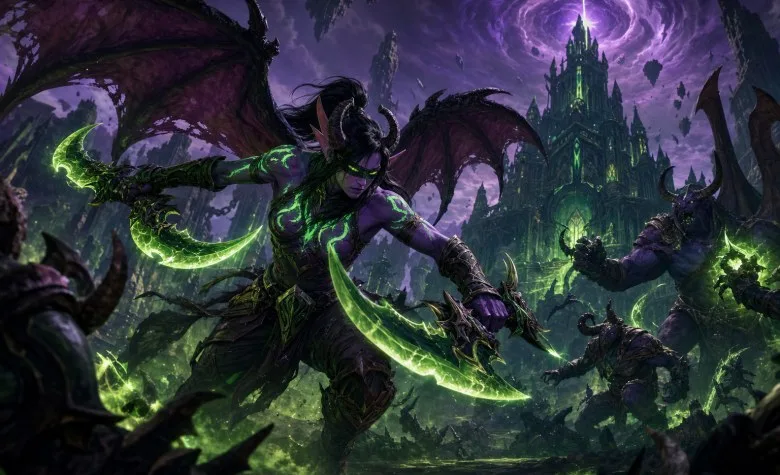
Demon Hunters level by keeping combat and movement connected. They can cross gaps, reposition quickly, gather enemies into short burst windows, and recover through Soul Fragments after a kill. That speed is a major advantage, but careless movement can also pull extra enemies or carry you out of your own damage area.
Standard Night Elf and Blood Elf Demon Hunters begin at level 8 and finish their class introduction around level 10. Allied Race Demon Hunters, including Void Elves, begin at level 10. The practical leveling range is therefore 8–90.
Quick Answer: Best Specialization for Leveling
Havoc is the best general recommendation for fast outdoor questing. It combines immediate damage, strong cleave, excellent mobility, frequent burst windows, and enough self-sustain to move between pulls with little recovery time. Eye Beam, Blade Dance, Immolation Aura, Fel Rush, and Chaos Strike give it useful answers for both isolated enemies and compact groups.
Vengeance is the stronger option for dangerous elites, large pulls, and players who want access to the tank queue, which usually means shorter dungeon waits. Devourer suits players who prefer a 25-yard caster rhythm, Soul Fragment management, and planned Void Metamorphosis windows. All three can level efficiently, but Havoc has the most direct outdoor flow with the least preparation.
Demon Hunter Leveling Overview
All three specializations use Fury, but they do not use it in the same way. Havoc generates Fury for Chaos Strike and other attacks. Vengeance combines Fury with Soul Fragments to support damage and survival. Devourer uses Fury and Soul Fragments to build toward Void Metamorphosis and Collapsing Star.
- Movement: Fel Rush, Infernal Strike, Shift, Vengeful Retreat, double jump, and Glide reduce travel time and help control positioning.
- Self-sustain: Soul Fragments and specialization-specific defensive tools reduce downtime after larger pulls.
- Control: Disrupt, Chaos Nova, and sigils can stop dangerous casts or stabilize groups.
- Positioning: mobility is useful only when the landing point keeps enemies grouped and avoids additional packs.
- Combat rhythm: spend Fury before it caps, but do not begin a difficult pull with every resource and defensive tool exhausted.
Comparison of All Demon Hunter Specializations
| Specialization | Role | Single-Target | Multi-Target | Survivability | Best Use Case |
|---|---|---|---|---|---|
| Havoc | Melee damage | Fast burst | Strong immediate cleave | Good with active defenses and Soul Fragments | Outdoor questing and damage queues |
| Vengeance | Tank | Steady but slower | Strong large-pull control | Excellent | Elites, crowded objectives, and dungeon tanking |
| Devourer | Mid-range spell damage | Strong planned windows | Powerful ramping burst | Good through range, mobility, and sustain | Planned pulls and caster-oriented gameplay |
Havoc
Havoc uses a fast build-and-spend loop with short offensive windows. It performs well against normal quest enemies because its important abilities begin contributing immediately, and it can move into the next pull before longer cooldowns return. The main weakness is overcommitment. Fel Rush or Vengeful Retreat used only for damage can place you outside melee range or inside another group.
Vengeance
Vengeance trades some individual kill speed for control and reliability. Fracture, Soul Fragments, Soul Cleave, Demon Spikes, Fiery Brand, and Fel Devastation let it gather several enemies and remain active under sustained pressure. It is forgiving in solo content, but dungeon leveling adds responsibility for threat, route choice, enemy positioning, and healer pace.
Devourer
Devourer is a 25-yard spell damage specialization built around Fury, Soul Fragments, Void Ray, and Void Metamorphosis. It can stay at mid-range or use optional melee interactions without becoming a standard melee spec. Its strongest windows require more preparation than Havoc, so weak enemies may die before the full cycle matters. Against larger or durable pulls, that setup produces powerful Cosmic damage through Collapsing Star.
Explore services related to this guide, selected from our Character Boost catalog.
View All Character Boost


Recommended Demon Hunter Leveling Build Priorities
A leveling build should improve frequent pulls rather than copy a narrow raid setup. Prioritize reliable resource flow, repeatable cleave, movement that supports positioning, and defenses that prevent recovery breaks.
Havoc Build Priorities
- Improve Fury generation and efficient spending through Chaos Strike.
- Strengthen Eye Beam, Blade Dance, and Immolation Aura for short multi-target pulls.
- Keep Blur and useful self-sustain instead of taking only offensive choices.
- Choose movement interactions only when you can use them without losing target uptime.
Vengeance Build Priorities
- Improve Fracture, Soul Fragment generation, and Soul Cleave value.
- Support Demon Spikes, Fiery Brand, and Fel Devastation for repeated dangerous pulls.
- Take sigil and control improvements for caster-heavy groups.
- Add area damage without weakening the defensive cycle needed for tanking.
Devourer Build Priorities
- Improve Consume, Soul Immolation, Reap, and Soul Fragment generation.
- Support Void Ray and faster access to useful Void Metamorphosis windows.
- Strengthen Collapsing Star for durable targets and grouped enemies.
- Choose the melee combo branch only when you want to move regularly into close range.
Talent Progression from Level 8 to 90
Levels 8–30
Learn Fury generation, your main spender, Disrupt, and the movement tools of the selected specialization. Keep pulls small enough to understand where each dash or leap ends. By the end of this range, the build should include a repeatable single-target loop, one practical multi-target option, and a defensive response for accidental extra enemies.
Levels 30–50
Strengthen the specialization’s core pattern. Havoc should connect Fury spending with Eye Beam and Blade Dance. Vengeance should stabilize Soul Fragment use and Demon Spikes coverage. Devourer should establish a clear sequence through Consume, Reap, Void Ray, and Void Metamorphosis. Add utility when dangerous casters or crowd control begin delaying pulls.
Levels 50–70
Fill gaps in survivability, control, and cooldown coverage. This is the range where a build should stop feeling dependent on one large button. Improve repeatable damage and choose talents that let you recover from a failed interrupt, an additional patrol, or a target that survives longer than expected.
Levels 70–80: Hero Talent Progression
The Hero Talent tree becomes the main new progression layer in this range. Select a tree that supports the playstyle you already use rather than rebuilding the entire specialization around a theoretical ranking. Leveling favors effects that appear frequently, work across short pulls, and do not require perfect boss-length timing.
Levels 81–90: Midnight Talent Expansion
The final levels add further class, specialization, and Hero Talent progression, including Apex Talents. Use these points to reinforce the content you are running. Outdoor leveling rewards frequent damage and self-sustain, while dungeon leveling places more value on group control, interrupts, defensive consistency, and predictable burst.
Hero Talent Options for Leveling
| Specialization | Hero Talent Options | Leveling Direction |
|---|---|---|
| Havoc | Aldrachi Reaver or Fel-Scarred | Planned glaive sequences or direct demon-form pressure |
| Vengeance | Aldrachi Reaver or Annihilator | Active glaive interactions or destructive Soul Fragment gameplay |
| Devourer | Annihilator or Void-Scarred | Mid-range Voidfall pressure or a mobile melee-combo variant |
Havoc Hero Talents
Aldrachi Reaver rewards deliberate sequencing around Reaver’s Glaive, Chaos Strike, and Blade Dance. Fel-Scarred reinforces Immolation Aura, demon form, and frequent direct burst. Fel-Scarred is easier to apply to short quest fights, while Aldrachi Reaver suits players who enjoy a more ordered ability sequence.
Vengeance Hero Talents
Aldrachi Reaver adds active glaive interactions to Fracture and Soul Cleave. Annihilator is shared with Devourer and focuses on destructive effects connected to Soul Fragments and its own tree mechanics. The practical choice is the one that keeps defense and enemy control consistent during repeated pulls.
Devourer Hero Talents
Annihilator emphasizes Reap, Voidfall, Soul Fragment generation, and stronger Collapsing Star windows. Void-Scarred supports the optional close-range sequence through Voidblade, Hungering Slash, Vengeful Retreat, and The Hunt. Choose Annihilator for a more caster-focused rhythm or Void-Scarred for frequent movement between mid-range and melee.
Apex Talents from Level 81 to 90
| Specialization | Apex Talent | Leveling Relevance |
|---|---|---|
| Havoc | Eternal Hunt | The Hunt strengthens the next Eye Beam, gains better multi-target reach, and later supports a stronger Blade Dance cycle. |
| Vengeance | Untethered Rage | Soul Cleave and Spirit Bomb can create short Metamorphosis windows and gain added value from consuming Soul Fragments. |
| Devourer | Midnight | Collapsing Star gains stronger critical effects, and entering Void Metamorphosis can provide immediate access to it. |
Apex Talents strengthen major specialization moments rather than replacing the basic leveling rotation. Use them when they become available, but continue generating and spending resources normally instead of delaying an entire pull for one perfect window.
Single-Target Rotation
Havoc Single-Target Priority
- Use Demon's Bite to generate Fury when stronger generators are unavailable.
- Use Immolation Aura early enough to gain its full damage and resource value.
- Spend Fury with Chaos Strike before capping.
- Use Eye Beam and Blade Dance as major parts of the damage cycle.
- Use The Hunt and Metamorphosis on elites or targets that will survive the full burst.
Keep at least one movement option available when the target has dangerous ground effects or knockbacks. Damage gained from a careless dash is rarely worth losing several seconds of melee uptime.
Vengeance Single-Target Priority
- Use Fracture to generate Fury and Soul Fragments.
- Maintain damage through Sigil of Flame and Immolation Aura.
- Spend Fury with Soul Cleave while consuming nearby Soul Fragments.
- Use Demon Spikes before sustained physical damage and Fiery Brand on the most dangerous target.
- Use Fel Devastation when its combined damage and healing will matter.
Against weak enemies, resources can be spent aggressively. Against elites, avoid entering the dangerous part of the fight without Demon Spikes coverage, a healing option, or enough Fury to stabilize.
Devourer Single-Target Priority
- Use Soul Immolation to begin generating Fury and Soul Fragments.
- Use Consume as the repeatable generator while stronger actions are unavailable.
- Use Reap to collect Soul Fragments and maintain the resource cycle.
- Spend Fury with Void Ray.
- Enter Void Metamorphosis when ready and use Collapsing Star during the transformation.
Do not enter Void Metamorphosis against a target that will die immediately. Save the full cycle for elites, durable enemies, or a pull that gives Collapsing Star enough targets to justify the setup.
Multi-Target Rotation
Havoc Multi-Target Priority
- Group enemies before committing your main area abilities.
- Use Immolation Aura while the pack remains close.
- Use Eye Beam across as many targets as possible.
- Use Blade Dance for repeatable cleave.
- Spend excess Fury with Chaos Strike while maintaining position.
Fel Rush should support positioning, not scatter the pack. Check the landing area before moving through enemies, especially in narrow quest hubs.
Vengeance Multi-Target Priority
- Use Infernal Strike and sigils to establish position and control.
- Use Immolation Aura and Sigil of Flame for early area pressure.
- Use Fracture to generate Fury and Soul Fragments.
- Spend with Soul Cleave, or Spirit Bomb in a build centered on multi-target fragment consumption.
- Cycle Demon Spikes, Fiery Brand, and Fel Devastation before damage becomes unmanageable.
Stable enemy positioning improves both survival and group damage. Pull ranged enemies into the controlled area rather than moving the entire pack toward each caster.
Devourer Multi-Target Priority
- Position at mid-range where the priority target and nearby enemies remain within your attack area.
- Use Soul Immolation and Consume to build Fury and Soul Fragments.
- Use Reap to collect fragments and support the next transformation.
- Spend Fury with Void Ray while targets remain grouped.
- Use Void Metamorphosis and Collapsing Star on packs that will survive the setup.
Do not stand in the center of a pack without a reason. Mid-range positioning lets you maintain damage while avoiding unnecessary melee attacks and still leaves room to use the optional melee combo when selected.
Fighting Elite Enemies
Clear nearby patrols, begin with useful resources, and identify the first dangerous cast before engaging. Keep one movement charge for mechanics instead of spending every dash in the opener. Chaos Nova and Disrupt can prevent more damage than an additional filler attack.
- Havoc should use Blur before predictable burst and commit major offensive cooldowns early enough to gain their full value.
- Vengeance should align Demon Spikes and Fiery Brand with the elite’s strongest attacks.
- Devourer should enter Void Metamorphosis only when the target will remain attackable long enough for Collapsing Star.
- Use mobility to reset position, not to drag the elite into nearby groups.
- If adds appear, group them for controlled cleave unless the main target must die immediately.
Defensive Abilities and Survivability
Havoc relies on Blur, active movement, interrupts, Soul Fragments, and talent-based Leech to remain aggressive. Use Blur before heavy incoming damage, not after health has already collapsed. Fel Rush and Vengeful Retreat can break contact, but only when their landing positions are safe.
Vengeance uses Demon Spikes against sustained physical pressure, Fiery Brand against a dangerous enemy, and Fel Devastation for combined damage and healing. Soul Fragments are central to its recovery. Devourer prevents damage through range and mobility, while Soul Fragments, Soul Immolation interactions, and general class defenses reduce the need to stop between pulls.
Mobility, Utility, and Crowd Control
Havoc uses Fel Rush and Vengeful Retreat, Vengeance uses Infernal Strike, and Devourer uses Shift as its specialization movement tool. All Demon Hunters benefit from double jump and Glide for terrain shortcuts. Movement should preserve attack range and enemy grouping rather than function as an automatic damage button.
- Disrupt: stop heals, fears, and dangerous damage casts.
- Chaos Nova: stun several nearby enemies and create a safe damage window.
- Sigils: control groups, interrupt positioning, or establish a tank pull.
- Glide: shorten descents and reach objectives across uneven terrain.
- Spectral Sight: locate hidden enemies when a quest or area makes them difficult to track.
Stats, Weapons, and Gear
Item level is usually the first gearing check while leveling, but the correct primary stat is mandatory. Havoc and Vengeance use Agility, while Devourer uses Intellect. Devourer remains a leather specialization despite operating as a mid-range spellcaster.
- Havoc: use Agility leather and current one-handed weapons, including warglaives, swords, axes, or fist weapons.
- Vengeance: use Agility leather and current one-handed weapons while considering Stamina and defensive consistency.
- Devourer: use Intellect leather and supported one-handed weapons, with warglaives, swords, and axes listed as preferred options.
- Warglaives: existing glaives can adapt their primary stat when changing between Agility and Intellect specializations.
- Secondary stats: use them as tie-breakers during leveling instead of rejecting a clear item-level upgrade.
Replace outdated weapons and trinkets promptly. Weapon quality has direct importance for Havoc and Vengeance, while Devourer should prioritize Intellect and overall item level rather than treating every upgrade as a melee weapon-damage comparison.
Questing Versus Dungeon Leveling
Outdoor leveling rewards controlled chain-pulling. Havoc moves quickly between compact packs, Vengeance can handle dangerous objectives with little risk, and Devourer benefits from choosing the engagement distance and saving Void Metamorphosis for meaningful groups. Combine nearby objectives so mobility reduces travel rather than creating unnecessary detours.
Vengeance can enter the tank queue and often receives shorter waits, but tanking requires control over threat, positioning, and pull size. Havoc brings immediate cleave to grouped enemies. Devourer performs well when packs live long enough for its transformation damage to develop, but very short dungeon pulls may end before the full ramp matters.
Common Demon Hunter Leveling Mistakes
- Using the wrong starting range: standard Demon Hunters begin at level 8, while Allied Race Demon Hunters begin at level 10.
- Confusing Soul Fragments with a nonexistent resource: Devourer and Vengeance use Soul Fragments, not Void Fragments.
- Spending every movement charge: keep one option for mechanics, repositioning, or a failed pull.
- Overcapping Fury: spend resources before generators begin wasting value.
- Entering a major window too late: Eye Beam, Metamorphosis, or Collapsing Star should have enough target life remaining to matter.
- Using defenses after the damage: activate Blur, Demon Spikes, and Fiery Brand proactively.
- Ignoring primary-stat differences: Devourer needs Intellect, not the Agility used by Havoc and Vengeance.
- Scattering enemies: careless dashes reduce cleave and can pull additional groups.
Practical Demon Hunter Leveling Tips
- Plan the landing point before every Fel Rush, Infernal Strike, Shift, or Vengeful Retreat.
- Interrupt dangerous casts before spending control only for extra damage.
- Group enemies before using Eye Beam, Blade Dance, Soul Cleave, Void Ray, or Collapsing Star.
- Use one defensive ability early during a large pull instead of stacking every defense at low health.
- Carry useful Fury or Soul Fragments into the next pull when the current enemy is already dying.
- Use Glide and double jump to shorten routes without landing inside hostile groups.
- Switch to Vengeance for repeated elite objectives or tank-focused dungeon sessions.
- As Devourer, save the full Void Metamorphosis cycle for targets that will survive it.
- Check primary stat before equipping gear after changing specialization.
- Choose the largest pull you can control efficiently, not the largest pull you can barely survive.