
WoW Midnight gives PvP players more than a routine seasonal reset. It introduces a new 40v40 epic battleground, expands PvP activity inside Voidstorm with a dedicated outdoor conflict space, and adds Training Grounds as a lower-pressure entry point for players who need real battleground reps before queueing into standard matches. That matters because Midnight does not frame PvP as one generic mode anymore. It splits the experience into three clear lanes with different goals, different pressure points, and different types of players in mind.
If you understand that structure first, the rest of Midnight PvP becomes much easier to read. Slayer's Rise is the large-scale battleground lane built around map flow, pressure, lane progress, and final objective control. The Voidstorm PvP area is the outdoor conflict lane where War Mode players fight over rotating zone activity, control, and zone-specific rewards. Training Grounds is the learning lane where newer or returning players can build map awareness and objective habits before they enter normal battleground queues. These parts are connected by theme, but they are not designed for the same job.
How PvP Works in WoW Midnight
Midnight PvP is built around three different forms of friction. The first is structured battleground PvP, where teams enter a map with a fixed win condition and a clear objective path. The second is open-world PvP, where the fight moves around control points, escorts, skirmishes, and rotating events inside Voidstorm. The third is practice-focused PvP, where players can learn battleground logic against stronger game-controlled opponents instead of walking straight into experienced player groups and getting flattened before they understand the map.
That split is one of the smartest parts of Midnight's PvP design. New players have been running into the same wall for years: they queue battlegrounds, die fast, do not understand what matters, and leave with no useful lesson except that they got farmed. Midnight tries to reduce that problem without dumbing PvP down for everyone else. Training Grounds gives newer players a bridge. Slayer's Rise gives experienced battleground players a proper large-map objective war. Voidstorm gives War Mode players an outdoor space with reasons to fight beyond random roaming kills.
Slayer's Rise Battleground in WoW Midnight
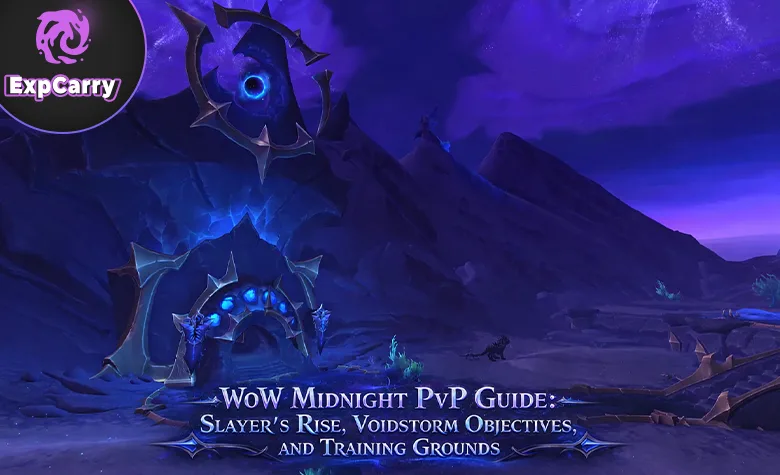
Slayer's Rise is Midnight's new epic battleground, built as a 40v40 map tied to the Voidstorm setting. Blizzard has positioned it as a large-scale conflict map in the tradition of Alterac Valley and Isle of Conquest, which tells you exactly what kind of battleground this is supposed to be. This is not a compact skirmish map and it is not a glorified team deathmatch. It is a broad objective war with an opening clash, lane pressure, defensive breakpoints, important NPC targets, and neutral support elements that can influence the match.
The basic structure is straightforward. Both teams begin on opposite sides, move toward an early clash, and fight over an opening control point that creates the first meaningful swing in momentum. From there, the battleground shifts into pressure across the lane. Teams push forward, break defenses, kill key NPC targets, recruit support forces when possible, and work toward defeating the opposing domanaar leader. Raw damage is not enough. Teams that win consistently are the ones that balance pressure, map reading, side value, and defensive timing instead of mindlessly feeding bodies into the nearest fight.
| Slayer's Rise element | What it does | Why it matters | Main mistake |
|---|---|---|---|
| Opening control point | Creates the first major contested objective | Sets the early tempo of the battleground | Overdying early for no lasting gain |
| Lane pressure | Pushes teams toward enemy defenses and base progress | Defines the main win path | Treating the map like a deathmatch |
| Neutral support forces | Adds extra pressure or utility to your side | Turns side play into real map value | Ignoring side value completely |
| Key NPC targets | Gate progress toward the enemy stronghold | Control match pacing and final access | Rushing ahead before the path is stable |
| Enemy domanaar leader | Final battleground objective | Ends the match when defeated | Hard committing before setup is ready |
How to Win More Games in Slayer's Rise
The fastest way to lose Slayer's Rise is to play it like a giant brawl and pretend activity equals progress. It does not. Large fights are only useful if they convert into map value. If your team wins a messy mid-map fight but gives up lane control, loses side pressure, or fails to stabilize the next step, that fight was mostly wasted time. Good teams do not just attack. They know when to peel players off for defense, when to secure side value, and when a push is real instead of just noisy.
The core rule is simple: do not confuse crowd size with good strategy. A long fight in the wrong place can lose the map. A smaller group handling a side task at the right moment can win it. Slayer's Rise rewards teams that read the state of the battleground better than the enemy, not teams that produce the prettiest damage meters while the objective collapses around them.
Voidstorm PvP Area and Open World Conflict
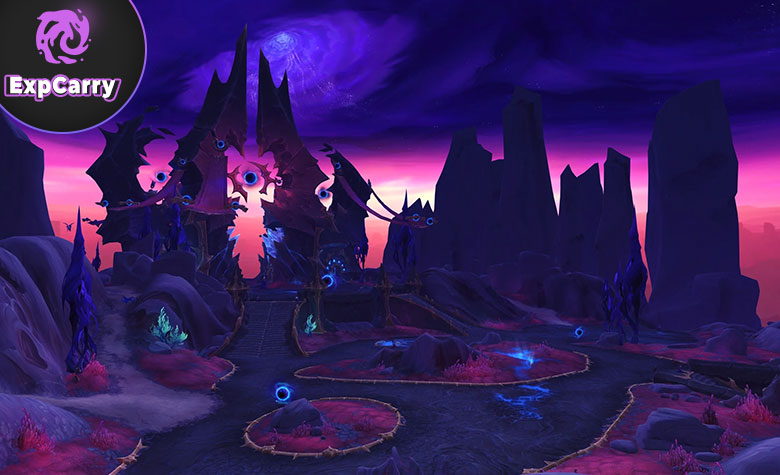
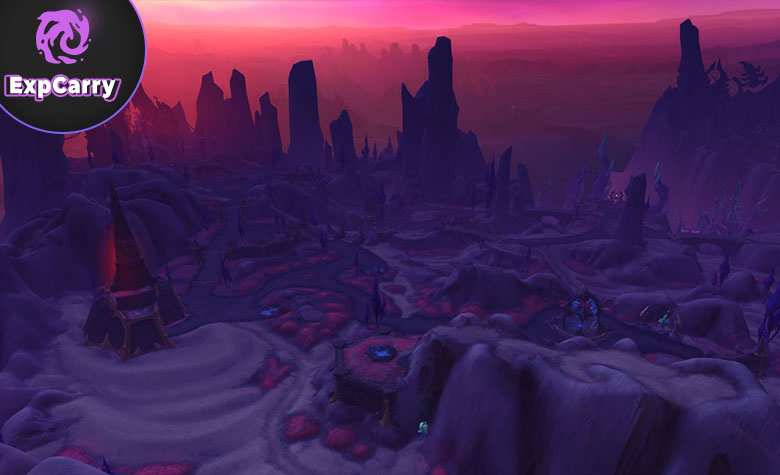
Slayer's Rise is the battleground, but Midnight also uses Voidstorm as a broader PvP setting outside the match itself. That distinction matters. The outdoor PvP area is not just battleground scenery. It is its own world PvP space with faction keeps, a neutral PvP hub, dueling access, vendors, and rotating objectives that give players a reason to move through the zone instead of treating it like a dead backdrop.
Midnight also handles participation more intelligently than older War Mode spaces. Players are not forced into a single on-or-off relationship with the zone. World Quests remain relevant even for players who are not actively using War Mode, while stronger incentives are tied to players who engage in the PvP layer of the area. That is a practical split. It keeps the zone from becoming irrelevant to everyone outside constant War Mode play, while still giving PvP-focused players a reason to contest events and push for better rewards.
What You Can Actually Do in the Voidstorm PvP Area
The outdoor section of Voidstorm is built to feel like an active conflict space rather than random ganking territory. Horde and Alliance each have their own keeps and support structure in the zone, while a neutral PvP hub provides a shared point for services, dueling, and movement into PvP activity. Rotating objectives and event-driven conflict are what make the zone work. If you enter it with no idea what is active, you are not really participating in the system. You are just wandering through the wrong fight at the wrong time.
That practical distinction is important because efficient world PvP in Midnight is not about aimless roaming. It is about understanding what the zone currently wants players to do, where the active objective is, and whether your goal is honor, event completion, reputation progress, or pure conflict. Players who react to the zone's active structure will get more out of it than players who treat every outdoor fight as interchangeable.
Explore services related to this guide, selected from our PvP catalog.
View All PvP Services


Voidstorm World PvP Events in Midnight
The world PvP side of Voidstorm becomes much easier to understand once you stop thinking of it as one shapeless outdoor brawl. The zone runs multiple event types, and each one changes what good play looks like. Some events reward control and rotation. Others are more about escort pressure, resource delivery, or temporary zone advantages. That means the right playstyle depends on the event, not on your personal habit of chasing every nearby fight.
| Voidstorm event | How it works | Best playstyle | What it is best for |
|---|---|---|---|
| Void Posts | Capture and hold key posts around the zone | Fast rotations and disciplined defense | Map control and steady conflict pressure |
| Captured Void | Move siphoned Void to your turn-in point | Escort carriers and cut off enemy routes | Objective-focused event progress |
| Domanaar Escort | Protect your escort while disrupting the enemy one | Split offense and defense properly | Coordination and timing value |
| Ethereal Control | Fight over multiple control areas | Zone denial and point stabilization | Territory pressure and organized skirmishing |
| Ethereal Disruption | Gather energy and trade it for temporary effects | Resource pressure and smart timing | Short-term tactical advantage |
| Void Scavenge | Increase remains income through active farming | Fast routing and efficient kill tempo | Better repeatable progress value |
The Events That Matter Most for Efficient PvP Progress
Not every event matters equally for every player. If your priority is direct fighting and visible control, Void Posts and Ethereal Control are the cleanest objective events because they reward groups that can rotate, defend, and deny space. If your priority is repeatable progress and better efficiency, farming-oriented activity like Void Scavenge matters more because it improves the pace of zone-specific collection and turn-in loops. If you care about temporary power swings, Ethereal Disruption becomes more valuable because short-term advantages can change how confidently you take the next fight.
The real mistake is entering the zone without understanding what is active and then acting surprised when your time return is bad. Midnight's outdoor PvP is not random by design. It rewards players who adapt to the event logic in front of them. Players who ignore that and just look for isolated kills are choosing a slower and dumber way to play the zone.
Rewards, Reputation, and Why Voidstorm Matters
Midnight does not treat the outdoor PvP area as disposable filler. The zone is tied to its own reward structure, which is what makes repeated participation matter beyond one evening of novelty. World PvP events, local activity, and repeatable zone engagement give players reasons to return, whether their goal is cosmetics, progression, or simply squeezing more value out of time spent in War Mode.
That part matters because open-world PvP dies fast when it has no spine. If a zone offers nothing except unscripted skirmishes, most players stop taking it seriously once the novelty fades. Voidstorm avoids that trap by tying conflict to an actual reward loop. The result is a zone that is more likely to stay relevant for players who enjoy repeatable PvP activity instead of touching it once and moving on.
Training Grounds in WoW Midnight
Training Grounds is Blizzard's answer to one of PvP's oldest structural problems: new players getting crushed before they even understand what a battleground is asking them to do. The mode expands on the old Comp Stomp idea, but Blizzard has described the enemies as smarter and the feature as a real learning lane rather than a throwaway novelty mode. Training Grounds currently uses Arathi Basin, Silvershard Mines, and Battle for Gilneas, which makes sense because those maps teach very different kinds of objective awareness.
This is not supposed to be a joke mode where the enemy collapses instantly. The stated goal is a more approachable win rate than normal PvP, not a brain-dead farm that teaches nothing. That distinction matters. If Training Grounds were too easy, players would leave it with fake confidence and bad habits. If it were too punishing, it would fail as an on-ramp. The value of the mode is that it gives players space to learn objective timing, positioning, and map flow before they throw themselves into normal battleground queues.
Who Should Use Training Grounds First
Training Grounds is built for three groups. First, completely new PvP players who need map familiarity and objective discipline. Second, returning players who understand older WoW PvP but do not want to re-enter live queues while rusty and useless. Third, players learning a new class, role, or spec who want repetitions on actual battleground tasks without instantly becoming dead weight in a full player lobby.
The right way to use Training Grounds is as a bridge, not a home. Learn node pressure in Arathi Basin, cart movement in Silvershard Mines, and control-point timing in Battle for Gilneas. Build the habit of watching the map instead of tunneling one fight. Once that starts to feel natural, move on. The mode is there to establish competence, not to replace real PvP permanently.
Best Beginner Path for Midnight PvP
If you are new to Midnight PvP, the cleanest progression path is simple. Start in Training Grounds so you understand battleground flow without getting run over instantly. Move into the Voidstorm PvP area once you are comfortable reading outdoor movement, event timing, and opportunistic skirmishes. Then queue Slayer's Rise when you can actually read a bigger map and understand that not every large fight deserves your body.
That order matters because Slayer's Rise punishes clueless play harder than some players will expect. A 40v40 battleground sounds forgiving because so many bodies are on the field, but large maps often hide bad habits until the whole team pays for them. If you do not understand when to defend, when to rotate, when to commit, and when a side task is worth more than another mid-lane pileup, you are not helping. Training Grounds and outdoor PvP are where you build those habits before the large battleground exposes every mistake.
What Midnight PvP Players Should Prioritize
If your goal is organized large-scale battleground play, Slayer's Rise should be your main focus. If your goal is repeatable world PvP, event participation, and zone-based rewards, the Voidstorm PvP area deserves more of your time. If your goal is getting competent enough to stop feeding and start understanding why battlegrounds are won or lost, Training Grounds is the smartest entry point. These lanes are connected, but they are not interchangeable, and players waste time when they pretend they are.
There is also a broader PvP context around Midnight's launch window. Season 1 introduces its own gear and reward chase, and crowd-control diminishing returns are less forgiving than before. Immunity now arrives faster in repeated control chains, which means sloppy overlap is punished harder. Kill setups, defensive timing, and team coordination all benefit more from cleaner DR discipline than they used to. Players who still chain control carelessly will feel that mistake faster.
Conclusion
WoW Midnight PvP works because it finally admits that not every PvP player needs the same kind of content at the same time. Slayer's Rise is the large-scale battleground for players who want map pressure, objective pacing, NPC value, and a real final target. The Voidstorm PvP area is the outdoor conflict space for players who want rotating events, faction pressure, repeatable rewards, and War Mode relevance. Training Grounds is the practical learning lane for players who need to build real battleground habits before jumping into standard queues.
The smartest part of this structure is that each lane solves a different problem instead of pretending one queue can serve everyone. Large-map battleground players get something that actually looks built for battleground strategy. Open-world PvP players get a zone with active reasons to fight. Newer players get a place to learn without being instantly discarded by the mode they are trying to enter. That is a much healthier design than throwing every skill level into the same funnel and pretending the results will fix themselves. If you want the practical version, it is this: use Training Grounds to learn how objectives really work, use Voidstorm to build map sense and reward efficiency in outdoor conflict, and use Slayer's Rise when you are ready for a battleground where pressure, rotation, and timing matter more than ego. That is how Midnight PvP gives you value. If you skip the learning curve and run straight into the biggest map because the queue looks exciting, you are much more likely to become another useless body in the zerg than someone who actually helps win.