
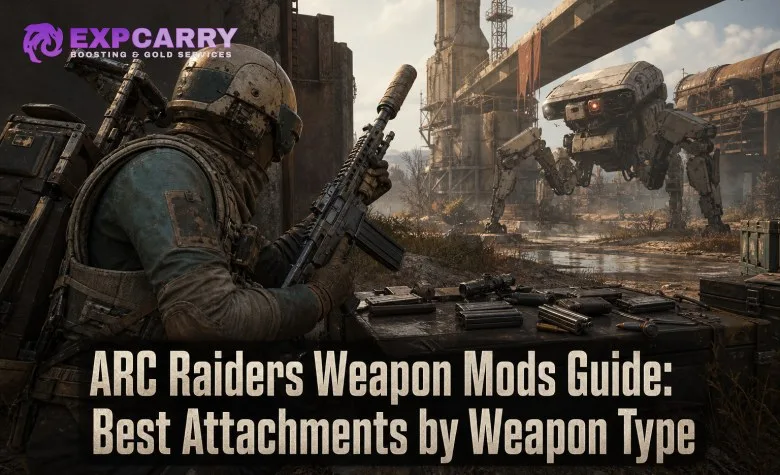
Weapon mods are one of the best ways to improve a gun in ARC Raiders without committing to a more expensive weapon tier. The current priority is simple: use magazines to reduce reload exposure, recoil or dispersion mods to make your intended engagement range reliable, and suppressors only when remaining quiet is more valuable than direct combat performance. As of Live Update 1.39.0, there has been no broad attachment rebalance, so the core recommendations below remain built around each weapon’s slots, fire mode, and intended range.
Best Weapon Mods at a Glance
| Weapon type | Best default mods | Best for | Main trade-off |
|---|---|---|---|
| Assault rifles | Extended Mag, Vertical Grip, Muzzle Brake or Compensator | Flexible PvP and medium-range ARC fights | High-tier recoil mods slow ADS |
| SMGs | Extended Light Mag, Vertical Grip, Lightweight Stock | Indoor PvP and aggressive close-range pushes | Lightweight Stock makes sustained fire less stable |
| Shotguns | Shotgun Choke, Extended Shotgun Mag, Stable Stock | Consistent close-range damage | Choke does not turn a shotgun into a long-range weapon |
| Battle rifles | Extended Barrel, Stable Stock, magazine where available | Controlled mid-to-long-range shots | Handling-focused builds give up some recoil comfort |
| Sniper rifles | Extended Barrel, Stable Stock, Extended Medium Mag | Open-map picks and long-lane pressure | Slow handling can be punishing when surprised |
| LMGs | Extended Medium Mag, Muzzle Brake, Stable Stock | Holding lanes and sustained ARC damage | Slow equip and ADS behavior becomes more noticeable |
| Pistols and hand cannons | Magazine or muzzle; Anvil Splitter only as a specialist choice | Backup weapons and close-range finishing | Few slots mean every choice matters |
Do not install a mod just because it has a higher rarity. Tier III muzzle, grip, and stock attachments often add a real penalty: slower ADS, worse weapon durability burn, or slower swapping. A Tier I or Tier II attachment that supports how you actually fight is often the better extraction-shooter choice because it is cheaper to replace and less likely to weaken the weapon’s most important trait.
How Weapon Mods Work in ARC Raiders
Mods are swappable attachments, not permanent upgrades. You can add and remove them freely, while weapon upgrades improve the weapon itself through the Gunsmith. Most weapons can be upgraded, but Legendary weapons cannot. Each weapon has fixed compatible slots, so you should always inspect the gun before crafting a mod for it.
The available mod families are muzzle mods, underbarrel grips, stocks, light magazines, medium magazines, shotgun magazines, and the Anvil’s unique Tech Mod slot. Mods can be crafted at the Gunsmith, looted Topside, or acquired through Tian Wen. The full current stat list is available in the ARC Raiders weapon mods database.
The practical decision order
- Identify the weapon’s job. A Bobcat is a close-range weapon; an Osprey is for long lanes. Do not build both around the same range.
- Fix the weapon’s biggest weakness. Add magazine capacity to guns that run dry during fights, recoil control to automatic weapons, and velocity or falloff range to precision weapons.
- Consider the map and objective. Suppressors are more useful on quiet solo loot runs than during a loud ARC operation. An indoor route rewards close-range control; open ground rewards velocity and stability.
- Test the final build in Practice Range. Check burst control, recoil recovery, ADS feel, and whether the penalty actually changes your ability to win the first engagement.
For weapon roles, ARC armor penetration, and primary-secondary pairings, see our current ARC Raiders best weapons and gadgets guide.
Best Muzzle Attachments
Muzzle Brake: best all-purpose automatic-weapon muzzle
The Muzzle Brake reduces both horizontal and vertical recoil. It is the safest recommendation for full-auto assault rifles, SMGs you expect to spray beyond point-blank range, and LMGs. Use it when your shots climb or drift off target during an extended burst.
- Best on: Tempest, Rattler, Bettina, Stitcher, Bobcat, Canto, Torrente.
- Best use: Keeping sustained fire on Raider targets and exposed ARC weak points.
- Watch for: Muzzle Brake III increases durability burn rate. Do not spend rare components on it for a weapon you regularly lose before its basic version would stop helping.
Compensator: best for burst rhythm and controlled follow-up shots
The Compensator reduces per-shot dispersion and maximum shot dispersion rather than directly reducing recoil. It is most valuable on weapons where you fire controlled bursts, tap shots, or repeated semi-auto shots. That makes it a strong option for Kettle, Arpeggio, Renegade, Ferro, and Burletta.
Choose a Compensator when the weapon is already manageable but its shots become less precise as you keep firing. On a close-range SMG, a Muzzle Brake is usually the more forgiving choice. On a semi-auto rifle, the Compensator often produces more useful consistency.
Extended Barrel: best for range and bullet velocity
Extended Barrels increase bullet velocity and push damage falloff farther away. They are the right muzzle attachment for long-range rifles and careful medium-range play, especially when targets are moving across exposed terrain.
- Best on: Osprey, Renegade, Ferro, Kettle, and other weapons used from deliberate cover-to-cover angles.
- Best use: Open maps, long rotations, and fights where a faster projectile makes leading targets easier.
- Watch for: Extended Barrel III increases vertical recoil. If it makes follow-up shots worse, step down to Tier II rather than forcing the highest tier.
Silencers: best when information control matters
Silencers reduce weapon noise. They do not improve recoil, magazine size, or damage, so their value is tactical rather than raw combat power. Use one when you want to remove small ARC threats, protect a quiet looting route, or avoid broadcasting every shot to nearby Raiders.
A suppressor is less compelling when your plan already involves loud objectives, boss fights, or heavy ARC engagements. In those situations, recoil control or range is usually more valuable. Shotguns use a separate Shotgun Silencer, which offers a larger noise reduction but occupies the same muzzle slot as a Choke.
Explore services related to this guide, selected from our ARC Raiders catalog.
View All ARC Raiders Services
Best Underbarrel Grips
| Grip | Best use | Strength | Important limitation |
|---|---|---|---|
| Vertical Grip | Automatic weapons that climb upward | Reduces vertical recoil | Tier III reduces ADS speed |
| Angled Grip | Weapons that drift sideways during bursts | Reduces horizontal recoil | Tier III reduces ADS speed |
| Horizontal Grip | Slow, deliberate firing from cover | Reduces both recoil directions | Always reduces ADS speed |
Vertical Grip: the default grip for full-auto weapons
Vertical Grip is the strongest general underbarrel option for weapons with vertical climb. It is the practical starting point for Tempest, Bettina, Stitcher, Bobcat, Canto, Torrente, and Vulcano if you want more predictable repeat shots.
Use it before an Angled Grip unless sideways drift is clearly the problem. Most players feel vertical recoil first, and reducing it makes sustained tracking easier without changing the weapon’s intended role.
Angled Grip: the better answer to sideways drift
Angled Grip reduces horizontal recoil. It works best on guns that remain at the correct height but wander left and right across the target during bursts. It is especially useful for controlled automatic fire at medium range and can be a strong fit for Kettle, Arpeggio, Rattler, and some SMG builds.
Horizontal Grip: powerful but niche
Horizontal Grip reduces both horizontal and vertical recoil, but it costs ADS speed. That trade is worthwhile for defensive lane-holding, prolonged ARC weak-point damage, or a heavy weapon you are not trying to snap-aim around corners. It is a poor choice for an aggressive SMG or shotgun build that depends on instantly acquiring targets.
Best Stocks by Playstyle
Stable Stock: best for disciplined bursts and follow-up shots
Stable Stocks reduce recoil recovery duration and dispersion recovery time. In practical terms, they help a weapon settle faster between bursts or after recoil. They are excellent on battle rifles, sniper rifles, shotguns, and controlled assault-rifle builds.
- Best on: Ferro, Renegade, Osprey, Kettle, Il Toro, Vulcano, and Torrente.
- Choose it when: You fire in bursts, re-peek frequently, or need reliable follow-up accuracy.
- Downside: Stable Stock III increases equip and unequip time.
Lightweight Stock: best for aggressive close-range builds
Lightweight Stock greatly improves ADS speed and makes weapon swaps faster, but it increases vertical recoil and recoil recovery time. It is best reserved for weapons that already operate at close range, where speed can matter more than a tight long burst.
Use it on a Bobcat, Stitcher, Canto, or a close-quarters shotgun only if you can control the added recoil. It is not a general upgrade for a medium-range rifle.
Padded Stock: best for maximum stability, not mobility
Padded Stock improves both recoil directions and per-shot dispersion, but slows equip, unequip, and ADS speed. It belongs on a prepared firing-position build, not a weapon you need to draw in a panic. Consider it on an LMG or a defensive rifle when you expect to shoot from cover rather than initiate fast pushes.
Kinetic Converter: high-risk specialist stock
Kinetic Converter increases fire rate at the cost of substantially higher horizontal and vertical recoil. It is not a universal “best” stock. It can raise close-range pressure on a weapon you already control well, but the recoil penalty can erase that gain at normal engagement distances.
Use it only after testing the exact weapon in Practice Range. If the faster fire rate causes you to miss the follow-up shots that matter, use a Stable Stock or Padded Stock instead.
Magazine Mods: Usually the First Crafting Priority
Extended magazines are the most consistently valuable attachment family because they create more time before a dangerous reload. They are especially important in ARC Raiders, where reloading during an ARC push or a third-party Raider attack is often the moment a fight collapses.
- Extended Light Mag: Best for Kettle, Stitcher, Canto, Bobcat, Burletta, and Hairpin. Prioritize it for rapid-fire light-ammo weapons.
- Extended Medium Mag: Best for Arpeggio, Tempest, Renegade, Venator, Torrente, and Osprey. Especially valuable for a Tempest or Torrente build that must sustain fire.
- Extended Shotgun Mag: Best for Il Toro and Vulcano. More shells provide a wider margin when a close-range fight does not end cleanly.
Not every weapon accepts a magazine mod. Rattler and Bettina, for example, have muzzle, underbarrel, and stock slots but no magazine slot. That means their build should emphasize the handling or recoil weakness you are trying to solve, rather than planning around a magazine attachment they cannot equip.
Best Attachments by Weapon Type
Assault rifles: build for the range you intend to hold
Kettle: Extended Light Mag is the first pick. Pair it with a Compensator for controlled semi-auto follow-up shots, then use a Stable Stock for a steady medium-range build or Lightweight Stock only for close-quarters mobility.
Arpeggio: Extended Medium Mag and Compensator are the most practical core. Its burst fire rewards a stable rhythm more than maximum fire-rate or quick-swap gimmicks. Add an Angled Grip if burst drift is sideways; choose Vertical Grip if the bursts rise above target.
Tempest: Start with Extended Medium Mag, then add a Vertical Grip and Muzzle Brake for sustained PvP control. It lacks a stock slot, so recoil management must come from its muzzle and underbarrel choices.
Rattler and Bettina: Both lack magazine slots, so prioritize Muzzle Brake or Compensator plus the grip that fixes their recoil pattern. Bettina benefits most from a stable sustained-fire setup when fighting armored ARC targets; consult our ARC enemy weak points and armor guide before committing expensive ammunition to heavy targets.
SMGs: magazine first, then choose control or speed
Stitcher, Bobcat, and Canto: Extended Light Mag is the default first mod. Add Vertical Grip and Muzzle Brake if you need to keep a longer burst on target. Choose Lightweight Stock only for an aggressive indoor kit where fast ADS and weapon swaps are more useful than consistent medium-range tracking.
SMGs should not be overbuilt for range. If you want to fight outside their comfortable distance, reposition or bring a secondary weapon that covers long lanes instead of spending every slot trying to make an SMG behave like a rifle.
Shotguns: Choke for consistency, magazine for insurance
Il Toro and Vulcano: Shotgun Choke is the best default muzzle because it reduces base dispersion and makes your close-range shots more dependable. Add an Extended Shotgun Mag before investing in a premium stock. Stable Stock is the best general stock for players who need reliable follow-up shots; Lightweight Stock suits a fast-entry build but makes recoil recovery worse.
Use Shotgun Silencer only when your objective is quiet movement or selective PvP. For normal close-range fighting, Choke is usually the better combat attachment. Do not expect Choke to make shotgun damage reliable across open streets; it improves spread, not the weapon’s intended range.
Battle rifles: prioritize precision over unnecessary fire-rate
Ferro: Extended Barrel and Stable Stock make the most sense for deliberate heavy-ammo shots. If the gun pulls off target during follow-ups, use the appropriate grip before chasing a higher-tier barrel.
Renegade: Extended Medium Mag is a major quality-of-life pick. Pair it with Compensator or Extended Barrel depending on whether your fights are medium-range taps or long-lane shots. Stable Stock supports repeat peeks and follow-up rounds.
Aphelion: It only accepts underbarrel and stock mods. Build it around stability unless your plan is a close-range burst ambush, where a Lightweight Stock can have a role. Because its mod options are limited, do not expect it to fill every range at once.
Sniper rifles: make the first shot and follow-up count
Osprey: Extended Barrel is the best default muzzle for velocity and improved falloff distance. Add Extended Medium Mag for more pressure before reloading, then use Stable Stock for clean repeat shots. Vertical or Angled Grip should solve the recoil direction you notice in your own follow-ups.
Jupiter: It has no mod slots, so its performance depends on positioning, ammunition management, and choosing the right firing lane rather than attachment investment.
LMGs: control sustained fire without making the gun unusable up close
Torrente: Extended Medium Mag is the priority, followed by Muzzle Brake and Stable Stock. This gives you a dependable build for holding a lane, breaking ARC armor, and providing sustained squad pressure. A Padded Stock can work for a defensive setup, but the slower handling is dangerous if Raiders reach close cover.
Pistols and hand cannons: specialize instead of spreading resources
Burletta: Extended Light Mag is the best first mod. Choose a Compensator for repeat-shot consistency or a Silencer for a quiet backup weapon.
Venator: Its underbarrel and medium magazine slots make Extended Medium Mag plus a recoil-focused grip the sensible default. It is a strong compact option when your primary weapon lacks close-range speed.
Anvil: Muzzle choice depends on role: Compensator for deliberate shots, Extended Barrel for longer lanes, or Silencer for discreet use. The Anvil Splitter is a unique Tech Mod that adds projectiles but heavily reduces projectile damage. Treat it as a specialized close-range or spread-oriented option, not an automatic upgrade over a conventional Anvil build.
Best Budget Mod Order
If your Gunsmith and component supply are still developing, do not try to craft a complete rare attachment set for every weapon. Build a small pool of reliable mods that fit multiple weapons, then move them between kits before each raid.
- Craft an Extended Light Mag, Extended Medium Mag, or Extended Shotgun Mag for the weapons you use most.
- Craft Muzzle Brake I and Vertical Grip I for automatic weapons.
- Craft Compensator I for semi-auto and burst-fire weapons.
- Add Stable Stock I for rifles, shotguns, and long-range builds.
- Upgrade to Tier II only when you use that weapon regularly and have the replacement materials.
- Craft Tier III attachments selectively, after considering ADS and durability penalties.
This approach keeps your stash functional after a bad run. If you are deciding which loose mods, blueprints, and materials deserve space, use the ARC Raiders keep-versus-sell stash guide to avoid selling components needed for your next practical build.
Common Weapon Mod Mistakes
- Using the highest rarity by default: Tier III is not always better once its penalty conflicts with your weapon’s role.
- Putting a Lightweight Stock on a medium-range rifle: Faster ADS is appealing, but added recoil and slower recovery can make follow-up shots much worse.
- Skipping magazines on rapid-fire weapons: A reload at the wrong time is more costly than a small paper-damage improvement.
- Equipping a silencer for a loud objective: A suppressor loses much of its tactical value once you are fighting a boss, an ARC operation, or a crowded loot area.
- Building two weapons for the same distance: A shotgun plus SMG can leave you helpless across open terrain; a sniper plus Ferro can become awkward indoors.
- Ignoring the map state: Low visibility, storm conditions, indoor routes, and high-risk objectives should affect whether you value stealth, mobility, range, or sustained fire.
Final Mod Recommendations
For most players, the best attachment rule is magazine first, recoil or dispersion second, stock third, and stealth only when the raid plan supports it. Put Extended Mag plus Muzzle Brake and Vertical Grip on automatic weapons; use Compensator, Extended Barrel, and Stable Stock for controlled rifles; and use Choke plus Extended Shotgun Mag for close-range shotguns.
Keep your favorite mods transferable rather than locking rare parts onto every gun in the stash. Match the attachment set to the weapon’s slot list, your expected range, and the risk you are willing to take into that particular raid. On solo runs especially, a reliable, replaceable Tier I or II setup is often more valuable than a fully optimized weapon you hesitate to bring Topside. For safer route planning around your chosen loadout, read our ARC Raiders solo survival and extraction guide.