
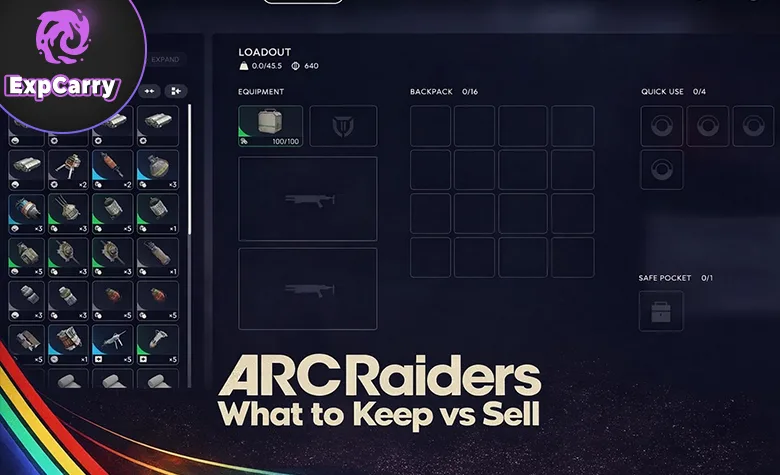
Your stash should hold items that create your next upgrade, craft, quest turn-in, or reliable raid kit—not every rare-looking object you extract. In the current ARC Raiders live build, keep active quest and Project requirements, unlearned Blueprints, materials for your next Workshop goal, useful ammunition, and gear you will actually deploy. Sell valuable surplus with no planned use, and recycle items only when their breakdown directly supplies a recipe or upgrade you are making soon.
This is the practical rule that prevents both common mistakes: selling a bottleneck component before a Project asks for it, or filling every stash slot with “maybe useful” loot while you cannot afford to bring a proper loadout. The guidance below is written for Live Update 1.39.0, released on July 28, 2026; that update also made Converging Paths trinkets stack, which removes one former source of unnecessary stash clutter. Read Embark’s official 1.39.0 notes for the latest confirmed changes.
The Fast Answer: Keep, Sell, or Recycle?
| Loot type | Default decision | Why | Exception |
|---|---|---|---|
| Unlearned Blueprint | Keep, then learn | It permanently unlocks a recipe for your current Raider. | Do not confuse it with a Blueprint already marked as learned. |
| Active quest or Project item | Keep | Replacing a specific turn-in item is often slower than replacing Coins. | Once the relevant objective is complete, reassess it. |
| Workshop upgrade material | Keep | Bench progression expands what you can craft and sustain. | Sell only true excess after checking your next upgrade. |
| High-value ARC component | Keep temporarily | It may support Projects, advanced crafting, or Nomadic Envoy trades. | Sell it if no current plan uses it and you need Coins or space. |
| Useful ammo, healing, shields, and gadgets | Keep a playable reserve | These items turn into successful extractions, not just stash value. | Trim ammo types and utilities you never take into raids. |
| Duplicate weapons and armor | Sell or recycle selectively | Unused gear occupies many slots and is easy to replace compared with progression items. | Keep weapons that match your preferred kit or a planned ARC hunt. |
| Common junk with no “Used in” need | Sell | Coins and empty stash space are more useful than dead inventory. | Recycle it instead if its components solve an immediate recipe. |
| Low-value item with a valuable breakdown | Recycle at Speranza | Its components can be worth more to your current crafting plan than its vendor price. | Do not recycle merely because an item can be recycled. |
Use the Item Card Before You Use a Loot Spreadsheet
The most reliable current rule is simple: inspect the item card. If the item is listed as being used in a recipe, Workshop upgrade, quest, Project, or other progression requirement, do not make a permanent decision until you know whether that requirement is relevant to you.
Static “sell every item on this list” guides age badly because ARC Raiders adds Projects, map conditions, recipes, trader offers, and seasonal objectives. Your inventory decision should reflect your active objectives, not another player’s completed progression path.
- Check Quests. Pin the objective you are pursuing and keep its required items until they are turned in.
- Check Projects. Projects are now grouped and clearer in the UI, but they still create long-term material demand. Keep only what supports an active or deliberately planned Project.
- Check the next Workshop upgrade. Do not stockpile materials for every future tier while an earlier bench upgrade is still unfinished.
- Check your crafts. If the item recycles into a component required for the weapons, healing, shields, grenades, or gadgets you use, it has practical value.
- Then compare Coins, components, and slot cost. If it has no planned use, sell it and reclaim the space.
Quest demand is especially important because ARC Raiders has an interconnected main quest chain, and requirements can arrive later than expected. That does not mean you should hoard every object forever. It means you should preserve items tied to a currently visible objective and keep a modest buffer of broadly useful components rather than dumping all of them after one good raid.
What You Should Always Keep
Unlearned Blueprints
Blueprints are one of the clearest keep decisions in the game. If you have not learned it, bring it home safely and consume it in Speranza. A Blueprint can unlock a weapon, attachment, augment, utility item, or component recipe that saves you from repeatedly buying or hoping to loot that item.
Do not carry an unlearned Blueprint casually in a normal backpack if your Safe Pocket has room. Its immediate sell value is not the point; the recipe unlock is usually the meaningful reward. Blueprints also matter around Expeditions: Embark’s Expedition systems include Blueprint-related rewards and carryover decisions, so review your current Expedition screen before treating any Blueprint as disposable.
Items Required by Active Quests and Projects
Keep the exact items requested by your active quests, especially unusual civilian objects, electronics, ARC parts, and map-specific finds. These are the items players most often sell because they look like flavor loot rather than progression materials.
Project items deserve the same treatment. Since Update 1.39.0, Projects unlock after you have played five rounds, and the Project interface has received improvements to show steps and descriptions more clearly. Check it after every few successful extracts instead of discovering a requirement only after you sold the stack needed to finish it.
For broader progression planning—including current maps, Project considerations, and extraction-focused routing—use our ARC Raiders full progression and loot guide.
Materials for Your Next Workshop Goal
Workshop upgrades have compounding value. A material that advances a bench can unlock better crafting options, which in turn makes your ordinary raid kits cheaper and easier to replace. This makes current upgrade materials more valuable than random vendor trash, even when the trash sells for more per slot.
Set one target at a time. If you are upgrading a bench, reserve what that upgrade requires. Once it is complete, immediately review the next target. This approach stops the “keep everything because it might be useful later” cycle.
Ammunition and Consumables You Actually Run
Keep ammunition for weapons you deploy, plus healing, shield recovery, and utilities that fit your normal kit. Ammo is not automatically worth storing just because it is rare: launcher ammo and energy-focused ammunition can be valuable, but only if you use the weapons that consume them.
Build your reserve around two or three dependable loadouts. If you never deploy a particular weapon family, selling that ammo is usually better than sacrificing space needed for your core supplies. The same applies to spare grenades, mines, and gadgets: keep the utilities you understand and use, not a museum of one-off items.
If you are deciding which weapon families deserve that reserve, see the current ARC Raiders weapons and gadgets guide.
Explore services related to this guide, selected from our ARC Raiders catalog.
View All ARC Raiders Services
What to Sell First
Sell items when their best remaining function is becoming Coins. The key word is remaining: an expensive item is not automatically a sell item if it is needed for a Project, a trader exchange, or an upcoming craft.
Vendor These When You Have No Active Use
- Decorative and civilian trinkets with no quest, Project, or recipe use.
- Duplicate learned Blueprints that cannot provide a new recipe.
- Extra weapons you do not like using, particularly stock weapons that do not fit your planned kits.
- Surplus armor and augments beyond the number of ready-to-run kits you realistically need.
- Ammo for abandoned weapon types.
- Overstocked common resources after you have reserved enough for your next craft and upgrade.
- High-value loot with no component need when you need Coins for repairs, purchases, or a better kit.
Do not let rarity decide for you. A purple or gold item can be excellent vendor loot if you have no recipe, Project, trade, or loadout use for it. Conversely, a common component can be worth far more than its price when it blocks your next upgrade.
Keep Fewer Weapons Than You Think
Weapons are among the easiest items to over-hoard because each one feels raid-ready. In practice, a deep weapon pile drains your stash and does not improve your next deployment. Keep a rotation of affordable, familiar kits; retain specialist weapons only when you have a defined plan for them, such as an armored ARC target, a difficult map condition, or squad play.
Before selling a weapon, remove and preserve any attachment you intend to reuse if the game allows it. Then ask one question: Would I willingly bring this weapon into one of my next several raids? If the answer is no, turn it into Coins or components.
When Recycling Beats Selling
Recycle for a purpose, not by habit. Recycling is the right call when an item breaks down into components that directly reduce the cost of a craft, upgrade, repair, or loadout you will make soon. Selling is the better choice when the breakdown materials will simply become another unused stack.
| Situation | Best action | Reason |
|---|---|---|
| You need a component for a queued craft or Workshop upgrade. | Recycle | It shortens a real progression bottleneck. |
| The item’s parts support your normal ammo, healing, shield, or gadget loop. | Recycle selectively | The breakdown replaces supplies you will spend. |
| You have no recipe, upgrade, or Project use for the output. | Sell | Coins and a free slot are more flexible. |
| You are still Topside and need immediate inventory room. | Recycle only low-priority loot | Make room for a Blueprint, quest item, key material, or extraction supply. |
| You are at Speranza with a full stash. | Recycle after planning | You can check all active requirements before destroying an item. |
A good discipline is to avoid recycling valuable unknown loot during a raid unless your backpack is blocking a more important pickup. Extract first when possible. At Speranza, you can inspect its use, compare the breakdown, and decide without the pressure of an incoming Raider or a closing extraction opportunity.
Protect High-Value ARC Materials Until You Check Ermal
Do not automatically vendor rare ARC materials just because you already have several. Since Patch 1.29.0, the Nomadic Envoy Ermal can trade with Raiders who have reached Level 25, accepting high-value ARC materials and stockpiled rare weapons for rotating offers. Those offers can include Blueprints, Raider Tokens, cosmetics, and gameplay or progression items.
That changes the value of certain “extra” items. A surplus ARC component may be more useful as trade leverage than as a one-time sale. Before clearing high-value ARC loot, open Ermal’s current offers and compare what you can obtain with what you would gain from selling it.
This does not mean every rare ARC item must stay in your stash indefinitely. Ermal’s inventory rotates, and stash space has value. Keep trade candidates only while a current offer interests you or while you are building toward a specific objective. Embark’s Patch 1.29.0 notes confirm the Level 25 requirement and the rotating Nomadic Envoy trade system.
Use Different Rules at Each Progression Stage
Early Game: Protect Progression
Early on, your priority is unlocking reliable crafting and completing quests. Keep more components than you would later, especially anything tied to Workshop upgrades, healing, shields, basic weapon parts, active quests, and unlearned Blueprints. Sell obvious valuables with no use, but do not liquidate all materials simply to grow your Coin total.
Mid Game: Keep a Planned Reserve
Once you can craft dependable kits, stop collecting unlimited stacks. Reserve what supports your preferred weapon families, healing loop, upgrades, Projects, and a few replacement kits. Sell duplicate weapons and off-build ammunition aggressively. Recycle only toward a planned craft.
Late Game: Convert Idle Value Into Options
In late game, your stash should be intentional: current Projects, Expedition preparation, trader exchanges, high-end kit components, and gear you are ready to risk. If an item has sat untouched through several cleanup cycles and supports none of those goals, sell it. Keeping it “just in case” is usually less useful than Coins, space, or a crafted loadout.
A Five-Minute Post-Raid Cleanup Routine
- Move protected loot first. Secure unlearned Blueprints, active quest items, Project items, and Workshop materials.
- Choose your next objective. Pick one quest, Project step, bench upgrade, or kit to prepare before sorting the rest.
- Refill your next raid kit. Set aside the weapon, ammo, shield recovery, healing, and utilities you will use next.
- Check Ermal and your current trade goals. Reserve only materials that matter to an available or planned exchange.
- Recycle toward your chosen craft. Break down items only if their components are immediately useful.
- Sell the rest. Clear duplicate gear, unused ammo, decorative valuables, and excess resources with no defined role.
This routine works because it gives every retained item a job. If you cannot name that job—quest, Project, upgrade, trade, craft, or next loadout—the item is probably a sale.
Common Inventory Mistakes That Cost More Than They Save
- Keeping everything rare: rarity does not equal utility. Check current use before protecting it.
- Selling all ARC materials after a profitable raid: you can accidentally lose Project, craft, or Nomadic Envoy options.
- Recycling every item with a breakdown: components are only valuable when you need them.
- Stockpiling weapons you will not risk: a weapon is not a reserve kit if it never leaves the stash.
- Ignoring map-condition opportunities: special conditions can change what is worth extracting, including rare loot, Blueprint opportunities, and ARC drops.
- Clearing stash space during a raid without priorities: sacrifice low-priority junk first, not a possible quest or progression item.
- Not checking Projects after updates: ARC Raiders continues to add and refine progression content, so old inventory rules can become outdated.
Recent content updates have made special operations, map conditions, and new combat tools more relevant to what you carry and save. For context on one of the larger 2026 content additions, read our Flashpoint update guide.
Your Best Stash Rule
Keep items that create progress. Sell items that only create Coins. Recycle items that create the exact components you need next. That is the complete ARC Raiders keep-versus-sell rule.
When your stash is tight, do not ask whether an item might matter someday. Ask whether it supports an active quest, Project, Workshop upgrade, current trade, planned craft, or next raid kit. If it does not, move on. A clean stash makes loadouts faster, extracts more valuable, and every future raid easier to plan.
If you want help securing difficult materials, completing Project goals, or learning safer extraction routes with experienced players, see the available ARC Raiders coaching and carry options.