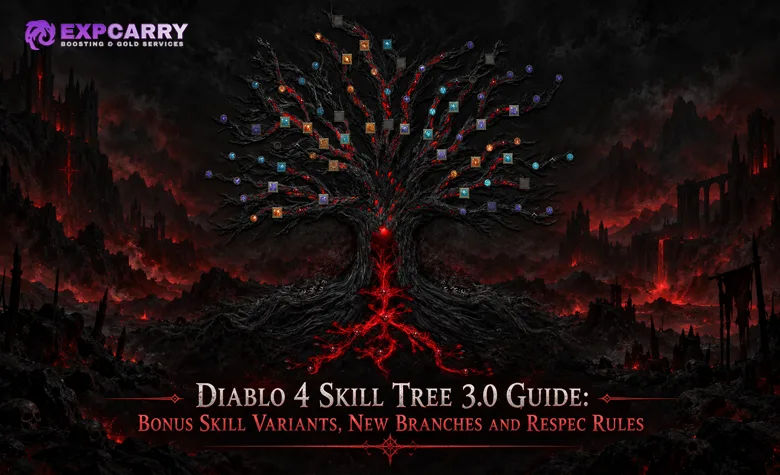
Diablo 4 Skill Tree 3.0 is a permanent redesign of class progression, not a seasonal mechanic that disappears when a season ends. The overhaul removes passive nodes from the tree, expands Active skills into three modifier branches, introduces build-defining Bonus Skill Variants, raises the total available Skill Point ceiling to 83, and moves several old Legendary and Unique effects into the skill system itself. The result is that a modern Diablo 4 build starts with the skill tree in a much more literal way than it did before 3.0.
This guide explains the current 3.0 architecture rather than the old launch-era tree: how the three branches work, what Bonus Skill Variants change, which parts require Lord of Hatred, how Skill Ranks interact with variants, what happened to passive and Legendary powers, how Druid and Necromancer differ from the standard rules, and how respecs and Armory loadouts work when you want to rebuild a character.
Diablo 4 Skill Tree 3.0 Is a Permanent Base-Game Overhaul
The most important distinction is scope. Blizzard lists Major Skill Tree Updates under permanent updates available across the full game rather than under temporary seasonal content. The overhaul launched alongside Lord of Hatred and Season of Reckoning, but the redesigned tree remains relevant on Seasonal and Eternal characters after that season changes.
Blizzard's Lord of Hatred systems overview describes more than 40 reworked choices, 80 additional options, and up to 83 available Skill Points. Those numbers are not a seasonal power package. They describe the new baseline character-building architecture introduced with 3.0.
This is why older Diablo 4 Skill Tree guides are structurally obsolete even when an individual skill name still exists. A pre-3.0 guide may tell you to spend points on passive clusters, choose one of two final upgrades, or acquire a defining behavior entirely from a Legendary Aspect. In 3.0, that same behavior may now sit inside one of the Active skill's branches instead.
Old Skill Tree Versus Skill Tree 3.0
The redesign changes where character power comes from. The old tree mixed Active skills, upgrades, passive nodes, and Key Passives. The new tree concentrates its points around Active skills and pushes many general passive effects into gear or other systems.
| System | Before 3.0 | Skill Tree 3.0 |
|---|---|---|
| Active skill upgrades | Short upgrade chains with relatively few final choices | Three branches per Active skill with one selected modifier from each branch |
| Build-defining skill behavior | Often split between the tree and Legendary or Unique powers | Bonus Skill Variants place many major behavior changes directly on the skill |
| Passive nodes | Spent Skill Points competed with Active skill ranks | Removed from the Skill Tree; many effects moved to reworked Aspects and Uniques |
| Former Legendary powers | Required the matching Aspect or item | Some were converted into Bonus Skill Variants or other skill-tree choices |
| Skill categories and tags | Usually fixed by the base skill | Many variants can change categories such as Fire to Frost or Bone to Blood |
| Total Skill Points | Built around the previous level and progression structure | Up to 83 points in the redesigned system |
The practical consequence is that a build guide written before 3.0 cannot be repaired by changing a few numbers. The skill allocation itself has to be rebuilt because passive spending, branch choices, skill tags, and several former item powers now live in different places.
How the Three Skill Branches Work
Every Active skill uses three branches that open progressively as the character levels. You select one modifier from each branch, so a finished skill is not defined by one final enhancement. It is the combination of the base skill, the first general modifier, the second general modifier, and the chosen Bonus Skill Variant.
- Branch 1: a general modifier that improves or changes part of the skill's normal operation.
- Branch 2: another general modifier chosen independently from the first branch.
- Branch 3: the Bonus Skill Variant branch, containing build-defining alternatives with larger mechanical changes.
The branches open through character-level progression rather than by forcing the old point-spending path through passive clusters. Blizzard states that modifiers become available once the character reaches the required level. That makes the new tree easier to respec during leveling: after reaching the appropriate level, you can rebuild around the skills and modifiers available at that stage instead of pathing through the old passive-node structure.
Players leveling a fresh class and trying to reach the later tree stages faster can use a Diablo 4 leveling route as one external option. The important mechanic is the same either way: branch availability follows character progression, while Skill Points determine which available skills and upgrades you actually invest in.
Skill Ranks Still Matter After the Branch Opens
Bonus Skill Variants are not isolated toggles that ignore the base skill. Blizzard specifically notes that many variants improve with Skill Ranks, so investing more points into the underlying skill can strengthen the variant as well as the ordinary skill output.
This changes the value of +Skill Rank gear. A rank bonus can now strengthen more than the base damage or healing number because the selected variant may also scale from those ranks. When comparing two items, do not assume that a generic multiplicative affix automatically beats additional ranks until you have checked how the current variant scales.
Explore services related to this guide, selected from our Diablo IV catalog.
View All Diablo IV Services


Bonus Skill Variants Are the Build-Defining Third Branch
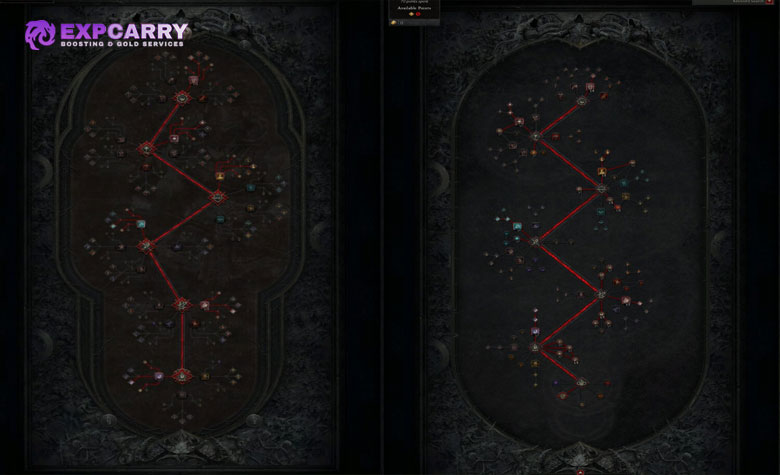
Bonus Skill Variants are the largest change in the 3.0 tree. The third branch offers three alternative properties for an Active skill, with many newly designed effects and others derived from powers that previously lived on Legendary gear. Only one variant is selected for that skill at a time.
The variant can change the shape, resource behavior, damage type, mobility function, summon behavior, defensive role, or other defining part of the skill. In practice, two characters can invest heavily in the same base skill and still build around different gear and Paragon interactions because their third-branch choices make the skill behave differently.
This is also why a modern build should be described by its variant rather than only by the base skill. "Blight build" is less precise when Piercing Darkness, Whirlpool, or another Blight variant changes how the skill interacts with damage zones, resources, items, and supporting tags. The selected variant is part of the build identity.
Lord of Hatred Ownership Changes the Third-Branch Choice
The 3.0 Skill Tree overhaul itself is available to all players, but the complete Bonus Skill Variant selection has an expansion restriction. Lord of Hatred owners can access all three variants in the third branch. Without the expansion, two of the three Bonus Skill Variants remain available.
That distinction matters when following a build guide. If a recommended build uses the expansion-gated third option, a base-game player cannot reproduce the setup exactly even though the redesigned tree is present. A useful guide should therefore identify the actual variant name instead of simply saying to "take the third branch."
Skill Variants Can Change Tags and Rebuild Gear Synergies
Many Bonus Skill Variants do more than add damage. Blizzard designed them to alter skill categories and tags, including conversions such as Fire to Frost or Bone to Blood. When the tag changes, every system that checks that tag can potentially evaluate the skill differently.
That affects several layers at once:
- Affixes: damage or utility bonuses tied to a skill category can begin or stop applying.
- Class mechanics: effects that reference a specific skill family may interact with the new category.
- Legendary and Unique gear: an item may support one variant much more strongly than another.
- Paragon: nodes and Glyphs that look for a damage type or skill tag can change value.
- Talisman: for Lord of Hatred owners, Seals and Charms can create additional interactions with the variant's resulting tags.
This is the central planning rule of Skill Tree 3.0: choose the variant before finalizing the rest of the build. If the third branch turns a familiar skill into a different damage family, the correct weapon affixes, Paragon path, Talisman setup, and supporting items may all change with it.
Former Legendary Powers Moved Into the Skill Tree
Before 3.0, many class-defining interactions required a particular Legendary Aspect. Blizzard reversed part of that relationship during the overhaul. Some important Aspects moved into the Skill Tree, while many removed passive and Key Passive effects moved out to reimagined Legendary Aspects and Unique items.
This exchange is important because it changes item-slot pressure. A behavior that once consumed an Aspect slot may now come from a Bonus Skill Variant, freeing that gear slot for a different offensive, defensive, or utility power. At the same time, an old passive that previously cost Skill Points may now require the correct piece of gear or Aspect.
Blizzard also reworked more than 200 Legendary Aspects around the 3.0 architecture. The goal is not to make gear less important. It is to move some of the most fundamental decisions onto the character while leaving equipment to amplify, redirect, or combine those choices.
If a returning build feels incomplete after recreating its old skill bar, a Diablo 4 build setup is one external way to reconcile the new tree with current gear and Paragon. The manual approach is to start with the variant, identify which former Aspect is now intrinsic to the skill, and only then refill the freed or changed gear slots.
Current Items Can Directly Interact With Skill Variants
The itemization link did not stop at launch. Current live Diablo 4 patch notes continue to balance individual variants and items that reference them, confirming that Skill Variants are a permanent part of the live item architecture rather than a one-patch experiment. The separate 3.2.0 PTR includes additional proposed variant changes, but PTR values are test data and are not treated as live values in this guide.
The current Diablo IV patch notes contain several examples. Battle Trance grants Frenzy's Barrage Variant for free. Ebonpiercer changes its behavior when Blight uses the Piercing Darkness Variant. Blood Mist's Blood Rush Variant explicitly adds the Mobility tag without removing Blood. Other current balance entries directly modify named variants across Necromancer, Sorcerer, Spiritborn, Paladin, and Warlock.
These examples show three different relationships:
- An item can grant a variant: the item becomes a way to gain the selected behavior without spending the normal tree choice in the same manner.
- An item can recognize a variant: the Unique power changes because a specific variant is active.
- A variant can alter tags: the skill becomes eligible for interactions it did not previously have.
Do not evaluate an item in isolation from the Skill Tree. In 3.0 and later, the phrase "supports this skill" may really mean "supports this specific variant of this skill."
What Happened to Passive and Key Passive Nodes?
Passive nodes are no longer part of the redesigned Skill Tree. That includes the old model where Skill Points were divided between ranking Active skills and buying general passive bonuses. Blizzard moved many Passive and Key Passive effects into redesigned Legendary Aspects and Unique items instead.
This makes Skill Point spending easier to read but moves part of the build puzzle into itemization. When a returning player sees that an old passive is missing, the correct response is not to search every branch for a renamed node. First check whether the effect was transferred to an Aspect, Unique, class mechanic, or another current system.
The opposite migration also happened. Some old Aspects were promoted into the tree because Blizzard wanted the defining behavior under direct player control. That is why comparing only the old and new skill nodes can give an incomplete picture; the overhaul deliberately redistributed power between the tree and equipment.
Up to 83 Skill Points Changes How You Prioritize Ranks
The redesigned system supports up to 83 Skill Points. Leveling to 70 provides the majority of them, while realm progression supplies the remaining points. Renown remains the permanent source on the Eternal Realm, while Seasonal characters earn the corresponding progression rewards through Season Rank and its objectives.
The important evergreen rule is not the current Season Rank objective count. It is that extra Skill Points do not replace character-level unlock requirements. A character can have bonus Skill Points available before a later branch is open, but those points are used on skills and upgrades that the character has already unlocked.
This creates a useful leveling priority:
- Unlock the skills your rotation needs. A new active button is usually more valuable than prematurely maxing a filler skill.
- Take the first two modifiers that make the rotation function. Solve resource, cooldown, area, defense, or setup problems first.
- Select the intended Bonus Skill Variant when its branch opens. This is often the point where the build's final identity becomes clear.
- Add ranks to the skills and variants that scale well from them. Do not spread points evenly just because the cap is higher.
- Use remaining points to strengthen supporting skills. Prioritize the abilities that actually contribute to the final rotation.
A finished 83-point build can still have very unequal skill investment. The higher point budget is there to deepen Active skills, not to make every button equally important.
Druid Has Free Form-Choice Nodes Between Its Branches
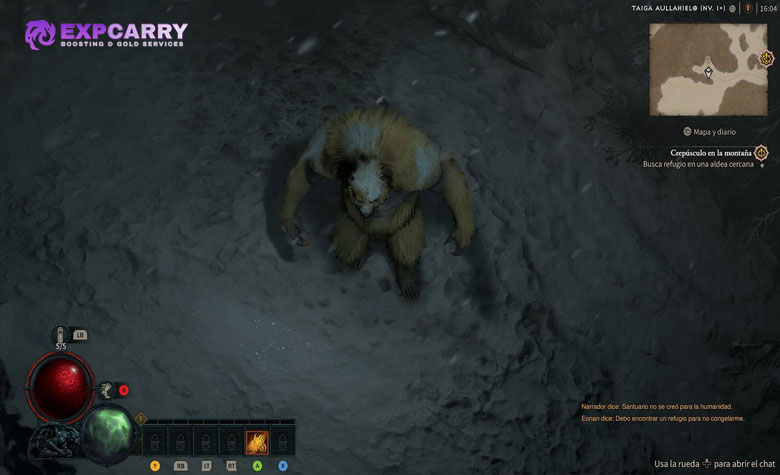
Druid follows the same three-branch foundation but adds Shifting choice nodes to many skills. These choices determine whether an eligible skill uses Werewolf, Werebear, or Human form, and Blizzard explicitly states that the form-choice nodes do not cost Skill Points.
The rules depend on the skill family. Storm skills can generally choose Human or Werewolf, while Earth skills can generally choose Human or Werebear, with exceptions for skills that are form-agnostic. Companion skills and Earthen Bulwark, Cyclone Armor, and Hurricane do not change the Druid's current form.
Choosing the native form can also provide an extra benefit. Blizzard's Trample example keeps the native Werebear form for a damage bonus, while converting Trample to Werewolf changes both the skill form and its animation into a leap. This means Druid build planning now starts with two separate questions: which Bonus Skill Variant do you want, and which form should that skill use?
Necromancer Minions Are Now Part of the Skill Tree
Necromancer received a deeper structural change. Raise Skeletons was split so Skeletal Warriors and Skeletal Mages have distinct skill behavior, and Skeletal Warriors, Skeletal Mages, and Golems now appear as part of the Necromancer Skill Tree. The Book of the Dead remains relevant for minion type and upgrade choices.
Sacrifice also changed. Sacrificing a minion type no longer automatically means the character can never summon that minion. If the corresponding skill has points invested and is equipped, sacrificed skeleton skills can still produce fewer minions and sacrificed Golems can remain present with reduced damage while the character receives the Sacrifice bonus.
This creates hybrid minion setups that were not possible under the old binary rule. A Necromancer can treat minions as support, buff sources, tanks, or partial damage tools while still taking a Sacrifice tradeoff. Old guides that say "Sacrifice means zero minions" should not be used for the 3.0 tree.
How Respec Works With the 3.0 Skill Tree
Skill respecs remain unlimited, but ordinary manual respecs are not free. Diablo 4's Respec Mode lets you edit a larger portion of the tree, preview the resulting allocation, see how many points will be refunded, and see the Gold cost before committing the changes. You can also work at a smaller scale when only one branch or skill needs to change.
The new tree makes partial respecs more useful because a build can often change behavior by replacing one branch choice rather than rebuilding every Active skill. If your item setup now supports a different Bonus Skill Variant, start by changing that skill's branch and the supporting tags before you reset the entire character.
Use the Armory for Builds You Expect to Reuse
The Armory is the better tool when you regularly switch between established builds. Blizzard's official Armory overview confirms five character-bound Loadout slots and saves Equipment, Skill selections, Paragon Boards and Glyphs, and the class mechanic. Loading a saved setup applies those stored selections rather than asking you to reconstruct the Skill Tree each time.
Current Armory switching is free, making it fundamentally different from manually refunding a live tree to create a new unsaved setup. Save a boss build, speed-farming build, or alternative variant setup in separate slots if you expect to use them repeatedly. Manual respec is for experimentation; Armory is for preserving finished configurations.
Gold Cost Matters More When You Rebuild Repeatedly
Diablo 4 does not require a new character every time you want to experiment, but repeated manual refunds still consume Gold. The Respec Mode preview is therefore important: make the complete change on the preview first, verify the point count, then confirm once instead of paying for a sequence of corrections.
Players who are already spending heavily on Enchanting, Masterworking, and repeated build testing can use Diablo 4 Gold as an external currency option. The cheaper approach is organizational: use the Armory for repeat builds and reserve paid manual respecs for genuinely new experiments.
Returning Characters Need to Recheck Old Legendary and Unique Gear
The 3.0 tree overhaul and the itemization overhaul were designed together. Blizzard warns that existing Eternal gear may still function but can be replaced with new versions whose powers no longer support the old build in the same way. This is especially relevant when the old item power was converted into a Bonus Skill Variant.
Some obsolete base or Tempered affixes were converted to +100 All Stats and marked Legacy when their old function no longer exists, including examples such as Passive skill ranks or old double-cast Weapon tempers. Legacy status matters because those items cannot be crafted normally or used in the Horadric Cube.
The current Tempering and Masterworking guide is the relevant follow-up when the Skill Tree is correct but the old gear package is not. Rebuild the skill architecture first, then decide which item is worth Enchanting, Tempering, or Masterworking under the current rules.
If an old item was converted to Legacy and you are considering replacing it through modern crafting, the Diablo 4 Horadric Cube guide explains why a current non-Legacy base is required for Cube projects. Do not keep an obsolete item only because it once carried the Aspect that now lives in the Skill Tree.
A Practical Skill Tree 3.0 Build Workflow
The fastest way to build under the new system is to work outward from the Active skill rather than inward from a list of items. This prevents you from farming gear for a version of the skill you later decide not to use.
- Choose the main Active skill. Decide which ability will carry the rotation or provide the main defensive or utility function.
- Read all three branches. The first two modifiers should solve the skill's operating problems before the third branch defines its identity.
- Select the Bonus Skill Variant. Note every tag, category, resource, cooldown, area, summon, or movement change.
- Check Skill Rank scaling. If the variant scales with ranks, compare +Skill gear more carefully.
- Rebuild gear around the resulting skill. Identify which former Aspect slot is now free and which current Aspect or Unique supports the chosen variant.
- Recheck Paragon and class mechanics. A changed skill tag can change which nodes and Glyphs are actually relevant.
- Test before expensive item finishing. Use the Training Grounds or normal endgame content before committing rare crafting resources.
- Save the successful setup in the Armory. Keep the working version before experimenting with another branch.
This order is safer than starting from a copied gear list. In 3.0, the variant can determine which gear list should exist in the first place.
Common Diablo 4 Skill Tree 3.0 Mistakes
Most problems come from applying pre-3.0 assumptions to a system that moved power between skills and items. The build may look familiar on the action bar while being mechanically different underneath.
- Using an old passive allocation: passive nodes are no longer part of the Skill Tree.
- Ignoring Branch 3: the Bonus Skill Variant is often the most important choice on the skill.
- Following an expansion variant without checking ownership: non-Lord of Hatred players have access to only two of the three Bonus Skill Variants.
- Choosing gear before choosing the variant: changed skill tags can invalidate the planned affixes, Paragon path, or Unique interaction.
- Assuming every former Aspect still belongs on gear: some build-defining powers were moved into the tree.
- Assuming every missing passive was deleted: many effects were moved to Aspects or Uniques instead.
- Refunding the whole tree for one branch change: partial respec is usually cheaper and easier when the base build remains intact.
- Paying to rebuild a setup repeatedly: save reusable configurations in the Armory.
- Keeping Legacy gear because the old power name looks familiar: 3.0 changed powers and unsupported affixes across the item architecture.
- Copying launch-day variant values forever: current patches continue to rebalance named Skill Variants and their item interactions.
The best check is to read the current skill tooltip after the variant is selected. If the tags or behavior differ from the guide you are following, stop and verify the build before spending on gear.
Diablo 4 Skill Tree 3.0 FAQ
These questions cover the parts of the permanent 3.0 overhaul that are easiest to confuse with the pre-expansion system or seasonal mechanics.
Is Diablo 4 Skill Tree 3.0 seasonal?
No. Blizzard classifies the Major Skill Tree Updates as permanent updates available across the full game rather than temporary seasonal content.
Do I need Lord of Hatred for the new Skill Tree?
The redesigned Skill Tree is available to all players. Lord of Hatred is required to access all three Bonus Skill Variants; without the expansion, two of the three variants are accessible.
How many branches does each Active skill have?
Each Active skill has three branches. You choose one modifier from each branch, with the third branch containing the Bonus Skill Variants.
What are Bonus Skill Variants?
They are build-defining third-branch choices that can substantially change how a skill behaves. Some are new and others are based on powers that previously existed as Legendary Aspects.
Can a Skill Variant change a skill's damage type or tag?
Yes. Blizzard specifically uses examples such as Fire to Frost and Bone to Blood, and current variants can alter other categories or add tags that affect gear and Paragon interactions.
Where did the old passive nodes go?
Passive nodes were removed from the Skill Tree. Many Passive and Key Passive effects were moved to reworked Legendary Aspects and Unique items.
How many Skill Points can you have in Skill Tree 3.0?
The redesigned system supports up to 83 available Skill Points.
Do Bonus Skill Variants scale with Skill Ranks?
Many do. Blizzard states that increasing ranks in the base skill can also strengthen applicable Skill Variants.
Does respeccing the Skill Tree cost Gold?
Manual respecs cost Gold. Respec Mode lets you preview the new allocation, refunded points, and cost before confirming the change.
Can I switch between saved Skill Trees for free?
Yes. The Armory stores Skill selections as part of character-bound loadouts and is the practical way to swap between saved builds without repeatedly paying for manual rebuilds.
Do old Legendary and Unique powers still work the same after 3.0?
Not necessarily. Some former powers became Skill Variants, many Aspects were redesigned, and older unsupported affixes can be converted to Legacy replacements. Recheck current gear before rebuilding an old character.
Conclusion
Diablo 4 Skill Tree 3.0 should be treated as the foundation of the current build system, not as an expanded version of the launch tree. Every Active skill now develops through three branches, the third branch supplies the build-defining Bonus Skill Variant, and many former passive or item powers have been redistributed between the tree, Legendary Aspects, and Unique gear. The system is permanent across Seasonal and Eternal play, although Lord of Hatred ownership determines whether all three Bonus Skill Variant options are available.
Build in the correct order: choose the Active skill, select its branch modifiers, lock in the intended variant, check how ranks and tags change the skill, and only then finalize gear, Paragon, and crafting. Use partial respecs for small experiments, Respec Mode for larger rebuilds, and the Armory for configurations you expect to reuse. That approach keeps the 3.0 tree flexible without wasting Gold or building expensive gear around the wrong version of a skill.