LoL Classic ranked progression works through Summoner's Journey, a competitive system built into Classic rather than a separate Ranked queue. You unlock it at Classic Level 10, complete five placement matches, and climb through Emblems from Salt to Legend using Seasonal Points (SP). This guide explains the system as of Patch 26.20, including promotion rules, matchmaking, role bonuses, rewards, and the differences from standard League Ranked. It also covers the upcoming regional queue restrictions in Patch 26.21 and Riot's confirmed end date for Classic's current run: January 6, 2027.
Short answer: League Classic has competitive progression through Summoner's Journey, but no separate Classic Ranked queue. Classic uses SP and Emblems, while standard Ranked uses LP and its own competitive ladder. Reaching a Classic Emblem does not grant an equivalent rank in Solo/Duo or Flex.
Does League Classic Have a Ranked Queue?
Riot launched Classic with one PvP draft queue alongside Co-op vs AI and custom games. Summoner's Journey adds competitive progression to the shared Classic experience without separating players into normal and ranked PvP queues. This means Classic has a rank-like progression system, but it does not have a dedicated Ranked queue with the same structure as modern League.
This design allows players chasing higher Emblems to share the mode with people revisiting older champions or playing casually with friends. Riot's original Classic overview explicitly describes that approach. Classic also uses position preferences rather than simply reproducing the old champion-select system. Standard Ranked Solo/Duo and Flex remain separate modern League modes, not alternative Classic ladders.
How to Unlock Summoner's Journey and Complete Placements
Reach Classic Level 10 to unlock Summoner's Journey. Your next five Classic matches determine your starting Emblem and division. Once those placements are complete, subsequent Classic matches contribute to your competitive progression. Classic Level is separate from your regular League account level, starts at 0, and has a maximum of 30. You earn Classic XP by playing Classic and completing its missions.
Before entering your placement matches, prepare champions and positions you can play confidently in Classic. Familiar champions may have older abilities, different damage patterns, and item interactions that no longer exist in modern League. Review your Classic runes and masteries and the Classic item paths for your preferred champions. Since position preferences affect assignments, having a reliable secondary or fallback pick also matters.
Riot confirms that five matches determine your initial placement but does not publish an exact conversion formula between placement results and starting Emblems. Winning a specific number of placement games therefore does not publicly guarantee a particular division. Do not apply standard Ranked placement calculators, LP estimates, or modern account-level requirements to Classic.
Classic Emblems, SP and Promotion Rules
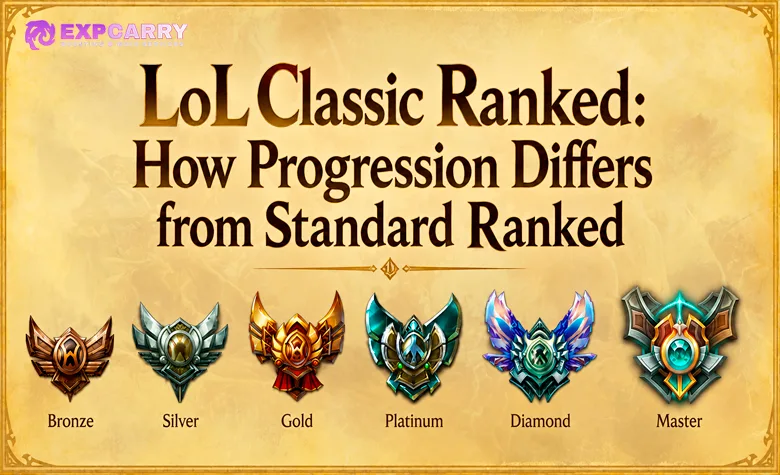
The Classic Emblem order is Salt, Wood, Silver, Gold, Platinum, Diamond, and Legend. Seasonal Points are the visible measure of your competitive progress: victories increase SP, while defeats decrease it. Unlike standard Ranked LP, these points belong specifically to Summoner's Journey and do not change your Solo/Duo or Flex rank.
Salt through Diamond each have four divisions, numbered IV through I. You need 100 SP to advance to the next division, or to the next Emblem when progressing from Division I. Dropping below 0 SP normally triggers a division demotion, but Riot specifies Division IV as the floor for each Emblem outside Legend. Therefore, the documented floor prevents ordinary demotion below Division IV of an Emblem. Legend has no divisions and no maximum SP cap. These mechanics are detailed in Riot's official Classic progression guide.
Although Classic and standard Ranked share labels such as Silver, Gold, Platinum, and Diamond, those names do not mean the same skill rating or player percentile across systems. A Classic Diamond Emblem cannot be converted into a modern Diamond rank. Riot has not published an official cross-mode rank conversion, so claims of equivalent ranks should not be treated as reliable.
Explore services related to this guide, selected from our League of Legends catalog.
View All League of Legends Services


Classic MMR and Role Preference Bonuses
Classic uses hidden Matchmaking Rating (MMR) to help create balanced matches, while SP represents visible Summoner's Journey progress. When matchmaking assigns you a lower-priority position, Riot's Aegis of Valor can increase SP earned from a victory. The published bonuses are 40% extra SP for your third preferred position, 70% for your fourth, and 100% for your fifth. These bonuses apply to winning matches; Riot does not describe them as protection against SP losses after defeats.
Select position preferences based on roles you can actually play. A larger potential SP bonus has little value if an unfamiliar role significantly reduces your chance of winning. Prepare at least one dependable champion and a basic rune, mastery, and item setup for your less-preferred positions. Because Classic uses older champion kits and items, modern role knowledge alone may not be enough.
Riot's general MMR explanation distinguishes hidden matchmaking ratings from visible ranked progression. The same conceptual distinction applies to Classic, but Riot has not published Classic's precise MMR calculation, initial matchmaking seeding, or a universal SP gain and loss formula. Visible SP is not a direct numerical display of your hidden MMR.
How Classic Differs from Standard Ranked
The central difference is how competitive progression is organized. Standard League Ranked uses dedicated Solo/Duo and Flex queues with their own ranks, LP progression, and queue-specific rules. Classic integrates Summoner's Journey into its shared PvP experience rather than offering a separate Ranked queue. Its progression uses different labels, point terminology, and documented promotion mechanics.
| System | League Classic | Standard Ranked |
|---|---|---|
| Competitive entry | Summoner's Journey within Classic PvP | Dedicated Ranked queues, including Solo/Duo and Flex |
| Visible points | Seasonal Points (SP) | League Points (LP) |
| Progression labels | Emblems from Salt to Legend | Standard ranked tiers up to Challenger |
| Rules to consult | Classic-specific progression and Emblem rules | Rules for the selected standard Ranked queue |
Do not automatically transfer modern Ranked placement restrictions, duo eligibility rules, inactivity decay, LP calculations, or seasonal reward conditions to Classic. Riot documents Classic's own SP thresholds and Emblem floors, but does not publish every equivalent modern Ranked mechanic for Summoner's Journey. For a closer look at modern matchmaking, see our LoL MMR guide. The League of Legends guides hub contains additional resources for both experiences.
Which Rewards Come from Ranked Progression?
Summoner's Journey, Classic Levels, and the Classic Pass are separate progression systems. Classic Levels provide permanent, one-time unlocks such as runes, currencies, rune pages, cosmetics, and access to Summoner's Journey at Level 10. Reaching Classic Level 30 awards the RUSTIER Blitzcrank Classic skin. Summoner's Journey instead tracks competitive Emblems and SP. These level rewards should not be mistaken for prizes awarded for reaching Gold, Diamond, or Legend.
Riot has confirmed that the Act II Classic Pass is completely free and uses Classic Pass Coins earned through missions rather than automatic XP-based progression. It starts October 20, 2026, at 11:00 AM PT, with progression ending January 4, 2027, at 11:59 PM PT and the Pass deactivating January 5 at 11:59 PM PT. Its six tiers include icons, emotes, titles, a rune page, random champions, cosmetic rune appearances, and a random skin. Cosmetic rune appearances do not change gameplay stats. The official Classic Pass guide lists the individual rewards and coin costs; this is Pass progression, not an Emblem reward table.
As of Patch 26.20, Riot's published Classic progression rules do not include a separate seasonal reward table based on finishing at a particular Emblem, nor do they define a detailed reset or carryover policy for a future Classic return. Consequently, there is no official basis for guaranteeing a Victorious skin, an exclusive Legend reward, or preservation of your current Emblem in a later version of Classic. Check Riot's announcements rather than assuming standard Ranked rewards apply.
Queue Availability and the End of the Current Run
Riot's October 14 Classic update confirms that the current run ends January 6, 2027. Riot hopes to bring Classic back later, potentially as an event mode with changes and additions, but has not confirmed a return date or whether existing Emblems, SP, or progression will carry over. Patch 26.21 also introduces regional queue restrictions. These are announced upcoming changes relative to Patch 26.20, not rules that existed throughout Classic's launch period.
From Patch 26.21, NA, Brazil, EUW, and EUNE are scheduled to retain continuous access to Classic matchmaking. Korea, LAN, LAS, Taiwan, Vietnam, Turkey, Southeast Asia, Oceania, and Russia move to time-limited matchmaking, while Japan and the Middle East shard become custom-match-only regions. Riot's developer announcement lists 4:00 PM to midnight on weekdays and 10:00 AM to 1:00 AM on weekends for windowed regions, using local server time. However, Riot's support overview lists 4:00 PM to midnight without a separate weekend window, so the published schedules are not fully consistent.
Check the League client and current regional announcements for the applicable queue window before planning matches, particularly in regions with restricted matchmaking. Riot states that Classic custom games remain available at all times, including in Japan and the Middle East, but their availability does not prove they count toward Summoner's Journey placements, SP gains, or every mission objective. Also remember that the Act II Pass progression deadline falls before Classic's January 6 closure.
Conclusion
League Classic offers competitive progression without a separate Ranked queue. Reach Classic Level 10, complete five placement matches, earn SP through victories, and climb the Emblem ladder from Salt to Legend while accounting for division floors and role-based bonuses. Keep Summoner's Journey separate from Classic Level and Pass rewards, avoid importing modern Ranked rules, and verify your region's queue availability before the current Classic run concludes on January 6, 2027.