
Path of Exile 2 Abyss guide quick answer: follow the green cracks, kill the weakened monsters beside each fissure, close every pit, enter an Abyssal Depths when one opens, and finish a large Abyssal Ravine to reach its guaranteed Abyssal boss. Ravines make boss access more predictable in patch 0.5.5, but their final encounter is not the Vessel of Kulemak itself. Kulemak remains a separate pinnacle encounter entered through the Well of Souls with Kulemak's Invitation.
There is also an important naming trap to clear up immediately. Hives and Hive Fortresses belong to Breach, not Abyss. The current Abyss route uses pits, Abyssal Troves, Abyssal Depths, Ravines or Fissures, the fixed Abyssal Wounds used by the Abyssal Power quest, faction bosses, and the Well of Souls. This guide explains that real route instead of blending two unrelated Path of Exile 2 systems.
What Changed for Abyss in Path of Exile 2 0.5.5?
Patch 0.5.5 added large Abyssal Ravines to the Atlas. Every map positioned along one of these ravines is guaranteed to contain Abysses. Grinding Gear Games also states that rewards rise as the player advances through the chain and that the last map guarantees an Abyssal boss encounter. This turns Ravines into a directed Abyss route rather than another isolated chance encounter.
The guarantee applies to an Abyssal boss at the end of the Ravine, not directly to Kulemak and not necessarily to a specific unique reward. That distinction matters when planning a farm. Use Ravines to secure repeated Abyss encounters and a boss endpoint, then use the invitations obtained through Abyss progression to access Kulemak separately. GGG's official 0.5.5 announcement confirms the escalating Ravine route and final boss.
For a broader explanation of the event league, economy, Trial of Chaos changes, and other additions that arrived beside Ravines, use the Path of Exile 2 patch 0.5.5 guide. The rest of this page stays focused on the permanent Abyss loop.
The Complete Abyss Route at a Glance
Abyss has several connected progression layers. A normal map encounter teaches the pit loop and supplies crafting materials. Abyssal Depths add denser monsters, better chests, and possible bosses at higher area levels. Ravines arrange several Abyss maps into a visible Atlas chain with a boss at the end, while the fixed Abyssal Wounds handle the Abyssal Power quest route. Kulemak remains a separate invitation encounter.
| Stage | What to do | Main result | What it does not guarantee |
|---|---|---|---|
| Normal Abyss | Follow fissures, kill weakened monsters, then clear the activated pit | Abyssal monsters and a chance for an Abyssal Trove | An Abyssal Depths or boss |
| Abyssal Trove | Open the chest after closing a rewarding pit | Preserved Bones and other Abyss loot | A Kulemak's Invitation |
| Abyssal Depths | Clear the underground area, kill its final empowered Rare, and open the unlocked chests | Preserved Bones, Desecrated Currency from the final Large Abyssal Trove, possible Omens and Lineage Supports, and possible boss access at high level | A boss in every random Depths |
| Abyssal Ravine | Complete the maps along the visible Atlas chain | Guaranteed Abysses in its maps, escalating rewards, and a final Abyssal boss | The Vessel of Kulemak as the endpoint |
| Abyssal boss | Defeat the faction boss or commander | Boss loot and a chance for Kulemak's Invitation outside the quest route | A full-power Kulemak clear |
| Well of Souls | Bring Kulemak's Invitation, jump into the Well, and enter the Black Cathedral | The Vessel of Kulemak encounter and its selectable escalation | Safe completion if the build is not ready |
The shortest practical summary is Ravine to Abysses, Abysses to Depths and bosses, bosses to possible invitation drops, then invitation to Kulemak. The fixed Abyssal Wounds around the Well of Souls form the separate Abyssal Power quest route. Each step should not be treated as one continuous dungeon.
How to Complete a Normal Abyss Encounter
An Abyss begins at a pit with several fissures branching away from it. Monsters generated near the Abyss are weakened by it. Kill those marked or weakened enemies near the active crack to make the fissure close back toward the main pit. When all relevant fissures close, the pit activates and releases a larger Abyssal wave.
- Touch or approach the Abyss to begin the encounter.
- Follow the moving green crack instead of clearing the entire map in another direction.
- Kill the weakened monsters around the active fissure until it closes.
- Repeat this process as the crack branches or moves back toward the pit.
- When the pit activates, stay nearby and kill the Abyssal monsters it releases.
- Check completed pits for Abyssal Troves; the final Abyss in the area can instead open an entrance to Abyssal Depths.
The rarity of the Abyssal monsters is connected to the rarity of the weakened monsters killed around the fissure. Emerging Abyssal enemies steal some or all of those modifiers, and Rare versions can upgrade stolen modifiers into Abyssal or, less often, Lichborn modifiers. This is why adding monster rarity and difficulty can improve the encounter while also making its final wave much more dangerous.
Do not sprint so far ahead that the active crack leaves the screen while monsters remain behind. Abyss is an objective encounter, not a simple kill-anywhere event. If the fissure appears to stop, return to the last active section and look for a surviving pack, a Rare enemy, or a branch that did not close.
Characters that cannot yet clear dense Rare packs without dying should run safer Waystones before adding more monster modifiers. Players who want help finishing a defined set of maps or testing an Abyss route can use a PoE 2 hourly farming service, but the route and desired outcome should be agreed before the session.
Explore services related to this guide, selected from our Path of Exile 2 catalog.
View All Path of Exile 2 Services


Abyssal Ravines: How the Atlas Chain Works
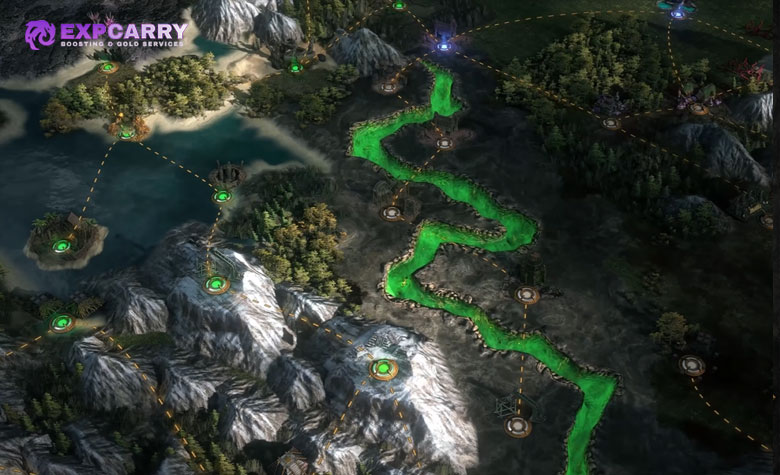
A large Abyssal Ravine is a visible cluster or chain on the Atlas. Maps situated along it contain guaranteed Abysses. Rewards increase as the chain advances, and its final map contains a guaranteed Abyssal boss. The Ravine therefore solves the access problem, but it does not remove the need to complete every Abyss correctly inside each map.
How to run a Ravine efficiently
Trace the Ravine before opening the first map and identify its endpoint. Reserve the strongest safe Waystone for the final map if the chain clearly scales toward the boss. Earlier maps can be used to judge whether the current damage, recovery, and crowd control are sufficient before committing a valuable Waystone or several tablets to the endpoint.
- Clear each Abyss while moving toward the map boss rather than backtracking after map completion.
- Open every completed Trove and enter every Depths unless the map is already beyond the build's safe limit.
- Keep enough inventory space for Bones, Omens, Tablets, and valuable rare bases.
- Do not assume that reaching the final map automatically completes its Abyss objective.
- Use conservative modifiers on the final map when the goal is quest or boss access rather than maximum loot.
A failed map can be attempted again, but the repeat does not preserve its additional content. That makes a death during a valuable Ravine map more costly than losing only experience. Clear speed is useful, yet reliable completion has higher expected value than adding one more dangerous modifier and losing the Abyss, Depths, or endpoint boss.
Are Abyssal Ravines the same as Abyssal Fissures?
Ravine is the current player-facing 0.5.5 name for the large Atlas structure. Current game data also uses Abyssal Fissure for a grouped series of single-faction Abyss areas whose monsters become stronger and more frequent toward the faction boss. In practical mapping terms, those descriptions refer to the connected Abyss-focused Atlas chain; they should not be confused with the fixed Northern, Southern, and Eastern Abyssal Wounds used by the Abyssal Power quest.
Hives Are Breach Content, Not Part of the Abyss Route
There is no Abyss Hive or Hive Fortress step between a Ravine and Kulemak. Breach Hives use Ailith, waves, Wombgifts, Hive Blood, and Breach progression. Abyss uses fissures, pits, Troves, Depths, Desecrated Currency, three Abyssal factions, and the Well of Souls.
If a map contains both mechanics, their icons and objectives can overlap visually, but completing a Breach Hive does not advance the Abyssal Power quest and does not turn the next Abyss into a Kulemak encounter. Follow the green Abyss crack for Abyss progression. Treat a Hive as optional Breach content with its own rewards and failure rules.
Abyssal Depths and Abyssal Bosses
The final Abyss in a normal area can open an entrance to Abyssal Depths instead of producing the usual conclusion. Depths are underground dungeons in which every Rare enemy carries an Abyssal modifier. The final empowered Rare has both an Abyssal and a Lichborn modifier; killing it unlocks the valuable chests nearby.
Those chests are one of the main reasons to enter. They can contain Preserved Bones, and since patch 0.5.3 the final Large Abyssal Trove in Abyssal Depths always contains Desecrated Currency. They can also rarely produce Abyss-exclusive Omens or Lineage Supports. At higher area levels, a Depths can lead to a proper Abyssal boss fight. If the goal is boss access rather than general pit loot, run level 78 or higher areas and prioritize the Abyssal Ire Atlas notable.
The three Abyssal factions
An Abyss area generally belongs to one of three groups: Amanamu's Lightless, Kurgal's Blackblooded, or Ulaman's Legion of the Pit. Faction selection matters because it changes monster families and can shape chest outcomes through the Strange Aversions Atlas notable.
- Ulaman: may produce Currency Chests, making it the straightforward general-currency choice.
- Kurgal: may produce Weapons Chests for weapon bases and weapon-focused Desecration projects.
- Amanamu: may produce Armour Chests for armour bases and defensive gear projects.
- Any faction: may produce Basic and Jewellery Chests and preserves variety when no single item category is required.
Balance of Power lets the player choose the faction for non-Fissure Abysses. It does not rewrite the fixed faction of an Abyssal Fissure/Ravine or the scripted Abyssal Power quest route, so set it for ordinary eligible Abysses rather than expecting it to change a fixed endpoint boss.
How to Reach the Vessel of Kulemak
Kulemak is not waiting in the last Ravine map. The actual access item is Kulemak's Invitation. The quest route through Abyssal Power sends the player from the Well of Souls through the Northern Abyssal Wounds, then into the Dark Domain to defeat Vandroth. It later continues through the Southern and Eastern Abyssal Wounds before the Lightless Void and Tasgul. The quest directs the player to pick up Kulemak's Invitation after Tasgul and return to the Well of Souls.
Outside the initial quest, invitations come from Abyssal bosses and can also be traded where the league rules permit it. Since patch 0.5.0, a dropped Kulemak's Invitation is allocated to the map owner. Party members should decide who is opening the map before starting an invitation farm because the key does not become a free-for-all party reward.
Bring the invitation to the Well of Souls. With it in the inventory, the Well offers the option to jump in and proceed to the Black Cathedral. The invitation is a consumable access key, so do not spend it merely to inspect the arena. Prepare resistances, recovery, mobility, and sustained single-target damage first. The official 0.5.0 notes document the Abyss Atlas rework, the large Atlas Abyss cracks and boss route, owner allocation for Kulemak's Invitation, and the level restriction on Abyss Omens.
How Kulemak escalation and rewards work
The encounter can be continued through increasingly dangerous versions rather than ending after the first successful kill. After defeating the Vessel of Kulemak, the player can take the Finger and end the sequence or steal a Lich's Power to revive and empower Kulemak for another fight. Continuing through the sequence adds custom Desecrated modifiers to the Grip of Kulemak, with the fully progressed version able to gain up to four custom modifiers.
For a first invitation, decide the goal before entering. A progression character may take a reachable reward instead of forcing the maximum sequence. A specialized bossing character can continue through the Lich powers and final confrontation. Each additional escalation improves the potential Grip of Kulemak outcome but requires another, harder version of the fight.
The Abyssal Power progression provides the dedicated points used on the Abyss Atlas tree. Under the current system, completing maps near the Well of Souls grants points in this tree, and defeating the Abyss Pinnacle Boss while you are the area owner grants 6 additional points. The former Lightless Books of Knowledge are no longer the current progression method, so judge completion by the quest and Atlas UI rather than old videos.
If the build reaches Kulemak but lacks the damage or defenses to finish the intended escalation, improving the character is safer than consuming more invitations blindly. A tailored PoE 2 build setup service can help establish a functional skill, gear, and passive baseline, while the actual target should be specified as endgame Abyss or Kulemak readiness.
Abyss Tablets: Uses, Stacking, and Valuable Modifiers
A normal Abyss Tablet has a drop level of 65, adds Abysses to affected maps, and starts with 10 uses. It is the main way to force the mechanic outside a natural Ravine. Multiple tablets of the same content type can be used together under the current Atlas system, although the exact way multiple Tablets scale content can differ by mechanic.
Tablets are not automatically worth stacking. Additional Tablets can increase Abyss content, while their explicit modifiers add encounter density, rewards, or monster pressure according to their lines. Close to the Surface also adds more pack size and more chances for Abyssal and Lichborn modifiers inside Depths for each Abyss Tablet. Begin with one tablet, measure clear time and deaths, then add more only when the build still completes every pit cleanly.
| Tablet or modifier | Confirmed effect | Best use | Main warning |
|---|---|---|---|
| Normal Abyss Tablet | Adds Abysses to affected maps and has 10 uses | Regular Abyss sustain outside Ravines | Does not guarantee a Depths by itself |
| Depths Chance | Increases the chance for Abysses to lead to Abyssal Depths according to the modifier or passive used | Boss, Omen, and Lineage Support hunting | Increased chance still does not make every Abyss open a Depths |
| Additional Abysses | Adds more Abyss encounters according to the rolled value | Pit volume and repeated Trove attempts | Greatly lengthens maps |
| More Abyss monsters or Rares | Adds density or raises the number of valuable enemies | Experienced builds farming monster drops | Stolen modifiers can create lethal Abyssal Rares |
| Pit reward modifier | Raises the chance for pits to produce rewards according to the roll | Trove and Strongbox strategies | Only valuable if pits are completed reliably |
| Unforeseen Consequences | One use, 14 to 18 additional Abysses, Overrun, additional Rare monsters, and increased Waystone rewards according to its current modifiers | High-investment single-map farming | Do not use on a map the build might fail |
Normal, Magic, Rare, and Unique tablet states are supported, and Orbs of Chance can be used on Tablets. Do not spend premium currency without first checking the actual modifier combination and remaining uses. A valuable suffix on a nearly exhausted tablet can be worse for self-use than a cheaper ten-use tablet with two practical farming lines.
Waystone modifiers are part of the same calculation because Close to the Surface makes explicit Waystone modifiers apply to the Abyssal Depths in that map. Review dangerous combinations before opening the map, especially increased monster speed, heavy damage modifiers, reduced recovery, or other lines that directly punish the build. The PoE 2 Waystone guide explains tiers, sustain, and modifier screening in more detail.
Best Abyss Atlas Setup by Farming Goal
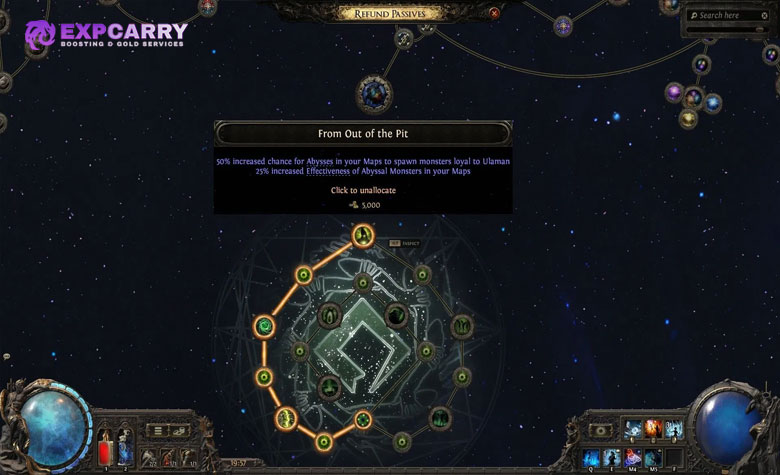
There is no single best Abyss Atlas setup because the tree supports four different outcomes: more Depths and bosses, more pit rewards, Overrun chaining, or harder Abyssal Rares. Some major Abyss nodes are multi-choice nodes, so their listed options are alternatives rather than simultaneous bonuses. Allocate toward the actual item or encounter being farmed instead of taking every difficulty node at once.
Boss and Kulemak invitation route
Take useful Depths Chance small passives first, then Abyssal Ire. Each Depths Chance node gives 10% increased chance for an Abyss to lead to Depths. Abyssal Ire gives level 78 or higher Depths a 25% chance to contain a boss and gives an Ulaman pit near the map boss a 25% chance to contain the Incubator Queen. Vile Treasures is the next useful reward node, but it is a multi-choice node: select Abyssal Eyes, Omens, or Lineage Supports depending on the target.
Pit, Trove, and Desecrated Currency route
Take From Below for one additional pit, then Dark Depths for chances at two, three, or four more pits. Ghastly Relics changes large pit chests into Abyssal Strongboxes, while Rotting Bones increases the chance to find Ancient Desecrated Currency by 25%. Strange Aversions and Balance of Power can then direct chest types toward currency, weapons, armour, or a mixed pool.
Overrun chain route
Stir the Swarm gives a 5% chance after completing Abysses for a nearby map to become Overrun. Endless War gives a 50% chance for completion of an Overrun Abyss to spread Overrun to an adjacent map. Lord of the Pit is a multi-choice node: choose scattered pits, 10% increased Abyssal Monster Effectiveness per closed pit up to 100%, or a 20% chance for an Abyss to contain another Abyss. Add Sprawling Rupture for 25% more spawned monsters only when clear speed remains stable.
High-risk Rare and equipment route
Unholy Influence gives 100% increased chance for Abyssal monsters to have Abyssal modifiers and 100% increased chance for them to have Lichborn modifiers. Dark Bloodlines gives Abyss Pits a 25% chance to spawn all monsters as at least Magic and gives Abyss Cracks the same 25% chance. Armaments of Evil gives Tier 5 rare equipment dropped by Abyssal monsters a Desecrated Modifier. This combination has a high ceiling, but it is the wrong opening setup for a character that already struggles with stacked Rare modifiers.
Close to the Surface is strongest when the Waystones and tablets are deliberately rolled for Abyss. Its Waystone-mod transfer can increase both reward and danger inside Depths, while each Abyss Tablet also grants the Depths 25% increased chance for Abyssal modifiers, 25% increased chance for Lichborn modifiers, and 4% increased pack size. Do not take it as a free reward multiplier.
Abyss Rewards and What to Keep
Abyss rewards are valuable because they support their own crafting ecosystem. Bones desecrate specific equipment categories, Omens control parts of the reveal process, Abyssal Eyes modify armour slots, and Kulemak produces items that cannot be evaluated like ordinary rares. The best drop depends on an active crafting or build project, not only on its color or rarity.
| Reward | Primary source | Use | Keep or evaluate when |
|---|---|---|---|
| Gnawed, Preserved, and Ancient Jawbones | Troves, Depths, and higher Abyss rewards | Desecrate a Rare weapon or quiver; Bone tier changes its item- or modifier-level restrictions | The base is already worth crafting |
| Gnawed, Preserved, and Ancient Ribs | Troves, Depths, and higher Abyss rewards | Desecrate Rare armour; Bone tier changes its item- or modifier-level restrictions | The armour base, defences, or existing affixes justify the attempt |
| Gnawed, Preserved, and Ancient Collarbones | Troves, Depths, and higher Abyss rewards | Desecrate a Rare amulet, ring, or belt; Bone tier changes its item- or modifier-level restrictions | The jewellery base and current affixes fit a build |
| Preserved Cranium | Abyss reward pool | Desecrate a Rare Jewel | A strong Jewel base is available and the risk is understood |
| Abyss Omens | Higher-level Abyss rewards and Depths | Reroll, restrict, preserve, or replace outcomes during Desecration | Area level is at least 65 and the Omen serves a planned craft |
| Abyssal Eyes | Abyss reward pool | Socketable Ancient Augments with different effects by armour slot | The exact slot effect fits a finished or near-finished item |
| Lineage Supports | Rare Depths chest rewards | Powerful endgame Support Gems | The gem is useful to a live build or has verified trade demand |
| Desecrated rare equipment | Abyssal monsters with Armaments of Evil | Provides a ready-made Tier 5 rare with a Desecrated Modifier | The base and complete modifier set are valuable together |
| Kulemak's Invitation | Abyssal bosses | Opens the Vessel of Kulemak route through the Well of Souls | The character is prepared or the key has trade value |
| Grip of Kulemak and pinnacle uniques | Vessel of Kulemak encounter | Build-defining items and customizable Desecrated powers | Evaluate the exact powers, roll ranges, and current market |
GGG improved the reliable reward floor in patch 0.5.3. Tasgul and Vandroth now always drop Desecrated Currency, the final Large Abyssal Trove in Depths always contains Desecrated Currency, and Kulemak has a chance to drop Ancient Jawbones, Ribs, and Collarbones. The same patch also revised Grip of Kulemak modifiers. These are confirmed changes in the official 0.5.3 patch notes.
Preserved Vertebrae should not appear on a current loot checklist. GGG removed that drop when Abyss became a core mechanic in 0.4.0, even though old databases, filters, and videos may still display it. This is one of the clearest examples of why a current guide should not copy the original Rise of the Abyssal reward list unchanged.
Which Omens matter for Desecration?
Omen of Abyssal Echoes can reroll a revealed set of Desecrated choices once. Omen of Light makes the next Orb of Annulment remove only Desecrated modifiers. Omen of Sinistral Necromancy restricts the next Desecration to prefixes, while Omen of Dextral Necromancy restricts it to suffixes. Omen of Putrefaction replaces all modifiers during the next Desecration, creates an item with up to six unrevealed modifiers, and corrupts it. Omen of the Sovereign guarantees a random Ulaman modifier for the next applicable weapon or jewellery Desecration, Omen of the Liege guarantees Amanamu, and Omen of the Blackblooded guarantees Kurgal.
Do not activate an Omen simply because it is available. Confirm the item category, open prefix or suffix space, existing valuable affixes, and whether corruption or instability can destroy the project. The Path of Exile 2 crafting guide covers the surrounding currency order so the Abyss step is not applied to an item that should have been finished differently.
Best Abyss Farming Route in 0.5.5
The strongest repeatable route balances guaranteed access with completion rate. Ravines provide the foundation, tablets increase the volume between natural Ravines, and the Atlas tree determines whether the farm targets bosses, Troves, or difficult Rare monsters.
- Find and trace a large Abyssal Ravine on the Atlas.
- Choose a target: boss access, Desecrated Currency, Lineage Supports, or general pit loot.
- Set Balance of Power and Strange Aversions only for eligible Abysses if a faction-specific chest category supports that target.
- Roll Waystones that the build can clear without losing recovery or being overwhelmed by Rare modifiers.
- Use one Abyss Tablet at first; stack more only after measuring clear time and survival.
- Complete every fissure and pit while moving toward the map boss.
- Enter every Depths, kill the final empowered Rare, and open the unlocked chests.
- Increase investment on later Ravine maps only if the earlier maps remain comfortable.
- Defeat the guaranteed Abyssal boss at the endpoint; if Kulemak's Invitation drops, it is allocated to the map owner.
- Bank invitations until the character can complete the intended Kulemak escalation.
For a low-investment start, use Depths Chance, Abyssal Ire, the appropriate Vile Treasures choice, and one ten-use tablet. For a stable mid-budget character, add From Below, Dark Depths, and a useful pit reward line. For a high-investment map, combine carefully selected rare tablets with Close to the Surface, Unholy Influence, and stronger Waystones only after testing the same monster pressure in cheaper maps.
Measure value per completed map, not the loot screenshot from one lucky run. Record tablet uses consumed, Waystones lost, invitations obtained, Depths opened, and time spent. A strategy that produces more drops but doubles map duration or fails one map in five may be worse than a safer Ravine chain.
If current league challenges require repeated Abyss objectives or difficult boss completion, verify the exact objective text before ordering or farming. A PoE 2 challenges service is relevant only when its selectable scope explicitly includes the required current-league task.
Common Abyss Mistakes
Most lost Abyss value comes from confusing access guarantees, over-investing before the build is ready, or following obsolete seasonal information. Avoid these errors before buying tablets or invitations.
- Calling a Breach Hive an Abyss stage: Hives do not advance Abyss or lead to Kulemak.
- Expecting Kulemak at the Ravine endpoint: the final map guarantees an Abyssal boss, not the separate pinnacle encounter.
- Leaving monsters behind the active fissure: the crack may not close until the relevant weakened pack is dead.
- Ignoring the final Depths chests: the final empowered Rare unlocks the actual reward containers.
- Stacking tablets immediately: density and Lichborn pressure can rise faster than the build's defenses.
- Reading multi-choice Atlas nodes as cumulative: nodes such as Vile Treasures and Lord of the Pit require selecting one of their available options.
- Following old Preserved Vertebrae advice: this currency no longer drops in the core version.
- Following old Lightless Book progression: current Abyss Atlas points come from maps near the Well of Souls and the Abyss Pinnacle Boss.
- Judging a Bone without its target base: crafting currency is valuable only when the eligible item and modifier pool justify it.
Frequently Asked Questions
These answers resolve the most common access, Ravine, Depths, tablet, and Kulemak questions for the current Path of Exile 2 version.
Do Abyssal Ravines guarantee Abysses?
Yes. Maps along a large Abyssal Ravine are guaranteed to contain Abysses in patch 0.5.5.
Does the final Ravine map guarantee Kulemak?
No. It guarantees an Abyssal boss encounter. The Vessel of Kulemak requires Kulemak's Invitation and is entered through the Well of Souls.
Where is the Hive in the Abyss route?
There is no Hive in the Abyss route. Breach uses Hives and Hive Fortresses; Abyss uses pits, Troves, Depths, Ravines, and the Well of Souls.
How do I make Abyssal Depths appear more often?
Take Depths Chance passives for 10% increased chance each and use relevant Abyss Tablet modifiers where available. These are increased chances, not absolute guarantees.
What area level is needed for Abyss bosses?
Abyssal Ire applies its 25% boss chance to Abyssal Depths in level 78 or higher areas. Ravine endpoints separately guarantee an Abyssal boss under the 0.5.5 Ravine rules.
Can multiple Abyss Tablets be used together?
Yes. The current Atlas system permits multiple tablets of the same content type. The exact way they scale content can differ by mechanic, while Close to the Surface adds extra Abyssal Depths danger for each Abyss Tablet if that notable is allocated.
Who receives Kulemak's Invitation in a party?
The invitation is allocated to the map owner. Decide ownership before the map is opened.
What should I take first on the Abyss Atlas tree?
For access, start with useful Depths Chance passives and Abyssal Ire. For pit loot, start with From Below and Dark Depths. Remember that some major nodes are multi-choice nodes, and add difficult Rare-monster nodes only after the build clears the basic loop reliably.
Should I always push Kulemak to full strength?
No. Full escalation is for a prepared bossing character and a specific reward goal. Taking a reachable reward can be the correct first-invitation decision.
Conclusion
The correct Path of Exile 2 Abyss route is now much easier to plan: clear pits in ordinary maps, use Depths for better chests and boss chances, follow a 0.5.5 Abyssal Ravine for a guaranteed endpoint boss, and take Kulemak's Invitation to the Well of Souls when the character is ready. The fixed Abyssal Wounds belong to the Abyssal Power quest, while Hives are Breach content and should never be inserted into that progression chain.
Build the Atlas around one target, begin with a single ten-use Abyss Tablet, and raise investment only after the character completes every pit and Depths without deaths. Ravines improve access, but profitable Abyss farming still depends on safe Waystones, correct faction choices, careful Desecration, understanding multi-choice Atlas nodes, and knowing when not to empower the next encounter.