
Path of Exile 2 crafting for beginners starts with three decisions: choose a base worth improving, select the cheapest method that can create the required modifier, and stop as soon as the item no longer has a cost-effective path to an upgrade. The current system includes ordinary currency, Essences, Alloys, Desecration, Augment Sockets, Remnant recipes, and Verisium Runeforging. These systems do not all stack freely.
The most important current restriction is that an item can have only one crafted modifier. Guaranteed crafting methods must be planned around that limit. A Desecrated modifier uses a separate category, but an item is also limited to one Desecrated modifier. Random modifiers added by ordinary currency follow the item's normal prefix and suffix limits.
Current PoE 2 Crafting Rules for Beginners
Every successful craft begins before the first currency item is used. Check the base type, item level, existing modifiers, open prefixes and suffixes, attribute requirements, and whether the finished item would solve a real problem. A strong roll on the wrong base is still the wrong item.
Choose the base before choosing the currency
The base type determines the item's inherent damage or defence profile. Item level determines which modifier tiers can appear. A low-level weapon cannot roll the same top-end options as a current endgame base, while an armour base that does not match the build's defensive layer creates a poor foundation even when its explicit modifiers look attractive.
Use this base check before crafting:
- The item type is compatible with the main skill, weapon set, or defensive plan.
- The item level can roll modifier tiers appropriate for the content being played.
- The attribute and level requirements are realistic for the character.
- The item would be equipped if the next crafting step succeeds.
- The expected upgrade is worth more than simply buying a finished item.
Understand prefixes, suffixes, and modifier categories
Rare equipment normally has room for up to six random explicit modifiers, divided between prefixes and suffixes. Additive currency such as an Exalted Orb requires available modifier space. Replacement currency follows a different rule: a Chaos Orb, Perfect or corrupted Essence, or Alloy removes or replaces a modifier as stated on its tooltip and can therefore operate through replacement rather than an empty slot. Before using any modifier-changing currency, hold the detailed item-information key and inspect what is already present.
The crafted-modifier limit changes how deterministic methods are combined. Essences, Alloys, and other methods that produce a guaranteed crafted modifier cannot be layered repeatedly on the same item. Desecrated modifiers no longer count as crafted, but the separate one-Desecrated-modifier cap still applies. Plan the guaranteed modifier first, then decide how much randomness the remaining slots can tolerate.
Set a stop rule before the first click
A stop rule defines the result required to continue. If a Transmutation roll is irrelevant, stop. If an Augmentation adds a modifier that makes the item unworthy of a Regal Orb, stop. If a Chaos Orb can remove the best modifier on the item, do not use it unless that loss is acceptable. The objective is not to save every base. It is to find an upgrade without turning a failed attempt into a larger loss.
Basic Currency Crafting Ladder
Ordinary currency remains the easiest way to learn item progression because each step has a clear effect. The safe ladder moves from Normal to Magic, evaluates the result, then moves to Rare only when the Magic item is already useful. It does not guarantee the modifier your build needs.
| Currency | Current effect | Beginner use |
|---|---|---|
| Orb of Transmutation | Upgrades a Normal item to a Magic item with one random modifier | Tests a good base at low cost |
| Orb of Augmentation | Adds one random modifier to a one-mod Magic item | Continues only after the first modifier is useful |
| Regal Orb | Upgrades a Magic item to Rare, retains its modifiers, and adds one random modifier | Promotes a Magic item that is already an upgrade candidate |
| Exalted Orb | Adds one random modifier to a Rare item with available modifier space | Finishes a usable Rare when any reasonable addition has value |
| Chaos Orb | Removes one random modifier from a Rare item and adds a new random modifier | Uses controlled risk when the item can afford to lose any current modifier |
| Divine Orb | Randomises the numeric values of existing modifiers | Adjusts a valuable finished item, not its modifier types |
| Vaal Orb | Modifies an item unpredictably and corrupts it | Used only when the player accepts that normal modification will end |
A safe Normal to Rare workflow
- Use an Orb of Transmutation on a correct Normal base.
- Stop if the first modifier does not help the build.
- Use an Orb of Augmentation only after a useful first modifier.
- Use a Regal Orb only when the Magic item is already worth equipping or finishing.
- Evaluate the Rare item before every Exalted Orb. Do not fill empty slots automatically.
This ladder is best when several random results would be acceptable. It is inefficient when the item needs one exact build-enabling modifier. In that case, a targeted Essence, Alloy, trade search, or another specialized system may be cheaper.
Greater and Perfect currency
Greater and Perfect versions of several basic currencies impose minimum modifier levels on the random modifier they create. They improve the floor of the outcome but do not guarantee a useful affix, the correct prefix or suffix, or the highest possible tier. Save them for a base that already deserves a more expensive attempt and confirm the currency tooltip before use.
Essences and Alloys Under the Crafted-Modifier Limit
Essences are targeted currency, but their current behavior depends on tier. Lesser, normal, and Greater Essences upgrade a Magic item to Rare and add the Essence's guaranteed modifier. Perfect and corrupted Essences operate on Rare items by removing one random modifier and adding their guaranteed modifier. The exact result is written on the currency item and changes according to the equipment slot.
How to use Essences safely
Start from a Magic item that already has useful random modifiers when using a Lesser, normal, or Greater Essence. The Essence then performs the Rare upgrade and supplies the targeted crafted modifier. Do not assume the old method of stacking several guaranteed Essence outcomes still works. The item can carry only one crafted modifier.
Perfect and corrupted Essences are replacement tools, not simple additions. They remove a random existing modifier before adding the listed guaranteed result. Use them only when every removable modifier is expendable or when the guaranteed result is worth the risk of losing the best existing affix.
- Read the complete Essence tooltip for the selected item type.
- Check whether the guaranteed modifier is a prefix or suffix.
- Confirm that the item does not already use its crafted-modifier allowance.
- For replacement Essences, assume the strongest random modifier can be removed.
- Stop after the guaranteed result if the remaining item is not worth further random investment.
How Alloys and Fluxes fit into crafting
Farrow's Act 2 progression unlocks 13 Alloy currency types through Remnant encounters. Alloys replace an existing modifier with a specific new crafted modifier. They share the one-crafted-modifier restriction, so an Alloy is a choice for the item's deterministic slot, not an extra guaranteed layer added after an Essence.
Fluxes serve a different purpose. They transform elemental resistance on an item from one element to another. This can repair a gear swap that leaves Fire, Cold, or Lightning Resistance unbalanced, but the conversion should be evaluated across the whole equipment set before use.
Explore services related to this guide, selected from our Path of Exile 2 catalog.
View All Path of Exile 2 Services


Augment Sockets, Runes, and Finishing Gear
Equipment sockets are now called Augment Sockets. An Artificer's Orb adds an Augment Socket to eligible equipment up to that item's socket limit. Runes and other Augments placed into those sockets add enchantment-style effects whose result depends on the equipment slot.
When an Artificer's Orb is worth using
Add a socket only after the item is already useful. A socket does not repair weak explicit modifiers or an unsuitable base. It is a finishing step that improves a keeper item. Campaign quest rewards provide access to Artificer's Orbs, but availability does not make every temporary item worth socketing.
Most socketed Augments cannot be retrieved normally. They can be overwritten by another Augment, which destroys the old one. Read the tooltip before committing a rare Rune because some special Augments have additional socket-bound rules. An Orb of Extraction can return eligible Augments only by destroying the equipment item, so it is not a free unsocketing tool.
Choose a Rune by slot and bottleneck
The same Rune can provide different effects in a martial weapon, caster weapon, or armour piece. Preview the exact result on the target item. Use defensive Runes to close resistance, Life, Mana, recovery, or base-defence gaps; use offensive Runes only when the character's survival and requirements are already stable.
A Masterwork Rune upgrades a Greater Rune that is already socketed into equipment to its Perfect version. It is not applied to an unsocketed Greater Rune. Confirm that the item is a keeper before using this upgrade, because the operation commits the improved Rune to that equipment.
Do not confuse socketing a Rune with Verisium Runeforging. Socketed Runes use Augment Sockets. Runeforging uses Verisium at the Verisium Anvil to transform the item's base and can add Runic Ward or upgrade eligible low-level equipment.
Runecrafting and Verisium Runeforging
Kalguuran Runecrafting is the broader Runes of Aldur system. Farrow introduces Verisium Remnants and unlocks new crafting features through four campaign quests. Remnant recipes, crafted Runes, Alloys, Fluxes, Kalguuran Skills, and Verisium Runeforging are connected parts of that system, but they produce different item types and should not be treated as one crafting button.
How Verisium Remnant recipes work
A Remnant offers a runic pattern with between two and ten slots. The available Runeshapes determine which rewards can be created. Adding more Runeshapes increases the number of enemy waves and adds runic modifiers to later enemies. The reward can be claimed only after the encounter is completed, so a longer recipe also raises the risk of losing access to the crafted result.
- Inspect the available recipe and the item or currency it will create.
- Check every Runeshape and the monster modifier it adds.
- Use only as many Runeshapes as the build can defeat safely.
- Complete the raised-monster waves and claim the created reward.
- Collect Verisium dropped by Remnant monsters for the Verisium Anvil.
A valuable recipe is not valuable if the character cannot complete the encounter. Early characters should prefer useful lower-risk outputs over filling every available slot. The Return of the Ancients guide explains how Remnants and the later Expedition version fit into the current league and Atlas.
Farrow's Runecrafting unlocks
| Progression | Unlock | Beginner use |
|---|---|---|
| Act 1 | Verisium Runeforging | Add Runic Ward to armour through the Verisium Anvil |
| Act 2 | Alloys | Replace an existing modifier with a specific crafted modifier |
| Act 3 | Unique Verisium Runeforging | Upgrade eligible low-level Unique weapon and armour bases |
| Act 4 | Ancient Runes | Create powerful Runes designed for particular weapon types |
How Runic Ward changes armour
Runic Ward becomes active when Life reaches 1, takes damage in place of further Life loss, and regenerates independently. Runeforging armour below level 55 adds Runic Ward without reducing its existing base defences. Armour above level 55 trades part of its normal base defence for Runic Ward. The Verisium Anvil previews the transformation, so compare the complete Armour, Evasion, Energy Shield, and Runic Ward result before confirming.
Runic Ward is not automatically an upgrade for every build. A character that relies on a large Armour, Evasion, or Energy Shield value may lose more from the conversion than it gains from the emergency Ward layer. It becomes more valuable when the build scales Ward, uses Kalguuran Skills that interact with it, or can absorb the loss of base defence.
Unique Runeforging and Ancient Runes
Unique Runeforging can upgrade the base type of eligible Unique weapons and armour that originate below level 55. Weapons gain a stronger damage base, while armour can gain improved base defence and Runic Ward. Higher-level Unique armour can still trade some base defence for Ward. Eligibility and material costs are shown at the Anvil; do not assume every Unique weapon can be upgraded.
Ancient Runes unlock later and provide effects tied to specific weapon types. Treat them as keeper-item upgrades. Confirm the equipment restriction, required level, socket limit, and exact weapon effect before replacing a common Rune.
Crafting or Trade: Choose the Cheaper Result
Crafting is not automatically cheaper than buying an item. Use crafting when several outcomes are acceptable, when a good base is already available, or when a targeted Essence, Alloy, Flux, or Rune solves one clear bottleneck. Use trade when the slot requires several exact modifiers and forcing them would consume more currency than the completed item costs.
| Situation | Recommended route |
|---|---|
| Good base and many acceptable random modifiers | Basic currency ladder |
| One exact guaranteed modifier is required | Essence or Alloy after checking the crafted slot |
| Elemental resistances are distributed incorrectly | Flux or a replacement item |
| Item is already strong and needs one socketed effect | Artificer's Orb and an appropriate Augment |
| Armour can benefit from Runic Ward | Preview Verisium Runeforging at the Anvil |
| Several exact affixes are required together | Compare finished items on trade before crafting |
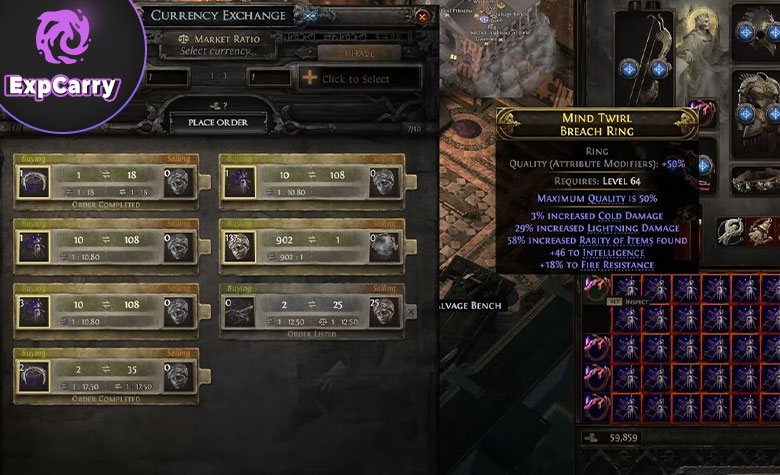
The current market-price search can populate filters from an owned item. Disable irrelevant modifiers and compare several listings. If the finished result is cheaper than the expected crafting attempts, buy it and save the crafting materials for a better base. Players following a broader equipment plan can use the PoE 2 fast gearing guide to identify which slot should receive the next budget.
If a specific campaign, Atlas, or crafting bottleneck is taking priority over self-play progression, the available Path of Exile 2 options can be considered without changing the safe crafting rules described here.
Beginner Crafting Workflows and Stop Rules
The following workflows cover the most common beginner situations. Each has an explicit stopping point because an item that fails early should not consume endgame materials.
Emergency campaign upgrade
- Choose a Normal base that improves the correct weapon damage or defence type.
- Use Transmutation and evaluate the first modifier.
- Add an Augmentation only if the first modifier is useful.
- Equip the Magic item if it solves the problem; do not use Regal automatically.
Stop: the first useful result is enough. Campaign repair gear does not need six modifiers, a rare Rune, or Runeforging.
Early Atlas keeper candidate
- Start from an appropriate item-level base.
- Decide whether the required modifier should come from an Essence, Alloy, or random currency.
- Reserve the one crafted-modifier slot for the most important guaranteed result.
- Add random modifiers only while the item remains an upgrade.
- Finish with an Augment Socket or Runeforging only after the explicit modifiers pass the check.
Stop: do not rescue a failed Rare with repeated Chaos Orbs, replacement Essences, or expensive finishing materials.
Runic Ward armour check
- Place the finished armour in the Verisium Anvil.
- Compare the previewed base defences and Runic Ward.
- Check whether the build scales Ward or uses a related Kalguuran Skill.
- Confirm only when the complete defensive package improves the character.
Stop: cancel the transformation when the loss of Armour, Evasion, or Energy Shield breaks the build's main defence.
More system-specific coverage is available in the Path of Exile 2 guides category. This article should remain the safe decision framework rather than duplicate every endgame crafting system.
Conclusion
Beginner crafting in PoE 2 is safest when the base, guaranteed modifier, risk, and stop condition are chosen before currency is spent. Use the Normal-to-Magic ladder when several random outcomes are acceptable, Essences or Alloys when one targeted crafted modifier is essential, and trade when the item needs a difficult combination of exact affixes.
Runecrafting adds useful options but does not remove those rules. Remnant recipes exchange encounter difficulty for selected rewards, Augment Runes finish keeper items, and Verisium Runeforging can add Runic Ward or improve eligible low-level Uniques. Preview every transformation, respect the one-crafted-modifier and one-Desecrated-modifier limits, and stop investing when the next step can no longer produce a cost-effective upgrade.