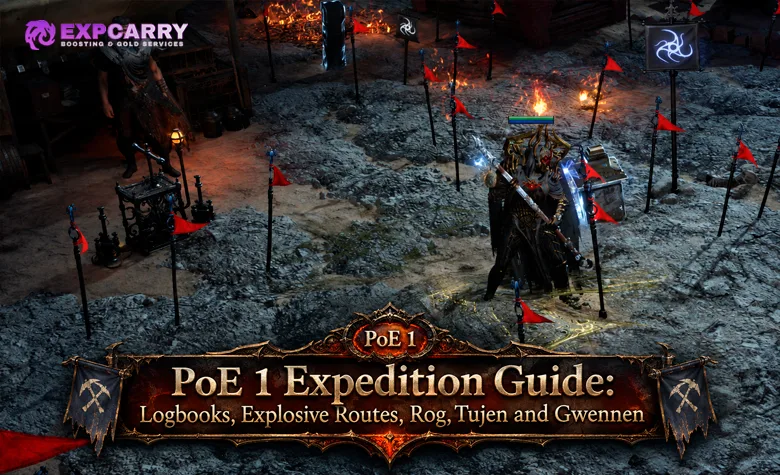
Expedition farming in Path of Exile 1 remains a reliable way to generate currency, craft valuable Rare equipment, and acquire Logbooks in patch 3.30: Covens of Umbra, including the 3.30.0c changes. The core mechanic revolves around placing explosives, activating profitable Remnants, and excavating Runic Monsters, but the order of your explosions determines how many rewards you can extract. Version 3.30 also changes the surrounding farming economy: Expedition Threads replace Scarabs, Rog's crafting offers have been adjusted, and Gwennen now modifies Rare equipment instead of selling unidentified gambles. These changes are LIVE following the league's November 13, 2026 launch.
The strongest Expedition strategy depends on whether you want to sell Logbooks, run them for Artifacts and vendor currency, craft equipment with Rog, or generate tradeable rewards through Tujen. This guide covers profitable explosive routes, dangerous Remnant modifiers, Logbook selection, all four Expedition merchants, and practical investment decisions under the current 3.30 rules.
Short answer: Farm Expedition in Atlas maps using Expedition Threads, detonate valuable Remnants before large Runic Monster markers, and collect Logbooks to run or sell. Prioritize Knights of the Sun and Black Scythe Logbooks for Dannig and Tujen resources, use Rog for targeted Rare-item crafting, and approach Gwennen's new 3.30 gambling system as a high-risk crafting option rather than a source of random Uniques.
PoE 1 Expedition Farming in 3.30: Maps, Logbooks and Threads
Expedition has two main farming activities: excavation sites inside Atlas maps and larger encounters accessed through Expedition Logbooks. Map Expeditions are particularly useful for obtaining Logbooks, Artifacts, and vendor refresh currency, while dedicated Logbooks provide larger excavation areas with specialized reward chests, underground areas, and possible bosses. Both activities use explosive chains and Remnant modifiers, but their reward priorities differ.
GGG's official 3.30 patch notes confirm that Scarabs have been removed and replaced with Threads of Creation. Expedition is one of ten primary mechanics that no longer spawn randomly in ordinary Atlas maps. Players can activate it with an Expedition Thread or access it through a matching Shaped Region that supplies free Threads.
| Farming method | Main objective | Important rewards | Investment |
|---|---|---|---|
| Atlas Expedition | Excavate Runic Monsters and valuable Remnants. | Logbooks, Artifacts, vendor refresh currency. | Maps, Expedition Threads, Atlas passives. |
| Low-investment Logbooks | Clear rewarding chests and underground areas. | Artifacts, currency, refresh currency, equipment. | Logbook and manageable item modifiers. |
| Boss Logbooks | Defeat a guaranteed or naturally appearing Expedition boss. | Large Artifact rewards, refresh currency, possible exclusive items. | Suitable Logbook, stronger character, careful Remnants. |
| Rog crafting | Improve Rare equipment through sequential deals. | Crafted gear for use or sale. | Order Artifacts and Scrap Metal. |
| Tujen trading | Exchange Artifacts for useful currency and other rewards. | Currency, fragments, and tradeable items. | Black Scythe Artifacts and Exotic Coinage. |
These methods complement each other, but a player does not need to perform every activity to make Expedition worthwhile. Selling valuable Logbooks and refresh currency is a simpler income route, while using Tujen and Rog requires additional decisions and time. Gwennen's revised gambling system is more specialized because its outcome can damage the value of the item being crafted.
Expedition Explosive Routes: Remnants, Runic Monsters and Chests
The explosion sequence is the most important decision in an Expedition encounter. Each explosive uncovers monsters, Remnants, and treasure within its radius, with later detonations benefiting from modifiers activated earlier in the chain. Choosing the right first Remnant can improve the rewards from several subsequent explosions, while activating the wrong defensive modifier can make the remaining monsters impossible for your build to kill.
Before placing explosives, examine the entire excavation area and identify valuable Remnants, large Runic Monster markers, and groups of chests. Plan a connected route that reaches profitable targets without forcing the chain through dangerous modifiers. The best route is rarely the one that simply covers the largest amount of ground.
Remnant Order: Apply Reward Modifiers Before Valuable Monsters
Expedition Remnants provide both a beneficial reward modifier and a downside affecting excavated monsters. Their effects apply to the explosion that activates them and to subsequent explosions, but not to enemies or chests excavated earlier. This makes an early reward Remnant much more valuable than the same Remnant activated after most of the Runic Monsters have already been uncovered.
For Logbook farming, prioritize Remnants that increase Logbook drops or improve the rewards from Runic Monsters. A modifier that duplicates Runic Monsters can also be valuable because it increases the number of eligible monsters in the encounter. However, these bonuses must be weighed against their accompanying monster modifiers; a powerful reward is worthless if its downside prevents you from finishing the encounter. The older Remnant modifier increasing general Item Quantity dropped by Monsters was removed in patch 3.30.
Runic Monster Markers: The Main Source of Logbooks
Large skulls mounted on stakes identify Runic Monster markers, which are particularly valuable in ordinary Atlas Expeditions. Runic Monsters can drop Expedition Logbooks, Artifacts, and vendor refresh currency, making them a priority after suitable Remnants have been activated. Smaller monster markers can add enemies and other rewards but should not displace large Runic markers when Logbook acquisition is the main goal.
Patch 3.30.0c increased the number of items dropped by Runic Monsters and their experience rewards by approximately 20–30%. Chests remain useful secondary targets, especially when several can be included without sacrificing important Runic markers. Their reward value depends on the encounter and modifiers applied to them, so a large group of ordinary chests is not automatically better than a Remnant followed by several Runic Monsters. Prioritize the reward source your farming strategy actually needs.
A Practical Five-Explosion Route
An ordinary Expedition site generally provides a limited explosive chain, making placement efficiency important. The following route illustrates the correct modifier order rather than prescribing fixed positions on every map. Adjust the path to the actual excavation layout, available explosion radius, and Remnant downsides.
- First explosion: activate a profitable Remnant, preferably one improving Runic Monster rewards or Logbook acquisition, while avoiding build-disabling downsides.
- Second explosion: cover a cluster of large Runic Monster markers so they benefit from the first Remnant.
- Third explosion: activate another useful Remnant if its reward justifies the additional monster difficulty.
- Fourth explosion: cover the largest remaining group of Runic Monsters while taking advantage of the accumulated bonuses.
- Final explosion: collect additional Runic markers or worthwhile chests without activating a dangerous modifier that would compromise the encounter.
The actual route may require fewer or different targets because Remnants and markers are not arranged identically across sites. If a valuable Remnant appears far from the main Runic cluster, consider whether reaching it consumes too many explosives. A smaller, efficient chain can outperform an elaborate route that leaves the most rewarding monsters untouched.
Dangerous Expedition Remnants and Build-Blocking Modifiers
Some Expedition Remnants increase enemy difficulty, while others directly disable common damage or recovery mechanics. Elemental and Physical immunity modifiers are particularly dangerous for characters relying on one damage type. A Fire-based build cannot treat Fire-immune monsters as merely tougher enemies, and a character dependent on Leech must be careful with modifiers that prevent recovery through damage.
These downsides accumulate through the explosion chain, so an early mistake can affect nearly every monster excavated afterward. Read the modifier text before confirming the detonation sequence, especially when multiple Remnants overlap with the same large Runic cluster.
| Modifier | Affected builds | Practical decision |
|---|---|---|
| Monsters are Immune to Fire Damage | Fire damage builds without an alternative damage source. | Skip the Remnant when Fire is essential to killing enemies. |
| Monsters are Immune to Cold Damage | Cold spell and attack builds. | Avoid unless reliable non-Cold damage is available. |
| Monsters are Immune to Lightning Damage | Lightning-focused builds. | Do not include in a Lightning-only damage route. |
| Monsters are Immune to Physical Damage | Physical attack and spell builds. | Check conversion and other genuine damage sources first. |
| Monsters are Immune to Chaos Damage | Chaos damage and many Poison builds. | Skip when Chaos damage provides the main kill mechanism. |
| Hits against Monsters cannot be Critical Strikes | Crit-dependent damage and trigger setups. | Avoid if critical hits are essential to damage or skill activation. |
| Damage cannot Leech Life or Mana from Monsters | Characters relying on Leech for sustain. | Use only when another reliable recovery method exists. |
| Monsters' Hits are always Critical Strikes | Fragile characters with limited protection against critical damage. | Evaluate the danger before adding other offensive Remnants. |
Immunity modifiers are not the only threat. Stacking several offensive monster bonuses can turn an otherwise manageable excavation into a dangerous encounter, especially when high-investment Threads add difficulty. Players should evaluate the combined result rather than judging each Remnant in isolation.
Explore services related to this guide, selected from our Path of Exile catalog.
View All Path of Exile Services


Expedition Threads and Atlas Passives in PoE 3.30
Expedition Threads are the main way to activate the mechanic in Atlas maps after the removal of Scarabs. One Expedition Thread guarantees access to an Expedition encounter, while additional Threads increase difficulty and the chance of randomized transformative effects. The normal maximum is eight Threads of one type, although specific Atlas mechanics can modify that limit. Patch 3.30.0c also guarantees at least one Thread modifier with 1–3 Threads, two with 4–7, and three with eight or more.
There is no universal reason to spend eight Threads on every map. Under patch 3.30.0c, three, six, and eight Expedition Threads grant respectively 15%, 30%, and 50% Surpassing Chance for Remnants to gain an additional Suffix modifier. The same patch reduced excessive Thread toughness scaling and adjusted rarity and damage scaling. Start with a manageable Thread count, then compare the additional rewards against Thread costs and clear time.
Expedition Shaped Regions and Free Threads
Shaped Regions can provide Expedition Threads without consuming purchased copies. Completing a regional objective increases the free Thread count on the remaining affected maps, allowing players to develop a group of Expedition encounters through Atlas progression. Astrolabes can also create suitable regions, making regional planning useful for players specializing in one mechanic.
Use free Threads before deciding whether to add more investment, and compare the resulting encounter difficulty with your character's actual performance. The existing PoE 3.30 Threads of Creation guide explains Shaped Regions, Map Device slots, and the broader system. Expedition farming should focus on the reward route inside the encounter rather than repeating every general Thread rule.
Atlas Investment for Logbook Drops and Better Remnants
The 3.30 Atlas Passive Tree has been redesigned, including its Expedition specialization. Current Atlas data includes bonuses supporting additional Runic Monster markers, more valuable Logbook drops, better Remnant modifiers, and increased explosive coverage. Players concentrating on Logbooks should prioritize the effects that increase Runic Monster opportunities and Logbook acquisition instead of spreading points across unrelated mechanics.
Important current Expedition passives include What Lies Beneath for increased Logbook quantity from Runic Monsters, Untold Riches for additional Remnant prefix and suffix modifiers, and Nothing Ventured, Nothing Gained, which makes Logbooks found in maps have four implicit modifiers and increases Expedition Monster difficulty and rewards for each detonated Remnant. Dead and Buried increases Runic Monster markers. Patch 3.30.0c changed Ancient Writings to grant 35% Surpassing Chance for an additional Remnant suffix and added Runic Distortion, which lets players choose to prevent Remnant suffixes affecting Chests or Monsters. Kalguuran Companionship can influence which vendor leads encounters.
Atlas progression determines how many points are available for these investments. If the character is missing the objectives needed to reach an effective farming cluster, PoE Atlas progression assistance concerns those missing objectives, while the Expedition strategy itself determines where the earned points should be allocated.
Expedition Logbooks: Best Factions, Implicits and Bosses
Logbooks open larger Expedition areas through Dannig, with multiple possible excavation sites listed on each item. Players choose one available location before opening the encounter, so the selected faction and implicit modifiers determine the type of resources and rewards they can pursue. A Logbook's value depends on those properties, not simply on its area level or the fact that it dropped from a high-tier map.
For currency-oriented farming, Knights of the Sun and Black Scythe Mercenaries are particularly attractive because their resources support Dannig and Tujen. Order of the Chalice is useful for Rog crafting, while Druids of the Broken Circle provide the Artifacts used in Gwennen's risk-based system. Their relative trade value changes with demand, so faction priority should reflect the rewards you actually intend to use or sell.
| Faction | Merchant | Refresh currency | Expedition boss |
|---|---|---|---|
| Knights of the Sun | Dannig | Burial Medallion | Olroth, Origin of the Fall |
| Black Scythe Mercenaries | Tujen | Exotic Coinage | Vorana, Last to Fall |
| Order of the Chalice | Rog | Scrap Metal | Uhtred, Covetous Traitor |
| Druids of the Broken Circle | Gwennen | Astragali | Medved, Feller of Heroes |
Valuable Logbook Implicits and Map Preparation
Several Logbook implicits directly affect how many rewards can be excavated. Increased number of Explosives, increased Explosive Radius, and increased Explosive Placement Range make it easier to connect profitable Remnants, markers, and side areas. An implicit stating that the area contains a named Expedition boss is also valuable because it guarantees that encounter instead of relying on a natural boss appearance.
Logbooks can be modified with currency, allowing players to improve potential rewards at the cost of additional difficulty. Their implicit values can also be adjusted with a Blessed Orb, but the cost should be compared with the value of the resulting improvement. Avoid rolling a Logbook into modifiers that your character cannot safely handle, particularly when the selected excavation already contains dangerous Remnants.
GGG has not established a single ideal Logbook modifier combination for every farming strategy. A strong boss Logbook and an ordinary Logbook intended for Artifact farming have different priorities. Evaluate the selected site, its modifiers, the character's damage, and the current price of the Logbook before investing further.
Explosive Routes Inside Logbooks: Chests and Underground Areas
Logbooks require a different target priority from ordinary map Expeditions. While Runic Monsters are important for Artifacts and refresh currency, they do not provide another source of Logbook drops inside a Logbook encounter. Reward chests, useful Remnants, underground areas, and Expedition bosses therefore become more important when planning the longer detonation sequence.
Explore the available excavation site before placing explosives and identify clusters of valuable chests. Underground entrances can be revealed with explosives and provide additional rewards, making them useful targets when they fit the route. Place reward-enhancing Remnants early enough to affect later targets, but do not sacrifice a valuable underground area merely to activate an irrelevant modifier.
The practical objective is to obtain the greatest useful reward from the available explosive chain without making the later enemies unmanageable. A Logbook with additional explosives or increased radius can provide more flexibility, but careful placement remains important. The PoE Wiki Logbook reference documents the established factions, underground areas, and excavation mechanics.
Expedition Bosses: Olroth, Vorana, Uhtred and Medved
Each Expedition faction has an associated boss that can appear in suitable Logbooks. A boss-specific implicit guarantees the named encounter, while other eligible Logbooks may contain bosses naturally. Bosses can provide substantial Artifacts, vendor refresh currency, and possible Expedition-specific equipment, making them important for higher-value Logbook farming.
Remnant order is especially important when planning a boss encounter because earlier modifiers can affect the boss when it is excavated. More rewarding modifiers may increase the difficulty considerably, so do not activate damage immunity or dangerous offensive bonuses merely to increase theoretical loot. The boss must still be defeated for the investment to matter.
Expedition Artifacts and Vendor Refresh Currency
Each Expedition merchant uses faction-specific Artifacts, available in several tiers, and a separate refresh currency. Artifacts are account-bound within the applicable league and stored through the Expedition Locker system rather than traded directly with other players. Refresh currencies are tradeable, giving players a choice between using vendor services and selling the currency to someone else.
This distinction is central to Expedition profit. Selling Exotic Coinage or Scrap Metal produces a straightforward tradeable return, while spending them may create more value through Tujen rewards or Rog-crafted equipment. However, vendor results are variable, and a rare item listed at an unrealistic price does not automatically make the associated crafting session profitable.
Tujen Currency Farming: Exotic Coinage and Artifact Bargaining
Tujen represents the Black Scythe Mercenaries and offers currency and other useful items in exchange for faction Artifacts. Exotic Coinage refreshes his inventory, creating new opportunities to find valuable rewards. This makes Tujen appealing to players who prefer obtaining tradeable items rather than crafting equipment that must later be evaluated and sold.
The defining part of Tujen's system is bargaining. Instead of automatically accepting the listed price, players can offer a smaller amount of Artifacts and attempt to negotiate a deal. Offering too little can cause the negotiation to fail, so the objective is to secure a useful discount without risking a desirable reward unnecessarily.
Tujen Bargaining Strategy and Currency Priorities
A reasonable starting approach is to compare the offered item's value with the required Artifacts and make a moderate counteroffer. Some experienced players begin around 60–70% of the initial asking price, but that is a community bargaining convention rather than a guaranteed acceptance threshold. Adjust the offer when the item is particularly valuable, and avoid repeated aggressive negotiations over rewards that can easily be replaced.
Currency, valuable fragments, and other liquid rewards are generally easier to evaluate than ordinary Rare equipment. When refreshing the inventory, prioritize items with clear trade demand and skip rewards whose Artifact cost is too high relative to their usefulness. Keeping enough Artifacts for several worthwhile purchases is usually more productive than spending the entire balance on mediocre offers.
Rog Crafting in PoE 3.30: Rare Gear, Modifier Upgrades and Profit
Rog represents the Order of the Chalice and specializes in modifying Rare equipment through a sequence of crafting deals. His system can produce valuable items without requiring the same manual currency investment as ordinary crafting, but successful results depend on choosing a suitable starting item and understanding when to accept or skip an offer. Scrap Metal refreshes the available selection, while Order Artifacts pay for the crafting process.
Patch 3.30 adjusted Rog's modifier reroll offers. Deals that reroll prefixes or suffixes while keeping the best result now provide 1, 3, or 5 attempts instead of the previous 3, 6, or 10. GGG also reduced the appearance frequency of several powerful crafting options, including modifier-tier upgrades, so older Rog strategies that assume frequent high-tier improvements are no longer reliable.
Choosing Profitable Rog Bases and Crafting Targets
Start with equipment that already has a useful base type and a realistic purpose. High-value outcomes often depend on compatible combinations of Life, Resistances, Attributes, Movement Speed, or weapon-specific damage modifiers, but the desired stats vary by item slot and build. Do not continue spending Artifacts on an item simply because several crafting steps have already been completed.
Evaluate every offer against the current item. An option that improves several weak modifiers may be worthwhile, while a random reroll can remove the most valuable affix combination. If the item becomes difficult to sell or no longer serves the original purpose, accepting a final usable result can be better than gambling for perfection.
The general relationship between base items, prefixes, suffixes, and crafting costs is covered in the existing PoE 1 Crafting Guide. Rog's deals are a specialized application of those principles, not a guarantee that every item will become a profitable finished Rare.
Rog Crafting Profit: Sell the Result or Keep the Upgrade
Rog is particularly useful when a player can identify equipment that other characters actually need. An item with several coherent modifiers may sell for more than one containing individually impressive stats that do not work together. Compare similar equipment on the trade market, including its base, item level, modifier tiers, and available crafting space, before assigning an expected sale value.
Artifact costs still matter even though they cannot be directly traded. Spending a large number of Artifacts on one uncertain item means giving up other crafting opportunities. The most efficient Rog sessions often come from stopping when an item becomes good enough rather than pursuing an exceptionally rare perfect outcome.
Gwennen's New Take a Chance Crafting in PoE 3.30
Gwennen received one of Expedition's largest changes in Covens of Umbra. She no longer sells unidentified equipment that players gamble on in hopes of revealing valuable Uniques. Instead, she offers Take a Chance, a crafting service where players submit their own Rare equipment and accept a randomized modification outcome.
GGG's official patch notes describe the new process: players spend an Astragali to begin, receive three pairs of possible crafting outcomes, and choose one pair. Gwennen then flips a coin to determine which of its two outcomes is applied. The selected offer also requires Broken Circle Artifacts, so both the item's existing value and the available currency must be considered before committing.
Gwennen Take a Chance: Item Requirements and Crafting Steps
The current system requires a suitable Rare equipment item with an available modifier slot. A subsequent 3.30.0b Hotfix 2 also restricts Take a Chance to items with empty sockets. These are separate requirements, and older descriptions of the system may omit the newer socket restriction.
- Choose a Rare item: select a base with valuable existing modifiers and enough potential value to justify the risk.
- Check its requirements: confirm that the item has the required available modifier space and empty sockets.
- Prepare the currency: have the necessary Astragali and Broken Circle Artifacts available.
- Submit the item: inspect the three pairs of crafting outcomes Gwennen offers.
- Select a pair: choose the combination with the most acceptable possible results, not only the strongest jackpot.
- Accept the coin flip: one of the two outcomes is applied to the submitted item.
- Evaluate the result: compare the new equipment value with the cost and risk of continuing to craft.
The November 15 3.30.0b restartless patch also added a warning that Gwennen will not return the submitted item until an outcome has been selected. Players without enough currency to afford any available gamble are prevented from starting the process. This makes Take a Chance unsuitable for experimenting with expensive equipment unless both possible outcomes are acceptable.
Gwennen Crafting Risk and Valuable Item Selection
Take a Chance can create interesting crafting opportunities, but it is not a deterministic upgrade system. Even when one offered outcome looks excellent, the coin flip can apply the alternative result. Players should therefore evaluate the weaker outcome before committing an item that already has substantial value.
Using a modestly valuable Rare with room for improvement is generally safer than risking a finished item whose strongest modifiers could be compromised. The system can reward players who understand modifier combinations, but it also consumes resources that could otherwise support another Expedition merchant. Astragali should no longer be evaluated using outdated strategies based on gambling for specific Unique Items.
Dannig Trading: Burial Medallions, Artifacts and Logbooks
Dannig represents the Knights of the Sun and acts as the main resource-exchange merchant for Expedition. His inventory can provide Artifacts and refresh currencies associated with the other merchants, often at discounted rates, as well as Expedition Logbooks. Burial Medallions refresh his offers, making them valuable to players who want to convert Expedition resources into opportunities with Tujen, Rog, or Gwennen.
For currency farming, Dannig is particularly useful when his inventory contains discounted Black Scythe Artifacts or Exotic Coinage. These resources can support additional Tujen negotiations without requiring the player to obtain every Artifact directly from a Black Scythe Expedition. Logbooks are also worth inspecting, especially when their factions, implicits, or bosses make them more valuable than ordinary examples.
However, purchasing every offer is not automatically profitable. Consider whether the available exchange supports a merchant you actually use, whether the offered Logbook is worth running, and how much Burial Medallion investment is required. A player specializing in Tujen may value Dannig's exchange options differently from someone primarily crafting equipment with Rog.
Expedition Currency Farming: Selling Logbooks or Using the Merchants
Expedition profit comes from several sources with different levels of predictability. Logbooks and refresh currencies can be sold directly, making their value relatively straightforward to estimate. Rog and Gwennen introduce crafting uncertainty, while Tujen requires time spent evaluating and negotiating offers. The most profitable method for one player may be inefficient for another because character power, knowledge of item modifiers, and available trading time all affect the result.
A practical strategy is to separate immediate tradeable rewards from potential future crafting value. If the player cannot reliably price Rare equipment, selling Scrap Metal or other refresh currencies may be more consistent than attempting complicated crafting projects. Conversely, an experienced crafter may create equipment whose value exceeds the currency cost of obtaining more Rog opportunities.
Low-Investment Expedition Farming
Begin with one Expedition Thread or a free Expedition Shaped Region and run maps your character can complete comfortably. Prioritize Runic Monster markers and useful Logbook-related Remnants, then collect refresh currencies and Artifacts from the encounter. Sell valuable Logbooks and tradeable currencies rather than spending them immediately if the goal is establishing a dependable currency reserve.
This approach minimizes both input costs and the number of complicated decisions required between maps. It also makes it easier to identify whether the character's damage, movement speed, or inability to handle certain Remnants is limiting farming efficiency. Once the basic route is consistent, consider additional Atlas investment before increasing Thread difficulty.
Higher-Investment Expedition and Boss Logbooks
Stronger characters can increase their Expedition Thread investment, target more rewarding Atlas modifiers, and purchase Logbooks with desirable boss or explosive-related implicits. The potential rewards are higher, but the cost of failure also increases. Dangerous Remnant combinations and difficult bosses can quickly erase the advantage of a more expensive setup.
Choose higher-investment Logbooks based on the faction, implicit modifiers, boss availability, and current trade prices. A guaranteed Olroth encounter may be attractive, but its profitability depends on the purchase price and actual rewards rather than the boss name alone. Do not treat an expensive Logbook as a guaranteed source of a particular Unique Item.
Tracking Expedition Profit Across a Farming Batch
Calculate Expedition profit using the value of the rewards you can realistically sell, minus the cost of maps, Threads, purchased Logbooks, and other consumed resources. Refresh currencies have a direct market value, while Artifacts are not independently tradeable and should be evaluated through their actual merchant results. Unsold Rare items should be priced conservatively rather than counted at an optimistic listing price.
Measure a repeatable batch of maps or Logbooks instead of relying on one exceptional drop. Include time spent preparing explosive routes, clearing monsters, using merchants, and listing equipment for sale. The relevant comparison is net currency earned per hour, not only the total value displayed after one lucky encounter.
Players using PoE hourly farming sessions can include Expedition among suitable repeatable league mechanics when available, but the game's random rewards do not establish guaranteed Logbook drops, vendor outcomes, or a fixed Divine Orb income.
PoE 3.30 Expedition Farming Route: From Atlas Maps to Vendor Rewards
A complete Expedition farming cycle should connect Atlas preparation, explosive placement, reward collection, and merchant decisions. Running encounters without a plan for the Artifacts and refresh currency often leaves part of the mechanic's value unused. The following route keeps the process focused on repeatable rewards while allowing players to specialize in particular merchants.
- Prepare the Atlas: select Expedition passives supporting Runic Monsters, Logbook rewards, and useful Remnant interactions.
- Choose the map: use an Expedition Thread or a suitable Shaped Region, keeping the initial investment manageable.
- Inspect the excavation: identify dangerous Remnants, valuable reward bonuses, and clusters of large Runic Monster markers.
- Plan the explosive chain: activate useful Remnants early, then excavate Runic Monsters and worthwhile chests.
- Complete the encounter: defeat the monsters and collect Logbooks, Artifacts, and vendor refresh currency.
- Separate the rewards: retain resources for the merchants you intend to use and identify tradeable items worth selling immediately.
- Evaluate Logbooks: inspect available factions, implicits, area level, and boss opportunities before choosing to run or sell each one.
- Run profitable Logbooks: prioritize reward chests, underground areas, and bosses without activating build-disabling Remnants.
- Use merchant currency selectively: bargain with Tujen, craft suitable items with Rog, inspect Dannig's exchanges, and reserve Gwennen for acceptable crafting risks.
- Review the batch: calculate net returns and adjust Threads, Atlas investment, or merchant spending according to actual results.
The sequence does not require every collected Logbook to be opened or every refresh currency to be spent. Selling a valuable Logbook may be preferable when the character cannot handle its boss or when market demand is high. The strongest long-term strategy is the one that consistently converts Expedition encounters into rewards without unnecessary difficulty or wasteful merchant spending.
Expedition Farming Mistakes That Reduce Currency Profit
Most Expedition losses come from incorrect explosive routes, dangerous Remnant combinations, or spending resources without understanding their opportunity cost. Patch 3.30 also introduces mistakes specific to players returning from older leagues, particularly the removal of Scarabs and Gwennen's revised system.
Detonating Reward Remnants After the Runic Monsters
Remnant bonuses do not apply backward to monsters excavated before the relevant explosion. Activating a Logbook reward modifier at the end of a chain leaves most earlier Runic Monsters unaffected. Plan the route so valuable bonuses are active before excavating the targets that benefit from them.
Ignoring Immunity and Recovery Restrictions
Physical, elemental, and Chaos immunity modifiers can make enemies impossible to defeat with certain builds. Other Remnants interfere with critical hits, Leech, or character survivability. Read all dangerous modifiers before detonating, especially when several effects will accumulate on later monsters or a Logbook boss.
Using Map Expedition Priorities Inside Logbooks
Large Runic Monster markers are central to obtaining Logbooks from ordinary maps, but Runic Monsters within dedicated Logbooks do not drop additional Logbooks. Inside a Logbook, the relative value of reward chests, underground areas, and bosses increases. Adjust the explosive route instead of blindly copying the same target priority between the two activities.
Following Old Gwennen Unique Gambling Strategies
Gwennen no longer sells unidentified item gambles in version 3.30. Her Take a Chance system modifies submitted Rare equipment through a coin flip between two selected crafting outcomes. Older advice about repeatedly buying specific base types to reveal valuable Uniques does not describe the current LIVE mechanic.
Using Outdated Expedition Scarab Setups
Expedition Scarabs were removed as part of the broader 3.30 endgame overhaul. Their previous roles were redistributed through Threads and Atlas passives, making old Scarab investment calculations obsolete. Plan around the actual Expedition Thread system rather than purchasing supplies based on a guide from an earlier league.
PoE 1 Expedition FAQ
These answers cover several practical Expedition questions that remain relevant when moving between Atlas mapping, Logbooks, and merchant crafting.
Which Expedition faction is best for currency farming? Knights of the Sun and Black Scythe Mercenaries are useful starting priorities because Dannig supports resource exchanges and Tujen provides tradeable rewards through bargaining. Rog can be more valuable for players who understand Rare-item crafting, but there is no permanent faction ranking independent of market prices.
Can Expedition Logbooks drop from Runic Monsters inside another Logbook? No. Runic Monsters can drop Logbooks in ordinary map Expeditions, but this does not create a repeating Logbook-drop chain inside dedicated Logbook areas.
Does Gwennen still gamble for Unique Items in PoE 3.30? No. Gwennen now offers Take a Chance on submitted Rare equipment, using Astragali and Broken Circle Artifacts. Her service uses paired randomized crafting outcomes rather than unidentified equipment purchases.
Are Expedition Scarabs still usable in PoE 1? No. The 3.30 update replaced Scarabs with Threads of Creation, including Expedition Threads. Existing Scarabs were converted into the relevant Thread types or Frayed Threads according to the conversion rules.
Conclusion
Expedition farming in PoE 1 3.30 rewards efficient explosive placement, careful Remnant selection, and a clear plan for Logbooks and merchant currency. Use Expedition Threads to access encounters, prioritize Runic Monsters when farming Logbooks, and shift toward reward chests, underground areas, and bosses inside dedicated Logbooks. Tujen provides a straightforward currency-focused route, Rog rewards crafting knowledge, Dannig supports efficient resource exchanges, and Gwennen offers a riskier new crafting system. Choose investments based on completed runs and realistic trade value rather than old Scarab strategies or guaranteed-profit claims.