Conquerors of Wraeclast is the new Path of Exile 2 Challenge League launching with version 1.0 on December 11, 2026 (PST). Instead of clearing another isolated league encounter, players recruit mercenaries, lead an army through campaign battles, capture castles, and build a stronghold that eventually supports automated Atlas expeditions. The campaign includes over 70 league-related points of interest and 23 announced battles, while the endgame adds three factions, stronghold development, up to three independent commanders, and a shared war for more than 100 castles. Rewards include gold, supplies, treasury loot, new Reforging materials, and access to special Hunting Grounds. As of November 13, the league is still unreleased, so this guide explains GGG's demonstrated progression and practical planning priorities without inventing exact mission coordinates, troop costs, crafting probabilities, or final challenge rewards.
Short answer: Start Conquerors of Wraeclast by rescuing Varek's mercenaries, recruit troops and collect supplies while completing campaign battles, then establish a faction stronghold after entering the endgame. Upgrade your army, use commanders for Atlas missions, advance The Blood Lord's Promise, and unlock the larger faction war for castles, Item Rarity bonuses, and Hunting Grounds.
How Conquerors of Wraeclast Works in PoE 2
Conquerors of Wraeclast adds a strategy system to the normal action RPG combat of Path of Exile 2. You are still responsible for fighting dangerous enemies with your own character, but you also control where allied troops are deployed and how your army develops. Early battles involve rescuing and hiring mercenaries, while later encounters introduce fortifications, specialized units, siege equipment, and stronger commanders.
The league is designed to grow alongside the character. Army recruitment and missions begin during the six-Act campaign, while stronghold construction and the larger territorial war are endgame systems. That separation matters because players should not expect to choose their final faction, build every structure, or send commanders across the Atlas immediately after encountering Varek. GGG introduced the league in its ExileCon 2026 announcement and detailed the larger systems during the November 6 keynote.
| Stage | What you do | Main progression or rewards |
|---|---|---|
| Meet Varek | Rescue captured mercenaries and begin recruiting a warband. | Access to the league's army system and initial missions. |
| Campaign warfare | Explore more than 70 points of interest, collect supplies, recruit units, and fight 23 announced campaign battles. | Gold, supplies, captured positions, loot, and army development. |
| Castle assaults | Position troops, break enemy defenses, defeat leaders, and open treasuries. | Equipment and materials for the new Reforging system. |
| Personal stronghold | Choose a faction and construct recruitment and support buildings. | Additional unit options and stronger army infrastructure. |
| Atlas commanders | Assign troops and Waystones to commanders for real-time map expeditions. | Map completion and collected loot while you pursue other objectives. |
| The Blood Lord's Promise | Advance the endgame story and assault the Sanguar stronghold. | Story progression and access to the larger faction conflict. |
| Faction conquest | Fight for territory among more than 100 castles on the shared league Atlas. | Item Rarity benefits, Hunting Grounds, and additional Atlas starting positions. |
The important distinction is that your personal army, your stronghold, and the shared faction war are connected systems but not interchangeable ones. You recruit and command your own troops, develop your own base, and later participate in faction-wide territorial control. A captured castle in the shared war is not simply another upgrade slot inside your personal stronghold.
How to Start the Conquerors of Wraeclast League
Conquerors of Wraeclast launches alongside Path of Exile 2's free-to-play full release. Players joining the challenge league begin with a fresh league character and progress through the campaign, where the first army-related encounters appear. You do not need to finish the Atlas before experiencing the new mechanic, but the stronghold and global conquest features require later progression.
The full release also replaces the incomplete Early Access campaign with a six-Act story, adding Acts 5 and 6. Existing campaign routes written for Acts 1–4 and the three Interludes therefore cannot be treated as complete version 1.0 walkthroughs. GGG's official full-release overview provides the announced expansion scope, while the existing PoE 2 campaign walkthrough documents the earlier progression structure and will need its own 1.0 route update.
Find Varek and Rescue the Mercenaries
The league begins when the player encounters captured mercenaries and rescues members of a warband. Their leader, Varek, becomes the main contact for expanding and managing the army. The ExileCon demonstration showed this introduction as the starting point for the league's military progression, followed by opportunities to recruit more soldiers and participate in battles throughout the campaign.
The exact first-zone coordinate, quest name, and required campaign level have not been published in the available official announcement. Do not follow a claimed fixed starting waypoint without checking the version 1.0 quest tracker. When the league launches, follow the marked Varek encounter and its subsequent objectives, then keep an eye on new league-related points of interest while advancing the main story.
Recruit Your First Troops and Gather Supplies
Mercenaries are recruited using gold, and the military missions also consume supplies. During the keynote, GGG showed supplies being obtained from caches encountered throughout the campaign. This gives the league two practical resource concerns: keeping enough gold available to recruit useful soldiers and collecting the supplies required to send those soldiers into battle.
Do not recruit entirely around raw troop numbers. A smaller force containing units suited to the next enemy formation may be more useful than a larger group with poor matchups. Until final recruitment costs and supply rewards are available, the safest approach is to collect accessible caches during normal campaign progress and avoid spending everything before the next major mission.
How Army Recruitment and Troop Types Work
Different troop types have distinct strengths and weaknesses, so building an effective force requires more than filling every available deployment space. The developer demonstration emphasized tactical matchups: shield-bearing troops are effective against incoming arrows, while certain specialized units are more useful against particular enemies. Your available forces also change as you recruit new allies and eventually improve the buildings inside your stronghold.
These mechanics make troop selection part of the actual battle strategy. A unit that performs well against a lightly defended camp may be less useful when attacking a fortified wall or facing a heavily armored front line. Likewise, a formation designed to survive incoming ranged attacks may need help finishing dangerous enemy leaders. The exact statistics, recruitment prices, maximum troop counts at each campaign stage, and complete unit roster remain subject to the final 1.0 release.
Shield Units, Ranged Troops and Specialized Fighters
Shield mercenaries were demonstrated as a counter to enemy archers. Positioning them where they receive the most ranged pressure helps protect more vulnerable troops behind them, which is a practical example of the game's intended tactical decisions. The showcase also discussed stronger units with specific combat advantages, but it did not provide a final ranking of every available troop type.
As a starting principle, examine the enemy formation before deploying your soldiers. If archers dominate the opposing side, prioritize troops capable of absorbing their attacks. If a dangerous champion or heavily protected defender is the main obstacle, consider how your own character and available specialists can reach that target. Do not assume a single unit composition will be optimal against every mission.
How to Position Troops Before a Battle
The army interface shown during ExileCon lets players arrange soldiers before combat begins. Deployment matters because units engage different enemies depending on where they start, and poor positioning can leave your vulnerable fighters exposed while their stronger allies are too far away. The objective is to use your troop types against the enemies they handle best, then support them with direct character combat when the battle starts.
A reasonable approach is to inspect the enemy's ranged units, defensive line, and major threats before committing to a formation. Place durable troops where they can absorb the initial attack and avoid leaving the most valuable specialists isolated. For a fortress assault, consider the position of walls and gates as well as enemy units. The precise deployment-grid limits and commands have not been finalized in public documentation, so these are tactical principles rather than a claim about a specific release interface.
Does Your Army Fight Without You?
During normal campaign battles, the character still fights alongside the recruited soldiers. GGG showed the player moving into enemy positions and attacking high-priority targets while friendly troops engaged the opposing army. The intended combat is a combination of army tactics and ordinary Path of Exile 2 action, not a system where the player places units and then watches the battle resolve automatically.
This makes your character's build important even if the army looks powerful. The ability to kill dangerous enemy leaders, survive surrounded by hostile forces, and move quickly between threatened positions can change the outcome of a battle. A character that struggles against ordinary campaign bosses should not expect troop recruitment alone to solve every encounter. Existing PoE 2 starter-build preparation addresses general character equipment and skills, but no currently verified service configuration guarantees a particular Conquerors army setup before launch.
Explore services related to this guide, selected from our Path of Exile 2 catalog.
View All Path of Exile 2 Services

Conquerors Campaign Missions and Battle Progression
GGG announced more than 70 league-related points of interest during the campaign, with 23 separate campaign battles. Those numbers describe different things: points of interest include opportunities to recruit soldiers and interact with league content, while battles are the actual military encounters. Not every marked point of interest should be assumed to contain a full siege or a separate boss.
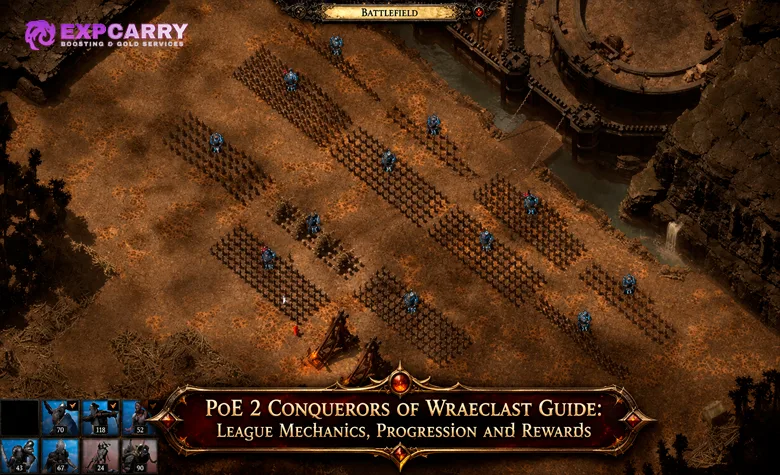
Campaign battles are designed around several objectives rather than one repeated encounter type. The demonstrated activities include protecting settlements, attacking enemy positions, storming forts, and breaking down fortified gates. As the warband grows, these encounters introduce more demanding enemy compositions and siege situations that require better use of the available soldiers.
Village Defense, Fort Assaults and Gate Battles
Village-defense missions emphasize protecting an area against an incoming force. In this type of encounter, committing every soldier to one offensive flank could leave another approach exposed. The player needs to consider the incoming threats and support whichever part of the formation is under pressure, rather than rushing toward the nearest enemy and abandoning the defense.
Fort assaults place more emphasis on reaching protected enemies and dealing with defensive positions. A frontline of soldiers can hold off regular defenders while the character attacks a priority target or attempts to open the way forward. Battles involving fortified gates introduce an additional objective beyond defeating nearby troops, so the correct approach may depend on siege equipment and the surrounding defenses rather than simple damage output.
The exact failure conditions, mission resets, reward scaling, and repeatability of each campaign battle have not been established from the preview. Players should follow the current objective and avoid assuming that a defense mission, a gate assault, and a castle treasury encounter use identical completion rules.
Gold, Supplies and Army Progression
Gold and supplies form the resource foundation of the campaign army. Gold is used to hire soldiers, while supplies support military expeditions. That means a player who spends every available resource on the next troop upgrade may have fewer options when a more difficult battle becomes available. The keynote showed resource management as part of army development, but did not provide a complete table of costs or guaranteed supply income for each mission.
For practical progression, collect convenient supply caches as you travel and recruit units with a clear purpose. A useful soldier is one that fills a weakness in your current formation, not necessarily the most expensive recruit available. If a mission fails, inspect which enemy type defeated your army before spending more gold on additional units of the same kind.
Castle Battles and Treasury Rewards
Conquered castles can lead to treasury rooms containing gold, useful items, and new crafting materials. The ExileCon demonstration connected successful battles against fortified positions with access to these rewards, making castle completion valuable for more than ordinary experience and enemy drops. Treasury loot also provides the early connection between the military activity and the game's new Reforging system.
Do not assume that every castle always contains a specific amount of gold or a guaranteed rare crafting material. GGG has not published final drop tables, boss-specific rewards, or a fixed treasury value for each mission. The value of a castle run will depend on its actual rewards, the difficulty of the encounter, and the time required to prepare and finish the assault.
Building Your Stronghold in the PoE 2 Endgame
After reaching the endgame, players can establish and develop a personal stronghold with Varek. This becomes the main infrastructure for maintaining a larger force, recruiting specialized troops, and eventually sending commanders on Atlas missions. GGG showed more than 20 buildings and upgrades for each faction's stronghold, with different structures contributing to the available army options.
The stronghold is more than decoration. A tavern can attract mercenaries, an archery range supports archer recruitment, and other buildings provide access to different fighters and services. The keynote also showed barracks and housing for cultists. Each construction decision is therefore relevant to the army you want to develop, although the exact upgrade costs, production rates, and final building requirements have not been released.
Karui, Ezomyte or Maraketh: The Three Factions
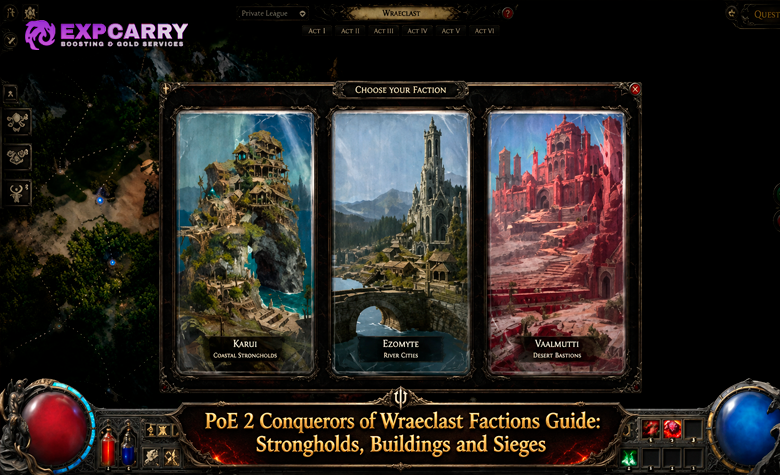
The league's endgame presents three faction choices: Karui, Ezomyte, and Maraketh. Each has its own stronghold appearance and unique troops, creating different ways to develop the army. The choice also connects to the later global war for castles, where players cooperate with others belonging to the same faction.
| Faction | Confirmed distinction | What to consider |
|---|---|---|
| Karui | Dedicated stronghold style and faction-specific troops. | Compare the final unit roster and available upgrades before choosing. |
| Ezomyte | Dedicated stronghold style and faction-specific troops. | Evaluate how its recruits fit the army composition you want. |
| Maraketh | Dedicated stronghold style and faction-specific troops. | Check its actual troop mechanics rather than assuming bonuses from the faction's theme. |
No complete official balance comparison currently establishes which faction has the highest damage, best farming rewards, or strongest commander efficiency. The developers have also not clearly documented the final rules for changing faction after making a selection. Treat it as a meaningful progression choice and read the in-game faction information at launch rather than following speculative rankings from the announcement period.
Barracks, Taverns, Archery Ranges and Other Buildings
Stronghold development creates access to additional troops and army functions. The previewed building types include barracks, taverns, archery ranges, and cultist housing, alongside many other structures and upgrades. Their main purpose is to develop your military infrastructure, providing a link between resources acquired during battles and the soldiers available for future missions.
For the first stronghold upgrades, focus on structures that unlock troops or functions your army currently lacks. A new specialist unit may solve a difficult battle more effectively than increasing recruitment of an already plentiful troop type. However, there is not enough verified information to publish a fixed building order or calculate the gold cost of fully upgrading a faction's base. Those decisions will need the final building descriptions and live costs.
How Castle Sieges Work in Conquerors of Wraeclast
Sieges are the largest version of the league's army battles. Instead of only engaging soldiers in an open field, players attack fortified positions and use specialized units or siege equipment to break defenses. GGG demonstrated siege engines, war elephants, and two-headed Chimeras as examples of the forces that become relevant during the larger conflicts.
Siege preparation matters because the objective is not always to kill every enemy in front of the gate. A fortified castle may require creating an opening before the army can advance, while dangerous defenders can threaten troops approaching the walls. The official Conquerors of Wraeclast trailer shows the scale of the battles, although cinematic footage should not be treated as a complete mechanical explanation or a reliable boss guide.
Siege Engines, War Elephants and Chimeras
Siege engines are intended to deal with fortified structures and battlefield defenses. During the keynote, catapults were positioned to attack castle gates, demonstrating that placement matters beyond choosing a troop type. War elephants provide powerful frontline pressure, while two-headed Chimeras were shown contributing to attacks against enemy forces.
These units are part of the demonstrated late-army system, not guaranteed starting recruits. Their final unlocking requirements, troop limits, resource costs, and numerical combat strengths have not been fully published. Do not spend campaign resources based on an assumed early access route to a war elephant or a guaranteed Chimera unlock.
A Practical Approach to Siege Battles
Prepare for a siege by identifying its main obstacle before choosing your formation. If the gate is blocking progress, a force composed entirely of ordinary frontline fighters may not address that objective efficiently. Place relevant siege equipment where it can reach the defenses, protect vulnerable attackers from enemy ranged units, and use the player character to eliminate enemies that threaten the assault.
As the defenses collapse, avoid leaving the army behind while rushing to the final enemy leader. The preview emphasized cooperation between the player and the deployed troops, so preserving useful soldiers and controlling enemy pressure remain important. The exact castle layouts and boss abilities are not available for a reliable room-by-room walkthrough before version 1.0 launches.
Reforging, Crimson Iron and Blood-Based Crafting Rewards
Conquerors of Wraeclast adds a crafting system linked to castle treasuries. Instead of replacing every modifier on an item, Reforging lets players target unwanted modifiers and replace them with new ones. The resulting modifiers become fractured, meaning they are locked against later ordinary modification. This gives players another way to improve promising equipment, but it also makes the outcome consequential because the replacement cannot simply be rerolled repeatedly.
Crimson Iron was shown during ExileCon as a material used with the Reforging Bench. The demonstration involved choosing one or more modifiers to replace, depending on the materials used, and receiving random fractured results. Blood-related materials were also showcased as a more targeted form of the system, with different blood types granting access to particular modifier pools. These details were shown in the developer presentation; their full availability, crafting restrictions, and market value cannot be verified in the current Early Access client.
How Crimson Iron Reforging Works
Crimson Iron offers a way to replace one or more unwanted explicit modifiers while retaining other useful parts of the item. The number of modifiers selected depends on the Crimson Iron materials used. For example, an item with several desirable affixes and one weak modifier might be a better candidate than equipment where every stat needs replacement. The Reforging process creates fractured outcomes, so the player must decide whether the item is worth committing to the result before using the material.
This is not a free method of turning every Rare into a perfect item. The exact new modifier is not guaranteed when using the random version of the mechanic, and the fractured result restricts subsequent changes. The safest approach is to evaluate the item as it exists, identify the modifier you would be willing to replace permanently, and consider whether an unfavorable result would still leave the item useful.
Blood Vials and Targeted Modifier Pools
The ExileCon showcase also introduced blood-infused crafting materials associated with the league's endgame story. These allow more targeted modifier outcomes than ordinary random Reforging, with different blood types offering different modifier groups. The developers demonstrated effects that interact with specific skill mechanics, suggesting that some results may be useful for particular builds rather than providing only generic damage or defensive stats.
However, the complete modifier pools, exact material names for every variant, crafting costs, and acquisition rates are not yet available for a definitive farming strategy. A targeted crafting outcome should not be described as a guaranteed best-in-slot modifier without knowing its actual restrictions. General gear planning remains important, particularly for fresh league characters that need functional equipment before investing in expensive crafting experiments.
The Blood Lord's Promise: Endgame Story and Boss Progression
The Blood Lord's Promise is the new endgame storyline attached to Conquerors of Wraeclast. It centers on the ancient Sanguar bloodline and attempts to resurrect Severa, an ancient vampire lord. The developer presentation identifies a rival Maraketh clan bound by Severa's promise, with her followers carrying out blood-infused rituals connected to her return.
Players must conquer three rival clans before advancing the military campaign toward Severa's Sanguar stronghold and its final confrontation. The storyline gives the castle warfare a larger objective beyond simply capturing territory for loot, and completing it is linked to unlocking the shared faction-conquest system. However, the final boss abilities, arena layout, resistance requirements, item drops, and any special entry costs have not been verified in the playable 1.0 version.
When Does the Global Faction War Unlock?
GGG describes the shared faction-conquest feature as becoming available after completing the league's endgame storyline. That makes The Blood Lord's Promise a major progression milestone rather than a side objective that can be ignored indefinitely by players aiming to participate in territorial warfare.
The detailed quest order has not been published, so beyond the announced three rival clans and final stronghold assault, there is no verified checklist of exact bosses or castles that must be cleared before the global war opens. Follow the storyline objectives introduced after establishing your stronghold, and avoid assuming that simply entering the Atlas or choosing a faction unlocks every castle on the shared map.
Characters struggling with ordinary campaign progression should solve their damage and defensive problems before pushing toward endgame warfare. Existing PoE 2 campaign progression options currently describe the earlier Acts and Interludes, not a confirmed service for the unreleased Sanguar storyline or version 1.0 bosses.
How Atlas Commanders and Automated Mapping Work
Atlas commanders introduce a separate progression path from directly fighting league battles. Once your stronghold supports the system, you can assign a commander an army and Waystones, then send that force across the Atlas to complete maps and collect rewards. The expeditions progress in real time rather than resolving instantly, allowing players to work on other content while their troops are occupied.
As the stronghold develops, players can recruit up to three independent commanders. The demonstrated system includes ordinary map clearing, completing Towers, and using Tablets to target additional rewards. This is one of the league's most important endgame features because it connects army recruitment and stronghold investment directly to Atlas progression.
Sending a Commander on an Atlas Expedition
The keynote demonstrated selecting a commander, assigning available troops, providing a Waystone, and choosing an Atlas destination. The commander then takes time to complete the expedition and returns the collected rewards. Multiple maps can be queued, making it possible to plan a series of expeditions instead of manually selecting every destination as soon as the previous one is finished.
The demonstration also showed commanders keeping the gold they find during their work. That makes automated mapping a resource decision as well as a convenience feature: the troops, Waystones, and potential costs all need to justify the rewards. Exact completion times, failure rates, troop losses, reward shares, and offline progression behavior have not been fully confirmed for launch.
Towers, Tablets and Targeted Rewards
Commanders can be assigned more than ordinary map clearing. GGG confirmed the ability to complete Towers and use Tablets when pursuing specific reward types. This means the Atlas delegation system can support exploration and targeted farming rather than functioning only as a source of random map loot.
The best use will depend on the final trade-off between sending a commander and running the same map yourself. Maps that your character can clear quickly may provide better direct experience or immediate progress, while delegated expeditions let another part of your army work in parallel. Compare the actual rewards and resource costs after release before declaring automated mapping more profitable than manual farming.
The existing PoE 2 Atlas Passive Tree guide explains the earlier Atlas point and Waystone progression. Its pre-1.0 layout should be rechecked after the announced endgame changes, especially where commander completion may interact with Towers and other Atlas objectives.
Faction Conquest: Shared Atlas Castles and Hunting Grounds
After completing the endgame storyline, players can participate in a faction-wide struggle for control of more than 100 castles. Each castle belongs to a faction, and the competing factions attempt to take territory from one another. This is a global league system rather than a private castle owned exclusively by one character, so territory control affects other players who have selected the same faction.
The rewards include Item Rarity benefits, access to special maps called Hunting Grounds, and the ability to use captured castles as starting locations for Atlas exploration. The developer presentation indicated that the player holding a castle receives a larger rarity benefit, while other members of the controlling faction receive a smaller one. Exact percentages, stacking rules, ownership duration, and capture frequency have not been published as final values.
How to Capture and Hold Castles
The shared war is unlocked through league progression, after which players contest castles held by opposing factions. GGG describes more than 100 castles in the system, with each successful capture providing benefits to the controlling faction. The keynote also discussed scaling difficulty as a faction controls more territory, intended to keep the conflict competitive rather than allowing the most populated faction to take every castle without resistance.
Do not confuse faction conquest with a traditional PvP duel. The announcements establish competition for castles and faction-wide ownership, but do not provide a complete rulebook for direct player-versus-player combat, defenses, recapture timers, or ownership transfers. Those details require the released league client and its final faction-war rules.
What Are Hunting Grounds?
Hunting Grounds are special maps associated with castles controlled by your faction. GGG states that they offer rewarding modifiers, making territorial control valuable for farming as well as for expanding your faction's influence. They also give a practical reason to watch which castles are currently held rather than focusing exclusively on your personal stronghold.
The available previews do not identify every Hunting Grounds map, its exact modifiers, or the amount of additional loot it produces. Treat these areas as a confirmed source of specialized endgame opportunities, not a guaranteed currency-per-hour strategy. Once 1.0 is playable, compare their actual requirements and rewards with ordinary Atlas mapping before investing heavily in a route around one castle.
Using Captured Castles as Atlas Starting Points
Any castle held by your faction can also serve as a starting point for Atlas exploration. This is distinct from the Item Rarity benefit and the Hunting Grounds access: controlling territory can change where players begin exploring connected parts of the Atlas. A useful castle may therefore be valuable because of its position even if its immediate loot rewards are not exceptional.
The full effect on routing, map availability, and progression efficiency remains to be tested. The important practical takeaway is to check available faction-held castles when planning Atlas exploration rather than assuming every expedition must begin from the original starting region.
All Announced Conquerors of Wraeclast Rewards
The league's rewards come from several systems, each serving a different purpose. Ordinary military missions provide resources and battlefield progress, captured treasuries supply loot and Reforging opportunities, developed strongholds unlock stronger army infrastructure, and global faction victories provide access to improved farming locations and rarity bonuses. The rewards are connected, but they should not be evaluated as one fixed drop table.
| Reward source | Announced reward | What it helps with |
|---|---|---|
| Campaign encounters | Gold, supplies, new recruitment opportunities, and battle loot | Maintaining and expanding the army |
| Castle treasuries | Gold, equipment, and Reforging materials | Improving character gear |
| Stronghold construction | Additional buildings, troop types, and army functions | Recruitment and military progression |
| Atlas commanders | Loot from completed maps and other assigned Atlas objectives | Delegated mapping and resource collection |
| Captured faction castles | Item Rarity benefits and alternate Atlas starting points | Territorial and farming advantages |
| Hunting Grounds | Access to special maps with rewarding modifiers | Endgame farming opportunities |
| Endgame blood-related crafting | Materials associated with targeted Reforging outcomes | Specialized equipment crafting |
GGG has not yet published a final league-challenge list with cosmetic reward milestones, a complete treasure table, or measured drop rates for Crimson Iron and blood materials. Do not confuse the more than 40 new Unique items coming with the full 1.0 release with a promise that all those items drop specifically from Conquerors battles. Some rewards are part of the wider expansion rather than exclusive loot from the league mechanic.
Best Progression Order from Campaign to Faction War
The most reliable approach is to grow the army while continuing normal character progression, then develop the stronghold and Atlas systems after the necessary unlocks become available. There is no verified fixed speedrun route for the new league, but the announced mechanics establish a clear sequence of goals. Trying to maximize every system immediately may waste resources when later features are not yet accessible.
- Start a fresh Conquerors character: Use a league starter that can clear the six-Act campaign without relying on expensive items or an unreleased interaction.
- Rescue Varek's mercenaries: Follow the initial league encounter and unlock army recruitment.
- Collect gold and supplies: Investigate convenient league points of interest while advancing through the campaign.
- Win campaign battles: Recruit units that counter the enemies in the next mission and improve the formation when an encounter becomes difficult.
- Claim useful treasury rewards: Consider Reforging materials for appropriate items rather than spending them immediately on temporary equipment.
- Finish the campaign and enter the Atlas: Establish a functional character build before increasing map and siege difficulty.
- Choose a faction and develop the stronghold: Unlock the buildings and units relevant to your army and commander plans.
- Recruit Atlas commanders: Assign suitable troops and Waystones when the delegated rewards justify the resources spent.
- Complete The Blood Lord's Promise: Follow the league's endgame storyline toward the Sanguar stronghold.
- Participate in faction conquest: Use captured castles, Hunting Grounds, and faction benefits to extend your endgame farming options.
Early Campaign: Build a Functional Army Without Stalling
During the first Acts, the character's main story and basic combat power should remain the priority. Recruitment is useful, but it should not become a reason to spend excessive time farming an uncertain supply source while the character is undergeared. Pick up accessible resources and complete nearby league encounters, then return to the campaign when the next army objective is too difficult for your available force.
A good early setup needs enough damage to defeat campaign bosses, reliable defenses, and an army that covers common battlefield weaknesses. Fresh characters should not assume that a strong army compensates for a broken skill build or poor resistances. The existing PoE 2 leveling progression options concern character levels and general campaign progress, not a verified shortcut to the unreleased league's troop and stronghold unlocks.
Early Endgame: Stronghold Before Automation
At Atlas entry, focus on unlocking the stronghold functions needed for recruitment and commander missions. A commander cannot become useful without suitable troops and Waystones, so spending every resource on isolated building upgrades may delay the very expeditions those upgrades are intended to support. Progress the normal Atlas at a difficulty your character can complete while gradually improving the military infrastructure.
The best building order and commander allocation will depend on the final economy. If troops are expensive or slow to replace, maintaining a stable reserve may matter more than immediately sending every available commander on an expedition. If the first maps are easy to clear directly, using the character to secure additional resources before delegating more difficult tasks may be sensible.
Late Endgame: Story Completion, Castles and Hunting Grounds
After establishing the stronghold, keep advancing the Blood Lord storyline and expanding your army. The shared territorial system becomes relevant after that story progression, while captured castles provide new farming and Atlas-routing opportunities. At this stage, the question changes from whether you can win a basic military mission to which objectives produce the most useful return for your available troops, maps, and time.
There is no confirmed best faction, fixed number of castles required for maximum rewards, or universal commander farming setup. Those decisions will depend on live population, castle control, the value of Hunting Grounds, and the balance of the released reward systems.
Related PoE 2 Guides for Campaign, Atlas and Gear Progression
Conquerors of Wraeclast combines several progression systems, but a single league overview should not duplicate every campaign route, Atlas passive choice, or crafting explanation. The following existing ExpCarry guides cover those separate subjects. Their Early Access-specific details must be checked against version 1.0, especially the expanded six-Act campaign and the redesigned endgame.
- PoE 2 League Start Checklist: Preparing a starter build, managing early upgrades, and reaching maps without unnecessary setbacks.
- PoE 2 Campaign Walkthrough: The earlier story route and permanent character rewards; Acts 5 and 6 require a dedicated 1.0 update.
- PoE 2 Atlas Passive Tree Guide: Waystones, Towers, Atlas objectives, and passive priorities in the previous endgame structure.
- PoE 2 SSF Progression and Crafting Guide: General principles for selecting equipment and managing limited crafting resources.
Dedicated explanations of Conquerors troop compositions, faction strongholds, Reforging, Atlas commanders, and Hunting Grounds should remain separate articles once those mechanics can be fully verified in the released client. No unpublished guide URL is assumed here.
Common Conquerors of Wraeclast Mistakes to Avoid
The main risks are spending resources without understanding the next objective, confusing the different progression systems, and treating pre-release demonstrations as final mechanics. The league gives players several ways to develop an army, but each system has its own prerequisites and rewards. A complicated plan is useful only when those parts actually support one another.
- Recruiting troops without considering matchups: Shield units, ranged fighters, and specialists are useful against different enemies; simply increasing army size is not always the answer.
- Ignoring supplies: Campaign expeditions require resources, so gold and supplies should be considered together when planning recruitment.
- Expecting the army to fight every battle alone: The character participates directly in campaign battles and must still handle high-priority enemies.
- Confusing the stronghold with faction castles: Your personal base provides military infrastructure, while shared castle ownership is a separate late-endgame system.
- Spending rare Reforging materials without a plan: New fractured modifiers are locked, making the resulting item harder to change afterward.
- Assuming commanders complete maps instantly: The demonstrated expeditions take real time and require troops and Waystones.
- Choosing a faction based on unverified rankings: Complete troop bonuses, economic advantages, and faction-switching rules have not been established.
- Copying pre-1.0 routes without checking changes: The full release introduces Acts 5 and 6 along with major changes to skills, passives, and endgame systems.
PoE 2 Conquerors of Wraeclast FAQ
These answers cover additional questions about the league's launch, army system, faction participation, and endgame progression.
When does Conquerors of Wraeclast start?
The Challenge League launches with the Path of Exile 2 full release on December 11, 2026 (PST). It is not playable in the current Early Access client as of November 13.
Can you play Conquerors of Wraeclast without controlling an army in every fight?
The army is central to the league's military encounters, but the player's character still participates in combat. The demonstrated campaign battles combine troop deployment with direct action rather than replacing normal combat entirely.
Do Atlas commanders work while you are offline?
GGG demonstrated real-time expeditions and the ability to queue maps, but the exact rules for progression while fully logged out have not been confirmed. Do not assume offline completion until the released system establishes it.
Is the faction war direct PvP?
Players compete through faction control of castles, but the complete rules for direct player combat, ownership changes, and castle defense have not been published. Faction-wide competition alone does not establish that ordinary character duels are required.
Conclusion
Build your warband alongside normal campaign progression, recruit troops for the enemies you actually face, and preserve enough resources for the next military objective. Once you reach the endgame, develop your stronghold, use commanders where they justify their cost, and advance The Blood Lord's Promise before focusing on global castle conquest. Final troop statistics, crafting costs, and reward efficiencies should be decided from version 1.0 gameplay rather than pre-launch estimates.