

Path of Exile 1 Heist in 3.29 is no longer the old routine of leveling every Rogue, hunting an "Unusual Gems Blueprint," and blindly revealing every room. The profitable modern loop is cleaner: use Contracts to generate Rogue's Markers and Blueprint reveals, use Gianna whenever her cheaper reveal applies, reveal only the Wings and rooms whose expected value justifies their cost, plan the Grand Heist with the correct Rogues, secure Curio rewards wing by wing, and calculate profit after Blueprint cost, Markers, reveal acquisition, and preparation time.
The most important 3.29 addition is a new Atlas-supported chance for Blueprints found in maps to carry a special implicit that forces a Curio target category. That creates a more targetable Heist market, but it does not make every Blueprint profitable. Currency-or-Scarabs Blueprints offer a more consistent reward profile, Experimented Item Blueprints are much more jackpot-driven, and ordinary Blueprints still share the unified Grand Heist end-reward pool introduced in 3.23. This guide follows the complete route from your first Contract to a fully costed Blueprint batch.
PoE 1 3.29 Heist Route From Contract to Profit
Heist has two connected layers. Contracts fund and prepare Grand Heists. Blueprints consume that preparation to give multiple Curio attempts and higher-value exclusive rewards. If you skip the Contract economy entirely, you can still buy Blueprints and Markers from other players, but those purchases must be included in the final profit calculation.
| Step | What you gain or spend | Best default decision | Common waste |
|---|---|---|---|
| 1. Run Contracts | Artifacts, Rogue's Markers, side loot, Blueprint reveals | Prioritize safe, fast Contracts and useful Rogue reveal generation | Running slow Contracts only because they dropped for free |
| 2. Build Marker stock | Markers from Artifacts and drops | Keep enough for entry and planned Blueprint reveals | Spending the entire Marker stack revealing weak rooms |
| 3. Acquire Blueprint | Self-found or purchased Grand Heist | Check wings, area level, special implicit, and current market value | Calling a self-found Blueprint zero-cost |
| 4. Generate reveals | Whakano plus Rogue-specific reveal uses | Use Gianna for expensive compatible reveals when possible | Ignoring the time and Contract cost behind a reveal |
| 5. Reveal Blueprint | Extra Wings, reward rooms, escape routes | Reveal the parts that improve expected net value | Fully revealing every Blueprint automatically |
| 6. Plan Grand Heist | Assign qualified Rogues to each wing | Use fast job execution and useful alert/duplication perks | Bringing a Rogue whose perk does not match the route |
| 7. Run Wings | Side-room loot and one Curio choice per completed wing | Secure valuable loot between Wings | Risking earlier wing loot by failing to stash it |
| 8. Calculate profit | Realized sale value minus every input | Count full wall-clock preparation and saleable value | Reporting gross Curio value as profit per hour |
This loop is the core of a useful Heist strategy. The correct optimization is not "open more things." It is to buy or farm the cheapest combination of Contracts, Markers, reveals, and Wings that creates the highest expected saleable value for the time spent.
How to Unlock Rogue Harbour and Run Your First Contract
Heist becomes available from Act 6 onward once Rogue's Markers begin appearing and you are introduced to the Rogue Harbour. Use a Rogue's Marker from a town or hideout to open the portal for your first visit. After you have visited the Harbour, you can also access it through its World Map pin, or use the /heist command from a town or hideout. Inside the Harbour, Contracts are started through Adiyah, who charges a Marker entry cost and lets you select a Rogue qualified for the required job.
A Contract is a normal Heist rather than a Grand Heist. Work through the facility, open the reward chests you intentionally budget into the alert bar, take the target Artifact at the end, then escape. Once the Artifact is safely out, sell it to Faustus for Rogue's Markers. The Artifact's main purpose is funding future Heist activity rather than becoming a build item.
Contraband and Lockdown Are the Two Rules to Learn First
Items obtained inside the Heist begin as Contraband. If you die before successfully escaping, unsecured Contraband is lost. Reaching the alert limit begins the lockdown sequence, and taking the main target also commits the run to escape. The practical beginner rule is to stop opening optional chests before the alert bar leaves too little room to finish the route safely.
Do not plan around old advice that treats monster kills as the central alert-management mechanic. Modern Heist routing is mostly about reward-chest alert, Rogue perks, chest-opening modifiers, route length, and how quickly you can reach the target and return.
If the account still needs Atlas progression before specializing in Heist map farming, a PoE Atlas progression route is relevant to unlocking the Atlas points used for Smuggler's Cache scaling. It does not replace Contracts or Blueprint preparation.
Rogues in 3.29: Unlock Them, Do Not Grind Their Job Levels
One of the largest pieces of stale Heist advice disappeared in 3.27. The official 3.27 patch notes changed Rogues so they start at the maximum natural level for jobs they are proficient in. You still need to unlock the Rogue roster, but you no longer need the old repetitive job-level grind before a new Rogue becomes useful.
Rogue Unlock Chains Still Matter
The traditional introduction chains still determine which Rogues appear in the Harbour. Tibbs leads into Tullina and then Nenet. Karst leads into Huck, then Niles, Vinderi, and Gianna. Isla is separate. If a Blueprint requires a job and the qualified Rogue is missing from your roster, run Contracts with the preceding Rogue in that introduction chain until the next member appears. Contracts used to trigger these Rogue introductions need to be area level 50 or higher.
This is different from job leveling. The Rogue can be unavailable because you have not unlocked them, but once unlocked in the current system their natural job proficiency is already at its normal maximum.
Gianna Is the Core Reveal Rogue
Gianna is the most important economic Rogue for many Blueprint strategies because completing an appropriate Contract with her generates her personal Blueprint reveal, and her natural maximum Deception level gives 30% reduced Blueprint Revealing Cost. Rogue gear that raises the relevant job level can push the effective perk beyond its natural maximum. Always use the live reveal preview rather than hard-coding an old boosted percentage.
Niles can also generate a discounted personal reveal, but his normal discount is smaller. Whakano supplies the baseline reveal system. The practical order is to save Gianna reveals for expensive reveals you already intend to buy, rather than spending them immediately on the first cheap room available.
Rogue Gear Priorities Depend on Your Route
Job Speed is the safest universal Rogue gear priority because doors, traps, and job interactions are pure downtime. If you rush directly to Curio Displays, faster job execution and movement matter more than squeezing value from every side chest. If you deliberately open side rooms, reduced alert, chance for a chest not to increase alert, currency duplication, and other reward-oriented modifiers become more valuable.
Vinderi is a good example of the tradeoff. His perk can duplicate Heist chest rewards, but his presence increases alert generation. That is attractive in a side-room-heavy plan and less attractive in a pure Curio rush where the Blueprint end target is the reason you entered.
Explore services related to this guide, selected from our Path of Exile catalog.
View All Path of Exile Services

Heist Contracts: Markers, Reveals and Which Jobs to Run
Contracts should be evaluated by what they contribute to the next Blueprint, not only by the loot inside the Contract itself. A fast Contract can generate an Artifact worth Markers, a reveal, and ordinary side loot while taking little preparation. A slow Contract with awkward doors can be worse even when it was self-found.
Deception Contracts Are Valuable Because of Gianna
Deception is the most strategically useful Contract family when you are actively revealing Blueprints because Gianna reaches her highest natural job level in Deception. Area-level 68+ Contracts always grant a Blueprint reveal after successful completion, and completing an appropriate Contract with Gianna grants her personal discounted reveal. Gianna can also run Counter-Thaumaturgy and Perception Contracts within her job limits, so Deception is the cleanest default for reveal farming rather than the only possible Gianna source.
Do not treat Gianna's reveal as free. If you bought the Contract, paid the Marker entry, and spent two minutes running it, that cost belongs somewhere in your Blueprint ledger. Hiding that preparation is one of the easiest ways to exaggerate Heist profit per hour.
Other Contracts Still Have Uses
Other job types can be worthwhile for side reward categories, Marker generation, SSF needs, or Rogue unlocks. Brute Force can produce Fragment Rewards after the 3.28 changes. In 3.29, Demolition's old Ultimatum reward outcome was replaced with Map Rewards because Ultimatum became the exclusive source of Catalysts.
Current 3.29 also removed Trarthan Gems from Heist Gem Chests and returned them to Mercenary encounters. The official 3.29 patch notes are therefore a necessary correction to 3.27-era Heist guides that still advertise Trarthan Gems as a Heist reward.
Contract Difficulty Should Match the Job of the Contract
Contracts can be crafted for additional difficulty and reward, but a reveal-farming Contract does not need to become a dangerous rare map substitute. If the primary purpose is "finish quickly, receive a reveal, sell Artifact," use a risk level your build can clear consistently. If the purpose is side-room loot, additional reward modifiers can matter more.
A dedicated Heist character benefits heavily from movement speed, defenses, and fast interaction flow. Boss DPS is much less important than in pinnacle farming. You should be able to run through dense packs, survive doors opening into enemies, and escape without turning every corridor into a full clear.
Rogue's Markers and the Real Cost of Blueprint Reveals
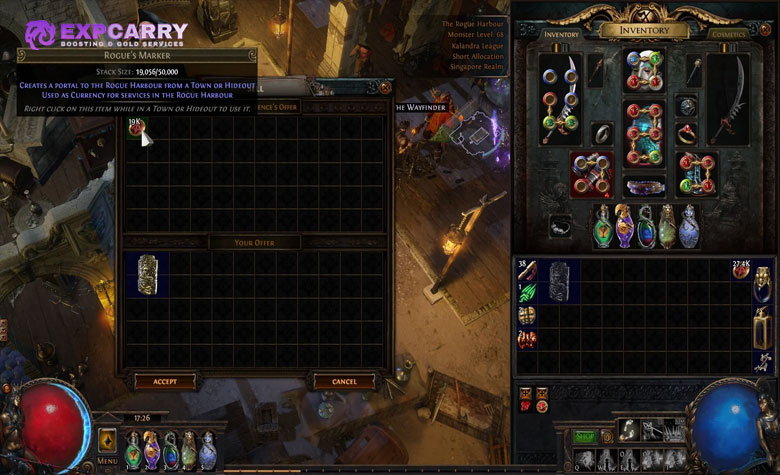
Rogue's Markers are both access currency and planning currency. Contracts consume Markers to enter; Blueprints consume them for reveals. This is why a large Marker stack is not profit until you decide whether selling it or spending it creates more value.
A self-found Marker has opportunity cost. If 20,000 Markers could be sold, spending those Markers on extra reward rooms is economically equivalent to buying the Markers for that purpose. The same applies to self-found Contracts and Blueprints.
Artifact Value Funds the Next Runs.
Successfully escaping a Contract with its Artifact lets you sell that target to Faustus for Markers. Atlas passives that bias Contracts toward higher-value targets can improve this Marker-generation side of the loop. That is useful when your goal is to self-sustain reveal currency rather than continuously buy Marker stacks.
Do not mix gross Marker generation with profit from the final Blueprint. If a Contract produces 3,000 Markers and you spend all 3,000 on the Blueprint, those Markers are an input to the Grand Heist even though no trade window was involved.
Value Reveals by the Cost They Avoid.
A reveal is economically valuable because it allows you to pay for a hidden Wing, room, or escape route, and Gianna or Niles can reduce that Marker price. The useful calculation is not "I have ten reveals." It is "How many Markers does the next reveal save on a part of the Blueprint I genuinely want?"
If a room would not be worth revealing at full price, a discount does not automatically make it good. First decide that the Wing or room is worth running; only then optimize which reveal source pays for it.
Blueprint Reveals: What to Reveal and What to Skip
A Blueprint can contain multiple Wings, hidden reward rooms, and escape routes. You do not need to reveal everything. The profitable reveal plan depends on the Blueprint purchase cost, whether it has a special implicit, how many Wings already show, and whether the extra side-room rewards justify both Marker cost and time.
Wings Usually Matter More Than Optional Reward Rooms
Each additional Wing creates another Curio selection at the end of that Wing. If the reason you bought an expensive special-implicit Blueprint is its forced target category, extra Wings multiply the number of chances to see that category while sharing the original Blueprint purchase price across more end rooms.
For a cheap ordinary Blueprint, the opposite can be true. If the known Wing already gives one Curio attempt and revealing another Wing is expensive in Markers and Contract preparation, running the cheap Blueprint quickly and moving to the next one may produce more Curio attempts per hour.
Reveal Side Rooms Only With a Current Reason
Reward rooms should be evaluated by the present economy. Currency, Divination, Scarab, Fragment, Map, or other room types change value across leagues and patches. A room that was automatic in one economy can become a time loss after reward changes.
In 3.29, do not reveal an old Ultimatum room in Demolition expecting Catalysts; that reward was replaced by Maps. Also do not enter Heist for Trarthan Gem side rooms because those Gems returned to Mercenary encounters.
Blueprint Planning Order
Once the desired details are revealed, finish the preparation in a fixed order so you do not waste a valuable Blueprint.
- Inspect the Blueprint. Check area level, Wings, revealed Wings, special implicit, required jobs, and valuable side rooms.
- Price the Blueprint itself. Even if self-found, record its realistic sale value as opportunity cost.
- Choose which extra Wings are economically justified. Expensive forced-target Blueprints usually justify more scrutiny than cheap regular ones.
- Choose optional rooms. Reveal only those you intend to open.
- Use the cheapest appropriate reveal source. Preserve Gianna's discount for a compatible expensive reveal when possible.
- Take the Blueprint to the Planning Room. Assign qualified Rogues to every revealed Wing.
- Confirm the plan. Recheck jobs and route before starting through Adiyah.
Players farming reveals and Blueprints as part of a longer currency session can use a PoE hourly farming option for an agreed progression goal. The profitability of a specific Heist batch still depends on the same Marker, Contract, and Blueprint ledger.
Regular vs Special-Implicit Blueprints in 3.29
The modern Blueprint market is easy to misunderstand because two different historical systems overlap in old guides. Since 3.23, ordinary Grand Heist end rewards no longer differ based on Blueprint area type. In 3.29, however, Blueprints found in maps can have a special implicit that forces the Heist target category. Those are modifiers on the Blueprint, not a return to the pre-3.23 area-type system.
The official 3.23 patch notes removed the old area-type split and rebalanced the unified Grand Heist reward pool. The 3.29 Atlas change then gave The Dutiful Soldier a 15% chance for Blueprints found in your maps to have a special implicit.
| Blueprint end-target profile | 3.29 character | Economic profile | Best use |
|---|---|---|---|
| Regular Blueprint | Mixed modern Curio pool | Cheap entry, high reward variance | Fast Curio rushing, SSF targets, bulk low-cost runs |
| Currency or Scarabs implicit | Curio targets forced to Currency/Scarabs | More consistent but strongly purchase-price sensitive | Batch farming when the current market leaves margin |
| Experimented Items implicit | Curio targets forced to Experimented bases | Very high variance with rare jackpot bases | Players with a large bankroll and large sample size |
| Replica Unique Items implicit | Curio targets forced to Replica Uniques | High variance and league-timing sensitive | Targeting valuable Replica outcomes |
| Enchanted Armaments implicit | Curio targets forced to enchanted equipment | Usually stronger earlier in progression/economy | Specific armament targets or early-league utility |
| Thieves' Trinkets implicit | Curio targets forced to Trinkets | Niche and highly market-dependent | Specific Trinket hunting rather than default profit |
The exact price hierarchy changes every league and even within one week. Do not turn the table into a fixed ranking. Currency Blueprints can become unprofitable when buyers bid their price up, while an Experimented Blueprint can look terrible for dozens or hundreds of Wings before a rare base changes the batch result.
Unusual Gems Blueprints Are Outdated Advice
Alternate-quality Gems were removed in 3.23 and replaced by the separate Transfigured Gem system associated with the Labyrinth. If an old Heist video tells you to buy an Unusual Gems Blueprint because its area type has a special gem Curio pool, it is describing a pre-3.23 system.
Current 3.29 regular Blueprints use the unified end-reward pool, while special implicits can force one of the modern target categories described above.
How to Run a Grand Heist Without Losing the Batch
A profitable reveal plan can still fail if the actual run is sloppy. Grand Heists reward movement, survival, clean Rogue interactions, and risk control. The priority is to reach the Curio room, choose the correct end reward, and escape with the value already earned.
Choose the Curio Reward Before You Commit to Escape
At the end of a Wing, inspect the Curio Displays and compare the actual items. Do not take the first recognizable Unique or base. Check modifier rolls, links or enchantments when relevant, current market demand, and whether the item is genuinely better than the other displayed choices.
The current PoE 1 Trading Guide is directly useful here because a rare Experimented base, Replica, or enchanted item can be mispriced if you search only the item name without checking variant and modifiers.
Stash Loot Between Wings
Grand Heists let you return to the Rogue Harbour between Wings. Use that opportunity. Once you leave a Wing safely, move valuable Contraband into the stash before entering the next Wing so the earlier reward is no longer at risk if the next escape goes wrong.
This is especially important with expensive special-implicit Blueprints. One successful Wing can already recover a large part of the batch cost, and there is no economic reason to expose that reward to another death when the Harbour gives you a safe checkpoint.
Movement and Survival Beat Boss Damage
Heist profit per hour is heavily affected by corridor travel, door interactions, Rogue job animations, and the return escape. A character with extreme pinnacle-boss DPS but mediocre movement can underperform a much cheaper build that moves quickly and rarely dies.
Prioritize movement speed, reliable defenses, ailment handling, phasing or smooth pack traversal where your build supports it, and enough damage to clear guards without stopping. The goal is not to full-clear the zone.
How to Farm Heist Contracts and Blueprints in Maps
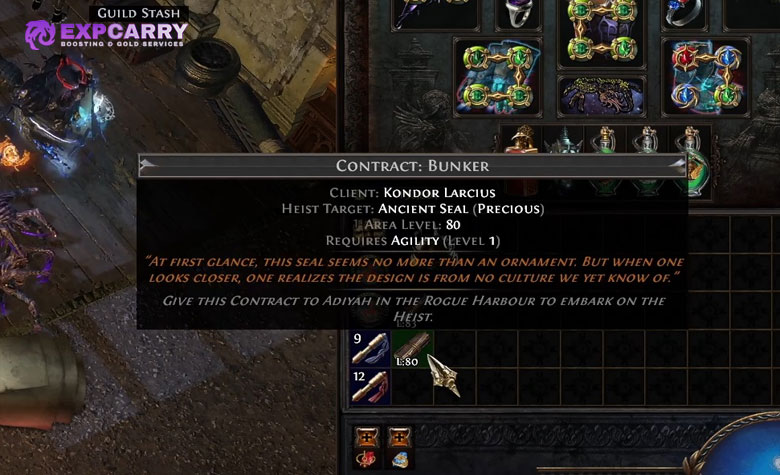
Heist has meaningful Atlas support but does not have a modern dedicated Heist Scarab family to build around. Self-farming therefore focuses on Smuggler's Cache frequency, additional Cache outcomes, Blueprint chance and reveal state, Contract target quality, and the current The Dutiful Soldier bonus.
- Secret Stash: increases the chance for maps to contain a Smuggler's Cache.
- No Honour Among Thieves: can create multiple additional Caches and improves Marker/Blueprint scaling as more Caches are opened.
- Casing the Joint: improves Blueprint drops from Caches and can cause found Blueprints to be fully revealed.
- Friends in High Places: biases Contracts toward higher-value Artifact targets, improving Marker generation.
- The Dutiful Soldier: adds Huck support after the first Cache and, in 3.29, gives Blueprints found in maps a 15% chance to have a special implicit.
Use the PoE 1 Atlas Passive Tree guide to fit those nodes around sustain and the second mechanic you actually farm. Do not copy a fake "five Heist Scarab setup" from a generated or outdated guide; current Heist scaling is primarily Atlas-node driven.
There is also an important 3.28-to-3.29 distinction. During Mirage, both Contracts and Blueprints could drop with special enchantments. Those Mirage Contract enchantments should not be presented as normal 3.29 core drops. The 3.29 core addition explicitly documented by GGG is the chance for Blueprints found in maps to gain a special implicit through The Dutiful Soldier.
How to Calculate Heist Profit Correctly
Heist is one of the easiest mechanics to make look more profitable than it really is because preparation can happen outside the timed Blueprint run. A four-minute Grand Heist is not a four-minute economic cycle if you first spent time buying Contracts, running Gianna, buying Markers, revealing Wings, planning Rogues, and selling specialized rewards.
Count Every Input
Use this formula for a Blueprint batch: Net Heist profit = realized sale value - Blueprint opportunity cost - Rogue's Marker cost - Contract/reveal acquisition cost - crafting/preparation cost. Then divide the result by total wall-clock hours, including preparation and reasonable selling time, for profit per hour.
- Blueprint cost: use purchase price, or realistic sale value if self-found.
- Marker cost: count every Marker spent on entry and reveals at its current exchange value.
- Reveal cost: count purchased Contracts plus the time used to generate Gianna/Niles reveals.
- Preparation: include Blueprint rolling or other consumable preparation when used.
- Rogue gear: amortize expensive permanent gear over a large batch instead of pretending it was free.
- Revenue: value items at prices they can realistically sell for, not the highest listing you can find.
The PoE 1 Currency Guide covers the opportunity-cost principle for PoE currency more broadly. It applies directly to Heist: a Marker, Contract, or Blueprint you could sell has economic value even when it dropped on your own map.
Use Per-Wing Break-Even Before Revealing Another Wing
An extra Wing is worth revealing when the expected net value of that Wing exceeds the Marker value, reveal-acquisition cost, and added run time. For a special Currency/Scarabs Blueprint that was expensive to purchase, spreading the Blueprint acquisition cost over more Wings can make extra reveals rational. For a cheap regular Blueprint, rapid one-Wing Curio attempts can be more efficient.
You do not need a universal Divine-per-Wing number. Price the exact Blueprint and Markers today, record the number of Wings you run, and compare the batch after the items actually sell.
Community Profit Snapshots Show Why Fixed Rates Are Dangerous
Community reports demonstrate how sensitive the result is to purchase price and variance. A March 2026 community run of 30 Currency-enchanted Blueprints reported strong profit even after repricing the Blueprints to about 200 Chaos each. A late-July 3.29 player, by contrast, reported losing currency across 20 Currency Blueprints while discussing market prices around 150 Chaos per Blueprint. These are player-reported snapshots, not guaranteed or controlled profit rates.
The lesson is not that one player calculated incorrectly. Different economies, Curio outcomes, Wing counts, reveal costs, Rogue setups, sale prices, and sample sizes produce different margins. Currency-target Blueprints reduce some variance; they do not remove market risk.
Use a Batch Ledger, Not a Screenshot
For a lower-variance special-implicit strategy, 20 to 30 Blueprints is a useful starting batch before drawing even tentative conclusions about the route, not a statistically guaranteed threshold. For Experimented Item or Replica hunting, use a substantially larger sample because rare jackpots can dominate the result.
| Ledger field | What to record | Why it matters |
|---|---|---|
| Blueprints | Count, purchase/opportunity cost, implicit, total Wings | Separates cheap regular runs from expensive forced-target runs |
| Contracts | Count, job type, purchase cost, run time | Makes Gianna/Niles reveals visible as inputs |
| Markers | Starting stock, generated, purchased, spent | Prevents "self-farmed Markers are free" accounting |
| Reveals | Whakano, Gianna, Niles uses and what each reveal opened | Shows whether expensive rooms or Wings paid back |
| Run time | Contracts, planning, Grand Heist Wings, stash time | Creates a real profit-per-hour denominator |
| Revenue | Curio items and intentional side-room loot at realistic sale value | Stops unsold jackpot listings from inflating profit |
| Net result | Realized revenue minus all economic inputs | The number that should determine whether you repeat the route |
If you need liquid Chaos for a tested Blueprint batch rather than another gear upgrade, the verified PoE Chaos Orb option is directly related to that trade-league input. The safer self-play rule is still to begin with a batch small enough that a bad run does not consume the bankroll required to continue.
Outdated Heist Advice to Ignore in 3.29
Heist is old enough that search results frequently mix several incompatible versions of the mechanic. These are the corrections that matter most before following a legacy video or spreadsheet.
- "Level every Rogue before serious Heist." Outdated since 3.27; unlocked Rogues now start at the natural maximum level for jobs they know.
- "Buy Unusual Gems Blueprints." Outdated since 3.23; Grand Heist end rewards no longer differ by Blueprint area type, and alternate-quality Gems were removed.
- "Blueprint area type determines Replica vs Gem vs Experimented end rewards." Outdated; regular Blueprints use the unified modern Curio pool.
- "Farm Mirage-enchanted Contracts with extra reveals in 3.29." Those special Contract enchantments were tied to 3.28 Mirage and are not normal documented 3.29 core drops.
- "Trarthan Gems are a Heist Gem-room target." Outdated in 3.29; they returned to Mercenary encounters.
- "Demolition Ultimatum rooms give Catalysts." Outdated in 3.29; the Heist reward was changed to Maps.
- "Heist has a current Scarab setup." There is no dedicated modern Heist Scarab family to list; use Atlas passives for Cache and Blueprint scaling.
- "Self-found Markers, Contracts, and Blueprints cost zero." Wrong for profit analysis; each has sale or alternative-use value.
- "Fully reveal every Blueprint." Wrong as a universal rule; reveal only Wings and rooms whose expected value beats their economic and time cost.
- "One Simplex or Replica screenshot proves the strategy's Divine-per-hour rate." Jackpot-based Curio pools need large samples.
The broader rule is to identify which part of an old guide is evergreen. Rogue job types, Contracts, Markers, Curio rooms, and the reveal loop still matter. Blueprint reward categories, Rogue leveling, special Contract modifiers, and individual side-room rewards have changed enough that patch context is mandatory.
PoE 3.29 Heist FAQ
These answers cover the main searches around Heist contracts, Blueprint reveals, Rogue's Markers, Rogues, and Heist profit in Path of Exile 1 3.29.
How do I start Heist in PoE 3.29?
From Act 6 onward, use a Rogue's Marker from a town or hideout to reach Rogue Harbour, then take a Contract to Adiyah, pay the entry cost, choose a qualified Rogue, complete the target, and escape with the Artifact. After your first visit, Rogue Harbour is also available from its World Map pin, and /heist can be used from a town or hideout.
Do I still need to level Rogues?
No job-level grind is required after the 3.27 change. Rogues start at the natural maximum level for jobs they are proficient in, although you still need to unlock the Rogue roster.
How do I unlock Gianna?
Progress the Karst introduction chain through Huck, Niles, and Vinderi until Gianna joins the Harbour. Use area-level 50+ Contracts when progressing Rogue introductions. She is especially valuable for discounted Blueprint reveals.
How do I get Blueprint reveals?
Completing an area-level 68+ Contract always grants a Blueprint reveal. Lower-level Contracts only grant one when their area level is no more than three below your character level. Completing an appropriate Contract with Gianna or Niles grants that Rogue's personal discounted reveal; otherwise the reveal is associated with Whakano.
What are Rogue's Markers used for?
They open Rogue Harbour, pay Heist access and are spent to reveal Blueprint Wings, reward rooms, and escape routes.
Should I reveal every Blueprint Wing?
No. Reveal another Wing when its expected Curio value exceeds the Marker cost, reveal-acquisition cost, and added run time. Expensive forced-target Blueprints can justify more Wings than cheap regular Blueprints.
Should I reveal reward rooms?
Only when the current reward category is worth enough to justify Markers, alert, routing, and time. Curio-rush strategies often reveal very few optional rooms.
What is the best Rogue for Blueprint reveals?
Gianna is generally the priority because her natural maximum Deception perk provides 30% reduced Blueprint Revealing Cost, and relevant +job-level gear can improve the perk further. Niles has his own smaller discounted reveal and Whakano supplies the baseline reveal system.
Are Currency Blueprints always profitable?
No. Their reward category is more consistent than jackpot-heavy Experimented targets, but the market can price the Blueprint above its expected margin. Recalculate purchase price, Wings, Markers, reveals, and actual sale value for every batch.
Can I still get Trarthan Gems from Heist?
No in 3.29. GGG moved Trarthan Gems out of Heist Gem Chests and back to Mercenary encounters.
Do Unusual Gems Blueprints still exist as the profitable gem Blueprint type?
No. That is legacy Heist advice. Since 3.23, regular Grand Heist end rewards no longer differ by Blueprint area type, and alternate-quality Gems were removed from that system.
What are special-implicit Blueprints in 3.29?
The Dutiful Soldier gives Blueprints found in maps a 15% chance to have a special implicit. Current special target profiles can force Curio rewards into categories such as Currency or Scarabs, Experimented Items, Replica Uniques, Enchanted Armaments, or Thieves' Trinkets.
Are there Heist Scarabs in 3.29?
No dedicated modern Heist Scarab family is part of the standard setup. Heist self-farming is primarily scaled through Atlas passives and Smuggler's Caches.
What build is good for Heist?
Prioritize movement speed, reliable defenses, smooth pack traversal, and enough damage to keep moving. Heist rewards fast routing and survival more than extreme boss DPS.
How do I calculate Heist profit?
Subtract Blueprint value, Markers, Contract and reveal acquisition, and other preparation costs from realistic saleable revenue, then divide by the full time spent preparing and running the batch.
How many Blueprints should I test before judging profit?
For more consistent target categories, 20 to 30 Blueprints is a useful starting batch for an initial assessment, not a guaranteed statistical threshold. Use substantially larger samples for Experimented or Replica jackpot strategies. One rare drop is not a stable profit rate.
Conclusion
PoE 1 3.29 Heist is a preparation-and-routing economy. Start with Contracts to build Rogue's Markers and reveals, unlock the complete Rogue roster without wasting time on obsolete job leveling, use Gianna's reveal discount intelligently, and inspect each Blueprint before spending. Regular Blueprints are cheap mixed-pool Curio attempts, while 3.29 special-implicit Blueprints can force a reward category and justify a different Wing-reveal strategy.
The profitable decision is made before the Grand Heist opens. Count the Blueprint even when self-found, count Markers even when farmed yourself, count the Contracts used to generate reveals, and count preparation time in profit per hour. Reveal extra Wings when their expected value beats that combined cost, stash valuable Contraband between Wings, and use a batch ledger instead of a jackpot screenshot. That turns Heist from an opaque niche mechanic into a repeatable system you can re-price whenever the 3.29 economy moves.