
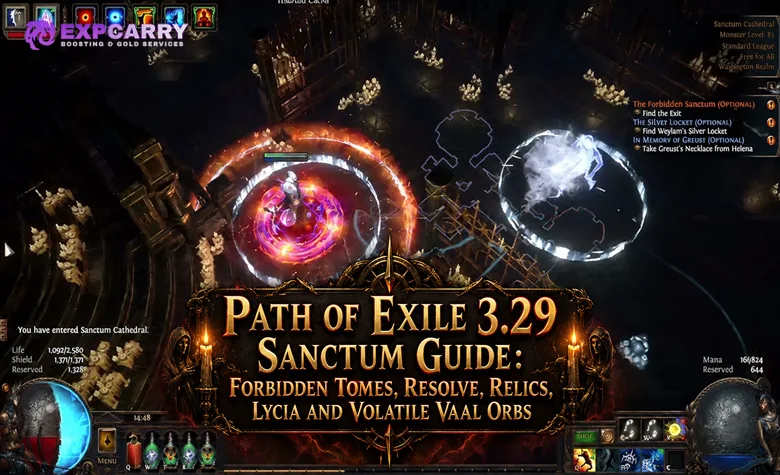
Path of Exile 1 3.29 gives the Forbidden Sanctum a new reason to matter even if you are not chasing raw Divine Orbs. Volatile Vaal Orbs can now be obtained as Sanctum rewards, moving a high-risk crafting currency introduced with Mirage into the current Sanctum reward economy. The important change is not that Sanctum became a different activity. Its core loop is still built around Forbidden Tomes, room choices, Resolve, Inspiration, Relics, Offer rewards, and a final Lycia kill. What changed is the value of reaching the later reward decisions consistently.
This PoE 3.29 Sanctum guide is therefore less about blindly taking every currency icon and more about protecting the run until the reward map becomes valuable. It explains how to enter with a Forbidden Tome, how Resolve and Inspiration actually end runs, which room choices are worth prioritizing, how Relics change the risk profile, how Lycia should be approached, where Volatile Vaal Orbs now fit into the reward loop, and when a no-hit attempt with The Original Scripture becomes a completely different problem from normal farming.
What Changed for Forbidden Sanctum in PoE 3.29
Patch 3.29 left the basic Sanctum structure intact but changed its farming value in two useful ways. The official Path of Exile 3.29 patch notes confirm that Volatile Vaal Orbs can now be obtained as Sanctum Rewards. Interacting with the Sanctum Map between rooms also restores normal Flask Charges, with The Writhing Jar explicitly excluded. Together, those changes make long room chains easier to sustain and give successful runs a new premium-currency outcome beyond the familiar Divine Orb hunt.
The Volatile Vaal Orb matters because it is not another generic currency reward. It can be used on unique equipment and either destroys the item or randomises modifier values and corrupts the item. On a successful result, scalable modifier values can be pushed outside their usual ranges. That makes the orb economically relevant to high-end unique crafting, but Sanctum does not guarantee one per run. Grinding Gear Games has not published a drop rate, floor weighting, or expected number per completed Sanctum.
Volatile Vaal Orbs are clearly farmable through Sanctum in 3.29, but GGG's official wording only establishes them as Sanctum Rewards and does not publish an exact floor, weighting, or per-run expectation. A sensible strategy is therefore to reach as many useful reward decisions as possible while maintaining a high completion rate, rather than budgeting around a guaranteed Volatile Vaal Orb from every Tome.
How to Unlock Sanctum and Use a Forbidden Tome
The permanent version of Forbidden Sanctum starts through Divinia in the Oriath Docks in Act 10. Once the entrance and Relic Altar are available, a Forbidden Tome is the item that starts a new run. Tomes are tradeable endgame drops, so you can farm them, buy them, or sell them instead of running every one yourself.
A Forbidden Tome opens the first floor. The Sanctum contains four floors with eight rooms on each floor, and the eighth room is the floor boss. After finishing a floor, the next floor is stored in a Sanctum Research item that keeps the state of the run. That means your Resolve, Inspiration, Aureus, Boons, Afflictions, and selected Relics carry forward rather than resetting between floors.
The core version supports Sanctums up to area level 83, and Relics are tradeable rather than permanently bound to the character. Higher-level Tomes are also required for some special Unique Relic challenges, so Tome level matters for more than monster health.
If your character is new to Sanctum, do not start by buying the most expensive item-level 83 Tome you can find. Learn the room patterns and Resolve economy on cheaper runs first. Players who want a character prepared specifically for repeated Sanctum farming can also use a Path of Exile custom build as a separate progression option, but the mechanical priority remains the same: fast single-target damage, reliable movement, and enough defensive margin to recover from mistakes.
Sanctum Resolve, Inspiration, and Why Normal Defences Are Not Enough
Sanctum has its own failure condition. Your Life can be full while the run is almost dead because Resolve is tracked separately. If Resolve reaches zero, the Sanctum ends and unfinished deferred rewards are lost. Inspiration acts as an additional buffer for Resolve loss, so it is one of the most important safety resources during a normal farming run.
Armour, Evasion Rating, and Energy Shield still matter, but they do not simply reduce Resolve loss in the same way they reduce ordinary damage. In GGG's core Forbidden Sanctum implementation, those primary defences were connected to Resolve-specific protection: Armour contributes Resolve Mitigation from enemy hits, Evasion contributes a chance to avoid Resolve loss from enemy hits, and Energy Shield contributes Resolve Aegis. This is why a durable mapping character can still feel bad in Sanctum if its movement, damage uptime, and room control are poor.
For practical play, treat Resolve as a resource that must survive thirty-two rooms, not as a health bar to refill after every mistake. Early Resolve loss is expensive because it reduces your freedom to choose profitable rooms later. A run that reaches floor four with high Resolve and Inspiration can take a valuable Offer even if the route around it is awkward. A run that arrives almost empty is forced to route through recovery instead.
When to Take Resolve Recovery
Take recovery when it materially changes your chance to finish the run. A Fountain that restores a damaged run to a comfortable state can be worth more than a small currency reward. The same Fountain is a poor choice when you are already near full Resolve and another route provides a Merchant, useful Boon, or better future pathing.
Do not overvalue maximum Resolve by itself. Increasing the cap is helpful, but Inspiration often gives a cleaner temporary safety buffer, especially when your Relics generate it repeatedly. The right balance depends on the Afflictions already active and the floor ahead.
Flasks Are Easier to Sustain in 3.29
In 3.29, interacting with the Sanctum Map between completed rooms restores ordinary Flask Charges, so charge management across a long Sanctum is less restrictive than before. The Writhing Jar is specifically excluded from this refill. That convenience does not make flask selection irrelevant. Movement speed, ailment handling, defensive utility, and instant recovery can still decide whether a room stays controlled. The current PoE 1 Flask guide covers the live 3.29 flask rules without relying on removed Harvest flask enchants.
Explore services related to this guide, selected from our Path of Exile catalog.
View All Path of Exile Services


Sanctum Floor Priorities and Reward Routing
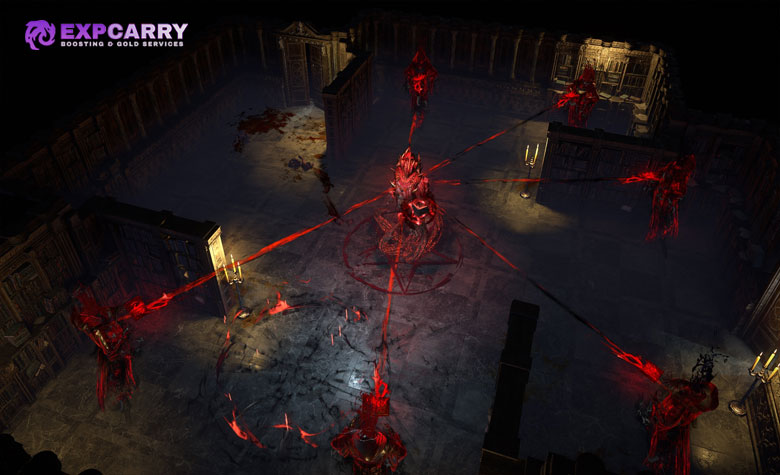
Every floor has the same basic decision: choose a connected room that keeps the run alive while improving future choices. The deeper you go, the more valuable it becomes to preserve room visibility and avoid Afflictions that hide rewards or force bad routes. The table is intentionally short because Sanctum routing is situational; it is a priority map, not a room-by-room script.
| Floor | Main Goal | What to Prioritize | What to Avoid |
|---|---|---|---|
| 1 | Build the run | Aureus, useful Boons, safe Relic synergy, room visibility | Early Afflictions that hide rooms, rewards, or reduce movement |
| 2 | Create a buffer | Merchant value, Inspiration, strong pathing options, controlled Pacts | Trading long-term safety for low-value immediate rewards |
| 3 | Start protecting profit | Strong Offer rewards, reveals, survivable routes toward deferred rewards | Greedy paths that can brick the run before floor four |
| 4 | Cash out the run | High-value Offers, Volatile Vaal Orb opportunities, Lycia preparation | Taking a dangerous Affliction when the existing route already pays well |
Floor one is where you buy future options. Floor four is where those options are converted into currency. The mistake is to use the same priority on all four floors. A Merchant or room-reveal effect can be better than a minor reward early because it improves several later decisions. Near Lycia, the opposite is often true: if the run is already strong, the correct choice may simply be the safest route to the best deferred reward.
Which Afflictions Hurt Sanctum Runs the Most
Not every Affliction has the same cost. The worst ones are usually those that remove information, damage movement, make monsters harder to kill quickly, or increase Resolve pressure. A small economic penalty can often be played around. Losing the ability to see rewards or connected rooms can damage every decision for the rest of the run.
- Reward and room concealment: effects that hide rewards, room types, or future rooms are dangerous because they turn routing into guessing.
- Movement penalties: reduced player speed or faster monsters make both guards and trap rooms less forgiving.
- Higher Resolve pressure: more Resolve loss from monsters or traps compounds every mechanical mistake.
- Merchant penalties: higher prices or fewer useful purchasing opportunities can weaken an Aureus-heavy strategy built around strong Boons.
- Recovery restrictions: reduced or disabled Resolve recovery matters most when the run has already taken damage.
Context matters. A recovery penalty is almost irrelevant to a high-Inspiration run that is barely being hit. The same Affliction can end a low-Resolve run. Before accepting an Accursed Pact, read the entire current Sanctum state instead of evaluating the Pact in isolation.
Sanctum Relics: The Difference Between Learning and Farming
Relics are the main persistent layer that makes repeated Sanctum runs easier. Normal Relics are selected at the start of the run and stay locked for that run, so the loadout should match the job. A beginner wants survival and information. A practiced farmer may sacrifice some safety for additional room reveals, Merchant utility, or other effects that improve reward control.
For learning, Inspiration generation is one of the most forgiving directions because it creates a buffer without requiring perfect Fountain routing. Room-reveal Relics are valuable for experienced farming because information lets you plan several columns ahead and avoid being trapped behind a bad Affliction. Merchant-oriented Relics become better when you already know which Boons are worth spending Aureus on.
Do not copy a high-investment Relic setup without understanding why it works. A reveal-heavy setup assumes the character already clears rooms reliably. A weak build gains little from seeing a perfect path if it cannot survive the rooms on that path. This is also why a general league starter and a Sanctum farmer are not automatically the same build. ExpCarry's current PoE 3.29 league starter comparison includes Sanctum-capable options, but a character optimized for Atlas progression can still need different gear and damage priorities before it becomes a dedicated Sanctum runner.
Relics for Profit Versus Relics for Completion
Completion Relics solve the immediate reason you fail: too little Inspiration, poor recovery, dangerous guards, or insufficient room information. Profit-focused setups assume those problems are already solved and use Relics to improve routing, information, Merchant access, or reward duplication where applicable. Move from the first approach to the second only after full clears are routine.
That transition is more important in 3.29 because Volatile Vaal Orbs increase the value of consistent Sanctum clears. A theoretically richer Relic setup that cuts your completion rate is not an upgrade. Reaching floor four and killing Lycia reliably remains more important than maximizing a single reward opportunity.
How Offer Rewards Work in the 3.29 Reward Loop
Offer rooms are the part of Sanctum that directly converts routing into tradeable currency. Depending on the Offer, you may be able to take a smaller reward immediately or defer a stronger reward until the end of the floor or the end of the entire Sanctum. Deferred rewards create the central risk-reward decision: they can be substantially more valuable, but they vanish if the run fails before the required checkpoint.
In 3.29, Volatile Vaal Orbs are part of the Sanctum reward economy. GGG officially confirms that they can be obtained as Sanctum Rewards, but has not published their exact weighting, a guaranteed floor, or an average number per run. Treat a Volatile Vaal Orb as a premium Sanctum outcome rather than a fixed completion bonus, and do not build a farming calculation around an assumed guaranteed rate.
The safest reward rule is simple: early floors should improve the run unless the immediate payout is unusually strong, while later floors should convert that setup into deferred currency that you can actually secure. Taking every small reward early can leave you with no Boons, no Aureus plan, weak visibility, and no margin for the rooms where higher-value currency matters.
Should You Take a Volatile Vaal Orb Over Divine Orbs?
There is no permanent answer because both prices move with the league economy. Compare the current value of the exact Offer, the number of items offered, and the risk of deferring it. Volatile Vaal Orbs have specific demand because they are used on high-end unique item projects, while Divine Orbs remain the main trading benchmark for many purchases.
If you are farming Sanctum mainly for currency rather than using Volatile Vaal Orbs yourself, price the reward before deciding whether one room is worth a dangerous route. A Path of Exile Divine Orb option can be used as a separate market reference when comparing upgrade budgets, but the current in-game economy should determine the actual value of a Sanctum choice at the moment you make it.
Lycia: How to Finish the Run Instead of Donating the Rewards
Completing the core Sanctum requires defeating Lycia in both required forms, ending with Lycia, Herald of the Scourge. The final floor is not the place to discover that your build only works while standing still for several seconds. Burst damage, fast repositioning, and the ability to read telegraphed attacks are more valuable than inflated damage that depends on perfect uptime.
Enter the final section with your movement skill ready and avoid spending all defensive resources before the actual boss. In 3.29, ordinary Flask Charges are easier to restore between rooms, but Lycia still punishes panic movement. The most dangerous mistake is crossing the encounter reactively after an attack has already started. Learn the safe gaps in advance and move with a purpose.
Damage is a form of defence in Sanctum because shorter guard and boss phases produce fewer opportunities to lose Resolve. That does not mean zero-defence builds are automatically best. A strong Sanctum farmer combines enough burst to shorten encounters with enough speed and control to recover when a mechanic is not skipped.
Players who repeatedly lose completed reward stacks to the final encounter may get more value from improving the character than from buying more Tomes. The practical in-game fix is to stop scaling reward investment until Lycia kills are consistent, then return to more expensive Tomes and reward-focused Relics.
Volatile Vaal Orbs: What Sanctum Farmers Should Know
Volatile Vaal Orbs have moved from their Mirage-era acquisition into the Sanctum reward system in 3.29. The orb applies to unique equipment, and the outcome is destructive by design: it either destroys the item or randomises modifier values and corrupts the item. Successful results can push scalable numerical modifier values outside their usual ranges. Patch 3.29 also allows the orb to be used on items that have no modifiers capable of scaling outside their normal ranges.
This makes the orb valuable to players chasing unusual versions of strong uniques, but it also means the expected value depends heavily on the target item. Farming the orb and using the orb are separate decisions. A Sanctum runner can simply sell the currency instead of accepting the risk of a high-end corruption project.
Do not quote a fixed Volatile Vaal Orb per-hour number from community posts as if it is a game rule. GGG has not published a Sanctum drop weighting or expected number per run. Personal farming samples can be useful for estimating current profitability, but they are not an official drop table. The stable advice is to maximize full-run consistency and good reward routing, then price each orb against the current economy.
The broader use and risk of core currency is covered in the PoE 1 Currency guide. Volatile Vaal Orbs deserve an even stricter rule than ordinary Vaal Orbs: never use one on a unique that the build cannot afford to lose.
No-Hit Sanctum and The Original Scripture
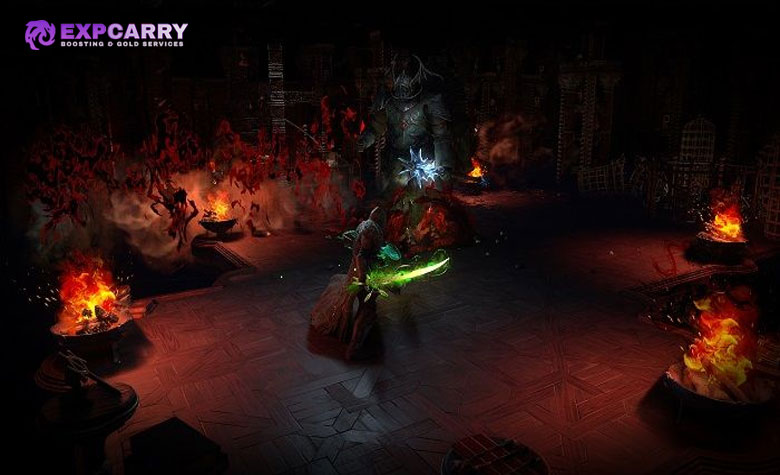
No-hit Sanctum is not simply the next difficulty step after a normal clear. It is a separate challenge with a different success condition. The Original Scripture can only be used with a level 83 Forbidden Tome, sets maximum Resolve to 1, prevents you from having Inspiration, and causes Lycia, Herald of the Scourge to drop Original Sin after a successful completion. Any event that actually reduces that single point of Resolve to zero ends the attempt.
Grinding Gear Games introduced the special Unique Relic challenge set in the official 3.20.1 Sanctum update. Unique Relics such as The Original Scripture are destroyed when applied to a Sanctum, so the Relic is already consumed when the challenge begins whether the run ultimately succeeds or fails. That is why a player who can comfortably farm ordinary Sanctum should not automatically attempt the challenge as soon as The Original Scripture appears.
For The Original Scripture, Resolve- and Inspiration-focused Relic modifiers provide no useful safety scaling because maximum Resolve is fixed at 1 and Inspiration is disabled. Priorities shift toward information, Aureus utility, room control, speed, and damage that kills guards before they can create overlapping attacks. Room knowledge also becomes far more important because one unfamiliar trap pattern can cost the entire attempt.
When a Build Is Ready for No-Hit
Use ordinary level 83 Tomes as practice. If the build regularly finishes them without losing Resolve, not merely with high Resolve remaining, then the mechanical foundation exists. Track what still touches you: guard projectiles, trap timing, movement mistakes, or Lycia. Fix the specific failure before risking The Original Scripture.
High single-target damage is especially valuable because it removes attack cycles, but reliable off-screen damage alone does not solve every room. Monsters in the core Sanctum are immune to damage when no player is within 100 units of them, so no-hit routing still demands controlled positioning.
Common PoE 3.29 Sanctum Mistakes
Most failed farming plans are not caused by one impossible room. They come from several small decisions that make later floors worse. Fixing those decisions produces more value than chasing a theoretical maximum currency-per-hour setup.
- Starting with profit Relics too early: if full clears are inconsistent, use survival and information first.
- Taking every early currency Offer: floors one and two are where Boons, Aureus, and routing strength are built.
- Ignoring room concealment: losing reward or path information can cost more than a direct Resolve penalty.
- Buying expensive Tomes before learning layouts: practice on cheaper runs, then move to level 83 farming.
- Assuming Volatile Vaal Orbs are guaranteed: GGG confirms the reward source, not a per-run rate.
- Overinvesting before Lycia is reliable: a high-value deferred reward has zero value if the final boss repeatedly ends the run.
- Treating no-hit as normal Sanctum with better gear: The Original Scripture changes the entire routing and Relic plan.
The best long-term improvement is consistency. Once the character can complete full runs with room information intact and enough Resolve buffer to choose profit over recovery, the 3.29 Volatile Vaal Orb reward becomes an additional income stream instead of a reason to take reckless routes.
If repeated failures come from missing damage, movement speed, or character progression rather than room decisions, a PoE hourly progression and farming service is one separate option for improving the character. It does not replace learning Sanctum routing, so the priority should still be identifying whether the failure is mechanical or build-related before spending more on Tomes.
FAQ
The questions below cover the parts of Forbidden Sanctum that changed in value or regularly cause confusion in 3.29.
Where do Volatile Vaal Orbs drop in PoE 3.29?
Grinding Gear Games added Volatile Vaal Orbs to Sanctum Rewards in patch 3.29. GGG has not published a guaranteed floor, exact weighting, or average number per completed run.
How do I start a Forbidden Sanctum run?
Meet Divinia through the Act 10 Sanctum introduction, gain access to the Forbidden Sanctum and Relic Altar, then use a Forbidden Tome to begin the first floor. Completing a floor generates the Sanctum Research item for the next floor with the run state preserved.
How many floors are in a Forbidden Sanctum?
A full run has four floors. Each floor has eight rooms, with the final room reserved for that floor's boss encounter.
What happens when Resolve reaches zero?
The current Sanctum run fails. Unclaimed rewards tied to later floor or Sanctum completion are lost, so preserving Resolve is part of the reward strategy rather than only a defensive concern.
Are Relics consumed after every normal run?
Normal Relics are not consumed by ordinary Sanctum farming. Unique Relics used to modify special challenge runs are destroyed when applied to the Sanctum.
Do Flasks refill between Sanctum rooms in 3.29?
Yes, when you interact with the Sanctum Map between rooms, ordinary Flask Charges are restored. The Writhing Jar is specifically excluded from that refill.
What is required for a no-hit Sanctum?
The Original Scripture requires a level 83 Forbidden Tome. It sets maximum Resolve to 1 and prevents you from having Inspiration; completing the modified Sanctum causes Lycia, Herald of the Scourge to drop Original Sin.
Conclusion
Path of Exile 1 3.29 does not change the foundation of Forbidden Sanctum, but it changes why the mechanic is worth learning. Forbidden Tomes still begin a four-floor run, Resolve and Inspiration still determine whether deferred rewards survive, Relics still decide how much control you have over the route, and Lycia still stands between a strong floor-four reward stack and the payout. The new layer is Volatile Vaal Orbs, which are now part of the Sanctum reward economy in 3.29.
Build the run on the early floors, protect room information, use Relics to solve the reason you actually fail, and become consistent at Lycia before making the setup more aggressive for profit. Treat Volatile Vaal Orbs as valuable but non-guaranteed Sanctum rewards, compare them with the current Divine Orb economy, and keep The Original Scripture separate from ordinary farming until level 83 Sanctums are nearly hitless. That route produces a Sanctum strategy that remains useful beyond one temporary economy spike while still taking advantage of the new 3.29 reward loop.