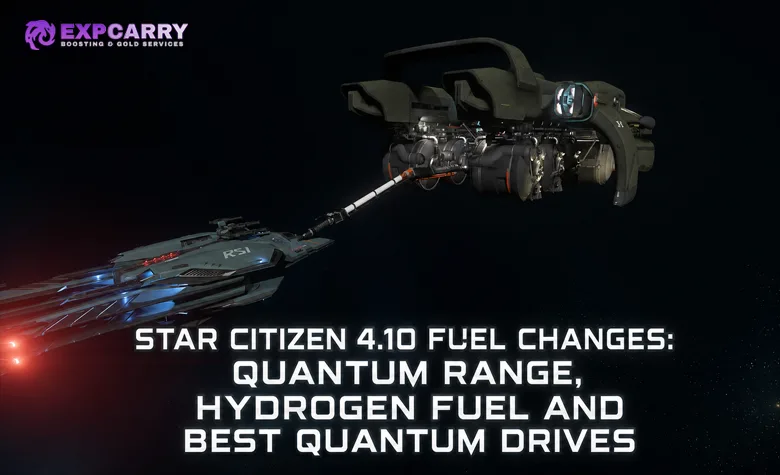
Star Citizen Alpha 4.10 changes fuel management in two different ways. Quantum fuel is redistributed by ship role, giving many haulers and explorers much longer range while cutting the stock range of several fighters and small craft. Hydrogen tank capacity is reduced across most of the flyable fleet, while CIG also says hydrogen fuel consumption rates have been greatly reduced. That means tank-size changes alone do not translate directly into the same percentage change in flight time. The result is not a universal fuel nerf: it is a role-based rebalance that rewards the correct ship, drive and route planning.
The practical question is no longer simply which quantum drive has the highest top speed. Pilots need to compare tank capacity, fuel consumed per gigameter, travel speed, spool time and cooldown. This guide uses the current 4.10 RC1 PTU data, identifies routes that become unsafe with stock loadouts and recommends Size 1, Size 2 and Size 3 drives for daily travel, maximum range and fast hauling. Pilots who want to test these choices on their own ships can use a Star Citizen coaching session to work through drive selection and route planning without copying an outdated loadout.
Star Citizen 4.10 Fuel Changes at a Glance
The short version is that small combat ships need more planning, while many working ships gain freedom. An Arrow or Gladius using its stock drive falls to about 32 Gm of quantum range. That is enough for ordinary local work, but not every direct Stanton or Pyro leg. A Cutlass Black, C1 Spirit, C2 Hercules or Carrack moves in the opposite direction and can complete several long jumps before its quantum tank becomes the limiting factor.
Drive rankings also change. Old 4.9 habits such as automatically fitting a VK-00 to a fighter or an XL-1 to a medium ship no longer produce the fastest travel setup. Civilian, competition and industrial drives now provide some of the best combinations of speed and fuel efficiency. The right choice depends on whether the pilot makes many short jumps, one long cargo leg or a remote route where the next service point is uncertain.
Hydrogen fuel is the harder part of the update to quantify. The compared 4.10 data set shows smaller hydrogen tanks on 185 of 198 flyable vehicles. Some raw thruster and intake fields appear unchanged, but CIG's official 4.10 patch notes also state that hydrogen fuel consumption rates have been greatly reduced. Because those two observations do not map cleanly onto a single endurance percentage, real flight time should be verified in the current PTU rather than inferred from tank size alone.
As of August 24, 2026, these figures are not final LIVE values. The official PTU status page lists 4.10 as the test environment and 4.9 as LIVE. The latest official build found for this review is RC1, version 4.10.0-PTU.12497254. The ship and component calculations below use the matching current 4.10 game-data set, identified as 4.10.188.47871. CIG can still change tanks, drives or fuel behavior before the LIVE release.
Quantum Range, Speed and Fuel Burn Are Separate Stats
Confusing these three values leads to most bad quantum drive advice. Quantum range is the maximum theoretical distance a ship can cover on a full quantum tank. Travel speed controls how quickly the cruise portion of the jump completes. Fuel burn states how much quantum fuel the installed drive uses per gigameter. Spool and cooldown determine how responsive the drive feels before and after jumps.
The range formula is straightforward:
Maximum quantum range in Gm = quantum fuel capacity in SCU divided by drive fuel use in SCU per Gm.
A 0.60 SCU tank using the stock Beacon at 0.01862 SCU per Gm has a theoretical range of about 32.2 Gm. Fit a LightFire using 0.00490 SCU per Gm and the same tank reaches about 122.4 Gm. Nothing about the ship's tank changed between those two loadouts; the more efficient drive created the extra range.
Speed creates a different tradeoff. A fast drive can save meaningful time on a long interplanetary jump, but cooldown matters more when chaining several short orbital markers. A drive can also be fast and efficient at the same time. In 4.10, the FoxFire and SunFire are examples, so the old assumption that competition speed must always destroy range no longer holds.
The official fuel mechanics overview explains the fundamental split: maneuvering thrusters use hydrogen fuel, while quantum travel uses the separate quantum tank. Replacing a quantum drive changes quantum performance; it does not alter the separate hydrogen-fuel balance.
Which Ships Gain or Lose Quantum Range in 4.10?
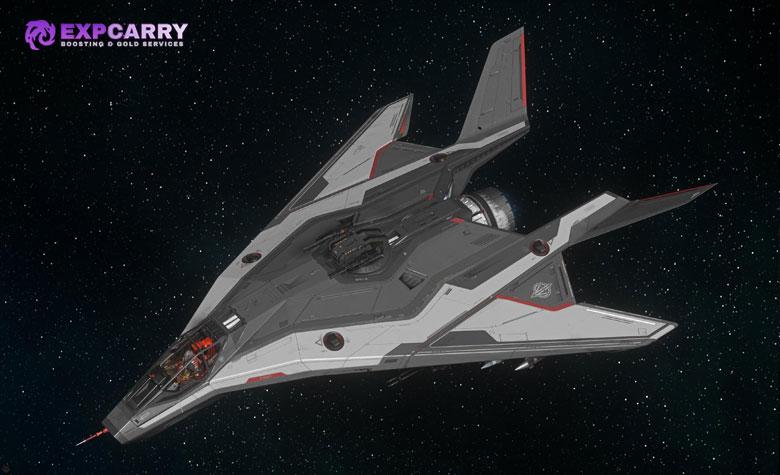
The fleet-wide result is range compression rather than a simple universal cut. The median stock range changes only slightly, from roughly 143 Gm to 154 Gm, but the extremes move closer together. Large operational ships receive much stronger reach, while short-range fighters lose the ability to ignore fuel planning.
| Ship and stock drive | 4.9 quantum fuel | 4.10 quantum fuel | 4.9 stock range | 4.10 stock range | Practical result |
|---|---|---|---|---|---|
| Arrow | 1.10 SCU | 0.60 SCU | 59 Gm | 32 Gm | The stock loadout becomes marginal for the longest Stanton leg and unsuitable for several direct Pyro legs. |
| Gladius | 1.30 SCU | 0.60 SCU | 70 Gm | 32 Gm | It shares the same approximate stock range problem as the Arrow in 4.10. |
| Avenger Titan | 1.10 SCU | 0.60 SCU | 112 Gm | 61 Gm | The longest common Stanton leg remains possible with little reserve, but the 101 Gm Terminus to Pyro V leg does not. |
| C1 Spirit | 1.80 SCU | 5.90 SCU | 79 Gm | 258 Gm | The hauler gains enough stock range for repeated system travel without constant quantum refueling. |
| Cutlass Black | 1.80 SCU | 4.60 SCU | 165 Gm | 422 Gm | Quantum endurance improves substantially even though its hydrogen tank capacity is much smaller. |
| 400i | 3.60 SCU | 8.10 SCU | 303 Gm | 682 Gm | The exploration role receives a clear long-range advantage. |
| C2 Hercules | 6.60 SCU | 20.90 SCU | 171 Gm | 541 Gm | Long cargo routes become easier, although the pilot still needs to monitor hydrogen use during repeated takeoffs, landings and atmospheric flight. |
| Carrack | 10.60 SCU | 20.90 SCU | 274 Gm | 541 Gm | The explorer can cover several long quantum legs before refueling. |
Stock range is a useful baseline, not a permanent limit. The Arrow and Gladius look severely restricted because their default 4.10 drive uses 0.01862 SCU per Gm. An efficient Size 1 replacement more than triples their range. Large ships also benefit from drive swaps, but many already have enough tank capacity to prioritize travel speed over absolute endurance.
Explore services related to this guide, selected from our Star Citizen catalog.
View All Star Citizen Services


Routes That Need a Refueling Stop With Stock Drives
Route distance depends on the selected marker and current navigation solution, so the numbers below should be treated as planning distances rather than guaranteed HUD values. A good operational rule is to keep at least 10 to 15 percent of the quantum tank after arrival. That reserve covers route variation, a failed detour, a blocked service location or the need to reach another orbital marker.
| Route | Approximate distance | Stock 4.10 loadouts at risk | Recommended action |
|---|---|---|---|
| Hurston to Crusader | About 32 Gm | A stock Arrow or Gladius has roughly the same theoretical range, leaving no useful reserve for arrival or diversion. | Start full and refuel on arrival, or install Atlas, FoxFire or LightFire before relying on the route. |
| Crusader to microTech | About 57 Gm | Stock Arrow, Gladius, 325a and Eclipse loadouts fall short. Defender and Avenger Titan can make the mathematical jump but retain very little fuel. | Use an efficient S1 drive or stop for fuel before beginning the long leg. |
| Terminus at Pyro VI to Pyro V | About 101 Gm | Stock Arrow, Gladius, 325a, Eclipse, Blade, Defender, Avenger Titan and several normal starters cannot complete it safely. FoxFire on a 0.60 SCU tank reaches about 102 Gm but still has no practical reserve. | Use LightFire on a small fighter, choose a longer-range ship, or arrange a valid refueling plan before departure. |
The practical dividing line is clearer with the corrected distances. A 32 Gm fighter can still work around local planetary space, but it cannot be treated as a stock cross-system commuter. The 57 Gm Crusader to microTech leg already excludes several default fighter loadouts, while the 101 Gm Terminus to Pyro V trip requires a genuinely efficient drive or a ship designed for range. Players relocating several short-range ships or testing a multi-stage logistics route can use hourly Star Citizen assistance for the repetitive travel portion while keeping the final component choices tied to their own fleet.
Best Size 1 Quantum Drives in Star Citizen 4.10
Size 1 is the most important category for fuel planning because small tanks amplify every efficiency difference. The former habit of buying a VK-00 for every fighter is obsolete in the current RC1 data. VK-00 is slower than several civilian and competition options and consumes far more fuel per Gm.
| Size | Drive | Fuel per Gm | 4.10 speed | Cooldown | Best use |
|---|---|---|---|---|---|
| S1 | Atlas | 0.00755 SCU | 259,054 km/s | 7.6 seconds | Best daily drive for frequent short and medium jumps. |
| S1 | FoxFire | 0.00588 SCU | 263,040 km/s | 11.9 seconds | Best stock S1 for maximum speed with strong efficiency. |
| S1 | LightFire | 0.00490 SCU | 239,127 km/s | 13.2 seconds | Best stock S1 for maximum quantum range. |
| S2 | Hemera | 0.00839 SCU | 326,114 km/s | 9.5 seconds | Best all-around S2 for daily routes and short-hop chains. |
| S2 | SunFire | 0.00654 SCU | 331,131 km/s | 14.9 seconds | Fastest stock S2 with very good range. |
| S2 | SparkFire | 0.00545 SCU | 301,029 km/s | 16.5 seconds | Best stock S2 for maximum range. |
| S3 | Erebos | 0.04959 SCU | 629,281 km/s | 12.6 seconds | Fastest stock S3 and best general hauling drive when range is already sufficient. |
| S3 | Agni | 0.03606 SCU | 585,716 km/s | 21.6 seconds | Best stock S3 for range and fuel economy. |
| S3 | Kama | 0.03864 SCU | 532,469 km/s | 24.0 seconds | Efficient stock option on ships that already carry it, but slower than Erebos and Agni. |
For a 0.60 SCU fighter tank, Atlas provides about 79.5 Gm, FoxFire about 102 Gm and LightFire about 122.4 Gm. All three solve the direct Stanton range problem. Atlas feels best for chains of short jumps because it cools down quickly. FoxFire is the strongest normal travel choice when long-jump speed matters, while LightFire is the answer for a small ship that must maximize reserve in Pyro.
Best Size 2 Quantum Drives in Star Citizen 4.10
Size 2 receives an equally important meta change. XL-1 is no longer the automatic answer for medium ships: it falls to 264,153 km/s and burns 0.02398 SCU per Gm. Spicule is also incorrectly described as an efficiency choice in some older recommendations, but its current consumption is 0.02071 SCU per Gm. The strongest travel drives are now civilian, competition and industrial components.
A Cutlass Black with 4.60 SCU of quantum fuel reaches approximately 548 Gm with Hemera, 703 Gm with SunFire and 844 Gm with SparkFire. A C1 Spirit with 5.90 SCU reaches about 703 Gm, 902 Gm or 1,083 Gm with the same drives. Those theoretical values are far beyond normal Stanton needs, so Hemera's short cooldown may save more real session time than chasing the absolute longest range.
Quantum drives and refueling costs are aUEC expenses rather than pledge-store decisions. Players building a budget for new components, fuel, repairs and a route-testing reserve can obtain the required amount through the Star Citizen aUEC service instead of spending the entire session repeating an unrelated farming loop.
Best Size 3 Quantum Drives in Star Citizen 4.10
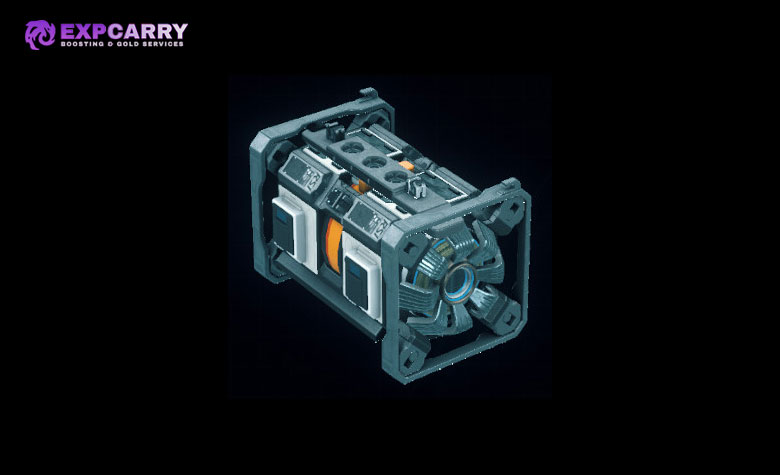
Large ships generally receive enough 4.10 tank capacity that travel speed becomes the primary choice. Erebos is the fastest stock Size 3 option, while Agni delivers the best listed fuel efficiency. TS-2 keeps military component advantages but is no longer a sensible default for hauling or exploration because it combines lower speed with much higher consumption.
With a 20.90 SCU quantum tank, a C2 or Carrack reaches about 421 Gm on Erebos and 580 Gm on Agni. The stock Kama provides about 541 Gm. Erebos therefore gives up theoretical range for the fastest cruise speed, while Agni adds range but has a long cooldown. For repeated cargo runs across long direct legs, Erebos is normally the practical winner because 421 Gm already exceeds current route requirements by a wide margin.
Quick Quantum Drive Recommendations by Ship Role
For ordinary missions with several short calibrations, choose the component that gets ready again quickly. Atlas is the comfortable Size 1 option and Hemera fills the same role for Size 2. Large ships can normally use Erebos because its 12.6-second cooldown and high cruise speed are more valuable than carrying fuel for distances the current route will never require.
For long direct travel, FoxFire, SunFire and Erebos are the simple speed choices. FoxFire is particularly useful because it remains efficient enough to give a 0.60 SCU fighter tank about 102 Gm of theoretical range. A pilot does not have to sacrifice every safety margin just to gain the fastest Size 1 cruise speed.
Remote travel changes the priority. LightFire, SparkFire and Agni use the least fuel per Gm among the recommended stock drives. LightFire is the safest answer for a small fighter crossing Pyro, while medium haulers generally have enough new tank capacity to stay with Hemera or SunFire. Large explorers should choose Agni only when maximum endurance is more important than the time saved by Erebos.
Hydrogen Fuel Changes and Their Real Impact
Hydrogen is the less predictable side of the rebalance for ordinary play. It powers maneuvering thrusters during normal flight, including takeoff, landing, atmospheric travel, acceleration and combat movement. A better quantum drive cannot change hydrogen consumption or tank capacity because the two systems use separate tanks and different consumers.
The compared files show hydrogen tank-capacity cuts on 185 of 198 flyable ships. For ships with multiple hydrogen tanks, the raw values below are per tank: Gladius drops from 13.5 to 1.6 SCU per tank, Avenger Titan from 9.0 to 1.6 SCU per tank, Cutlass Black from 36.0 to 7.8 SCU per tank and Carrack from 360.0 to 40.6 SCU per tank; the single-tank C1 Spirit drops from 45.0 to 7.3 SCU. These figures describe capacity, not guaranteed flight time.
Absolute flight minutes should not be presented as fixed data. Thruster files express burn through force-related engine values, while tanks are listed in SCU, and the available data does not provide a dependable universal conversion. More importantly, CIG's official 4.10 notes say hydrogen fuel consumption rates were also greatly reduced. Atmospheric density, gravity, ship mass, control input, boost use and damage further change real endurance. For that reason, an 80 percent reduction in tank capacity must not be presented as an automatic 80 percent reduction in flight time; practical endurance needs in-game PTU testing.
How to Fly Efficiently After the Hydrogen Rebalance
- Refuel before leaving a landing zone or station instead of treating a partially filled tank as sufficient for the next mission chain.
- Avoid holding boost throughout long atmospheric climbs. Use it when acceleration or escape pressure actually matters.
- Use quantum markers for long repositioning whenever possible instead of covering large distances under normal thrust.
- Plan cargo, bounty and bunker loops around known service locations, especially when the route includes repeated planetary descents.
- Check both hydrogen and quantum percentages before accepting a second contract. A ship may have excellent quantum range but insufficient hydrogen for another landing and takeoff.
- For group operations, establish a refueling point and keep a rescue option available rather than letting every fighter launch with an unknown reserve.
The official Vehicle Maintenance Services guide confirms that landing services can refill hydrogen and quantum fuel separately through mobiGlas. When service buttons fail in PTU, reposition the ship on the pad, store and retrieve it if safe, or move to another service location rather than assuming the fuel value is only a display error.
Common 4.10 Fuel Planning Mistakes
Choosing a drive from an old tier list.
4.10 changes quantum speed enough to overturn several familiar rankings. VK-00 and XL-1 are no longer the fastest travel choices, and Spectre or Spicule should not be labeled maximum-range drives when their current fuel-per-Gm figures are much higher than the leading industrial and competition options.
Using stock range as the hull's permanent maximum.
Stock range includes the default drive. An Arrow at about 32 Gm becomes an approximately 122 Gm ship with LightFire because the drive burns far less fuel.
Planning to arrive at zero percent.
A displayed route close to theoretical maximum leaves no room for a different arrival marker, reroute or unavailable service pad. Keep a 10 to 15 percent quantum reserve and a larger hydrogen margin for atmospheric destinations.
Assuming a bigger quantum tank fixes hydrogen problems.
Cutlass Black, C1 Spirit, C2 and Carrack gain quantum range while receiving much smaller hydrogen tanks. Quantum range and hydrogen behavior must be planned separately; the smaller hydrogen capacity is partly offset by CIG's reduced consumption rates, so service frequency should be judged from actual PTU use rather than tank percentage alone.
Treating PTU values as permanent.
RC1 indicates a release candidate, not an immutable final balance. Check the LIVE patch notes and in-game component values before spending aUEC after 4.10 deploys.
Star Citizen 4.10 Fuel Changes FAQ
Is Star Citizen 4.10 LIVE?
No. As of August 24, 2026, 4.10 is an All Backers PTU release candidate and 4.9 remains LIVE. Fuel values can still change before deployment.
Did every ship lose quantum range?
No. Many fighters and small ships lost tank capacity, while haulers and explorers such as the Cutlass Black, C1 Spirit, C2 Hercules, 400i and Carrack gained substantial stock range.
What is the best Size 1 quantum drive in 4.10?
Atlas is the best daily short-hop choice, FoxFire provides the highest stock speed with strong efficiency, and LightFire gives maximum range.
What is the best Size 2 quantum drive in 4.10?
Hemera is the best all-around daily drive, SunFire is the fastest stock option, and SparkFire uses the least fuel per Gm among the listed stock S2 drives.
What is the best Size 3 quantum drive in 4.10?
Erebos is the fastest stock Size 3 drive. Agni is the range and fuel-economy choice. Large ships with very large tanks generally benefit more from Erebos speed.
Can a stock Gladius cross Stanton in 4.10?
Not on every direct leg. Its approximately 32 Gm stock range only matches the Hurston to Crusader distance and falls well short of the roughly 57 Gm Crusader to microTech trip. Atlas, FoxFire or LightFire gives the ship a usable system-travel margin.
Why can hydrogen behavior feel different in 4.10?
Most ships have much smaller hydrogen tanks in the current 4.10 data, but CIG also states that hydrogen fuel consumption rates were greatly reduced. Raw tank capacity therefore cannot be converted directly into a matching endurance loss. Boost use, atmospheric flight, gravity and ship-specific behavior all matter, so compare the in-game percentage over the same route and flight profile.
Does a quantum drive affect hydrogen consumption?
No. Quantum drives consume quantum fuel during quantum travel. Normal maneuvering thrusters use hydrogen fuel.
Conclusion
Star Citizen 4.10 makes fuel a loadout and route-planning decision instead of a background meter. Quantum range is redistributed by role: fighters such as the Arrow and Gladius fall to about 32 Gm on their stock loadouts, while the Cutlass Black, C1 Spirit, C2 Hercules, 400i and Carrack receive far longer operational reach. Efficient replacements can transform a short-range fighter, so players should calculate tank capacity divided by drive consumption instead of judging the hull from its stock number.
The best current stock choices are Atlas, FoxFire and LightFire for Size 1; Hemera, SunFire and SparkFire for Size 2; and Erebos or Agni for Size 3. Select by job: cooldown for repeated short jumps, speed for long cargo legs and low fuel burn for remote routes. Hydrogen requires separate planning because tank capacity is cut across most of the fleet, while CIG also reduced consumption rates; no quantum component changes that separate system. Keep a real reserve, judge hydrogen endurance from current PTU behavior rather than tank size alone and recheck all values when 4.10 moves from PTU RC1 to LIVE.