
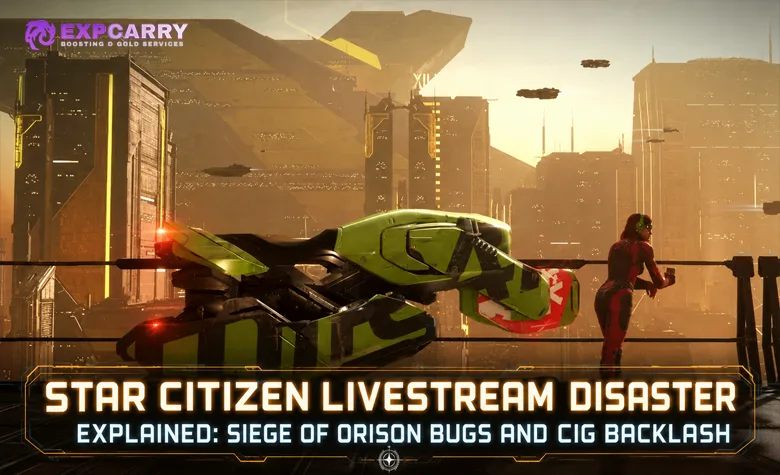
The Star Citizen livestream controversy began with an official August 5, 2026 episode intended to demonstrate the redesigned Siege of Orison. Max, Elliot, Loek, and Olli from CIG played the cooperative FPS mission using an internal development build rather than the public PTU. Instead of providing a clean demonstration of the intended experience, the session exposed weapon and inventory failures, inconsistent AI, desynchronization, weak performance, medical and respawn trouble, lengthy recovery after deaths, and a complete party wipe before the mission was finished.
The broadcast became a much larger story almost two weeks later. Clips moved from the Star Citizen community into general gaming coverage, and Penguinz0's August 17 reaction brought the incident to millions of viewers who did not follow Alpha 4.10 development. The result was a collision between observable technical problems, Star Citizen's existing reputation, awkward on-camera moments, and several exaggerated claims that spread without the context of the full stream.
Verification status: This analysis was checked on August 24, 2026. It compares CIG's official Gamedev: Siege of Orison broadcast with the later 4.10 PTU cycle. At the time of checking, Alpha 4.10 had reached RC1 build 12497254 on the PTU, while LIVE remained on Alpha 4.9. The stream therefore showed real problems in an earlier development build, but not the current LIVE client and not the RC1 build currently being tested on the PTU.
What Happened in the Star Citizen Livestream
| Question | Verified Answer |
|---|---|
| When was the stream? | August 5, 2026 |
| What was being shown? | The Alpha 4.10 redesign of Siege of Orison as an instanced cooperative FPS mission |
| Who played? | Max, Elliot, Loek, and Olli from CIG |
| Which environment was used? | An internal development build and controlled session, not the public LIVE or PTU environment |
| Did they complete the mission? | No. The party wiped before completing Siege of Orison |
| What visibly failed? | Weapon handling, inventory interaction, synchronization, AI behavior, performance, and medical or respawn flow |
| Was the VOD removed? | No. The official recording remained publicly available |
| Was this the current 4.10 RC1 build? | No. Multiple PTU updates and RC1 build 12497254 arrived afterward |
The word disaster describes the outcome as a public demonstration, not a literal loss of the game project or proof that every Star Citizen system failed. CIG used an internal development environment to make the intended mission flow easier to demonstrate than it had been on the troubled public PTU. Because the controlled session still suffered repeated problems and ended without a successful completion, the broadcast failed to clearly demonstrate the intended experience.
What the Stream Was Supposed to Prove
Siege of Orison had been moved from Alpha 4.9 to Alpha 4.10 alongside the new mission-instancing work. Public testers were already reporting performance and progression trouble. At the beginning of the broadcast, CIG acknowledged the PTU state and explained why the team was using an internal environment instead of simply repeating the public test experience.
The internal session was meant to show the design target: a private instance, a four-player route through the Orison platforms, security-network interactions, escalating combat, checkpoints, and a final fight. This distinction matters. It was not presented as a polished marketing trailer, but it was also not an ordinary uncontrolled player stream. CIG deliberately selected a development environment to make the intended flow easier to see.
That decision raised expectations for the demonstration. When basic equipment, synchronization, AI, and recovery problems remained visible, viewers could no longer attribute every failure solely to congestion on the public PTU. The stream did not prove that server or backend load was irrelevant, because an internal networked session still depends on multiple online systems. It did show that public-PTU crowding alone could not explain everything that went wrong.
Which Siege of Orison Systems Broke
The broadcast did not fail because of one dramatic crash. It deteriorated through several connected problems that made the long FPS operation increasingly difficult to play and follow.
| Observed Problem | Player-Facing Effect | Possible System Area |
|---|---|---|
| Weapons would not reload, equip, or swap reliably | Players became unable to respond during combat or spent time troubleshooting equipment | Inventory state, input handling, animation, item authority, or synchronization |
| Inventory and looted equipment behaved inconsistently | Loadouts became harder to manage and recovery from ammunition problems slowed down | Physical inventory, item state, or networked item ownership |
| Players and enemies appeared out of sync | Characters slid, teleported, or appeared in inconsistent positions between clients | Replication, server authority, entity streaming, or latency |
| AI alternated between passive and suddenly lethal | Combat difficulty felt inconsistent instead of deliberately challenging | AI perception, navigation, server simulation, or synchronized combat state |
| Performance remained poor in a controlled session | Combat looked sluggish and reinforced concern about the public PTU experience | Client rendering, instance simulation, entity streaming, or server performance |
| Medical and respawn flow did not recover the party cleanly | A death could produce a long return instead of a dependable local recovery | Medical-bed registration, regeneration location, checkpoint state, or instance re-entry |
| The team wiped before completing the operation | The audience never saw the full mission flow reach its conclusion | Combined effect of technical failures, combat decisions, supplies, and time pressure |
Not every failed action can be diagnosed from video alone. A weapon problem might involve server-side item state, input handling, an invalid magazine, synchronization, or a sequence the player misunderstood. The defensible conclusion is that the symptoms were visible and disruptive, while their exact root causes require logs and reproduction data that viewers do not possess.
Explore services related to this guide, selected from our Star Citizen catalog.
View All Star Citizen Services


A Practical Timeline of the Failed Demonstration
The opening establishes that CIG is using an internal build to demonstrate the intended experience rather than simply repeating the troubled public PTU session. The group then enters the mission and begins the expected platform progression. Early combat already shows unreliable equipment handling and inconsistent AI response.
As the session continues, weapon and inventory troubleshooting consumes time that could otherwise have been used to demonstrate objectives. Deaths separate the group, and medical recovery does not provide a quick, dependable return. Some team members spend long stretches trying to rejoin while the remaining players continue with reduced combat strength.
Around the middle of the broadcast, the mood becomes more strained. Banter about whether a downed teammate makes a difference and a later request for community completion times are subsequently clipped and shared across social media. The completion-time discussion becomes especially awkward because the developers themselves remain far from finishing the operation.
In the closing portion, the remaining attempt collapses into a party wipe. The final exchange includes the widely shared instruction to wrap up the show. The delivery is uncomfortable, but the statement explicitly refers to the program being at time. The available evidence therefore supports an awkward scheduled ending after the failed attempt more strongly than claims that a server crash forced an emergency shutdown.
Verified Events Versus Viral Claims
| Claim | Assessment | Why |
|---|---|---|
| CIG failed to complete Siege of Orison on stream | Verified | The four-player team wiped before reaching the end |
| The stream showed weapon, inventory, AI, desync, and medical problems | Verified | These symptoms are visible during the recording |
| The build was a private internal development version | Verified | CIG explained the choice at the beginning of the broadcast |
| The private server had no latency or backend load | Not established | The session was controlled, but its complete server topology and service load were not publicly documented |
| The stream was immediately cancelled because the server crashed | Misleading | The team failed and the ending was abrupt, but the closing exchange explicitly referred to running out of scheduled time |
| The stream used the current RC1 build | False | RC1 build 12497254 was published later in the PTU cycle |
| The video proves every CIG team has a dysfunctional culture | Unsupported inference | Awkward interactions are visible, but one pressured broadcast cannot establish company-wide working conditions |
| The VOD was hidden to suppress criticism | False | The official recording remained publicly accessible and continued to be linked by later coverage |
Why the Star Citizen Stream Went Viral
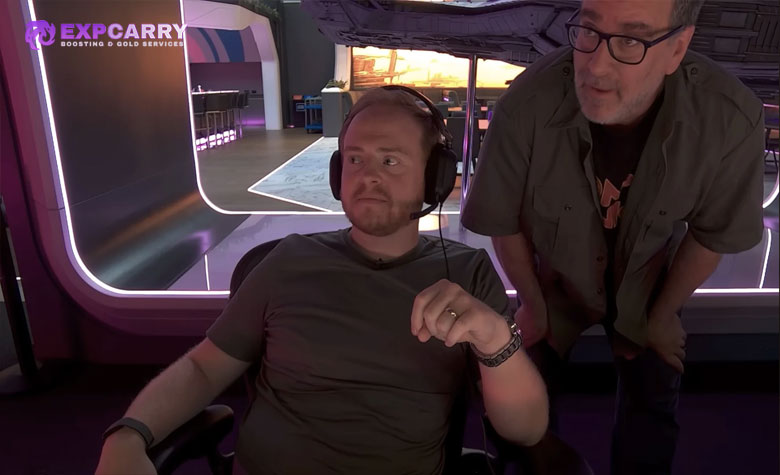
The broadcast itself aired on August 5, but the largest wave of outside attention arrived around August 17 and 18. That delay is important. The incident did not suddenly trend because CIG announced a new failure; footage escaped the existing Star Citizen community through clips, reaction videos, and gaming coverage that gave a general audience an immediately understandable story.
Community breakdowns and widely shared clips helped package the long broadcast into a simpler narrative, and Penguinz0 then released I Can't Believe They Streamed This on August 17. His roughly 19-minute reaction compressed highlights from the nearly two-hour broadcast into commentary that reached more than four million views within days. Search interest consequently expanded beyond Siege of Orison testers to people looking for Star Citizen controversy, the livestream disaster, CIG backlash, and explanations for why the game was suddenly receiving mainstream attention.
The viral version had five elements that work especially well outside the existing community: a famous and extremely expensive long-running project, developers playing their own product, an internal development environment, basic actions visibly failing on camera, and a tense closing exchange. No detailed knowledge of mission instancing was necessary to understand why the footage was embarrassing.
What Penguinz0 Added to the Controversy
Penguinz0 did not discover a new technical failure or conduct an independent technical test. His role was amplification and framing. The reaction selected the most immediately understandable moments, connected them to Star Citizen's long development history, and presented the stream to an audience much larger than regular Star Citizen Live viewership.
That distinction matters when evaluating the story. Penguinz0's video is a direct source for his commentary, while the complete CIG VOD remains the best source for evaluating what actually occurred during the session. A reaction video necessarily removes travel, setup, quieter explanations, and some of the sequence surrounding individual clips.
The strongest criticism raised by the reaction is straightforward: why did CIG choose to broadcast this demonstration when an internal development environment still produced so many visible problems? The weaker leap is treating one earlier build as a complete measurement of every current Star Citizen environment or assuming awkward staff interactions prove how the entire studio operates. The stream provides substantial material for criticism without requiring either conclusion.
Why the Backlash Was More Severe Than an Ordinary Alpha Bug
Star Citizen players already expect defects in PTU builds. This incident generated broader criticism because the broadcast was not an ordinary public test session. CIG deliberately used an internal environment while discussing the intended version of Siege of Orison, yet the controlled demonstration still reproduced several categories of frustration familiar to testers.
The visible failures also affected foundational FPS actions. A broken optional collectible is relatively easy to dismiss in an Alpha. An unreliable weapon, inventory, respawn point, AI state, or group position directly undermines the core loop of a long combat mission. When several of those systems fail together, viewers have difficulty separating the mission's design from the technology supporting it.
Finally, the stream entered a pre-existing argument about development time, funding, ship sales, delayed features, and the distance to a stable release. The incident did not create that skepticism, but it provided unusually clear footage that critics could use as an example. People who had never played Star Citizen could understand a failed reload, severe desync, or the uncomfortable wrap-up exchange without knowing the game's technical history.
What the Critics Get Right
The strongest criticism is that the broadcast failed to provide a convincing demonstration of the intended Siege of Orison experience. The team used an internal development environment instead of the troubled public PTU, yet viewers still saw multiple systemic problems and never received a complete playthrough of the operation.
- The internal build did not isolate the team from major gameplay problems.
- Equipment and medical failures were serious enough to affect the run.
- AI behavior and synchronization made the intended combat design difficult to judge.
- The party wipe prevented the stream from showing a complete objective loop.
- The strained closing made the failed demonstration more damaging as a public presentation.
- A fallback such as prepared footage, a checkpointed demonstration, or a developer walkthrough could have shown the remaining mission flow after the live attempt failed.
A transparent development stream can still be valuable, but transparency does not automatically make the demonstration successful. As an unfiltered look at development it was informative; as a showcase intended to explain how the redesigned mission should work, it produced the opposite impression.
What the Backlash Overstates
The stream is not evidence that Alpha 4.10 or the new Siege of Orison can never work. It used an earlier internal build, and CIG continued issuing PTU updates afterward. Later PTU reports include successful completions of the instance, while CIG's patch notes also show continued work on progression, performance, NPC behavior, elevators, and related systems.
It also does not prove that all problems came from a single cause. Inventory state, item replication, AI, medical recovery, instance state, client performance, network synchronization, and player decisions involve different systems. Calling every symptom server lag is no more precise than assuming that an internal server automatically eliminates all network and backend dependencies.
The on-camera tone can fairly be criticized as part of the presentation, but claims about employee relationships or company-wide culture go beyond what one broadcast can establish. Frustrated or awkward interactions during a pressured live session are not enough to diagnose an entire organization.
Most importantly, the stream did not show the current LIVE game. Alpha 4.9 was LIVE during the broadcast and remained LIVE at the August 24 verification point, while the instanced Siege of Orison rework belonged to the unreleased Alpha 4.10 cycle. The distinction does not excuse a failed official demonstration, but it prevents the incorrect claim that the footage represented the version every LIVE player was running.
How the Stream Compares With Alpha 4.10 RC1
Several PTU builds followed the August 5 stream. By August 21, Alpha 4.10 had reached RC1 build 12497254. As of the August 24 verification, this remained the latest publicly listed 4.10 PTU build. The official 4.10 RC1 patch notes continued to list instanced Siege of Orison, stability, bug fixes, and LTP between PTU releases among the main testing focuses.
| Stream Problem | Later PTU Work | Responsible Conclusion |
|---|---|---|
| Unreliable instance progression | RC1 included potential fixes for Siege being marked complete immediately after the briefing or before the correct initiating event | Specific premature-completion failure paths were targeted, but the fixes still require validation under wider load |
| Instance elevator access | Build 12488012 included a potential fix for authority-assignment messages being dropped and leaving the instance elevator uncallable | One documented elevator failure path was addressed, not every possible access problem |
| AI behavior after recovery | RC1 included a potential fix for Siege NPCs abandoning assigned defense areas after server-crash recovery and rushing players | Recovery behavior remained an active release-candidate test area |
| Fuse and objective interactions | Build 12488012 addressed missing fuse-lever animation data at runtime and keycards appearing inside inaccessible armor slots | Specific interaction and loot problems received targeted potential fixes |
| Medical and checkpoint reliability | PTU iteration continued around death, respawn, airlocks, recovery, and instance progression | Players should verify checkpoint and regeneration behavior instead of assuming every recovery path is reliable |
| Desync and performance | RC1 specifically listed further server load-balancing and performance improvements, while earlier builds also targeted crash-recovery and authority problems | Improvement has to be judged through repeated testing rather than the RC label alone |
| Weapon and inventory state | Later PTU builds continued to include input, interaction, inventory, and item-state corrections | The exact weapon failures seen on stream cannot be declared fixed without reproducing the same conditions |
The correct comparison is not broken on August 5 versus fixed in RC1. An earlier internal build exposed several risks, and subsequent PTU notes show that CIG worked on recognizable versions of those problems. RC1 demonstrates continued progress toward a LIVE deployment, but it is not proof that every issue visible in the viral footage has been eliminated.
Did CIG Respond to the Livestream Backlash?
CIG had not published a dedicated public apology or detailed postmortem specifically addressing the awkward broadcast by the August 24 verification point. The VOD remained online. The clearest official response was continued development activity: repeated All Waves builds, additional debugging and performance work, targeted fixes, a focused stress test, and eventually the RC1 designation.
The official Alpha 4.10 stress-test request described the patch as being in the home stretch and asked players to put Siege of Orison, Recco Battaglia, cargo missions, and the Kruger S-65 Stingray under load before a LIVE rollout. That provides a concrete technical response to the problems surrounding 4.10 even though it is not a direct postmortem of the livestream itself.
Operational fixes do not completely answer the communication failure. The more important test will be whether the LIVE version can provide reliable entry, progression, combat, recovery, and completion under ordinary player load. A stable public deployment would address the central technical criticism far more effectively than another statement or release-candidate label.
What the Failure Reveals About Mission Instancing
Mission instancing is not simply a private room with fewer players. The system must create a space, assign it to an eligible player or party, load the required entities, isolate mission objectives, handle access and transport, preserve relevant state, coordinate AI, track progression, support death and re-entry, and eventually close the instance without disrupting the wider Persistent Universe.
The stream showed symptoms across several of those boundaries, although video alone cannot identify their exact causes. A seemingly local weapon problem can involve networked item state. A medical bed can exist physically while regeneration or checkpoint state fails. An AI character can render correctly while acting on delayed or incorrect simulation data. Players can appear to occupy the same environment while their clients disagree about positions or object states.
This is why moving Siege into an instance can reduce interference from unrelated players without automatically making the mission stable. Instancing removes some open-world variables but introduces lifecycle, access, transition, authority, progression, and recovery requirements of its own. Alpha 4.10 therefore has to make both the underlying gameplay systems and the new instance-management layer work together reliably.
Does the Stream Represent the Real Player Experience?
It represents one genuine session on an internal development build, not every Star Citizen session. The visible symptoms overlap with categories reported during the 4.10 PTU cycle, including equipment state, synchronization, AI inconsistency, performance, instance progression, and recovery problems. That makes the footage relevant, but it should not be treated as a controlled benchmark for every later build.
Actual results vary with build number, server conditions, party coordination, hardware, region, and whether the instance initializes correctly. Successful later PTU reports show that the redesigned operation can be completed when its systems behave correctly. Broken sessions can still lose substantial time when an elevator, objective trigger, checkpoint, item state, or recovery path fails.
Players planning to test the activity should bring complete heavy or medium armor, spare ammunition, a backup weapon, medical refills, and a coordinated party. Current Star Citizen armor options can help compare replacement kits, but no loadout can compensate for an invalid mission state or severe synchronization problems.
What Players Should Check in the Current 4.10 Build
A useful test begins by recording the exact build number. Do not report a problem from the August 5 stream as current without reproducing it on RC1 build 12497254 or any newer candidate that appears afterward.
- Enter with the complete supported party and verify everyone reaches the same instance.
- Confirm the mission activates correctly and does not enter a premature completion state.
- Test weapon reload, swapping, magazine state, looting, and inventory access before leaving staging.
- Watch whether AI remains in intended defensive positions, particularly after a server recovery.
- Activate available checkpoints and confirm the regeneration location before relying on them.
- Record frame rate and server behavior at comparable locations rather than judging a single moment.
- Verify that security objectives, keycards, fuses, lieutenants, and IFFI-related steps update in the intended order.
- Report failures with the build number, region, party size, timestamp, and reproduction sequence.
New groups struggling to separate mission mechanics from coordination errors can use Star Citizen coaching to practice FPS roles, revives, target calls, and inventory preparation. Technical bugs should still be documented through the Issue Council rather than treated as a player-skill problem.
Why Star Citizen Was Trending
Star Citizen attracted broader attention because the story was understandable without specialist context. An official studio broadcast used an internal development environment to demonstrate upcoming content; the developers encountered multiple familiar gameplay problems; the team failed to finish the mission; and the final minutes looked tense. Large reaction creators and gaming outlets then connected the footage to the wider debate about Star Citizen's development history and funding.
Search demand consequently split into several intentions. Existing players wanted to know whether the stream problems still existed in Alpha 4.10. General viewers searched for the disaster clip and the meaning of the wrap-up exchange. Penguinz0 viewers looked for the original footage. Potential backers wanted to know whether the video represented LIVE. Critics searched for evidence supporting their existing view of the project, while supporters looked for technical and chronological context missing from shorter clips.
A complete explanation needs both sides of that chronology. Repeating that the livestream was buggy does not explain why it spread, while pointing to later PTU fixes does not erase the failed official demonstration. The August 5 stream and the later 4.10 test cycle have to be evaluated separately.
Star Citizen Livestream Controversy FAQ
- Was the Siege of Orison stream real? Yes. It was an official CIG broadcast using an internal development build.
- Did the developers complete the mission? No. Max, Elliot, Loek, and Olli wiped before finishing the operation.
- What broke? Visible symptoms included weapon and inventory problems, desync, inconsistent AI, poor performance, and medical or recovery trouble.
- Did a server crash force CIG to end the stream? The broadcast ended awkwardly after the failed run, but the closing exchange explicitly says the program was at time. An emergency cancellation caused by a server crash is not established.
- Why is Penguinz0 connected to the story? His August 17 reaction brought the broadcast to a much larger general audience and passed four million views within days.
- Was the stream running Alpha 4.10 RC1? No. RC1 build 12497254 arrived later in the PTU cycle.
- Is the redesigned Siege of Orison on LIVE 4.9? No. The instanced rework belongs to the Alpha 4.10 cycle.
- Did CIG fix the bugs? Later PTU notes contain potential fixes for several relevant failure paths, but a potential fix or an RC designation is not a guarantee of stable LIVE behavior.
- Did CIG remove the VOD? No. The official stream remained publicly accessible at the August 24 verification point.
Conclusion
The Star Citizen livestream disaster was not invented by reaction channels. CIG chose an internal development build to demonstrate the redesigned Siege of Orison, yet Max, Elliot, Loek, and Olli encountered disruptive weapon, inventory, synchronization, AI, performance, and recovery problems before wiping without completing the operation. The demonstration failed to show the intended mission cleanly, and the strained ending made the technical problems particularly easy to turn into viral clips.
The broader internet then simplified the event. Penguinz0 and other creators brought it to millions of viewers, but some retellings treated the earlier internal build as though it were the current RC1, presented an emergency server-crash cancellation as established fact, or treated awkward interactions as proof of company-wide dysfunction. None of those stronger claims is necessary to criticize what actually happened.
The most accurate conclusion as of August 24 is that the stream exposed genuine risks in the Alpha 4.10 development cycle and showed that public PTU crowding was not sufficient to explain every visible problem. Subsequent builds targeted recognizable instance-progression, elevator, AI recovery, objective, input, and performance failures, culminating so far in RC1 build 12497254. Whether CIG has adequately answered the technical backlash will ultimately depend on how the redesigned Siege of Orison performs when Alpha 4.10 reaches ordinary LIVE conditions.