



Ashes of Creation uses a class system that rewards planning more than hype. Your primary archetype gives you the core kit and your role fundamentals. Your secondary archetype does not replace that identity. It mainly changes how your primary abilities behave through augments. That is the point of the so-called “Augment Revolution”: you are not rerolling into a new job, you are tuning how your best buttons deliver damage, control, mobility, defense, or support.
This guide is a practical playbook for customizing your secondary archetype for real play: messy fights, real counterplay, and limited time to experiment. It covers how to choose a secondary archetype for outcomes instead of vibes, how to think about augment schools without getting lost, how to build a stable plan instead of a pile of ideas, and how to test and iterate without rebuilding every week.
Important note: Ashes of Creation is still in active development, so UI, names, unlock timing, and exact interactions can change as systems are implemented and tuned. The decision framework below stays useful even when numbers shift, because it is built around the structure the team has described publicly: your primary archetype is the foundation, your secondary archetype modifies through augments, and strong builds come from clear job definition plus disciplined customization.
Augment System: What Your Secondary Archetype Actually Changes
Before you think in class names and combo fantasies, lock in the simple truth: you build around your primary kit, and your secondary archetype is the customization layer that changes how parts of that kit behave. If you start with outcomes and constraints, augments stay a tool you control instead of a rabbit hole of “what if” interactions.
Primary vs Secondary: What Changes, What Does Not
As the system has been described so far, you choose a primary archetype early, then later unlock a secondary archetype and gain access to augmentation. That secondary choice creates your class combination and unlocks augment options that modify your primary abilities. The core idea is consistent: you keep your primary kit as the base, then change how specific skills behave through augment effects. Those effects can shift delivery, targeting, scaling, damage type, control behavior, mitigation, or utility, depending on the augment.
This distinction matters in real fights because it keeps you grounded in the buttons you already rely on. You are not asking “what new kit do I become”, you are asking “which of my existing win tools need better reach, safer delivery, stronger control flow, or more reliable defense windows”. When your build is anchored in your primary toolkit, your secondary choice becomes a focused upgrade path rather than an identity reset.
If you want a clean mental model, treat augments like a layer that rewires your most important skills. Your real build is not the class label. Your real build is the set of augmented abilities that define how you start fights, how you survive pressure, how you control space, and how you help your group win even when opponents respond correctly.
Augment Schools: Why the Same Class Can Play Like Two Different Builds
Augmentation is also commonly described as being split into multiple “schools” within a secondary archetype. The intent is simple: the same class combination can feel different depending on which school you invest in and which abilities you choose to augment. Two players can share the same class name and still approach fights differently because their augmented buttons define engagement patterns, crowd control flow, defensive windows, and group utility. Treat the label as shorthand, not as the full playstyle.
This is also why you should plan your school choice around the fights you actually take. Different environments punish different weaknesses. Open field rewards reliability and target access. Chokes reward area value and predictable output under line of sight breaks. Focus fire punishes builds that only work when left alone. A school that looks exciting can still fall apart if it pushes you into a delivery pattern the enemy can shut down with spacing, cleanses, interrupts, terrain denial, or coordinated pressure.
The practical takeaway is simple: treat “secondary archetype + school” as your build engine. Then treat “which abilities you augment first” as your build identity. If those two pieces match your job, the rest becomes iteration, not reinvention.
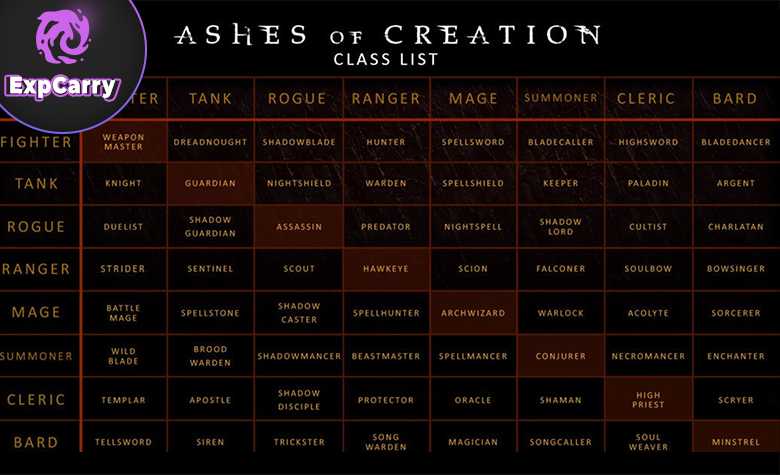
Complete 64 Class Combination Table
The table below is a naming map, not a build guide. It is useful because it tells you what people will call your combination, but it does not tell you how your character actually plays. Use it to orient yourself and communicate with others, then immediately move back to role, school, and target skills.
How to Use the Matrix Without Getting Trapped by Names
This table lists every primary and secondary archetype pairing and the commonly shown class name for that combination. Find the row for your primary archetype, then the column for your secondary archetype. Example: Fighter (primary) + Ranger (secondary) = Hunter. Names can shift during development, but the pairing logic stays the same: primary sets the base kit, secondary defines the augment flavor.
Read it in two passes. First pass: shortlist secondaries that match your content and role. Second pass: ignore the label and ask what the secondary is doing for your primary win buttons. If you cannot point to at least two high impact abilities that become easier to land, safer to use, or harder to counter with that secondary, it is usually not a great practical pick for the content you play most.
| Primary archetype | Fighter | Tank | Rogue | Ranger | Mage | Summoner | Cleric | Bard |
| Fighter | Weapon Master | Dreadnought | Shadowblade | Hunter | Spellsword | Bladecaller | Highsword | Bladedancer |
| Tank | Knight | Guardian | Nightshield | Warden | Spellshield | Keeper | Paladin | Argent |
| Rogue | Duelist | Shadow Guardian | Assassin | Predator | Nightspell | Shadow Lord | Cultist | Charlatan |
| Ranger | Strider | Sentinel | Scout | Hawkeye | Scion | Falconer | Soulbow | Bowsinger |
| Mage | Battle Mage | Spellstone | Shadow Caster | Spellhunter | Archwizard | Warlock | Acolyte | Sorcerer |
| Summoner | Wild Blade | Brood Warden | Shadowmancer | Beastmaster | Spellmancer | Conjurer | Necromancer | Enchanter |
| Cleric | Templar | Apostle | Shadow Disciple | Protector | Oracle | Shaman | High Priest | Scryer |
| Bard | Tellsword | Siren | Trickster | Song Warden | Magician | Songcaller | Soul Weaver | Minstrel |
Start Here: A Fast Checklist Before You Pick a Secondary Archetype
Most build problems come from skipping the boring part. Before you pick a secondary archetype, define what your character must do in the content you actually play. A clean build starts with constraints, then picks an augment engine that serves those constraints. This prevents the classic trap of choosing a secondary for one cool interaction, then realizing the rest of the kit does not support your real job once opponents adapt.
Lock Your Role and Content First, Then Let Everything Else Follow
Start by writing your job as one sentence you can say in comms. Not a fantasy, not a vibe, a job. “I engage and force cooldowns so my team can collapse.” “I peel and deny dives so our backline can free cast.” “I control space in chokes so we win the push.” This matters because the secondary archetype is not a replacement kit, it is a modifier. If you do not define the job, you cannot judge which augments are actually improving outcomes.
Then tie that job to the fight size you play most. Solo roaming and small group fights reward tools that work without perfect setup. Node wars and siege scale fights punish builds that only work on isolated targets. Chokes reward predictable area value. Open fields reward target access and reliable follow up. If you force one build to do everything, you usually end up with a kit that does nothing sharply.
- Role: engage, peel, backline control, burst damage, sustain damage, healer, off-healer, or utility support, written as one sentence you can call in comms.
- Content focus: solo roaming, small group PvP, raids">raids-service">raids, node wars, caravans, or siege-scale fights, because different fight sizes punish different weaknesses.
- Your 3 win buttons: the few primary skills that decide outcomes for you (gap close, hard CC, cleanse, major heal, major shield, execute), plus the condition required to land them.
- Weakness budget: what you accept being worse at (mobility, burst, sustain, range, durability), and which weakness you cannot afford in your main content.
- Dependencies: what you need from allies to function (setup CC, pocket heals, cleanse coverage, peel), and what you must be able to do alone when that support is not available.
The rule that prevents regret is simple: choose your secondary archetype for the job you will actually perform most of the time. If your guild needs a reliable peeler, build for peel first and add damage later. If you play mostly solo, prioritize tools that stay reliable without perfect setup. If you cannot explain your job in one sentence, your build will drift and your augments will fight each other.
The Build Framework: Engine, School, Then Target Skills
A strong augment build is created in a repeatable sequence. First you pick the secondary archetype that matches your role identity. Second you pick an augment school that matches the battlefield conditions you face most often. Third you apply augments to a small number of high impact abilities. Finally you test in real fights and refine with controlled changes. This process beats random theorycrafting because it produces stable strengths you can execute under pressure.
Step 1 and Step 2: Choose the Engine, Then Choose the Spec Theme
Step 1: Pick the secondary archetype as an engine. Ask what the secondary gives you as a theme: more mobility, more control, more survivability, more support utility, or more disruption. Do not pick the engine for one highlight clip. Pick it because it improves your consistency across many fights, especially against players who respect your threat and play around it.
Step 2: Pick an augment school as a spec theme. Schools are where the same engine becomes different playstyles. The right school makes your key skills easier to land, easier to repeat, or harder to shut down. The wrong school can look exciting on paper and still fail because enemies can answer it with basic spacing, cleanses, interrupts, terrain denial, or coordinated focus fire.
A practical filter here is to ask what the school changes for your first contact. How do you start a fight, how do you survive the first response, and how do you keep value when the enemy does not give you a clean engage. If you cannot describe that loop clearly, the school choice is probably not aligned to your real content.
Step 3: Build Around 2 to 5 High Impact Abilities First
Step 3: Augment only your high impact skills first. Your first iteration should focus on 2 to 5 abilities that decide fights for your role. Most players fail by spreading changes across too many skills and ending up with no sharp strengths. Build sharp first, then round edges later when you already have a reliable win loop.
Use the list below as a targeting checklist. It is not about augmenting everything, it is about choosing the few buttons that define your identity and making those buttons harder to counter and easier to execute under pressure.
- Engage and gap close: augments that improve reach, reliability, target access, or follow-up control when the first hit matters.
- Primary control tool: augments that improve area, targeting, chain potential, or anti-mobility so your CC actually creates outcomes.
- Main defensive window: augments that increase survival, repositioning, or counter-pressure so you do not die before you press your second rotation.
- Primary support tool (if applicable): augments that change delivery, coverage, or utility, such as safer application under pressure or better uptime.
- Fight turning button: augments that create a decisive reset, save, or kill window, and a clear trigger for when you commit it.
Choosing the Right Pairing: Patch, Amplify, or Change Delivery
You do not need to evaluate all 64 combinations to make a good build. A clean build comes from picking the secondary that supports the job you already defined, then using schools and targeted augments to turn that job into repeatable outcomes. The fastest way to do this is to decide what the secondary is doing for your kit: patching a weakness, amplifying a strength, or changing delivery so the same job works in more fight types.
Patch, Amplify, Delivery: The Three Pairing Patterns That Actually Work
There are many class combinations, but you do not need to evaluate all of them to build well. Most players need a short list that matches their role and content. A practical filter is to choose a secondary archetype that does one of three things: patches your primary weakness, amplifies your primary strength into a win condition, or changes your delivery so your role works better in different terrain and fight sizes.
Patch builds are for primaries that struggle with mobility, survivability, or reliable control. The secondary should make it easier to do your job without perfect conditions, and it should improve your floor, not just your ceiling. Amplify builds are for primaries that already have a strong identity. The secondary should make your identity more repeatable and more threatening, not more complicated. Delivery builds keep the same job but change how you apply it, such as shifting toward more area coverage, safer range patterns, cleaner setup timing, or more reliable value in choke fights.
Counterplay Check: Fallback Loops Matter More Than Perfect Combos
A good pairing also has a clear answer to counterplay. Ask these questions before you commit: what shuts my plan down, what is my fallback when the enemy responds correctly, and which of my augmented skills still works when fights are messy. If you cannot answer those, the build will collapse in organized play. Your goal is not a perfect combo, your goal is a plan that still functions when the enemy has cleanses, interrupts, and focus fire.
Build your fallback loop into the first version of the build. That can mean a secondary that improves reliability when the first engage fails, a school that gives better re-entry timing, or an augment choice that shifts value from “perfect hit” to “consistent pressure and control”. If your only plan is landing one high value moment, you will win clips and lose wars.
Testing and Iteration: How to Improve Without Constant Respec
You do not validate augments on perfect targets. You validate them in the fights you actually take. The goal is not to prove a build is “good”, it is to identify which part of your plan is failing, then fix that part without breaking the rest. A simple protocol keeps your learning tight and prevents the respec loop where you change everything and learn nothing.
A Simple Testing Protocol: Measure Your Plan, Not Your Mood
Use the scenarios below as a repeatable test set. Run the same situations, with the same role goal, and track whether your key tools land and whether you still get value when the enemy plays correctly. This gives you clean feedback and makes your next change obvious instead of random.
- Open field: can you execute your engage or peel plan without perfect setup, and can you still contribute when the enemy refuses your preferred angle.
- Choke fights: do your augmented skills still land when movement is compressed and line of sight is inconsistent.
- Focus fire: can you survive the first burst and still press your win buttons, or does your plan end when you get called.
- Messy fights: when targets swap and comms are loud, does your kit stay reliable, or do you require perfect coordination to function.
Diagnose the Failure Type, Then Change One Meaningful Element
When something fails, diagnose the failure type. Delivery failure means you cannot reliably land the tool. Timing failure means cooldowns or windows do not align. Identity failure means the build is doing the wrong job for your content or group. Fix one category per iteration. Make one meaningful change at a time so you can measure what actually improved instead of guessing.
For disciplined respec planning, keep a baseline build you trust and return to it when testing fails. Use a three session rule for evaluation unless a change is obviously unplayable. The goal is stability plus improvement, not endless reinvention. If you keep losing the same way, your next change should address that exact failure, not a new fantasy.
Team Play, Common Mistakes, and Quick Fixes
Augments feel strongest when your group understands your windows. In organized play, your build should read like an assignment: who you enable, what you deny, and when you create a push or a save. If your plan is clear, your teammates can play around it. If your plan is vague, even a strong build becomes inconsistent.
Team Play: Make Your Windows Obvious and Repeatable
Use simple comms that describe outcomes, not ability names. Call “engage in 3”, “peel now”, “save ready”, or “control chain on target”. If your build relies on one key cast or channel, treat it like an objective and assign peel to it. Sync cooldown economies with teammates, because many augments that look average solo become dominant when paired with ally setup, ally cleanse, or ally burst. Your job is to be predictable to allies and dangerous to enemies.
The best team builds are not the most complex. They are the easiest to coordinate around. If your group can anticipate your timing, your value goes up even when enemies are disciplined and fights are chaotic.
Common Mistakes and Fixes: Keep It Sharp, Keep It Measurable
- Mistake: picking a secondary for fantasy, not function. Fix: write your real job in one sentence and choose the engine that supports it.
- Mistake: augmenting too many abilities early. Fix: start with 2 to 5 high impact skills and sharpen identity first.
- Mistake: testing in the wrong environment. Fix: validate in the content you play most, especially choke fights and focus fire.
- Mistake: ignoring counterplay. Fix: define what shuts you down and build a fallback loop for that response.
- Mistake: constant respec with no learning. Fix: change one major element at a time and keep notes for three sessions.
Conclusion
The Augment Revolution in Ashes of Creation is not about finding one best secondary class. It is about building a repeatable identity that matches your real role, then using augment schools to customize how your primary kit wins fights. Choose the engine, choose the school, augment the skills that matter, test in real scenarios, and iterate with discipline. If you do that, you get the real advantage going forward: a character that stays effective across different content and group needs because your build is something you can execute, not a screenshot you hope will work.
Keep the order tight. Define your job in one sentence, then pick a secondary archetype that supports that job across the fights you actually take, not the fights you wish you took. Commit to a school that improves your first contact loop: how you engage or peel, how you survive the first response, and how you keep value when the enemy respects your threat. Then lock in your identity by augmenting only a handful of high impact abilities first, the same few buttons you press to win under pressure. Finally, treat counterplay as part of the build, not a surprise. If your plan gets answered by cleanses, interrupts, spacing, or focus fire, you need a fallback loop that still produces value. Test in the environments that expose those failures, change one meaningful element at a time, and keep a baseline you can return to. That is how you end up with a build that stays sharp as the game evolves: clear job, clear engine, targeted augments, and measured iteration.