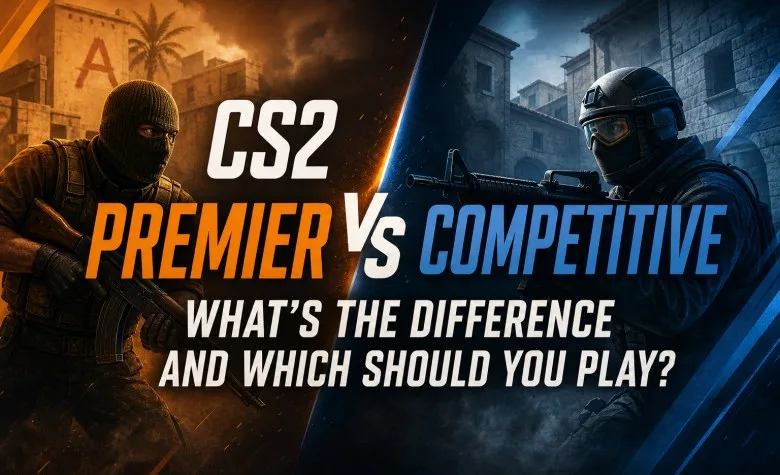
Premier and Competitive are both ranked 5v5 modes in CS2, but they do not use the same ranking system. Premier gives you one numerical CS Rating across its current map pool. Competitive gives you a separate Skill Group on every map you play, from Silver I to The Global Elite.
The difference changes more than the badge next to your name. Premier and Competitive also handle map selection, access requirements, progression and long-term goals differently. Choosing the right mode depends on whether you want one overall rating to climb or control over the exact maps you play.
CS2 Premier vs Competitive at a Glance
| Feature | Premier | Competitive |
|---|---|---|
| Rank system | Numerical CS Rating | 18 Skill Groups |
| Rank scope | One rating across Premier | Separate rank for every map |
| Top milestone | 30,000+ Gold color band; no published hard ceiling | The Global Elite |
| Map choice | Four maps are picked and one is randomly selected | You select the maps you want to queue |
| Map pool | Current Active Duty pool | Broader Competitive selection |
| Rank calibration | CS Rating calibration / seasonal recalibration | Per-map Skill Group |
| Last published first-rank requirement | 10 Premier wins for seasonal re-establishment | 2 wins on that map |
| Prime | Required, plus Profile Level 10 | Can be played without Prime, but Skill Groups require Prime |
| Leaderboards | Yes | No equivalent CS Rating leaderboard |
| Seasons | Yes | No equivalent Premier season ladder |
The Main Difference: One Rating vs a Rank for Every Map
The biggest difference between Premier and Competitive is how CS2 represents your skill.
In Premier, you receive one CS Rating. That number follows your Premier progression across the entire current Premier map pool.
In Competitive, each map is treated separately. You can therefore have completely different ranks on Mirage, Nuke, Inferno, Cache or another available map.
For example, the same account could be:
- Legendary Eagle on Mirage;
- Master Guardian II on Inferno;
- Gold Nova III on Nuke;
- unranked on Cache;
- 18,500 CS Rating in Premier.
None of those values is a contradiction. They belong to different ladders.
For the full rank structure, see our CS2 Ranks Explained guide.
Premier Uses CS Rating
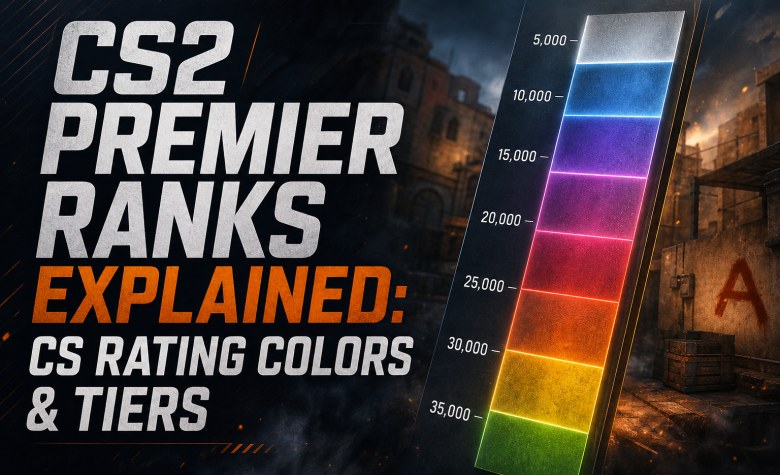
Premier does not use the classic Silver-to-Global-Elite badges. It uses a numerical rating divided into visible color bands.
| CS Rating | Color Band |
|---|---|
| Below 5,000 | Gray |
| 5,000–9,999 | Light Blue |
| 10,000–14,999 | Blue |
| 15,000–19,999 | Purple |
| 20,000–24,999 | Pink |
| 25,000–29,999 | Red |
| 30,000+ | Gold |
The exact number matters more than the color. Two players can both be Purple while still being several thousand rating points apart.
Our CS2 Premier Ranks guide covers the rating bands, seasonal mechanics and current Premier rules in more detail.
Explore services related to this guide, selected from our Counter Strike 2 catalog.
View All Counter Strike 2 Services


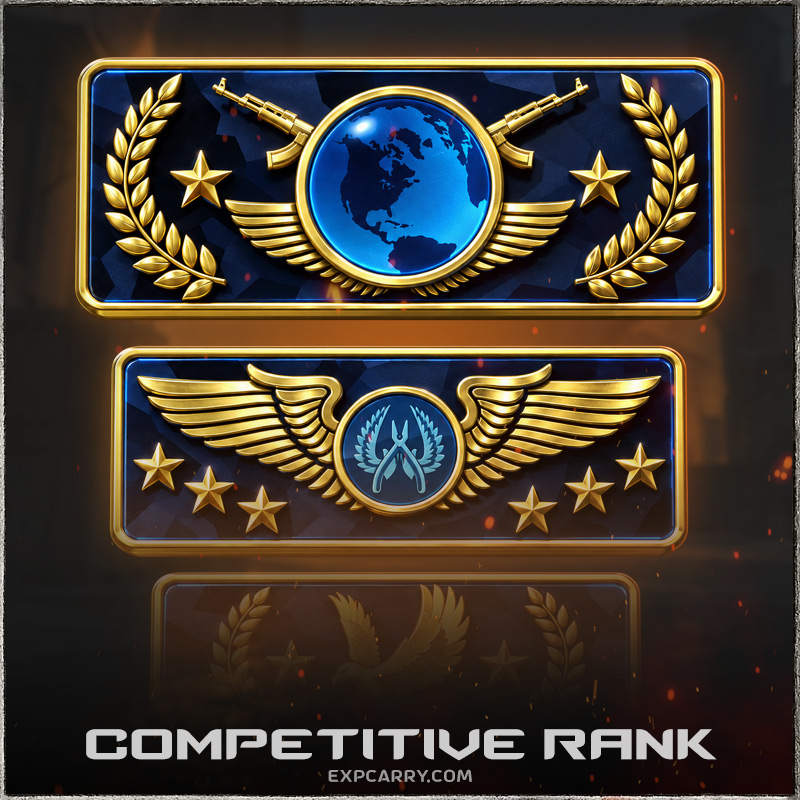
Competitive Uses 18 Classic Skill Groups
Competitive uses the familiar rank ladder inherited from Counter-Strike's classic matchmaking system:
Silver I → Silver II → Silver III → Silver IV → Silver Elite → Silver Elite Master → Gold Nova I → Gold Nova II → Gold Nova III → Gold Nova Master → Master Guardian I → Master Guardian II → Master Guardian Elite → Distinguished Master Guardian → Legendary Eagle → Legendary Eagle Master → Supreme Master First Class → The Global Elite.
The important CS2 difference is that the Skill Group belongs to the map rather than to the entire account.
Improving your Mirage rank does not automatically improve your Inferno or Nuke rank.
How Map Selection Differs
This is now one of the clearest practical differences between the two modes.
Premier Map Selection
Valve changed Premier map selection on September 22, 2026.
The current system works like this:
- Team 1 picks one map.
- Team 2 picks two maps.
- Team 1 picks one final map.
- One of the four selected maps is randomly chosen for the match.
The old system where teams simply banned maps down to one final map is therefore outdated.
Premier requires you to be reasonably comfortable across the current Active Duty pool because you cannot simply queue only Mirage or only Dust II.
Competitive Map Selection
Competitive gives you direct control over the maps you queue.
If you want to play only one specific map, you can select that map and build its Skill Group independently.
This makes Competitive particularly useful for:
- learning a new map;
- practising one CT position;
- working on map-specific utility;
- playing a favourite map without risking your Premier CS Rating;
- trying maps that are not currently in the Premier Active Duty pool.
Which Maps Are in Premier Right Now?
Premier Season 5 began on July 8, 2026. Cache entered the Active Duty pool and Overpass was removed.
The current Premier pool is:
- Ancient;
- Anubis;
- Cache;
- Dust II;
- Inferno;
- Mirage;
- Nuke.
Competitive can offer a broader selection because it is not limited to the current seven-map Premier pool.
Premier and Competitive Placements Are Different
Another common source of confusion is the number of wins required before a rank becomes visible.
Premier Calibration
Valve has used a ten-win requirement when players need to re-establish their CS Rating after a seasonal recalibration.
Ten wins does not necessarily mean ten total matches because losses do not complete the win requirement.
If your Premier rating is still hidden, calibration is a different objective from increasing an already visible numerical rating.
Competitive Placement per Map
Valve reduced the Competitive requirement in June 2024 so that a per-map Skill Group is revealed after two wins on that map.
This is map-specific. Two wins on Mirage do not reveal your Nuke rank.
Older guides that say you need ten wins on each Competitive map are using an outdated requirement.
Prime Requirements: Premier vs Competitive
The access rules are different.
Premier
To access Premier, Steam currently requires:
- Prime Status;
- Profile Level 10.
Without Prime, Premier is not available.
Competitive
Free CS2 accounts can access Competitive matchmaking, but non-Prime users do not receive a Competitive Skill Group.
If you want a visible Silver-to-Global-Elite rank, Prime Status is therefore still required.
Profile Level 10, however, is specifically part of the Premier access requirement and should not be confused with a Competitive rank requirement.
Does Playing Competitive Change Your Premier Rating?
No visible rank progression is shared between the two systems.
Steam Support states that Competitive Skill Groups are calibrated and assigned through Competitive matchmaking, while CS Rating is calibrated and assigned through Premier matchmaking.
That means:
- winning Competitive does not directly add CS Rating;
- losing Competitive does not directly remove CS Rating;
- winning Premier does not directly increase your Competitive Skill Group;
- a Premier rating does not automatically assign the same skill level to every Competitive map.
The systems should therefore be tracked independently.
Which Mode Has the Better Rank System?
Neither system is universally better. They answer different questions.
Premier answers: “Where am I on one overall Valve rating ladder?”
Competitive answers: “How strong am I on this specific map?”
If you want one number that is easy to compare with friends and track over a season, Premier is usually more useful.
If you want a map-specific measure, Competitive provides more detail about individual map performance.
Which Mode Is Better for Learning CS2?
For learning a new map, Competitive is usually the cleaner environment because you can select exactly what you want to practise.
You can queue the same map repeatedly and focus on:
- CT rotations;
- T-side defaults;
- site executes;
- retake utility;
- timings;
- common off-angles;
- economy decisions specific to that map.
Once that map becomes comfortable, the knowledge transfers into Premier without requiring you to learn it while protecting an important CS Rating.
Which Mode Is Better for Climbing?
If by “climbing” you mean increasing one account-wide number, Premier is the clearer ladder.
You always know your exact CS Rating and the next visible color milestone.
Competitive progression is less linear because every map has a separate rank. Reaching Global Elite on Mirage does not finish your Competitive progression on Nuke, Cache or Inferno.
This makes Premier easier to use for one long-term numerical target and Competitive better for individual map goals.
Premier Is More Seasonal
Premier is explicitly built around seasons.
Season transitions can include:
- CS Rating recalibration;
- map-pool changes;
- season medals;
- leaderboard resets or refreshed competition.
Competitive still receives matchmaking and rank-system changes, but it does not operate around the same visible seasonal CS Rating ladder.
Premier Has Leaderboards
Premier CS Rating is connected to regional and global leaderboards.
This gives high Premier ratings another layer of progression beyond simply entering a color band.
Competitive does not offer an equivalent global Silver-to-Global-Elite leaderboard for every map.
For players who care about comparing an exact Valve rating against a larger population, Premier therefore provides a more direct system.
Can You Be Better in Competitive Than in Premier?
Yes.
A player can specialise heavily in one map and have an excellent Competitive rank there while holding a much lower Premier rating.
The opposite can also happen. A strong all-round Premier player may have a low or unranked Competitive Skill Group on a particular map simply because they rarely queue that map in Competitive.
This is another reason why direct conversion charts between the systems are unreliable.
Is There a Premier-to-Competitive Rank Conversion?
Valve does not publish an official conversion table.
There is no official rule that says:
- 10,000 Premier = Gold Nova;
- 15,000 Premier = Master Guardian;
- 20,000 Premier = Legendary Eagle;
- 25,000 Premier = Supreme;
- 30,000 Premier = Global Elite.
Charts like these are community estimates and can change as rating distributions change.
The problem is even larger because Competitive ranks are map-specific while Premier uses one rating across its entire map pool.
Premier vs Competitive for Solo Players
Both modes can be played solo, but they create different kinds of variance.
In Premier, the map itself adds uncertainty because one of four selected maps will be drawn. You need a wider useful map pool.
In Competitive, you can remove most of that map uncertainty by queuing only maps you know well.
If your main weakness is adapting to different maps, Premier will expose it faster. If your goal is reducing variables and improving one environment at a time, Competitive is easier to control.
Premier vs Competitive for New Players
For a new player, Competitive can be the better learning tool before treating Premier as the main climb.
A simple progression could be:
- learn one map in Competitive;
- build basic utility and rotations;
- add a second and third map;
- reach enough account progression to unlock Premier;
- move into Premier once the Active Duty pool feels less unfamiliar.
This reduces the problem of learning gunplay, economy, utility, communication and seven different maps at the same time.
Should You Play Both Premier and Competitive?
For many players, using both modes is more useful than choosing only one.
| Goal | Better Choice |
|---|---|
| Build one main Valve rating | Premier |
| Learn a new map | Competitive |
| Reach Global Elite on one map | Competitive |
| Push 20K, 25K or 30K CS Rating | Premier |
| Play maps outside the current Active Duty pool | Competitive |
| Compete for a Valve leaderboard position | Premier |
| Practice one weak map without risking Premier rating | Competitive |
| Test yourself across the current pool | Premier |
Premier or Competitive: Which Should You Choose?
Choose Premier if:
- you want one clear numerical rating;
- you enjoy seasonal progression;
- you care about leaderboards;
- you are comfortable across several maps;
- your goal is a CS Rating milestone such as 15K, 20K or 30K.
Choose Competitive if:
- you want to select exactly which maps you play;
- you are learning a new map;
- you want the classic Silver-to-Global-Elite ladder;
- you care about proving your rank on one specific map;
- you want to practise without changing your Premier CS Rating.
Which ExpCarry Service Matches Each Mode?
The two ladders require different targets, so the services should not be treated as interchangeable.
If your goal is a numerical CS Rating such as 15K, 20K, 25K or 30K+, use CS2 Premier Rating Boost.
If your goal is Silver-to-Global-Elite progression on one selected map, use CS2 Competitive Rank Boost.
If your Premier rating is still hidden, the relevant starting point is Premier Placement Matches.
Last verified: October 2026. Premier access requirements, per-map Competitive Skill Groups, Season 5, current Premier map selection and Valve's last published two-win Competitive rank reveal were checked against current Steam/Valve documentation and release notes.