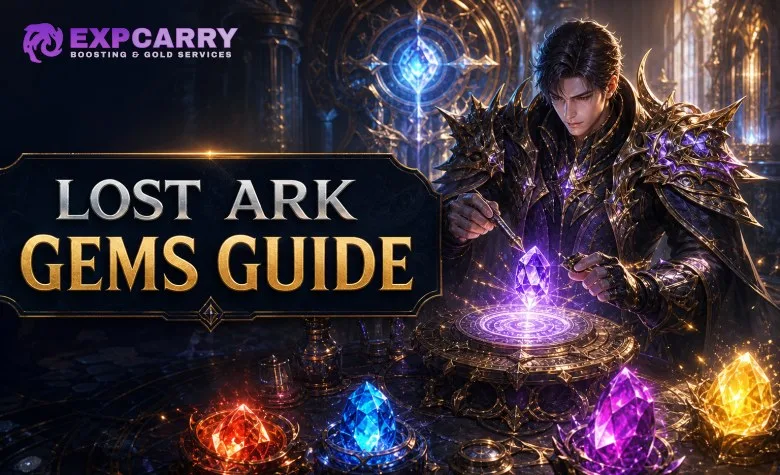
In the current Western version of Lost Ark, gems remain one of the most important ways to improve a character’s real combat performance. The correct priority is usually simple: equip damage gems for your highest-impact skills, use cooldown gems where they improve your rotation, fuse only when the upgrade is affordable, and avoid converting valuable Tier 4 gems without a clear plan. Tier 4 characters can also use the Luminous Gem system, which allows a gem to be configured as either a damage or cooldown gem for a selected skill.
This guide explains how Lost Ark gems work, how fusion and upgrades function, when damage or cooldown gems are better, and how to spend limited silver, gold, and gem resources without weakening your build.
Lost Ark Gems: Quick Overview
| Question | Practical answer |
|---|---|
| What do gems improve? | They increase damage for a selected skill or reduce that skill’s cooldown. |
| How many gems can be equipped? | Characters have 11 total gem slots across the available gem types. |
| How does fusion work? | Three gems of the same level can be fused into one higher-level gem. |
| What are the main Tier 4 gem types? | Annihilation Gems, Doomfire Gems, and Luminous Gems. |
| Who should prioritize upgrades? | Damage dealers should prioritize their main damage skills; supports should prioritize essential buff, shield, and identity-related cooldowns. |
| Are Luminous Gems tradeable? | Luminous Gems are bound to the character. |
The table is most useful as a spending rule: gem level matters, but the skill attached to the gem matters just as much. A high-level gem assigned to a low-impact skill can provide less value than a lower-level gem supporting the core of your build.
What Are Gems in Lost Ark?
Gems are character combat items that enhance individual skills. Depending on the gem type and configuration, the effect is either damage increase or cooldown reduction. A gem is not a general character-stat upgrade: it applies to one selected skill, so correct assignment is essential.
Damage gems are usually called attack or damage gems by players. They increase the damage of the assigned skill. Cooldown gems reduce the time before that skill can be used again. The value of each type depends on your class, engraving setup, specialization, skill rotation, attack-speed buffs, and whether you can use the skill consistently during a raid.
Gems are especially important in Tier 4 because endgame progression is no longer determined only by item level. A character with appropriate gems, engravings, Ark Passive choices, and a stable rotation can perform much better than a higher-item-level character with poorly assigned gems.
Annihilation, Doomfire, and Luminous Gems
Annihilation Gems
Annihilation Gems are one of the standard Tier 4 gem types. They provide a damage-increase effect for a selected skill. They are generally the first priority for damage-focused builds because they directly strengthen the skills responsible for most of your damage.
Do not automatically place Annihilation Gems on every skill that appears in your damage meter. A skill may deal substantial damage only because it is used frequently, while another skill may have a larger burst multiplier or be required for a specific rotation. Use your class build’s actual damage distribution and rotation requirements when assigning them.
Doomfire Gems
Doomfire Gems are the standard Tier 4 cooldown gem type. They reduce the cooldown of a selected skill. Their value is highest when the reduced cooldown allows you to reach a meaningful rotation breakpoint, fit an extra cast into a damage window, or keep an important party-support skill available more consistently.
A cooldown gem does not automatically increase damage. It creates the opportunity to use a skill more often. If your rotation, mana, positioning, or encounter downtime prevents the additional cast, the practical value will be lower than the tooltip suggests.
Luminous Gems
Luminous Gems are created through the Gem Resonance System. Conversion is available for Tier 4 gems through the Gem Expert NPC. A Luminous Gem allows you to select either a damage-increase effect or a cooldown-reduction effect and choose the skill affected by that effect.
Luminous Gems can be equipped alongside Annihilation and Doomfire Gems, but the total number of equipped gems remains 11. They are not an additional set of 11 slots.
The main advantages of Luminous Gems are flexibility and preset control:
- You can choose between damage and cooldown functionality.
- You can select the skill affected by the gem.
- The configuration can be managed independently for different presets.
- A Luminous Gem can be used with Annihilation and Doomfire Gems.
The main disadvantage is that Luminous Gems are character-bound. They should therefore be treated as a long-term investment rather than a temporary Auction House item.
Explore services related to this guide, selected from our Lost Ark catalog.
View All Lost Ark Services


How to Convert a Tier 4 Gem into a Luminous Gem
- Visit the Gem Expert NPC in a major city.
- Select the Gem Resonance or conversion option.
- Choose an eligible Tier 4 Annihilation or Doomfire Gem.
- Configure the Luminous Gem’s effect and assigned skill.
- Equip it in one of your 11 gem slots and verify the active preset.
Conversion does not permanently destroy the original gem’s identity. A Luminous Gem can be restored to the Annihilation or Doomfire Gem from which it was resonated, with its previous gem type and skill assignment restored.
However, restoration has an important restriction. After resonating a gem, you normally need to wait 15 days before restoring it without an additional cost. Restoring it earlier consumes Crystals. The restoration timer means you should not convert a gem casually before testing your planned build.
There is no cost to calibrate or restore a gem once the normal restoration conditions are met. If you fuse a Luminous Gem while it is still waiting for restoration eligibility, the fusion resets that restoration eligibility.
How Gem Fusion Works
Gem fusion combines three gems of the same level into one gem of the next level. In Tier 4, Luminous, Annihilation, and Doomfire Gems can be fused together when they meet the required level condition. The result becomes a higher-level Ignition or Explosion Gem according to the game’s fusion rules.
The practical fusion loop is:
- Collect or purchase three gems of the same level.
- Open the gem fusion interface.
- Place the three eligible gems into the fusion slots.
- Confirm the fusion.
- Configure the resulting gem if it is a Luminous Gem or assign it through the normal gem interface.
Fusion is useful because it turns several weaker gems into a single stronger gem, but it also reduces the number of equipped effects available to your character. Before fusing, check whether the three gems are already useful on different skills. A fusion can raise one gem’s level while removing two functional skill effects from your setup.
When to Fuse
Fuse when the resulting gem gives a clear improvement to your current build and you can replace the lost gem effects without creating a rotation or Party Finder problem. This is normally reasonable when:
- You have several surplus gems that are not used by your class.
- Your core skills already have appropriate gem coverage.
- The next-level gem improves a high-priority skill.
- You are not saving the gems for another character or build preset.
- The fusion does not consume a valuable bound Luminous Gem you may need to restore later.
When Not to Fuse
Do not fuse automatically just because three gems are available. Delay fusion when one of the gems is assigned to a core damage skill, a key party buff, an important shield, or a cooldown breakpoint used by your class.
Also avoid fusing tradable gems before checking their market value and your roster plans. A gem may be more valuable as a saleable item than as a small personal upgrade, particularly when the fused result does not match your class.
Damage Gems or Cooldown Gems: Which Is Better?
There is no universal damage-to-cooldown ratio that works for every Lost Ark class. The correct choice depends on whether the gem improves a real rotation breakpoint.
Choose Damage Gems First When:
- The assigned skill is responsible for a large share of your total damage.
- The skill has a long cooldown and cannot be cast more often even with additional reduction.
- Your build already reaches the required rotation through Swiftness, specialization, engravings, Ark Passive effects, or party buffs.
- You frequently lose casts because of boss patterns, movement, or downtime.
- You are progressing through raids where burst damage is more valuable than theoretical sustained uptime.
For many damage dealers, the first damage gems should cover the main burst skill, the primary spender, and the most important repeated damage skill. Do not spread early upgrades evenly across every ability. Concentrating investment on the skills that define your build usually produces a larger improvement.
Choose Cooldown Gems First When:
- The cooldown reduction allows an extra cast during a normal damage window.
- The skill is a central part of your rotation rather than an occasional utility button.
- The skill supplies a party buff, shield, counter, stagger tool, or identity resource.
- Your class scales strongly with skill frequency.
- You can maintain the rotation without running out of mana or losing positional uptime.
Cooldown gems are often especially valuable on support characters. A support’s most important gem may not be attached to a personal damage skill. It may instead improve the availability of a damage buff, attack-speed buff, shield, cleanse, or identity-generating ability.
Gem Upgrade Priorities for Damage Dealers
Use this priority framework when setting up a new character:
- Cover the core skills. Identify the skills that define your class engraving and build identity.
- Assign damage gems to major damage sources. Start with burst skills and high-contribution spenders.
- Add cooldown gems to rotation-critical skills. Prioritize skills that must be available for your normal cycle.
- Check breakpoints before upgrading. A higher cooldown gem is valuable when it changes the number of casts or improves buff alignment.
- Upgrade concentrated gems before filling low-impact slots. A stronger gem on a core skill usually beats a minor upgrade on a rarely used skill.
- Review the setup after changing gear or Ark Passive choices. A change in specialization, Swiftness, skill level, or rotation can change the correct gem assignment.
For burst classes, damage gems on the principal burst skills normally come first. For sustained classes, cooldown gems can become more competitive because repeated casts form a larger portion of total output. These are recommendations, not universal class rules.
Gem Upgrade Priorities for Supports
Supports should not copy a damage dealer’s gem order. The most valuable support gems usually improve the skills that maintain party uptime and defensive coverage.
- Prioritize cooldowns on the main damage-amplifying buff.
- Improve the cooldown of the skill used to maintain attack-speed or movement-speed support when applicable.
- Upgrade shields and defensive skills that are needed for predictable raid patterns.
- Support identity generation if it allows more frequent identity buffs or emergency protection.
- Use damage gems only when they provide meaningful personal contribution and do not delay essential support coverage.
A support with lower personal damage but reliable buff and shield uptime can contribute more to a group than a support whose gems are invested in abilities that are rarely used.
A Practical Gem Route for a New Character
Step 1: Use Any Functional Gems Immediately
Do not leave gem slots empty while waiting for perfect rolls. Equip suitable gems on the skills you actually use, then refine the setup after you understand the character’s rotation.
Step 2: Remove Incorrect Skill Assignments
Check every gem after changing your build, class engraving, or skill tripod setup. A gem assigned to a removed or rarely used skill provides little value even if its level is high.
Step 3: Build Core Coverage
Make sure your main damage skills or essential support skills have the appropriate gem types before investing in secondary abilities. For many classes, a mixed set of damage and cooldown gems is more effective than equipping only one type.
Step 4: Test Cooldown Breakpoints
Compare the skill’s cooldown with your actual rotation. If the skill becomes ready while you are waiting for another ability, the cooldown investment may not be improving your output. If it lines up with your identity window, party buff, or burst cycle, the same upgrade can be highly valuable.
Step 5: Fuse Surplus Gems Carefully
Once your useful skills are covered, fuse unwanted duplicates and surplus gems. Keep a small reserve if you regularly switch builds, maintain multiple presets, or plan to gear another character.
Step 6: Consider Luminous Conversion at Tier 4
Convert only after you know which skill and effect you want. Remember that Luminous Gems are bound and that early restoration can require Crystals. Flexibility is valuable, but converting a gem does not compensate for poor skill selection.
Common Gem Mistakes
Fusing Before Checking Skill Coverage
Three gems can look like free fusion material, but one may be filling an important cooldown or damage slot. Review your equipped presets before confirming.
Using Damage Gems on Low-Impact Skills
A skill that appears frequently in the hotbar is not necessarily one of your best damage targets. Check its role in the class rotation and build identity.
Chasing Cooldown Reduction Without a Breakpoint
Cooldown reduction is useful only when it creates additional casts, improves buff alignment, or increases practical utility. More reduction is not automatically more damage.
Ignoring Support Utility
Supports should not prioritize gems exclusively around personal damage. Buff uptime, shields, identity generation, and defensive availability often matter more to a raid group.
Converting Luminous Gems Too Early
The 15-day restoration condition makes rushed conversion inconvenient. Test the effect and skill assignment first, especially if you are changing from a damage setup to a cooldown setup.
Copying Another Player’s Gem Setup Blindly
Two characters of the same class may use different gem priorities because of different engravings, stats, Ark Passive configurations, skill rotations, or raid goals. Use guides as a starting point, then confirm that the setup matches your character.
How Gems Fit into Current Tier 4 Progression
Gems should be upgraded alongside, not instead of, the rest of your character. Weapon and armor progression, engravings, accessories, Ark Passive development, cards, and raid knowledge all affect performance. A high-level gem cannot fix an incorrect build or an unstable rotation.
For a returning player, the most efficient approach is usually to establish a functional character first, cover the core skills, and then invest in higher-level gems as the character begins clearing current Tier 4 activities. The Western progression structure has also changed over time, so older guides that focus on legacy Tier 3 gem sources or outdated upgrade routes may no longer describe the current economy.
If your main obstacle is reaching the item level required for current raids rather than choosing gem assignments, review the Lost Ark gear progression guide. If a difficult weekly clear is preventing access to raid materials or gem-related rewards, you can also review the current Lost Ark services and select the activity that matches your character’s progression.
Frequently Asked Questions
How many gems can I equip in Lost Ark?
You can equip 11 total gems. Luminous, Annihilation, and Doomfire Gems share the same overall gem-slot limit rather than providing separate full sets of slots.
Can Luminous Gems be used with Annihilation and Doomfire Gems?
Yes. Luminous Gems can be equipped alongside the standard Tier 4 gem types, provided you remain within the total 11-gem limit.
Can I change a Luminous Gem back?
Yes. A Luminous Gem can be restored to its original Annihilation or Doomfire Gem, including its previous type and skill assignment. Normal restoration requires the applicable waiting period; restoring earlier consumes Crystals.
Should every damage dealer prioritize damage gems?
No. Damage gems are usually the safest starting point for major damage skills, but cooldown gems can be better when they create an additional cast, align a rotation, or improve a core class mechanic.
Should supports use cooldown gems?
Usually, yes. Supports commonly gain more practical raid value from cooldown gems on core buffs, shields, identity-generation skills, and defensive tools than from investing heavily in personal damage gems.
Is it worth fusing every three gems of the same level?
No. Fuse surplus or low-value gems after confirming that you are not removing useful coverage from your equipped presets, another build, or another roster character.
Related Lost Ark Guides
- Lost Ark Gear Progression Guide
- Lost Ark Solo Raids Guide
- Lost Ark Paradise Season 4 Guide
- Official Lost Ark Game Guides
Published: July 22, 2026 — Initial version based on official Western information available on this date.