
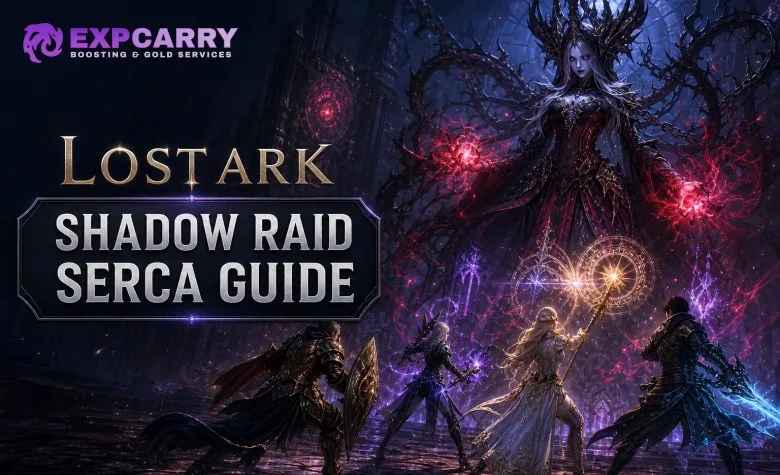
Shadow Raid: Serca is a live four-player endgame raid in the Western version of Lost Ark. It has two gates and three regular difficulties: Normal at Item Level 1710, Hard at 1730, and Nightmare at 1740. The raid launched on April 15, 2026, and remains current as of July 22, 2026. Since the July update, players can also use Matchmaking Mode for a reduced-difficulty run with dynamic scaling.
This guide explains how to unlock Serca, how the two gates work, what the Brawl System and shared resurrection pool change, which rewards matter for progression, and how to build a reliable learning and farming route.
Shadow Raid: Serca Quick Facts
| Feature | Current Western information |
|---|---|
| Raid | Shadow Raid: Serca, the Witch of Pain |
| Party size | Four players in regular raid difficulties |
| Gate count | Two gates |
| Normal | Item Level 1710+ |
| Hard | Item Level 1730+ |
| Nightmare | Item Level 1740+ |
| Unlock quest | [Unlock] Notice: Shadow Raid |
| Main progression material | Agony Thorn and Fragmented Agony Thorn |
| Special systems | Brawl System, Shadow Skills, and shared resurrection pool |
| Frontier Mode | Not applied to Serca |
The practical meaning of these thresholds is simple: Normal is the entry point for learning the raid and beginning Serca-related progression, Hard is the main route for Agony Thorn and Destined Tremor Gear, and Nightmare adds the highest difficulty rewards and exclusive achievements. The minimum Item Level is only an entry requirement; appropriate Ark Passive setup, gems, engravings or accessories, combat levels, and raid familiarity still determine whether a group can clear consistently.
How to Unlock and Enter Serca
To unlock Shadow Raid: Serca, reach Item Level 1710, complete the main quest Inherited Will, and accept the guide quest [Unlock] Notice: Shadow Raid from the Quest Journal's Guide tab.
- Reach Item Level 1710 or higher.
- Complete Inherited Will.
- Open the Quest Journal with J and check the Guide tab.
- Accept and complete [Unlock] Notice: Shadow Raid.
- Enter through the Shadow Raid object in a major city, Find Party, or the Content Guide with Alt + Q.
Regular Serca is designed for four players. You can form a premade party or use Find Party. The raid shares gold-reward counts and free extra-reward counts with other endgame content, so include it in your weekly gold-earning plan rather than treating it as a completely separate source of raid income.
Matchmaking Mode: The Current Easier Entry Route
The July 15, 2026 Summer of Extremes update added Matchmaking Mode for Serca. It uses the Normal entry requirement of Item Level 1710 or higher but reduces the difficulty and adjusts combat balance according to the number of players.
Matchmaking Mode can be accessed from the Adventure category in the Game Menu or through the Matchmaking Mode button in the Serca entry interface. You may enter alone, matchmake as a solo player, or join with a premade party of two or three players. A premade four-player party cannot use matchmaking.
This mode is particularly useful for returning players, first clears, and characters that meet the Item Level requirement but are not yet accepted easily into experienced Hard or Nightmare groups. It is not a replacement for learning the normal raid mechanics: patterns still need to be recognized, but the reduced difficulty gives you more room to practice positioning and timing.
Matchmaking Mode also changes failure rules. The party does not wipe simply because every player dies, and resurrections are unlimited through Phoenix Plumes or Crystals when Plumes are unavailable. If a player does not resurrect during the available waiting period, that character is removed and the entry count is consumed.
Explore services related to this guide, selected from our Lost Ark catalog.
View All Lost Ark Services

What Makes Shadow Raid Different?
The Brawl System
Serca replaces the traditional stagger-only approach with the Brawl System. When the party successfully staggers the boss, players are transported into a separate Brawl space for a limited period.
The Brawl contains three stages. Each stage has its own completion condition. Completing the stages correctly extends or improves the party's advantage when the encounter returns to the main arena, while poor execution wastes the limited Brawl window.
- Save burst skills for the correct Brawl opportunity instead of spending everything immediately before the stagger.
- Read the objective for each stage before using major cooldowns.
- Prioritize the condition required to advance rather than attacking randomly.
- Keep track of the timer; the Brawl ends automatically when its time expires.
- Assign responsibility before pulling the boss, especially if your group is learning.
The most common Brawl mistake is treating it as a free damage phase. It is a short objective phase first and a damage opportunity second. A party that completes the stages efficiently gains much more value than a party that enters with cooldowns but ignores the required tasks.
Shared Resurrection Pool
Regular Shadow Raids use a shared resurrection count per gate instead of giving every player an independent supply of lives. The base count depends on difficulty, and additional resurrections can become available after a period of time, up to the encounter's maximum.
Because the resource belongs to the whole party, reviving immediately is not always correct. A support or high-value damage dealer may deserve priority when the group can continue, while spending the final resurrection on a player who is likely to die to the next pattern can end the attempt.
The raid fails when the party runs out of available resurrections and all players are dead. A full-party death caused by a one-shot mechanic can also fail the raid even if resurrection charges remain. If the group restarts the dungeon, the resurrection count resets.
Shadow Skills
Shadow Skills are special Battle Items introduced with Shadow Raids. The first available Shadow Skill is Shadow of Corvus Tul Rak, associated with Serca's Gate 2 encounter.
The recipes are tied to achievements related to Gate 2. After learning a recipe, craft the item in the Expedition Estate Crafting Workshop. Whirlwind Grenades are used as crafting materials. The recipe box is roster-bound when claimed, can be used from Item Level 1710, and the completed Shadow Skill Battle Item becomes roster-bound and cannot be traded.
Shadow Skill items are stored in the Shadow Skill category of the Battle Item Storage and can be equipped in a normal Battle Item slot. Do not assume that every party member needs to craft one immediately. First confirm your group's strategy and whether the skill is being used for progression, learning, or a specific achievement.
Gate 1 Guide: Serca, the Witch of Pain
Gate 1 is the encounter against Serca in her witch form. Its patterns emphasize arena awareness, moving safe zones, defensive timing, counters, and controlled positioning. The fight becomes much less reliable when players stand wherever they are attacking instead of watching the floor and boss animations.
Important Gate 1 patterns
- Broom sweeps: A large sweeping attack covers part of the arena. Watch the safe zone and move early rather than reacting after the broom is already moving.
- Moving arena sections: Some patterns shift the playable space and combine movement with saws or spikes. Keep your camera clear and avoid being trapped at the edge.
- Anvil pattern: The safe position changes according to the initial arrangement. Learn the movement sequence instead of standing still and hoping the first safe tile remains safe.
- Compressing wall: When the arena closes in, follow the actual movement of the spikes and walls rather than relying only on red telegraphs.
- Multiplication pattern: Several players may need to move while watching floor cracks and the witch-marked area. Spread only when necessary and preserve enough space for the final movement.
- Counter patterns: Serca can expose counter opportunities during specific attacks. Assign at least one player to watch for counters instead of having every player continue their rotation.
- Iron Maiden attack: The fire-breathing pattern can create a counter opportunity. Do not force a counter if the timing or positioning is unsafe.
- Broom slam and scythe attacks: These punish players who remain directly in front of the boss or ignore the attack animation. Use a dodge or Just Guard when appropriate for your class.
Gate 1 is primarily a consistency check. The group should practice moving as a unit, recognizing safe zones, and preserving resurrection charges. Greedy damage during a movement pattern usually costs more time than it saves.
Gate 1 learning priorities
- Learn the arena's safe-zone patterns before optimizing damage.
- Keep one counter-capable player watching the boss during counter windows.
- Use defensive skills during unavoidable movement instead of trying to facetank mechanics.
- Do not stack in an unsafe area simply because a burst window is available.
- Communicate when a player is dead so the party does not spend several resurrections at once.
Gate 2 Guide: Corvus Tul Rak
Gate 2 reveals the Primordial form connected to Serca: Corvus Tul Rak. This gate is generally the more demanding part of the raid because it combines heavier pattern recognition with Brawl execution and stricter punishment for repeated mistakes.
Important Gate 2 priorities
- Watch the boss rather than only the ground: Corvus Tul Rak's animations often provide the clearest warning for attacks that punish players near the front or sides.
- Respect one-shot patterns: A shared resurrection pool does not protect a group from mechanics that fail the raid when everyone is caught.
- Prepare for Brawl objectives: Entering the Brawl with no cooldowns or no agreed assignment makes the three-stage sequence much harder.
- Control debuffs and positioning: If a pattern marks a player or creates a dangerous area, move deliberately so the effect does not cut off the rest of the party.
- Use counters and stagger tools on call: Save the relevant skills when a mechanic is approaching instead of spending them as soon as they become available.
- Keep damage uptime safe: The raid's DPS check is not solved by dying during every burst window. A living character contributes more than a perfect rotation followed by a forced resurrection.
Gate 2 is also where Shadow Skill progression becomes relevant. If your group is pursuing the Gate 2 achievements connected to Shadow of Corvus Tul Rak, decide in advance who is responsible for the required actions and when the item will be used.
Gate 2 learning route
- Clear the gate once with the goal of identifying visual cues, not achieving a fast time.
- Record which patterns consume resurrection charges and which can be handled with movement or Just Guard.
- Practice the Brawl stages separately from the main damage rotation.
- Assign counter, stagger, and objective responsibilities before the next pull.
- Only add aggressive burst timings after the group can reach the later phases consistently.
Recommended Battle Items and Preparation
The exact Battle Item lineup depends on your class and party plan, but a Serca group should normally prepare the tools needed for movement, stagger, counters, and emergency survival.
- Whirlwind Grenades: Useful when your group needs additional stagger and also relevant to crafting the Shadow of Corvus Tul Rak item.
- Dark Grenades: Consider them for progression groups that are close to a damage check, provided the raid mechanic does not require another Battle Item.
- Destruction tools: Bring them only when your group confirms that the selected gate or pattern requires destruction.
- Purification or cleanse options: Useful when a party member's class does not provide reliable cleansing and the encounter applies removable debuffs.
- Healing and defensive items: Keep emergency options available for learning attempts instead of using every slot for damage.
- Phoenix Plumes: Regular modes use a shared resurrection resource, so bring enough Plumes and agree on revival priority.
Before entering, check your battle items, gems, Ark Passive configuration, accessories, card setup, and combat level. Meeting the Item Level requirement does not compensate for an unfinished build or missing party utility.
Serca Rewards and Progression Value
Serca is important because it connects directly to Tier 4 Upper Ancient progression. Hard and Nightmare provide Agony Thorn, which is used to craft Destined Tremor Gear and new Tier 4 Upper honing materials.
Normal Mode uses a different progression route. It provides Fragmented Agony Thorn, which can be exchanged for Agony Thorn and honing materials. This Western reward structure allows players to progress toward Serca-related gear without being forced to clear Hard or Nightmare immediately.
| Reward or feature | Practical use |
|---|---|
| Agony Thorn | Used for Destined Tremor Gear, upper honing progression, and certain Tier 4 upgrades. |
| Fragmented Agony Thorn | Normal Mode progression material that can be exchanged for Agony Thorn and honing materials. |
| Destined Tremor Gear | Tier 4 Upper Ancient gear for characters progressing from Item Level 1730 onward. |
| Shadow of Corvus Tul Rak | Roster-bound Shadow Skill Battle Item crafted after obtaining the related recipes. |
| First Clear rewards | Granted once upon the first clear, regardless of the difficulty used. |
| Nightmare title | The title Doloris was available for players who cleared Nightmare during the initial week before the April 22, 2026 maintenance. |
| Mount rewards | Witch of Agony's Broom is a Nightmare clear reward, while additional witch broom mounts are tied to Nightmare loot auctions. |
The first-clear title window has passed, so it should not be treated as a currently obtainable first-week reward. The Nightmare clear mount and loot-auction mounts remain part of the raid's reward structure, subject to the game's current loot rules.
Each gate also supports the View Extra Reward option after clearing. Because Serca shares gold-earning and extra-reward counts with other endgame raids, compare the cost of the bonus chest with your immediate need for crafting materials before purchasing it.
Normal, Hard, or Nightmare: Which Difficulty Should You Run?
Choose Matchmaking or Normal when:
- You are learning Serca for the first time.
- Your character has reached Item Level 1710 but is not ready for Hard progression.
- You want Fragmented Agony Thorn and a lower-pressure route toward Agony Thorn.
- Your group is still practicing Brawl stages and shared-resurrection management.
Choose Hard when:
- Your character is at least Item Level 1730.
- You need Agony Thorn for Destined Tremor Gear or upper honing.
- Your party understands both gates and can complete the main mechanics without repeated deaths.
- You want a stronger weekly progression route without committing to Nightmare.
Choose Nightmare when:
- Your character is at least Item Level 1740 and your build is prepared for the highest regular difficulty.
- Your party can execute Brawl objectives reliably.
- You are pursuing Nightmare rewards, achievements, or auction items.
- Your group values a challenging clear more than the most forgiving learning environment.
Do not jump directly into Nightmare because the Item Level requirement is met. Serca punishes unfamiliarity more severely than a simple gear check suggests, especially when the group has limited shared resurrections.
Common Serca Mistakes
- Entering without the unlock quest: Reaching Item Level 1710 alone does not replace the required unlock process.
- Treating Matchmaking as a free carry: Reduced difficulty helps, but players still need to recognize mechanics and resurrect during the waiting window.
- Spending stagger skills before the Brawl: Save enough stagger and burst tools to complete the Brawl objective.
- Using resurrection charges automatically: Discuss revival priority before the pull.
- Ignoring one-shot patterns: Remaining resurrection charges do not save a group that fails a full-party one-shot mechanic.
- Overcommitting to damage: Move first, then return to your rotation.
- Buying every extra-reward chest: Compare the gold cost with your current need for Agony Thorn, Fragmented Agony Thorn, and honing materials.
- Confusing Western and Korean rewards: The Western version deliberately changed the Normal Mode material path, so Korean guides may show different reward assumptions.
- Crafting Shadow Skills without a plan: Confirm the recipe, material cost, and party strategy before consuming Whirlwind Grenades.
A Practical Weekly Serca Route
- Check which characters are eligible for gold rewards and which are still progressing toward Item Level 1710.
- Run Matchmaking or Normal on characters that need a first clear or Fragmented Agony Thorn.
- Move characters at Item Level 1730 into Hard when their builds and party readiness justify it.
- Reserve Nightmare for prepared characters with a group that knows the mechanics.
- Claim gate rewards and compare View Extra Reward costs before spending gold.
- Exchange or use Fragmented Agony Thorn according to your current honing and Destined Tremor Gear plan.
- Craft Shadow Skills only after checking whether your next group needs them.
If Serca is blocking your weekly progression because of Item Level, honing materials, or Party Finder requirements, review the Lost Ark gear progression guide before spending resources randomly. For a difficult clear or an urgent weekly lockout, the Lost Ark Serca Raid Boost page covers current Normal, Hard, and Nightmare options.
Related Lost Ark Guides
- Browse the Lost Ark guides category for current progression, raid, and system updates.
- Lost Ark Gear Progression Guide for the route to Tier 4 and Item Level 1740+.
- Lost Ark Solo Raids Guide for the current solo progression options.
- Kazeros Act 1 Extreme Guide for another current high-level raid challenge.
FAQ
Is Shadow Raid: Serca currently live in Western Lost Ark?
Yes. Serca launched in the Western version on April 15, 2026, and is live as of July 22, 2026.
How many players are needed for Serca?
Regular Shadow Raid difficulties are designed for four players. Matchmaking Mode can scale for solo entry or smaller premade groups.
Can you enter Serca at Item Level 1710?
Yes. Item Level 1710 is the entry requirement for Normal difficulty and Matchmaking Mode, but you must also complete Inherited Will and the [Unlock] Notice: Shadow Raid quest.
Does Normal Serca give Agony Thorn?
Normal Mode provides Fragmented Agony Thorn, which can be exchanged for Agony Thorn and honing materials. Hard and Nightmare provide Agony Thorn directly.
What is the hardest part of Serca?
For most learning groups, the main challenges are recognizing arena patterns, completing the three-stage Brawl objectives, and managing the shared resurrection pool. Gate 2 generally demands more coordination than Gate 1.
Is the first-week Nightmare title still obtainable?
No. The title Doloris required a Nightmare clear before the April 22, 2026 maintenance, so that initial-week reward window has ended.
Published: July 22, 2026 — Initial version based on official Western information available on this date.