
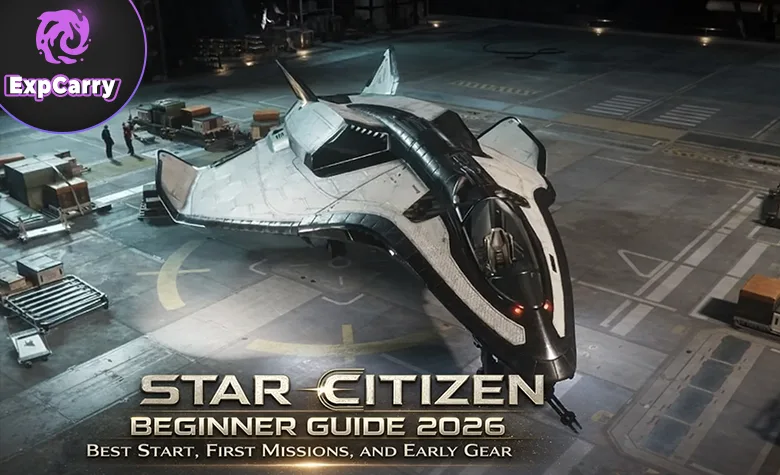
Starting Star Citizen in 2026 can feel overwhelming. New players enter a Persistent Universe built around physical inventory, personal hangars, ship retrieval, medical regeneration, contracts, reputation, cargo handling, combat, mining, and travel between Stanton, Pyro, and Nyx without immediately knowing which systems matter during the first few hours.
This Star Citizen beginner guide gives you a practical route from your first login to a stable progression loop. You will learn where to start, how to choose a Primary Residence, what to do after spawning, which contracts to accept first, how inventory and ship claims work, how to earn your first aUEC, when to build reputation, and which career path to explore next.
Quick answer: Start in Stanton, complete the New Player Experience, learn your home landing zone and personal hangar, establish a convenient operating routine, prepare inexpensive replacement equipment, and focus on one reliable contract or money-making loop. Move into Pyro or Nyx only after you can navigate, land, refuel, recover from death, replace equipment, and handle ship loss confidently.
Last verified: September 2026. This guide is designed around the current Star Citizen Persistent Universe while avoiding unnecessary patch-specific strategies that can become obsolete after an update.
Star Citizen Beginner Checklist
- Choose Stanton if you want the safest environment for learning the basic systems.
- Select a Primary Residence based on convenience and the activities you want to try.
- Complete the New Player Experience and tutorial tasks.
- Learn how to use your personal hangar, ASOP terminals, and ship retrieval.
- Choose a convenient medical regeneration point.
- Prepare several inexpensive replacement equipment sets.
- Learn Personal Inventory, Storage Access kiosks, ship storage, and freight handling.
- Start with low-risk delivery, hauling, investigation, or entry-level combat contracts.
- Keep an aUEC reserve for fuel, repairs, ammunition, insurance claims, and replacement gear.
- Build reputation with employers connected to the activity you actually enjoy.
- Upgrade your ship only when the upgrade solves a real progression limitation.
Best Starting System for New Players
Why Most Beginners Should Start in Stanton
Stanton is the best starting system for most new players because it combines established landing zones, orbital stations, shops, medical facilities, fuel services, contracts, and relatively convenient recovery routes. It gives you enough infrastructure to learn the core systems without adding unnecessary frontier risk.
Pyro and Nyx are already accessible parts of the Persistent Universe, but both demand more preparation. Pyro is significantly more lawless, while Nyx is a frontier system with its own locations, contracts, and progression opportunities. If you want to explore the latter later, our Star Citizen Nyx System Guide covers the system in more detail.
Use Stanton to learn:
- Quantum navigation and route planning.
- Hangar access, takeoff, landing, and ship storage.
- Fuel, repair, and ammunition management.
- Personal and local inventory management.
- Medical treatment and regeneration.
- Contracts, mission markers, and reputation.
- Cargo handling and freight systems.
- Ship insurance claims and replacement procedures.
Travel deeper into Pyro or Nyx after these actions have become routine rather than something you still solve through trial and error.
Best Starting Location in Star Citizen
There is no single perfect Primary Residence for every player. Your choice determines where you initially begin and where your starting ships, vehicles, equipment, and other stored items are located, so convenience matters more than scenery.
| Starting city | Best for | Orbital station | Main consideration |
|---|---|---|---|
| New Babbage | General learning, shopping, microTech activities | Port Tressler | Large surface location, but strong all-purpose infrastructure |
| Lorville | Hurston contracts and central Stanton access | Everus Harbor | The city and transport network take time to learn |
| Area18 | Shopping, weapons, and ArcCorp activities | Baijini Point | Dense urban navigation can initially be confusing |
| Orison | Crusader activities and access to the Crusader area | Seraphim Station | Atmospheric travel can add time to some routes |
Recommended All-Purpose Start: New Babbage
New Babbage remains a strong general recommendation for a first Primary Residence. It offers extensive commercial areas, medical services, vehicle access, a personal hangar, and straightforward access to the microTech region. It is also particularly practical if you own or intend to use ground vehicles.
Lorville, Area18, and Orison are still perfectly viable choices. The best starting location is ultimately the one that puts you near the contracts, shops, and activities you intend to use most often.
Do not overthink this decision. Your Primary Residence matters for initial storage and logistics, but you can travel throughout the universe and establish different operating locations once you understand the game.
Explore services related to this guide, selected from our Star Citizen catalog.
View All Star Citizen Services
What to Do After Your First Spawn
1. Complete the New Player Experience
After choosing your starting location, Star Citizen can offer the New Player Experience, a tutorial sequence designed to introduce the basic systems and assign several introductory tasks. Follow it instead of immediately chasing higher-paying contracts.
Your first objective is not maximum income. It is becoming able to repeat the essential actions without wasting time or losing equipment.
Learn how to:
- Open mobiGlas and use the Contracts Manager.
- Navigate elevators, public transport, hangars, and location signs.
- Retrieve a ship through an ASOP terminal.
- Request takeoff and landing clearance.
- Set a quantum route and identify navigation markers.
- Land and store a ship correctly.
- Access your local inventory and equip your character.
2. Learn Your Personal Hangar and ASOP Terminals
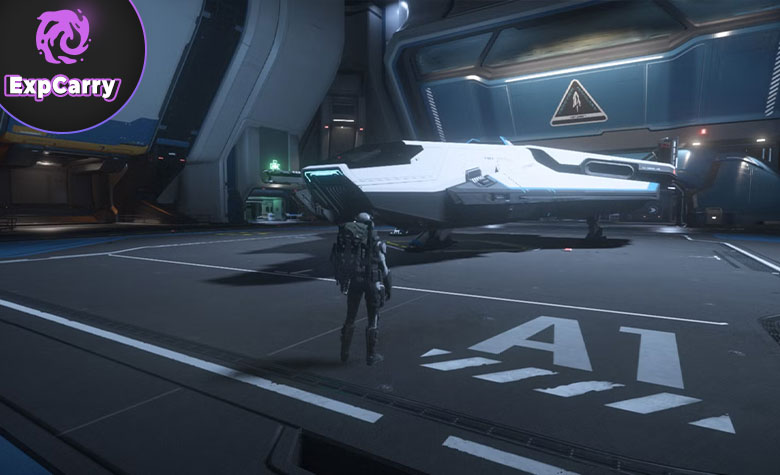
Your personal hangar is one of the most important logistics locations to understand. Learn where the ASOP terminal, hangar elevators, cargo facilities, and inventory access points are before beginning long or expensive activities.
ASOP terminals are used to manage your available ships and vehicles. When a ship is available locally, you can retrieve it. If it is destroyed, stolen, stranded, or otherwise unavailable, you may need to file an insurance claim before obtaining a replacement.
3. Choose a Convenient Regeneration Point
Star Citizen uses medical regeneration after death. Visit an appropriate medical facility or medical bed and set the regeneration point you want to use when possible.
A convenient regeneration location can substantially reduce recovery time after a failed contract. If your selected regeneration bed is unavailable or out of range, the game can return you to your home location instead, so understand where both locations are before taking major risks.
4. Prepare Replacement Equipment
Do not carry your most valuable equipment simply because you own it. Death, failed recovery attempts, hostile players, or technical issues can separate you from items carried on your character.
Prepare several inexpensive replacement sets containing:
- An undersuit and helmet.
- Light or medium armor when combat is expected.
- A Multi-Tool and any attachment required for your activity.
- MedPens or other appropriate medical equipment.
- A primary weapon and compatible ammunition for FPS contracts.
- Food and drinks for longer sessions.
Carry only what the current activity requires. A disposable loadout is often more useful to a beginner than an expensive set you are afraid to lose.
How Star Citizen Inventory Works
Star Citizen does not use one unlimited global inventory. Equipment and other items are associated with physical locations, local storage, your character, ships, vehicles, or containers. Learning where an item actually is becomes part of normal progression.
Personal and Local Inventory
Your Primary Residence initially holds much of your starting property. Storage Access kiosks at supported locations allow you to manage locally stored equipment, while your Personal Inventory contains items physically carried by your character.
If an item is stored somewhere else in the universe, you generally need to travel to that location or physically transport it. Treat inventory management as logistics rather than a global bank.
Freight and Larger Items
Larger cargo, containers, equipment, and certain other items use hangar and freight systems. Before accepting a hauling contract, verify that your ship has sufficient cargo capacity and that you understand how the pickup and delivery process works at both ends of the route.
Ship and Vehicle Storage
Ships and vehicles can also provide dedicated inventory through compartments, lockers, weapon racks, cargo grids, or other storage depending on the vehicle. Use appropriate storage instead of leaving important equipment loose inside the cabin.
Do not assume that an insurance claim will restore everything you placed inside a ship. Ship replacement, insured loadouts, cargo, and personal possessions are separate considerations.
Best First Contracts in Star Citizen
The best beginner contract is not necessarily the one showing the highest reward. Choose activities that teach a reusable mechanic while keeping the financial cost of failure manageable.
| Contract type | What it teaches | Beginner risk |
|---|---|---|
| Delivery | Navigation, landing, item handling, location access | Low to medium |
| Hauling | Cargo capacity, freight handling, route planning | Low to medium |
| Investigation | Searching locations, EVA, navigation, exploration | Medium |
| Maintenance or service tasks | Tool use, interaction systems, location navigation | Low to medium |
| Entry-level bounty hunting | Ship combat, targeting, shields, weapon management | Medium |
| Entry-level mercenary work | FPS combat, ammunition management, medical recovery | Medium to high |
Recommended Contract Progression
- Complete the introductory tutorial tasks.
- Run one or two low-risk delivery, hauling, or investigation contracts.
- Practice landing and ship recovery at several locations.
- Try an entry-level ship combat contract if your ship and piloting skills are suitable.
- Prepare a replaceable FPS loadout before entering mercenary content.
- Begin building reputation with employers connected to your preferred activity.
Contract availability, locations, and payouts can change as Star Citizen evolves. Always read the description, destination, required equipment, legal status, and expected opposition before accepting an unfamiliar mission.
How to Make Your First aUEC
Your first money-making goal should be consistency, not the highest possible aUEC-per-hour figure. A route that you can complete repeatedly with a cheap ship and minimal losses is more valuable to a beginner than a theoretically profitable activity that regularly ends in failed contracts or destroyed cargo.
Good early options include delivery and hauling contracts, basic investigations, low-level bounty hunting once you understand ship combat, and entry-level mercenary work after preparing a disposable FPS loadout.
Keep part of your earnings as operating capital. You need aUEC for ammunition, repairs, fuel, medical supplies, insurance-related costs, equipment replacement, rentals, cargo, and future upgrades.
Avoid putting your entire balance into one ship, one cargo run, or one expensive equipment set. First build enough reserve that a failed mission does not stop your progression.
Before planning a larger purchase, use the Star Citizen aUEC Calculator to estimate the amount of currency you still need.
How Reputation Affects Beginner Progression
Many Star Citizen contracts are connected to employers, organizations, and reputation progression. Successfully completing work can improve your standing and unlock access to additional or higher-level opportunities, while failed or abandoned contracts can slow that progression.
Beginners should avoid constantly switching between unrelated activities. If you enjoy bounty hunting, hauling, mercenary work, or another contract chain, spend enough time with the relevant employers to understand how that progression develops.
Different factions and systems use reputation in different ways. For a deeper explanation of organizations, progression, unlocks, and newer factions such as InterSec, see our Star Citizen Reputation Guide.
Which Star Citizen Career Should You Start With?
You do not need to choose one permanent profession. Your first career should simply teach useful mechanics while helping you discover which part of Star Citizen you enjoy enough to invest in.
| Activity | Beginner friendly? | What you learn |
|---|---|---|
| Delivery | Yes | Navigation, landing, item handling |
| Hauling | Yes | Cargo logistics, route planning, ship capacity |
| Bounty Hunting | Yes, after flight basics | Targeting, weapons, shields, ship combat |
| Mercenary / FPS | Moderate | Ground combat, healing, ammunition, equipment recovery |
| Mining | Yes, after basic flight | Scanning, extraction, materials, refining |
| Cargo Trading | Moderate | Capital management, routes, cargo risk |
| Reputation Progression | Yes | Contract unlocks, employer progression, higher-tier content |
Mining as a Beginner Career
Mining is a good option once you are comfortable flying and navigating between locations. It introduces resource scanning, extraction, material value, ship or vehicle specialization, and the industrial side of the economy.
Use our Star Citizen Mining Guide to understand the mining loop, then continue with the Star Citizen Refinery Guide when you are ready to process raw materials more efficiently.
Best Starter Ships for New Players
Your existing starter ship is usually enough to learn Star Citizen. Do not upgrade immediately because another ship appears faster, stronger, or more profitable. First identify the gameplay loop you actually enjoy and the limitation your current ship is creating.
| Ship | Best use | Main advantage | Limitation |
|---|---|---|---|
| Aurora-series starter | Basic travel and introductory contracts | Simple entry into general gameplay | Limited cargo and interior utility |
| Mustang Alpha | Flight practice and light combat | Responsive flight characteristics | Less practical interior utility |
| Drake Cutter | General exploration and small cargo activities | Accessible interior and practical utility | Limited combat performance |
| Avenger Titan | Mixed contracts and early combat | Useful balance of combat, cargo, and interior space | More expensive than basic starter options |
The Avenger Titan is a capable multipurpose step up for players who know they want mixed gameplay, while the Cutter favors general utility and accessible interior space. The Mustang Alpha is better suited to players focused primarily on flying and light combat.
None of these ships removes the need to learn navigation, landing, inventory management, insurance claims, or recovery after death.
Recommended Beginner FPS Loadout
Your first combat loadout should be inexpensive, familiar, and easy to replace. Medium armor can provide a useful balance of protection and storage, while lighter equipment is often sufficient for low-risk non-combat activities.
A practical entry-level FPS loadout includes:
- One light or medium armor set.
- A compatible backpack when additional storage is useful.
- One familiar rifle, SMG, shotgun, or other primary weapon.
- Several compatible magazines.
- MedPens or other appropriate medical equipment.
- A Multi-Tool when required by the activity.
The best beginner weapon is not necessarily the most expensive one. Choose equipment you understand and can replace without damaging your operating budget. For more detailed weapon choices and combat roles, see our Star Citizen FPS Weapons Guide.
Ship Claims, Insurance, Repairs, and Recovery
If your ship is destroyed, stolen, stranded, or otherwise unavailable, visit an ASOP terminal and file an insurance claim when necessary. A replacement becomes available after the claim process, and additional costs or waiting periods may apply depending on the situation.
One important distinction is that replacing the ship does not automatically mean every custom component or item associated with it is restored. Custom ship equipment can require appropriate loadout insurance, while cargo and personal possessions should be treated separately.
Important rules for beginners:
- Store a ship normally whenever possible instead of filing unnecessary claims.
- Do not assume cargo or loose personal items will return with a replacement ship.
- Understand whether modified ship components are covered by your current loadout insurance.
- Repair, refuel, and restock before beginning a long route.
- Keep enough aUEC available to recover from at least one failed contract.
- Never place all of your available wealth into one cargo run.
Common Star Citizen Beginner Mistakes
Travelling to Dangerous Systems Too Early
Pyro and Nyx offer important content, but they are not required for learning the basic mechanics. Build navigation knowledge, equipment reserves, fuel awareness, and a recovery routine in Stanton before taking unnecessary frontier risks.
Buying a New Ship Before Choosing a Career
A specialized mining ship provides little value if you discover that you prefer bounty hunting or FPS missions. Test different gameplay loops through starter contracts, rentals, borrowed ships, or group play before committing a large amount of aUEC.
Carrying Every Valuable Item
Only equip what you are prepared to lose. Leave rare armor, expensive weapons, and unnecessary equipment in storage until you understand death and recovery mechanics.
Ignoring Contract Details
Contracts can require cargo capacity, specific tools, combat capability, legal authorization, long-distance travel, or entry into contested locations. Check the destination and objective before leaving your hangar.
Spending All Available aUEC
Maintain an operating reserve for fuel, repairs, ammunition, medical supplies, insurance costs, equipment, rentals, and unexpected losses. A purchase that leaves you unable to continue playing is not a useful upgrade.
Treating Every Technical Problem as Player Error
Star Citizen remains in active alpha development. Server problems, mission issues, inventory errors, inaccessible locations, ship retrieval problems, and other technical faults can still occur. Do not keep adding equipment, cargo, or currency to an activity that is clearly malfunctioning.
Star Citizen Beginner FAQ
What is the best Star Citizen starting location?
New Babbage is a strong all-purpose starting option, but Lorville, Area18, and Orison are all viable. The best Primary Residence is the one that gives you convenient access to the activities and logistics you intend to use most often.
Should beginners start in Stanton, Pyro, or Nyx?
Stanton is the best choice for most beginners because it offers a mature network of major landing zones, stations, shops, services, and relatively forgiving logistics. Move into Pyro or Nyx after you understand navigation, equipment management, medical recovery, and ship replacement.
What should a new player do after the tutorial?
Learn your hangar and inventory, prepare a cheap replacement loadout, complete several low-risk contracts, build an aUEC reserve, and start reputation progression with an employer connected to the activity you enjoy most.
What is the best first way to earn aUEC?
Choose a repeatable low-risk activity rather than chasing one temporary meta. Delivery, hauling, investigation, entry-level bounty hunting, and other basic contracts can all work if you can complete them reliably and keep your operating costs low.
What happens to equipment after death?
Items carried by your character can be lost or require recovery depending on what happened. Keep spare equipment at a convenient storage location so one death does not prevent you from continuing.
Should I buy the Avenger Titan immediately?
No. Learn your existing starter ship first. The Avenger Titan is a versatile option, but an upgrade should solve a specific limitation rather than replace a starter ship before you know what kind of gameplay you prefer.
How long does it take to learn Star Citizen?
You can learn basic movement, ship retrieval, navigation, landing, inventory, and simple contracts within your first several sessions. Becoming comfortable with combat, cargo logistics, reputation, mining, medical recovery, and multi-system travel takes longer because Star Citizen contains many interconnected systems.
Final Star Citizen Beginner Route
- Start in Stanton and choose a practical Primary Residence.
- Complete the New Player Experience.
- Learn your personal hangar, ASOP terminals, and inventory access.
- Choose a convenient regeneration point.
- Prepare several inexpensive replacement equipment sets.
- Complete low-risk contracts and build an operating aUEC reserve.
- Develop reputation with employers connected to your preferred activity.
- Test several careers before making an expensive ship purchase.
- Upgrade only when your current ship creates a clear progression bottleneck.
- Explore Pyro and Nyx after you can reliably recover from ship loss or death.
The fastest way to progress as a new Star Citizen player is not to chase the highest advertised payout immediately. Build a repeatable operating routine first. Once navigation, inventory, medical recovery, ship handling, and basic contract progression become automatic, mining, cargo, combat, reputation farming, and multi-system exploration become substantially easier.