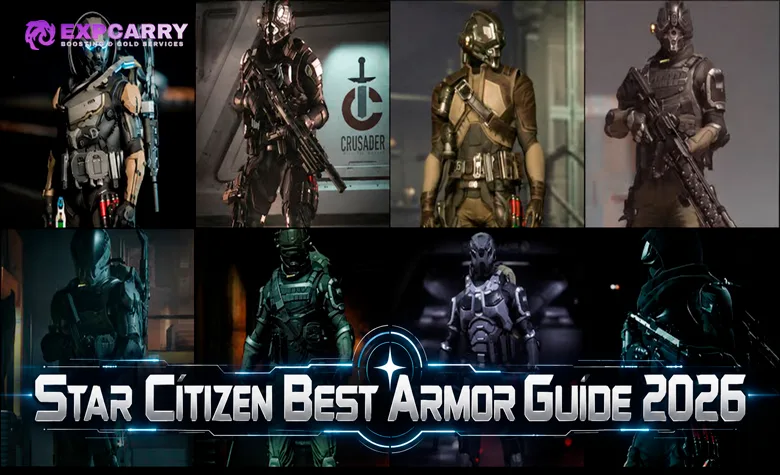
The best armor in Star Citizen depends on whether you need protection for FPS combat, mobility for PvP or environmental resistance for mining and exploration. In Alpha 4.10.2 LIVE, personal armor includes Light, Medium, Heavy and Super Heavy classes, alongside specialized utility suits. ORC-mkX is a practical medium-armor choice for everyday missions, ADP-mk4 and Morozov-SH provide stronger combat protection, and BUL-H4 supports a specialized super-heavy infantry loadout. Venture favors mobility, while Aril, Pembroke and Novikov are better suited to industrial or hazardous environments. The correct set also depends on carrying capacity, equipment compatibility and how easily you can replace it. This guide compares current protection values, explains movement trade-offs and identifies documented shops, loot sources and crafting paths.
Short answer: Choose ORC-mkX for balanced PvE and PvP, ADP-mk4 or Morozov-SH for heavy combat, Venture for mobility and BUL-H4 for specialized frontline operations. Use Aril for routine mining, Pembroke for extreme heat and Novikov for extreme cold; environmental protection matters more than ordinary damage reduction in hazardous locations.
Star Citizen Armor Classes: Light, Medium, Heavy and Super Heavy
Armor classes determine the basic trade-off between protection and movement. Heavier armor generally provides greater resistance to incoming damage and additional equipment capacity, but reduces agility and increases physical demands. Lighter equipment allows more freedom of movement and is often preferable when speed, positioning and repositioning matter more than absorbing additional hits.
Star Citizen also distinguishes combat armor from specialized utility equipment. A mining suit or exploration suit can provide environmental protection that ordinary heavy combat armor cannot match. These categories should not be compared solely through their damage-reduction percentages.
| Class | Protection | Mobility | Best Use |
|---|---|---|---|
| Light | Lower | Highest among standard combat classes | Scouting, piloting, mobile PvP |
| Medium | Balanced | Moderate | Bunkers, missions, general FPS combat |
| Heavy | High | Reduced | Defensive PvE, assault operations, sustained firefights |
| Super Heavy | Extremely high | Specialized powered-suit movement | Heavy infantry and Vendetta HMG operations |
| Heavy Utility | Environment-focused | Depends on suit | Extreme temperatures and hazardous exploration |
For ordinary missions, medium armor is often the most convenient compromise. Heavy armor becomes more attractive when repeated enemy hits are likely, while light armor helps players who rely on quick movement. Super Heavy is a separate equipment system and should not be treated as simply another conventional four-piece armor set.
How Much Damage Does Each Armor Class Reduce?
Current Alpha 4.10.2 equipment records provide concrete examples of protection differences. Standard ORC-mkX pieces list 30% damage reduction, while ADP-mk4 provides 40% on its standard armor pieces. Light Venture equipment generally provides approximately 20%, although its standard core is recorded at 17%. The BUL-H4 super-heavy suit lists 88% physical and energy damage mitigation in current extracted data, with lower values for certain other damage types.
These are component statistics from community-maintained 4.10.2 records, not universal values assigned to every piece in an armor category. Different armor families, damage types and crafted-quality modifiers can change the result. The percentages also should not be added together across body slots: protection depends on the equipment covering the body part struck.
For example, wearing heavy torso armor with a light helmet does not provide heavy protection to the head. Similarly, a high damage-reduction value does not make the player immune to injury, environmental hazards or combat conditions that bypass the expected protection.
Mobility, Sprinting and Stamina
Armor weight affects more than running speed. Heavy equipment changes movement responsiveness and stamina demands, which can make repeated sprints, repositioning and longer engagements less convenient. The effect matters particularly in PvP, where reaching cover or changing angles can prevent damage more effectively than absorbing additional hits.
Heavy armor can also make piloting less practical because of its weight and potential effects on G-force tolerance. A player who spends most of the session flying may have little reason to remain in a full heavy combat loadout. Light armor or a suitable flight suit is often more practical until the player expects to enter an FPS encounter.
There is no verified universal movement-speed percentage that applies to every current armor family. Actual mobility depends on the equipped pieces and current game implementation, so older movement penalties should not be copied as fixed Alpha 4.10.2 values.
Inventory Capacity, Weapon Slots and Backpacks
Armor components also determine how much equipment a character can carry and which attachments are supported. Torso armor commonly provides magazine slots, weapon attachment points and backpack compatibility, while other armor components may supply additional utility and consumable slots.
Current equipment records show that the ORC-mkX Core supports six spare magazine attachments and a Size 1–2 backpack. Certain Morozov-SH heavy cores support eight spare magazines and backpacks up to Size 3. Venture is more restricted, with its light core supporting four spare magazines and a Size 1 backpack.
This makes heavier armor useful for extended missions involving considerable ammunition or recovered equipment. However, additional capacity is not always worth the movement penalty. Choose a backpack and armor core according to the intended activity rather than automatically equipping the largest available combination.
Best Star Citizen Armor Sets for PvE, PvP and Mining
The following selections prioritize practical roles rather than creating a universal tier list. Each recommendation is supported by current armor classifications and equipment records. Acquisition methods are summarized here and explained in more detail below.
| Armor Set | Class | Recommended Use | Acquisition |
|---|---|---|---|
| Venture | Light | Scouting, piloting, mobile FPS | Shops for selected variants, loot, blueprints for supported pieces |
| ORC-mkX | Medium | General PvE and balanced PvP | Armor shops, loot, selected crafting recipes |
| Artimex | Medium | Alternative combat set and collectible equipment | Loot and crafting blueprints |
| ADP-mk4 | Heavy | Defensive PvE and assault combat | Shops, loot, blueprints |
| Morozov-SH | Heavy | Extended FPS missions and equipment-heavy loadouts | Shops, selected loot sources, blueprints |
| BUL-H4 | Super Heavy | Specialized frontline and Vendetta HMG loadouts | Siege of Orison blueprints, loot, Wikelo variant |
| Aril | Medium | Mining and general industrial work | Industrial shops, loot, blueprints |
| Pembroke | Heavy Utility | Extreme heat | Selected shops and crafting |
| Novikov | Heavy Utility | Extreme cold and exploration | Selected shops and crafting |
These recommendations use standard equipment characteristics. Rare color variants, modified versions and crafted armor with quality-based bonuses may have different availability or statistics. The best practical set is one that suits your mission and can be replaced without an excessive amount of farming.
Best Armor for PvE: Bunkers, Bounties and Hostile Facilities
PvE missions often involve several enemies, limited cover and extended periods away from shops or medical facilities. Protection is useful, but ammunition capacity, movement and replacement cost also matter. For most routine FPS missions, medium armor remains a sensible starting point, with heavy armor reserved for more demanding combat.
ORC-mkX: Best General-Purpose Medium Armor
ORC-mkX is a medium armor family manufactured by Clark Defense Systems. Standard pieces provide 30% physical and energy damage reduction in current 4.10.2 equipment records, with a listed environmental range of approximately -61°C to 91°C. Its balance of protection, equipment capacity and mobility makes it suitable for bunker missions, routine bounty-related FPS combat and general exploration where extreme hazard protection is unnecessary.
The armor is also relatively convenient to replace. Current shop records list ORC-mkX variants at Port Tressler, Everus Harbor, Tammany and Sons in Lorville and Cubby Blast in Area18. Availability depends on the specific part and color, so check helmet, core, arms and legs individually rather than assuming every location sells a matching complete set.
For players who frequently lose equipment or change missions, ORC-mkX is a more practical default than collecting rare armor for every deployment. It offers meaningful protection without committing to a heavy loadout.
ADP-mk4: Best High-Protection Combat Option
ADP-mk4 is heavy combat armor designed for demanding infantry engagements. The standard pieces provide 40% physical and energy damage reduction in current records, with high-quality crafted versions capable of additional improvements. Its heavier construction and protective design make it a strong choice for hostile facilities, defensive positions and missions where the player expects sustained incoming fire.
The trade-off is reduced mobility compared with lighter equipment. ADP-mk4 is less attractive when fast repositioning or repeated long-distance sprinting is the main requirement. It also does not eliminate the need to use cover, manage medical supplies and protect exposed body parts.
Current item records confirm that selected ADP-mk4 pieces are available through in-game armor shops, including variants listed at Stanton Gateway locations, Port Tressler and Cubby Blast. Pieces can also be recovered as loot or manufactured when the corresponding blueprints are unlocked. Craftable parts use materials such as Ouratite and Aslarite, but an existing recipe record does not automatically mean the blueprint is unlocked for every player.
Morozov-SH: Best Heavy Armor for Long FPS Missions
Morozov-SH is another heavy armor family, offering 40% standard physical and energy damage reduction with a wider listed temperature range than several conventional combat sets. Its protective design and carrying capacity make it useful for longer bunker operations, mercenary assignments and missions requiring additional ammunition or utility tools.
Its current core variants can support eight spare magazines and a Size 1–3 backpack, giving the wearer more equipment flexibility than lighter alternatives. The same heavy classification carries movement disadvantages, so Morozov-SH is better suited to a deliberately prepared combat run than casual travel between stations.
Several Morozov-SH variants are sold at locations such as Port Tressler, Everus Harbor and other Stanton armor shops. Selected pieces also have loot or crafting acquisition paths, depending on the variant. Check the exact item because individual colorways have different shop and blueprint availability.
Explore services related to this guide, selected from our Star Citizen catalog.
View All Star Citizen Services
Best Armor for PvP and Contested Zones
PvP equipment must balance survivability with the ability to move, aim and reposition under pressure. Heavy protection can help during direct exchanges, but a slower player can become easier to track or flank. The correct choice depends on whether you expect open movement, close-quarters combat or a defensive position with teammates.
Venture: Best Lightweight Mobility Option
Venture is an RSI light armor family intended for mobile operation and EVA use. Standard arm and leg components provide approximately 20% physical and energy damage reduction, while the standard core is recorded at 17%. The reduced weight makes it suitable for scouting, piloting and players who depend on movement rather than absorbing repeated hits.
Venture is not the best choice for prolonged exposure to concentrated gunfire. Its lighter protection and smaller equipment capacity are meaningful limitations in contested facilities or prolonged bunker engagements. However, it remains useful for players who want to preserve mobility and avoid carrying heavy armor during ordinary travel.
Current records list selected Venture variants in shops, including Venture Core Sienna at CRU-L4. Other pieces can be found through loot and supported crafting paths. Check the individual variant's source before planning to purchase an entire matching set.
Artimex: Medium Armor for Mobile Combat
Artimex is medium armor manufactured by Quirinus Tech. Current standard crafting data lists 30% physical and energy damage reduction, placing it in the same general protection category as ORC-mkX. Its appeal is a combination of medium-class handling, distinctive appearance and access through gameplay rather than a unique defensive statistic that makes every other medium set obsolete.
Artimex is associated with equipment loot and crafting records. The standard Artimex Core is listed as obtainable from loot containers, while its crafting blueprint exists in current item data. No ordinary shop source is established for that specific core in the checked records.
Choose Artimex when you already have a suitable set or want to pursue it as a collectible loadout. For routine PvP where replacing equipment quickly matters, purchasable medium armor may be more convenient. The broader Star Citizen FPS Weapons Guide explains which weapons work well with different combat roles and loadouts.
Should You Use Medium or Heavy Armor in PvP?
Medium armor is the safer general-purpose choice when fights involve frequent movement, short exposure windows and repeated repositioning. Heavy armor becomes more attractive when the player expects sustained defensive combat, holds fixed positions or supports teammates in confined spaces.
Neither class guarantees victory. A player in heavy armor can still lose to accurate shots, poor positioning or insufficient medical support, while a lightly equipped player has less room for mistakes when caught without cover. Compare the protection gained against the movement penalty you actually experience with your preferred weapons.
BUL-H4: Best Specialized Super-Heavy Armor
BUL-H4 is a Clark Defense Systems super-heavy combat platform introduced in the Alpha 4.10 series. Unlike ordinary heavy armor, it uses a powered full-body suit with a matching helmet and H4-PBF Ammo Carrier. Its design is connected to the Apocalypse Arms Vendetta heavy machine gun.
Current Alpha 4.10.2 crafting records list 88% standard physical and energy damage reduction for the armor and helmet, with a modeled maximum of approximately 90% for high-quality crafts. Other damage categories can have lower mitigation values. These figures are extracted item statistics, not proof of immunity to every weapon or combat condition. The set also has special equipment restrictions and should not be treated as a normal replacement for ADP-mk4 or Morozov-SH.
Super-heavy armor enables the use of specialized heavy weapons, but changes mobility, equipment handling and medical interactions. In particular, its limited medical equipment attachment options make conventional self-treatment less convenient than with standard armor. Group support becomes especially valuable during extended engagements.
How to Get BUL-H4 Armor
The base BUL-H4 crafting blueprints are associated with the reworked Siege of Orison operation. The relevant reward pool contains the BUL-H4 Armor, BUL-H4 Helmet and H4-PBF Ammo Carrier as separate designs. Completing the Retake Platforms From Nine Tails contract awards a blueprint from the relevant reward pool, but obtaining one recipe does not automatically unlock all three components.
The Snow Camo version follows a separate Wikelo progression path. It should not be confused with the standard Siege of Orison blueprint rewards. For the complete unlock and crafting requirements, see the BUL-H4 Armor, Vendetta and Ammo Guide.
This is a specialized combat objective rather than a sensible first armor investment. Players who do not intend to use its supported heavy-infantry role will usually gain more flexibility from a conventional medium or heavy setup.
Best Armor for Mining and Industrial Activities
Industrial armor should be selected for the work environment, equipment access and carrying capacity rather than maximum combat protection. Mining and salvage operations may involve EVA, hand tools, physical cargo and hazardous surface temperatures. The best mining outfit therefore depends on whether you are collecting ordinary minerals or entering an extreme environment.
Aril: Best Everyday Mining Armor
Aril is Greycat Industrial's medium armor family designed for mining activities. Its protective structure, tool-oriented design and backpack compatibility make it useful for hand mining, general industrial missions and collecting small resources. Current 4.10.2 crafting records list 30% standard physical and energy damage reduction for its armor pieces.
Aril offers ordinary medium-class protection rather than the extreme-temperature specialization of Pembroke or Novikov. It is therefore a practical work outfit for standard mining environments but not a substitute for a dedicated hazard suit when environmental conditions exceed its safe operating range.
Current acquisition records identify Aril equipment in selected shops, including Providence Surplus at Orison for documented pieces, as well as loot and crafting sources. Availability differs by piece and variant, so check the exact item before traveling to purchase a full set.
Pembroke: Best Armor for Extreme Heat
Pembroke is a Caldera heavy utility exploration suit designed for hot environments. Its recorded operating range extends from approximately -75°C to 225°C, substantially beyond the upper-temperature protection of ordinary combat armor. This makes it relevant to hot planetary surfaces and industrial locations where environmental exposure is a greater threat than enemy gunfire.
Pembroke is a specialized exploration suit with a matching helmet and backpack, not a conventional four-piece combat armor set. Current standard crafting records list 25% physical and energy damage reduction for its principal wearable components. Its main benefit is environmental protection, so comparing it directly with a 40% heavy combat set would ignore the purpose of the equipment.
The suit and helmet have documented shop sources including Tammany and Sons in Lorville and Skutters at GrimHEX. Crafting recipes also exist, using Stileron and Aslarite for the suit. Inspect the required temperature rating before entering hazardous terrain rather than assuming that any heavy armor provides equivalent heat protection.
Novikov: Best Armor for Extreme Cold
Novikov is Caldera's cold-environment exploration suit. Current equipment data lists a temperature range of approximately -225°C to 75°C, making it appropriate for extremely cold locations where ordinary medium and heavy combat armor would provide substantially less protection.
The Novikov system includes a specialized exploration suit, helmet and compatible backpack. Current crafting records list 25% standard physical and energy damage reduction for its protective wearable components, but its primary strength is cold-weather endurance and environmental resistance rather than conventional FPS protection.
Novikov pieces are listed at multiple cargo and equipment shops, including Everus Harbor and Port Tressler, with additional sources in other accessible systems. Crafting recipes also exist. The exact required pieces should be checked before departure because a partial Novikov loadout is not equivalent to the complete environmental suit.
Radiation and Other Environmental Hazards
Extreme-temperature resistance is not the same as radiation protection. Current armor records include separate radiation-protection values and radiation scrub rates, meaning two suits with similar temperature performance may provide different protection from irradiated environments.
For example, standard equipment records list substantially higher radiation-protection values for some heavy utility suits than for conventional light, medium or heavy combat equipment. However, those values do not establish that the wearer can remain indefinitely inside every irradiated cave or industrial hazard zone.
Before entering a hazardous area, verify the equipment's temperature rating, radiation protection and any relevant environmental conditions. Bring appropriate medical supplies and plan an extraction route. A high combat mitigation percentage does not compensate for environmental exposure outside the suit's supported limits.
How to Get the Best Armor in Star Citizen
Armor acquisition falls into three main categories: buying equipment, recovering physical items through gameplay and unlocking crafting blueprints. A particular armor family may support several methods, but variants and individual pieces can have different availability. Always verify the exact item rather than assuming one source applies to the complete family.
Buying Armor From Shops
Purchasing standard armor is generally the simplest route for a replaceable everyday loadout. Current item records identify selected ORC-mkX, ADP-mk4, Morozov-SH, Aril, Venture, Pembroke and Novikov pieces at in-game equipment vendors.
Useful documented examples include:
- Port Tressler: Selected ORC-mkX, ADP-mk4 and Morozov-SH variants, plus Novikov equipment.
- Everus Harbor: Selected ORC-mkX and Morozov-SH pieces, with additional equipment in relevant shops.
- Tammany and Sons, Lorville: Pembroke suit and helmet, along with selected combat armor variants.
- Cubby Blast, Area18: Selected ORC-mkX and ADP-mk4 items.
- Skutters, GrimHEX: Pembroke and other personal equipment.
- Industrial and cargo shops: Selected Aril, Novikov and other utility equipment.
Shop stock is item-specific. A store carrying an ORC-mkX helmet may not stock the matching core in the desired color, while a variant available in Stanton might not be sold at the same location in Pyro or Nyx. Check current store inventory and individual item pages before planning a shopping route.
Looting Armor From FPS Missions
Some armor families are obtainable from equipment containers, hostile NPCs and restricted mission areas. Artimex is a relevant example because current records confirm physical loot availability without an ordinary shop listing for its standard core. Specialized sets such as Antium, Corbel and other collectible variants may require more targeted gameplay.
Looting an armor piece does not provide its crafting blueprint. It also does not guarantee that the same container will produce the matching helmet, arms and legs. Inspect recovered equipment and maintain a record of the missing pieces when completing a collection.
For example, the Bokto Armor Guide covers another specialized armor acquisition route and the requirements involved in completing the set.
Crafting Armor With Blueprints
Crafting provides an additional route to obtaining armor and allows suitable material quality to influence supported statistics. Current 4.10.2 blueprint records contain recipes for Venture components, ORC-mkX, Artimex, ADP-mk4, Morozov-SH, Pembroke, Novikov and BUL-H4 equipment, among other families.
The presence of a recipe in extracted game data does not guarantee that every player can already obtain its blueprint. Unlock sources depend on the relevant mission pools and faction progression, and armor pieces can require individual recipes. Before collecting crafting materials, confirm that the exact helmet, core, arms, legs or suit recipe is unlocked in your Fabricator.
The main ingredients vary between armor families. Current records associate ADP-mk4 with Ouratite and Aslarite, Artimex with Taranite, Lindinium and Aslarite, and Morozov-SH with Tungsten, Laranite and Aslarite. Utility suits such as Pembroke and Novikov use Stileron and Aslarite, while Aril uses Corundum, Tungsten and Aslarite.
The Bounty Hunter's Guild Blueprints Guide explains another important blueprint progression path and how to approach its unlock requirements.
Armor Quality, Damage Types and Mixed Loadouts
Armor comparisons become less reliable when they ignore the actual equipment pieces. The protection shown by a crafted component can differ from the standard store version because material quality affects supported statistics. Damage type and body location also matter, so a single reduction percentage should not be treated as a complete description of survivability.
Does Crafted Armor Have Better Protection?
Current 4.10.2 crafting records model damage-reduction improvements from higher-quality materials. ADP-mk4 pieces, for example, have 40% standard physical and energy damage reduction and a modeled maximum of 46% under the listed quality modifiers. ORC-mkX pieces are listed at 30%, potentially increasing to 33%, while Artimex uses a similar medium-armor baseline.
These maximum values are derived from extracted blueprint formulas. They do not guarantee that every theoretical maximum can be achieved through currently available materials, nor do they prove that a particular crafted version will outperform every alternative in actual combat.
Use the Fabricator's predicted output and the finished item's current statistics to evaluate a craft. Do not spend rare materials simply because a database displays a higher theoretical maximum.
Physical, Energy and Other Damage Types
Armor protection is influenced by incoming damage type as well as the equipped components. Current item records distinguish several resistance categories, including physical, energy, distortion, thermal and biochemical damage. Consequently, two sets with similar general mitigation may respond differently to a particular weapon or environmental threat.
Equipment also protects the body part it covers. A character using heavy core armor with light arms and legs has a mixed defensive profile, not a complete heavy-armor protection value across the entire body. Helmets are particularly important because their performance cannot be inferred from the torso component.
For consistent protection, wear compatible armor pieces appropriate to the expected threat. Mixing classes can be useful when reducing weight or improving equipment capacity, but the choice should be deliberate rather than based only on appearance.
Why the Undersuit and Helmet Matter
Most conventional combat armor is equipped over a suitable undersuit, with separate helmet, core, arm and leg components. A helmet also provides the protection and equipment functions required for supported EVA and hazardous-environment activities. Some specialist suits follow a different construction, combining major protective elements into a dedicated suit.
Before entering a vacuum or extreme environment, verify that the complete equipment configuration supports the conditions. Equipping an ordinary combat helmet with an unrelated specialist suit should not be assumed to reproduce the temperature or hazard protection of its intended matching equipment.
Recommended Armor Loadouts by Activity
A complete loadout includes more than armor protection. Weapons, medical supplies, ammunition and carrying capacity should be matched to the mission. These are practical equipment combinations rather than mandatory builds with fixed item counts.
PvE Bunker and Mercenary Loadout
Use ORC-mkX for ordinary FPS missions or Morozov-SH when stronger protection and additional equipment capacity are needed. Equip a compatible backpack, reliable primary weapon, sidearm, medical supplies and enough ammunition for the planned encounter. Before leaving, confirm that the loadout does not exceed your preferred carrying weight.
For higher-risk combat such as Siege of Orison, heavy armor can be worth the movement penalty when the group expects sustained fire. The Siege of Orison Guide covers the operation, its combat encounters and the associated progression rewards.
PvP Mobility and Assault Loadout
Choose Venture when movement is the primary goal, or ORC-mkX and Artimex when a balance of mobility and protection is preferable. Avoid filling every available inventory slot with unnecessary equipment, since the loadout's weight and handling can affect practical movement.
For defensive or coordinated heavy-infantry gameplay, ADP-mk4 and Morozov-SH offer additional protection. BUL-H4 is reserved for specialized situations where its powered suit and supported weapon role justify the restrictions.
Mining and Industrial Loadout
Use Aril for ordinary mining and utility work, with a suitable backpack and the required tools. Switch to Pembroke when high temperatures exceed the protection of ordinary armor, or Novikov for severe cold. Carry only the equipment needed for the operation and leave enough space for collected resources.
For areas with radiation, compare the suit's actual radiation protection separately from its temperature range. Environmental suitability should be checked before departure rather than after the player begins taking exposure damage.
Common Star Citizen Armor Mistakes
Most poor armor choices come from selecting the highest displayed protection without considering the task, or from assuming that every armor family is obtained in the same way. The following problems are worth checking before spending money or pursuing a rare set.
- Using heavy combat armor for extreme environments: A high damage-reduction value does not replace Pembroke or Novikov temperature protection.
- Ignoring mobility in PvP: More armor can reduce movement flexibility and make repositioning more difficult.
- Buying mismatched pieces: Confirm the helmet, core, arms and legs individually, including their variants and protection values.
- Assuming a blueprint is obtainable because it exists in a database: Verify its current unlock source before gathering resources.
- Using an incompatible backpack: Check the core's supported backpack sizes and attachment slots.
- Overvaluing rare cosmetic variants: A collectible appearance does not automatically provide better combat statistics than a standard set of the same class.
Prepare a replaceable everyday loadout before investing in expensive or difficult-to-farm equipment. This is particularly useful for players who alternate between mining, travel and FPS missions.
Star Citizen Best Armor FAQ
These answers address additional questions about armor classes, special equipment and the current crafting system.
Is heavy armor always better than medium armor in Star Citizen? No. Heavy armor generally provides stronger protection but reduces mobility and increases loadout weight. Medium armor can be more practical when movement, stamina and positioning are important.
What is the best armor for extreme temperatures? Pembroke is designed for extreme heat, with a recorded upper temperature rating of 225°C. Novikov is designed for extreme cold, with a recorded lower rating of -225°C. Neither rating guarantees protection against every other environmental hazard.
Can you craft better armor than the shop version? Some crafting recipes allow material quality to improve supported defensive statistics. However, extracted theoretical maximum values are not guaranteed results, and the required blueprint must be unlocked before production.
Conclusion
ORC-mkX is a dependable general-purpose choice, ADP-mk4 and Morozov-SH suit heavier combat, and Venture favors mobility. BUL-H4 is a specialized super-heavy platform, while Aril, Pembroke and Novikov address industrial and environmental needs. Choose equipment according to the mission, verify individual item availability and compare protection with movement and hazard resistance before upgrading.