
Higher-tier contracts in Star Citizen unlock through specific combinations of reputation, introductory missions, certifications, completed mission chains, and contract-specific requirements. A better ship or a larger account balance does not automatically unlock advanced hauling, bounty hunting, security, salvage, or industrial missions. To unlock your next contract, you must meet the requirements set by its issuing organization or mission giver.
This guide covers higher-tier contract unlocks in Star Citizen Alpha 4.10.2 LIVE: which missions to complete first, which ranks unlock advanced assignments, how prerequisite chains work, and how to investigate contracts that remain unavailable. Covalex Shipping provides a detailed example of rank-based hauling progression, while the Bounty Hunters Guild, Foxwell Enforcement, InterSec Defense Solutions, Adagio Holdings, Recco Battaglia, and Vaughn demonstrate other unlock conditions. Some detailed thresholds and prerequisites come from Alpha 4.10 and 4.10.1 mission records, with available 4.10.2 records used for additional verification. Database requirements do not guarantee that every mission is currently functioning correctly on LIVE servers.
Short answer: identify the advanced contract you want, complete its required introduction or certification, reach the necessary reputation rank, and finish the earlier missions in its chain. Then check Contract Manager in the appropriate region, because reputation alone does not replace story, certification, location, or contract-specific requirements.
This article focuses specifically on unlocking higher-tier contracts. For general faction systems, Delphi, reputation ranks, reward categories, and broader progression methods, see the Star Citizen Reputation Guide. The two guides serve different purposes: this page explains contract eligibility and mission progression, while the reputation guide covers the broader organization and reputation systems.
How to Unlock Higher-Tier Contracts in Star Citizen
Star Citizen uses several distinct contract access mechanisms. Some organizations offer new missions when you reach a reputation rank. Others require a completed certification or story mission. Advanced assignments can combine several conditions.
The usual progression follows these steps:
- Identify the exact advanced contract or mission family you want.
- Find the organization or mission giver responsible for it.
- Complete any required introductory mission or evaluation.
- Earn the necessary reputation with that specific issuer.
- Complete earlier contracts in the relevant mission chain.
- Finish any mandatory certification, story mission, or promotion.
- Travel to a region where the contract is offered, if necessary.
- Check Contract Manager for the newly available mission.
- Review its requirements, rewards, and repeatability before accepting.
The essential distinction is that reputation rank and mission-chain completion are separate requirements. A player may have enough reputation but lack the completion flag from an introduction or story mission required to receive the contract.
| Requirement | What Is Checked | Example |
|---|---|---|
| Introductory contract | Has the player completed the starting mission? | Covalex evaluation or InterSec introduction |
| Reputation rank | Standing with the relevant issuer | Veteran Contractor with Foxwell or Sr. Contractor with InterSec |
| Certification | Completion of an official qualification mission | Bounty Hunters Guild Master Tracker License |
| Sequential mission chain | Previous contracts completed in the required order | Foxwell patrol progression |
| Story completion flag | Completion of a specific narrative mission | Recco Battaglia's Idea for Isaac |
| Location or jurisdiction | Is the contract offered in your current operating area? | InterSec contracts in Nyx |
| Ship equipment or capabilities | Practical ability to complete the assignment rather than necessarily determine whether it appears | Large cargo containers or specialized combat equipment |
| Mission availability | Whether the contract is currently offered, repeatable, or subject to its own conditions | Rotating or limited contract offers |
Ship capabilities generally determine whether you can complete an assignment efficiently rather than replacing its reputation requirement. Likewise, accepting a shared advanced mission does not automatically grant permanent access to that contract tier in your own Contract Manager.
How to Check Why a Contract Is Locked
Before grinding more reputation, inspect Delphi and Contract Manager.
- Open Delphi and confirm your standing with the correct organization.
- Open Contract Manager and look for the relevant mission family.
- Check whether the required introductory mission has been completed.
- Confirm completion of all earlier missions in the chain.
- Look for an outstanding certification or story mission.
- Make sure you are in the correct system or jurisdiction and meet any applicable legal access or CrimeStat restrictions.
- Check whether the contract is unavailable because of mission rotation or a technical issue.
If your rank is correct but the next mission still does not appear, do not immediately assume you need another reputation rank. A missing prerequisite may be responsible. An empty mission history after restarting the client does not prove that previously completed prerequisites have been lost.
How Hauling Contract Ranks Work
Hauling provides a clear example of rank-based contract progression. Covalex Shipping, Red Wind Linehaul, and Ling Family Hauling maintain separate reputation tracks, and additional missions become available as players complete qualifying deliveries.
Hauling contract names may describe rank, route type, distance, and cargo size. However, an older Interstellar label or internal category does not establish that a route actually crosses between star systems. Check the pickup and delivery locations.
Higher-rank hauling contracts may change:
- the total cargo volume required in SCU;
- the maximum physical container size;
- the number of pickup and delivery stages;
- the distance between locations;
- whether travel crosses planetary or star-system boundaries;
- the payout and reputation reward;
- the availability of certain missions offering crafting blueprints.
A higher-tier hauling contract is not simply a beginner delivery with a larger payout. It may require greater capacity, better loading access, more preparation, or a different operating region.
These differences describe the assignment itself. Your career rank determines which contract tier you can access; your ship's capabilities determine whether you can complete the assignment efficiently.
Starting Covalex Hauling Progression
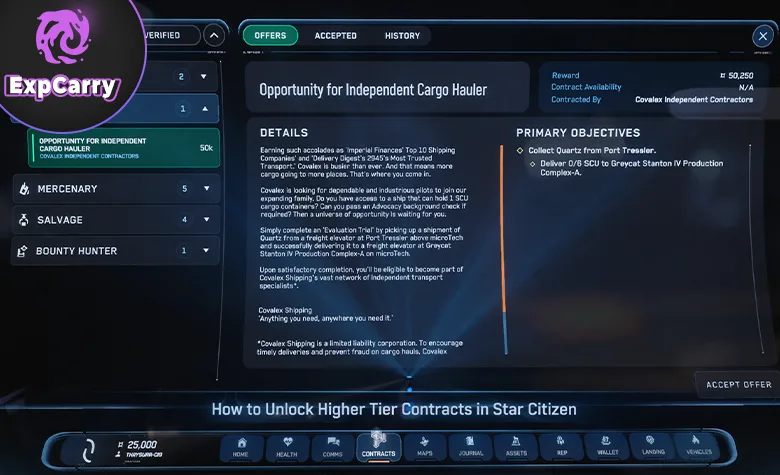
Covalex Shipping requires an introductory evaluation before normal career progression.
The starting mission is Opportunity for Independent Cargo Hauler. Complete this evaluation to gain access to Covalex contract progression.
The process is straightforward:
- Find the Covalex hauling introduction in Contract Manager.
- Read its pickup, delivery, and container requirements.
- Use a ship that can physically accommodate the required mission containers.
- Collect the assigned freight through the appropriate cargo system.
- Deliver the mission cargo to the correct destination.
- Confirm that Freight Manager recognizes the delivery and perform any final confirmation required by the active contract.
- Confirm mission completion and check for newly available Covalex assignments.
The evaluation requires actual mission completion. Owning a larger ship or delivering unrelated commodities does not substitute for passing it.
The Star Citizen Freight Elevator Guide covers loading, mission cargo recognition, ATLS operation, and delivery problems. Those physical mechanics are separate from the contract-unlocking process covered here.
Explore services related to this guide, selected from our Star Citizen catalog.
View All Star Citizen Services


Covalex Hauling Ranks Explained
The main Covalex career track has seven contractor ranks. Each tier makes different mission sizes or categories available. The reputation thresholds below come from recorded hauling faction data; always check your current progress in Delphi.
| Rank | Main Access | Important Distinction |
|---|---|---|
| Trainee | Starting and Extra Small missions | First career tier; 0 XP |
| Rookie | Additional Small and planetary missions | Expands the starting selection; 50 XP |
| Junior | Additional Medium cargo opportunities | Introduces more demanding delivery volumes; 250 XP |
| Member | Member contracts, including gateway-related hauling templates | Interstellar classification does not necessarily mean an actual cross-system journey; 5,250 XP |
| Experienced | Experienced contracts, Large Hauls, and expanded Medium Hauls | Relevant Medium Hauls may use containers up to 16 SCU; 27,750 XP |
| Senior | Senior-rank hauling contracts | Continues upper-level career progression; 77,750 XP |
| Master | Highest Covalex rank, including selected cross-system missions with special rewards | Advanced assignments and potential component blueprints; 237,750 XP |
Important distinction: Member-level mission records include contracts classified as Hauling - Interstellar, including assignments involving Magnus Gateway. That does not establish that Member unlocks the same cross-system blueprint contracts as Master. Verify the actual route and requirements of each mission.
Experienced is the main milestone for increased hauling volumes, while Master is the highest rank and provides access to its own advanced assignments.
The availability of a particular interstellar mission may still depend on its individual requirements and your current location. Reaching the rank does not guarantee that every route will appear simultaneously.
Which Hauling Ranks Matter Most?
The relevant Covalex milestones depend on the contract you want to unlock. A player seeking large cargo volumes does not necessarily need the same rank as someone pursuing top-tier blueprints.
Trainee to Junior: Learning the System
These ranks provide access to basic deliveries and establish the foundation for later progression.
Your immediate goal is to complete contracts consistently enough to unlock the next tier.
Choose straightforward missions with manageable volumes and clear destinations. Failures or abandonment may slow your progress even when a contract advertises an attractive payout.
There is little reason to complicate the early ranks with enormous cargo loads or difficult deliveries before they become necessary.
Member: Building a Reliable Routine
Member expands your available work and gives you more opportunities to establish a repeatable hauling routine.
Review newly available Member contracts, including gateway-related assignments. Do not assume that an Interstellar label guarantees a jump to another star system or access to Master-rank blueprints.
Contract eligibility and practical completion are separate questions. Check your ship's range, cargo capacity, and access to the required destination facilities.
Experienced: The First Major Volume Milestone
Experienced unlocks substantially larger hauling opportunities.
Recorded progression includes Large Hauls and expanded Medium Hauls, with relevant Medium missions featuring larger total cargo volumes and containers up to 16 SCU.
Experienced is therefore the most relevant target for unlocking larger volumes rather than simply completing more missions.
At this point, ship geometry, cargo-grid compatibility, and available loading equipment become important limitations.
A ship may technically have enough total SCU capacity while being unable to accommodate the largest required physical container.
Master: Advanced Contracts and Crafting Blueprints
Master is the highest Covalex rank and unlocks Master-tier missions.
Certain advanced assignments contain component blueprint reward pools, including quantum drive and shield recipes. Documented examples include actual routes from Stanton to Pyro or Nyx.
These rewards depend on completing eligible missions and their actual reward pools. Reaching Master does not automatically award every blueprint, and not every Master contract should be assumed to have the same rewards.
Before accepting a lengthy assignment for a specific blueprint, check its current rewards.
If your only goal is Large Hauls, Experienced may be sufficient. Master becomes more relevant when additional contracts or particular rewards justify further progression.
Other Advanced Contract Unlock Chains
Hauling is only one model of advanced contract access. Combat, security, salvage, and industrial mission givers use different combinations of reputation and prerequisite missions.
The following table summarizes documented access requirements rather than the broader reputation systems already explained in the separate reputation guide.
| Organization | Starting Requirement | Advanced Unlock | Additional Requirement |
|---|---|---|---|
| Bounty Hunters Guild | Tracker Training Permit | Master Tracker License and ERT contracts | Sequential certifications and applicable regional assessments |
| Foxwell Enforcement | Exciting New Opportunities with Foxwell Enforcement | Red Level Contract: High-Risk Security Patrol | Veteran Contractor at 15,000 XP and completed earlier patrol chain |
| InterSec Defense Solutions | New Defense Contract: [TargetName] Elimination | Tactical Strike Group Needed | Sr. Contractor at 5,800 InterSec XP and completed introduction |
| Adagio Holdings | Adagio Holdings in Need of Salvagers | Additional salvage and material delivery contracts | Required Adagio reputation and individual conditions; paid salvage claims must be assessed separately |
| Recco Battaglia | Welcome to the System | Idea for Isaac and later Prestige contracts | Associate and Trusted Associate thresholds, plus story missions |
| Vaughn | A Chance to Impress | Additional assassination and blueprint missions under Unverified | Introduction, reputation, location, and mission-specific prerequisites |
Bounty Hunters Guild: Unlocking HRT, VHRT, and ERT
The Bounty Hunters Guild uses a certification system. Players must progressively qualify for more dangerous targets rather than simply buying a powerful fighter and immediately accepting Extreme-Risk Targets.
| Target Tier | Required Certification |
|---|---|
| VLRT | Tracker Training Permit |
| LRT | Tracker Beginner's Permit |
| MRT | Tracker License |
| HRT | Journeyman Tracker License |
| VHRT | Advanced Tracker License |
| ERT | Master Tracker License |
Complete qualifying bounty contracts until the next certification becomes available, pass it, and then check the newly accessible target category. This table describes the standard PvE license progression; some mission records may also include alternative qualifying completion flags.
Some jurisdictions also require local assessments. Holding the appropriate Guild license does not necessarily bypass every regional prerequisite.
PvP bounty certifications are a separate category and should not be confused with this PvE risk progression.
For specialized Guild crafting rewards, see the Star Citizen Bounty Hunter Blueprint Guide.
Foxwell Enforcement: Patrol Chain and Required Ranks
Foxwell demonstrates why reaching the correct reputation threshold is not always enough to unlock a higher-tier mission.
The documented patrol chain requires successive completion:
- Exciting New Opportunities with Foxwell Enforcement.
- Yellow Level Contract: Routine Patrol.
- Yellow Level Contract: Security Sweep.
- Orange Level Contract: Security Patrol.
- Orange Level Contract: Potential Security Threat.
- Red Level Contract: High-Risk Security Patrol.
Individual missions may require both a reputation rank and completion of an earlier assignment.
| Mission | Minimum Reputation | Additional Requirement |
|---|---|---|
| Yellow: Security Sweep | Jr. Contractor — 800 XP | Introduction and earlier patrol stage |
| Orange: Security Patrol | Contractor — 2,200 XP | Previous patrol chain completed |
| Orange: Potential Security Threat | Sr. Contractor — 5,800 XP | Previous patrol chain completed |
| Red: High-Risk Security Patrol | Veteran Contractor — 15,000 XP | Previous patrol chain completed |
These requirements appear in the Alpha 4.10 mission database for this specific Foxwell patrol family. They must not automatically be applied to every Foxwell Ambush, Protection, or other combat assignment. The cited High-Risk Security Patrol record lists availability in Pyro, so check the operating region as well as your rank.
Advanced Foxwell missions may award MG Scrip, reputation, and selected blueprints, depending on the contract and its reward pool.
If High-Risk Security Patrol is missing despite Veteran rank, check the patrol sequence and your location before continuing to grind reputation.
For individual missions, the SC DataHub Mission Database lists recorded rank ranges and prerequisite chains. Check the displayed patch version before treating a database entry as confirmed current LIVE behavior.
InterSec: Unlocking Tactical Strike Group
Tactical Strike Group Needed is an advanced cooperative InterSec operation in Nyx.
Its recorded access requirements are specific:
- Travel to Nyx and find the InterSec introductory contract.
- Complete New Defense Contract: [TargetName] Elimination.
- Run qualifying InterSec assignments.
- Reach Sr. Contractor with InterSec Defense Solutions.
- Confirm at least 5,800 InterSec reputation XP according to the recorded faction progression.
- Look for Tactical Strike Group Needed in Contract Manager.
InterSec reputation is separate from Foxwell, Crusader Security, and other organizations. Similar security missions for another issuer do not satisfy the InterSec threshold.
Tactical Strike Group is shareable. An eligible mission owner can invite other players, but completing a shared mission does not automatically give every participant permanent access to launch the same contract independently.
The mission is designed for an organized group and can award specialized blueprints from separate reward pools.
For its complete phases, ship requirements, and rewards, see the Star Citizen Tactical Strike Group Guide.
Adagio Holdings: Advanced Salvage Contracts
Adagio Holdings illustrates an industrial contract track controlled by an introductory mission and contractor reputation.
The introductory mission is Adagio Holdings in Need of Salvagers. Completing the relevant variant unlocks salvage and material delivery assignments whose individual requirements must then be checked.
Higher reputation can expand your eligible Adagio assignments. Do not treat a salvage claim fee, including a 100,000 aUEC fee, as proof of a particular Adagio rank. Paid salvage claims and material delivery progression are separate mission records.
A fee granting access to a salvage opportunity is an upfront cost, not a guaranteed payout or profit.
A higher-tier salvage assignment is worthwhile only if your ship, salvage speed, material storage, and operating expenses make it practical.
For salvage claims, RMC, Construction Materials, and contract economics, see the Star Citizen Salvage Guide.
Recco Battaglia: Story Prerequisites Before Advanced Industrial Missions
Recco Battaglia's progression in Levski demonstrates the importance of story completion flags.
Her advanced contracts do not depend on reputation totals alone. Several require earlier narrative missions to be completed.
| Stage | Required Reputation | Mandatory Mission | Unlock Result |
|---|---|---|---|
| Introduction | Starting access | Welcome to the System | Initial repeatable missions |
| Associate | 2,400 XP | Emergency: Blinding Hope in Trouble | Additional missions and second story completion flag |
| Trusted Associate | 6,000 XP | Idea for Isaac | Third story completion flag and later mission families |
| Prestige 1 | 10,800 XP | Extra Special Job | Mission rewarding the Drake Golem Alliance |
| Prestige 2 | 30,000 XP | Scan with a Prospector Payout | Mission rewarding the MISC Prospector Alliance |
| Prestige 3 | 69,600 XP | Mining and MOLE | Mission rewarding the ARGO MOLE Alliance |
For example, reaching 6,000 reputation without completing Emergency: Blinding Hope in Trouble does not replace that earlier story prerequisite.
Similarly, completing Idea for Isaac unlocks later mission families dependent on its completion flag; it does not automatically grant every subsequent Prestige reward contract. The listed Prestige values are access thresholds, not automatic vehicle grants. The special Alliance vehicles are mission reward items rather than automatically issued website pledges.
For the full progression sequence, exact reward types, and individual missions, see the Star Citizen Recco Battaglia Guide.
Vaughn: Advanced Contracts Under Unverified
Unverified mission progression can also involve introductions, reputation requirements, and previously completed assignments.
The documented Vaughn route begins with A Chance to Impress, followed by additional assassination missions and criminal activities.
Additional Vaughn branches may include:
- They Will Be Missed;
- All Things Come To An End;
- A Challenging Contract;
- A Well Deserved Break.
These missions are associated with different weapon and armor blueprint pools, but the list is neither one mandatory sequence nor a universal high-rank progression path.
To unlock your chosen mission, complete the applicable Vaughn introduction and meet its reputation, prerequisite, and location requirements. For example, a recorded variant of A Well Deserved Break takes place in Nyx and requires A Chance to Impress. It should not be presented as requiring every other mission listed above.
The exact mission matters because different assignments may have different blueprint rewards.
Unverified contracts can cause CrimeStat consequences and risks to lawful-area access depending on their objectives.
For individual branches and blueprint pools, see the Star Citizen Vaughn Blueprint Guide.
Best Contracts for Fast Reputation Progression
When your goal is a specific advanced assignment, the best contract is one that advances the correct reputation track while maintaining a consistently high completion rate.
The largest payout is not necessarily the most efficient choice. Long routes, difficult enemies, cargo handling, and failed objectives can make a theoretically better contract slower in practice.
Evaluate your options based on:
- the correct mission issuer;
- reputation awarded on completion;
- whether the contract completes a required chain step;
- actual time required;
- equipment and ship requirements;
- the risk of losing progress after failure;
- the availability of repeatable alternatives.
| Target | Recommended Approach | Main Objective |
|---|---|---|
| Covalex Experienced or Master | Repeat manageable Covalex deliveries | Reach the required hauling rank |
| HRT through ERT bounties | Complete qualifying bounties and promptly finish certifications | Unlock the next tracker license |
| Advanced Foxwell patrols | Complete patrols in sequence and reach the required ranks | Unlock Orange and Red missions |
| InterSec Tactical Strike Group | Complete the introduction and reach 5,800 InterSec XP | Unlock Tactical Strike Group Needed |
| Advanced Adagio salvage | Complete the introduction and eligible Adagio contracts | Access additional salvage and delivery missions |
| Advanced Recco missions | Complete story prerequisites as soon as they become available | Unlock later mission families and Prestige |
| Vaughn blueprint contracts | Follow the prerequisites for the mission tied to your desired reward | Unlock a specific assassination mission |
When a mandatory story mission or certification appears, prioritize completing it before continuing unrelated repeatable assignments.
Reputation becomes useful when it unlocks the mission you want. Beyond that threshold, extra reputation may have little immediate value if the target contract is already available.
Why Focusing on One Hauling Company Is Usually Faster
Covalex, Red Wind Linehaul, and Ling Family Hauling maintain separate contractor progression tracks.
If your target belongs to Covalex, Red Wind assignments may provide income, but they do not automatically increase your required Covalex rank.
For a targeted unlock, follow this process:
- Choose the exact company and contract tier.
- Complete the company's introduction when required.
- Concentrate on its reliable missions.
- Reach the necessary rank.
- Check newly available assignments and their individual conditions.
- Develop another organization when its contracts become your next goal.
The same principle applies outside hauling. Foxwell reputation does not replace InterSec standing, and a Guild bounty certification cannot bypass Recco's story missions.
The goal is not to maximize every reputation bar. It is to unlock your chosen contract with as little unnecessary progression as possible.
Best Region for Hauling Reputation
A practical operating region reduces the time between completed contracts. This can significantly affect how quickly you reach the next rank.
For Covalex-focused progression, choose an area with:
- accessible Covalex assignments;
- reliable ship retrieval;
- functioning freight elevators;
- several manageable delivery destinations;
- nearby repair and refueling services;
- reasonable travel times;
- minimal unnecessary travel between systems.
The right region depends on the actual contract board. No universal location permanently provides the fastest progression for every issuer.
For other careers, the principle works differently: Tactical Strike Group requires operations in Nyx, Recco is based in Levski, and some Foxwell or bounty contracts may be tied to specific regions.
Choose the region required by your target mission, not simply the closest place offering any available contract.
Choosing a Ship for Higher-Tier Hauling Contracts
Your ship determines whether an unlocked assignment can be completed efficiently. It generally does not replace reputation, certification, or story requirements.
For hauling, total SCU capacity is only one factor. Container dimensions, cargo-grid access, loading methods, and destination compatibility also matter.
| Contract Stage | Main Ship Requirement |
|---|---|
| Early contracts | Enough room for small containers and straightforward loading |
| Medium contracts | Practical cargo-grid access and container compatibility |
| Experienced contracts | Capacity for expanded Medium Hauls and applicable 16 SCU containers |
| Large Hauls | High hauling throughput and compatibility with large containers |
| Cross-system assignments | Suitable range, a ship capable of traversing jump points, capacity, and destination access |
| Master contracts | Ship and logistics suited to the individual mission, not merely its rank |
The principle is similar in combat. A player may unlock ERT bounties or Tactical Strike Group through progression but still need suitable weapons, defenses, and teammates.
For purchasing and reselling commodities rather than reputation-gated hauling assignments, see the Star Citizen Trade Routes Guide.
Higher-Tier Contracts in Stanton, Pyro, and Nyx
System and location conditions also explain why an advanced contract may not appear in your current list.
Some organizations operate across multiple systems. Others offer their important progression primarily in a particular region.
| Region | Relevant Examples | What to Check |
|---|---|---|
| Stanton | Bounty certifications, hauling companies, regional security, Vaughn contracts | Jurisdiction, issuer, certification, and available mission branch |
| Pyro | Selected Foxwell missions and other security or Unverified contracts | Mission location, required reputation, and route prerequisites |
| Nyx | InterSec, Recco Battaglia, selected Vaughn missions, and cross-system freight | Levski access, issuer, story flags, and contract-specific conditions |
For cross-system hauling, prepare for additional fuel requirements, jump-point travel, longer routes, and greater recovery time if something goes wrong.
For industrial and combat missions in Nyx, verify that the required assignment belongs to the correct organization. Completing unrelated missions in the same system does not necessarily advance your target chain.
For Levski, jump connections, Nyx stations, and travel logistics, see the Star Citizen Nyx System Guide.
What Slows Down Higher-Tier Contract Unlocks?
Most progression problems come from grinding the wrong reputation, missing a prerequisite, or repeatedly attempting unreliable missions.
Spreading Reputation Too Early
Working for several independent organizations delays a specific rank unlock. Focus on the issuer of your desired contract.
Choosing Contracts Only by Payout
A high-paying mission may be poor for reputation farming when travel, loading, risk, or recovery make it particularly slow.
Using the Wrong Ship
Even after unlocking a contract, an unsuitable ship may prevent efficient completion. Check total capacity and practical mission requirements.
Accepting Too Many Complex Missions at Once
Stacking incompatible assignments increases the risk of confusing objectives, destinations, or required cargo.
Ignoring Failures and Reputation Loss
Failed, abandoned, or expired missions can reduce reputation depending on their rules. Repeated failures may erase the progress gained from previous successes.
Forgetting an Introductory Mission
Some higher-tier assignments require a specific starting mission. A high reputation rank does not automatically bypass this condition.
Ignoring Certifications or Story Missions
Standard bounty progression uses certifications. Foxwell patrols require previous stages. Advanced Recco industrial assignments may depend on completed story flags.
These are mission completion requirements, not merely additional reputation points.
Checking the Wrong Organization or Location
A similar mission type from another organization may advance a different rank. Availability can also depend on your current system and lawful-access conditions.
Confusing Shared Missions With Personal Unlocks
Joining another player's advanced contract does not necessarily satisfy your own rank, certification, or introduction requirements.
If you want independent access, complete the corresponding personal progression.
Ignoring Current Mission Bugs
A missing assignment, unrecognized cargo, enemies that fail to spawn, or a broken objective can temporarily block otherwise valid progression.
Alpha 4.10.2 preserves Long Term Persistence, but individual contract problems remain possible. CIG also documents a visual issue that clears displayed mission history after the client closes; fully completed missions retain their completion credit.
Check the official Alpha 4.10.2 Known Issues when a mission repeatedly fails for technical reasons. An empty history alone is not a reason to repeat every prerequisite.
Are Higher-Tier Contracts Always More Profitable?
No. They provide more opportunities but are not automatically the most efficient way to earn aUEC.
A large delivery may require substantially more loading and travel. A difficult bounty may result in expensive repairs. A salvage claim may require a significant upfront fee before any materials can be recovered.
Contract value should account for:
- the actual aUEC payout;
- the reputation reward;
- the time required;
- operating and equipment costs;
- the probability of successful completion;
- additional prerequisites;
- special blueprints or equipment rewards.
Some players primarily pursue advanced assignments for their blueprints, special operations, or progression rewards rather than ordinary monetary payouts.
For example, a Covalex Master blueprint assignment or an InterSec Tactical Strike Group operation may be worthwhile for a specific reward even if it is not the best activity for earning currency alone.
Higher-tier access provides more choices. It does not make every available assignment profitable or worthwhile.
Reputation Service for Unlocking Contracts
If your goal is a specific contractor rank, certification, or higher-tier contract, ExpCarry offers targeted Star Citizen reputation progression.
The relevant objective should be defined by the exact faction and contract conditions rather than an unrelated maximum rank.
The same principle applies to players progressing independently: choose the final mission, identify its prerequisites, complete them in order, and stop when the desired access is obtained.
For general information about factions, Delphi, reputation, and organization rewards, see the separate Star Citizen Reputation Guide.
Star Citizen Higher-Tier Contracts FAQ
These answers focus on access requirements for advanced assignments rather than general reputation progression.
How do you unlock higher-tier contracts in Star Citizen?
Complete the appropriate introduction, earn reputation with the correct organization, and satisfy any necessary certification, mission-chain, story, or location requirements.
How do you unlock better Covalex contracts?
Complete Opportunity for Independent Cargo Hauler and progress through the Covalex ranks. Each tier opens additional eligible assignments.
Which Covalex rank unlocks large deliveries?
Experienced is the main milestone for Large Hauls and expanded Medium Hauls, including some assignments using containers up to 16 SCU.
Does interstellar hauling require Covalex Master?
It depends on the specific contract. Some Member templates have an Interstellar classification, but that label does not prove the route crosses between systems. Documented Covalex blueprint routes between Stanton and Pyro or Nyx require Master. Check actual destinations and reputation requirements.
What does Covalex Master unlock?
Master grants access to the highest Covalex contract tier. Some Master assignments can provide component blueprints according to their current reward pools.
Should you level Covalex, Red Wind, and Ling Family together?
Only if you want progression with multiple companies. For a specific Covalex unlock, focus on its contracts until you reach the necessary rank.
Does a bigger cargo ship unlock better contracts?
No. Additional capacity makes larger deliveries more practical but does not replace reputation or introductory missions.
Can you receive payment for a partial delivery?
Covalex mission descriptions allow payment proportional to delivered cargo. Partial payment alone does not prove full reputation credit, certification completion, or eligibility for every special reward. Check current contract conditions before submitting an incomplete delivery.
Are Master contracts worth doing?
They can be worthwhile for advanced freight and selected blueprints. Their value depends on the assignment, cargo requirements, time, costs, and rewards.
How do you unlock ERT bounties?
Follow the standard Bounty Hunters Guild PvE progression until Master Tracker License Certification becomes available, then complete it. Contract-specific and regional conditions may also apply.
Why is a Foxwell Red Level contract still locked?
In recorded mission data, High-Risk Security Patrol requires Foxwell Veteran Contractor at 15,000 XP and completion of the earlier patrols. Check the region as well; the cited variant is available in Pyro.
How do you unlock Tactical Strike Group?
Complete the InterSec introduction in Nyx and reach Sr. Contractor at the recorded threshold of 5,800 InterSec reputation XP.
Can you join Tactical Strike Group without unlocking it?
An eligible mission owner can share the assignment. Participation does not automatically guarantee independent access to launch subsequent operations.
Why are advanced Recco missions missing?
Check the mandatory story missions. Emergency: Blinding Hope in Trouble and Idea for Isaac require reputation and earlier narrative completions. An empty history after restarting the client does not by itself mean those completions were erased.
Do all higher-tier missions require reputation?
No. Some depend on certifications, completed chains, locations, items, events, or other conditions. Reputation is common but not universal.
What should you check when a contract does not appear?
Check the issuer, rank, introduction, previous missions, certifications, story flags, location, CrimeStat restrictions, and current mission availability before assuming a bug or an unknown reputation requirement.
Final Recommendation
The fastest path to higher-tier Star Citizen contracts is to select the exact assignment and work backward through its requirements. For Covalex, complete the evaluation and advance toward your desired hauling tier. For bounty hunting, pass the necessary certifications. For Foxwell, InterSec, Recco, and other mission givers, check both reputation and mandatory introductions or story chains.
Use reliable lower-tier assignments to reach the next important prerequisite, then complete the required promotion, certification, or story mission as soon as it becomes available. Experienced is the main Covalex milestone for larger volumes; Master adds top-tier assignments and selected blueprint opportunities. Other careers have different requirements: one organization's progression is not a universal unlock system.
The core rule is simple: reputation, certifications, and completed mission chains determine which contracts you can access; your ship, equipment, and team determine whether you can complete them efficiently.